The Great North River Tugboat Race has run in New York Harbour since 1991. It is one of the few events in North America where working port vessels compete in public. Every year on the Sunday before Labor Day, tugboats race a one-nautical-mile course down the Hudson River off Manhattan’s West Side.
The audience ranges from waterfront families to professional mariners who know what it takes to push 2,000 horsepower through tidal water. This article covers the full history, vessel classes, race format, and what the competition reveals about how New York Harbour actually functions as a working port.
The Origin of the NYC Tugboat Race
The race was inaugurated in 1991 at Pier 86 on the Hudson River, under the auspices of the Intrepid Sea, Air & Space Museum. The founding organiser was Captain Jerry Roberts, a harbour pilot and maritime educator. Roberts recognised that most New Yorkers had no meaningful contact with the working waterfront on their doorstep.
He wanted a format that showed tugboats as highly manoeuvrable working craft operated by skilled crews. Not anonymous industrial vessels churning past in the background.
The original course ran northbound from Pier 86 to the 79th Street Boat Basin — roughly the inverse of today’s layout. The Intrepid Museum hosted the event for its first 13 years. Roberts served as chief announcer throughout, translating tug manoeuvring for a non-maritime crowd.
After Roberts left the Intrepid Museum’s staff following the 2004 event, the race entered a transitional period. In 2005, it moved to Staten Island under a steering committee that included Roberts, Bert Reinauer of Reinauer Transportation, John Doswell of the Working Harbor Committee, and Chris Roehrig of Roehrig Maritime. The Staten Island location reduced spectator access.
In 2006, the event moved to Pier 63 Maritime. In 2007, it settled into its current configuration: a southbound course from the 79th Street Boat Basin to Pier 84 at West 44th Street. The finish line and judging platform sit alongside the Circle Line terminal.
The Working Harbor Committee and Institutional Framework
Since the mid-2000s, the Working Harbor Committee has been the primary organising body. The WHC is a New York-based non-profit focused on educating the public about the vitality of New York and New Jersey Harbour. It registers participating vessels, coordinates with US Coast Guard Sector New York, and manages the Pier 84 site with Hudson River Park Trust.
Corporate sponsors have included McAllister Towing, Reinauer Transportation, Vane Brothers, and Kirby Offshore Marine — all active operators in the harbour. Institutional co-sponsors include the NYC Economic Development Corporation, the South Street Seaport Museum, and the US Army Corps of Engineers. Commercial operator involvement gives the event operational credibility that a purely heritage festival would lack.
Race Format and Competition Structure
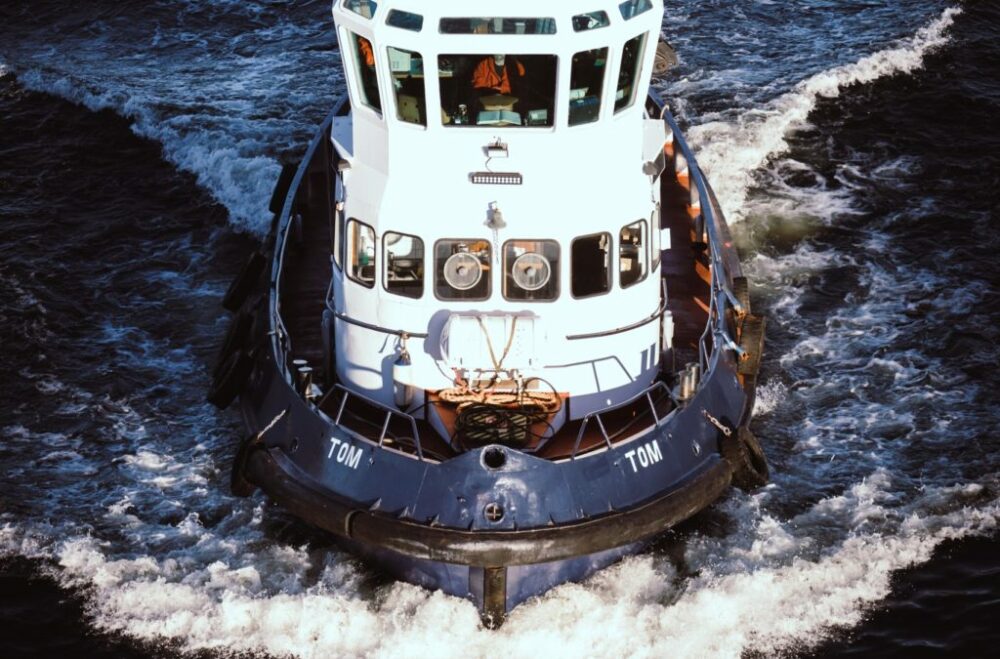
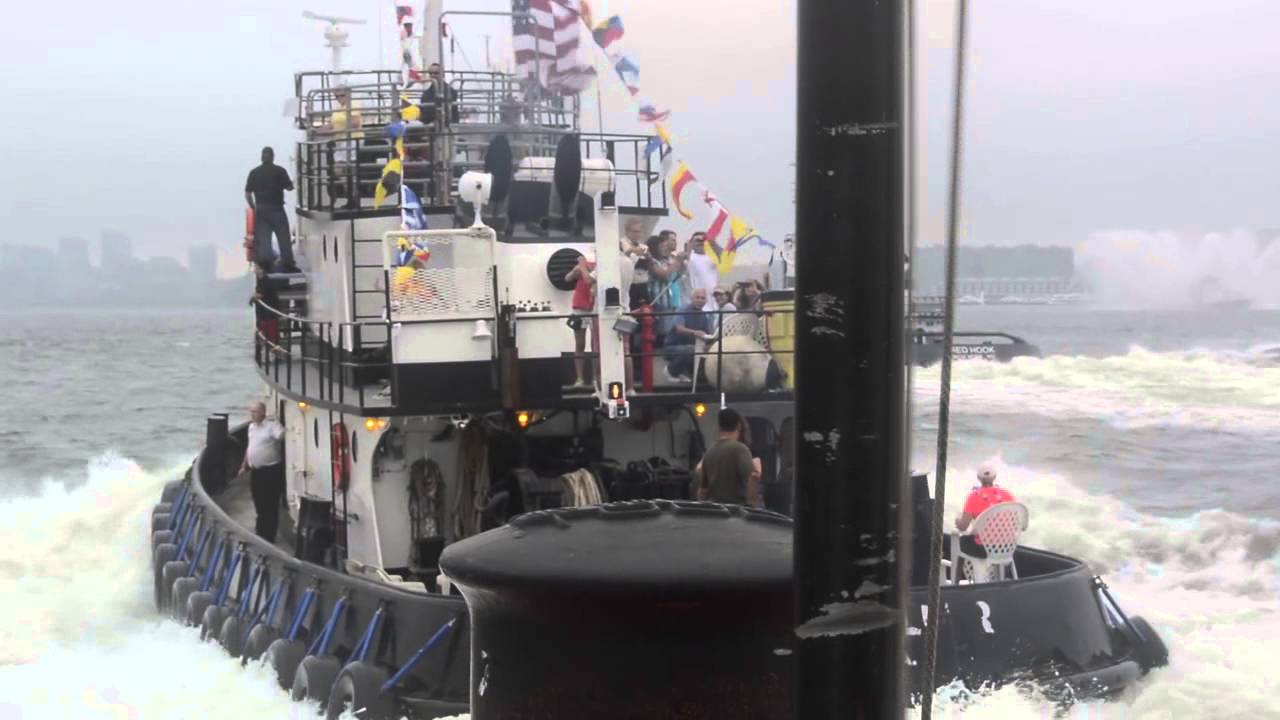
The headline event is a one-nautical-mile speed race down the Hudson. Vessels depart from the 79th Street Boat Basin and run southbound to the finish at Pier 84. Racing is organised by horsepower class to make meaningful competition possible between vessels of different sizes.
A 1,500 hp harbour tug and a 3,000 hp ship-assist vessel have fundamentally different hull forms, draft, and thrust characteristics. Racing them on elapsed time alone would produce a result determined by machinery, not seamanship.
The field on any given year includes six to twelve vessels grouped into two or three horsepower bands. The 2014 event featured Buchanan Marine LP (Buchanan 1 and Mister T, both 2,200 hp), Donjon Marine (Emily Ann at 3,000 hp and Meagan Ann at 2,250 hp), and Miller Launch (Susan Miller, 1,500 hp), among others. Each class runs its own heat and its own awards.
Margins of victory can be tight. In 2019, just 20 seconds separated first and second in Class A. The Vinik No. 6 of Vinik Marine took first; the Ava M. McCallister of McAllister Towing placed second.
Nose-to-Nose Pushing Competition
The nose-to-nose pushing contest tests a different set of skills than the straight race. Two tugs are positioned bow-to-bow and apply full thrust. The tug that pushes the other backward — or holds its ground longest — wins the bout.
This format tests thrust efficiency and propeller pitch control, not hull speed. A smaller tug with a good propulsion configuration can defeat a larger vessel if the crew misjudges power application.
For mariners, the contest directly demonstrates what these vessels do commercially. A tug assisting a tanker into berth must produce sustained, controllable thrust against a loaded ship’s weight and momentum. The pushing competition makes that capability visible — and puts the relationship between tugboat bollard pull and harbour work into a tangible context.
Line Toss and Skills Events
The line toss competition requires crew members to throw a heaving line accurately onto a shore target within a set time limit. This directly tests a skill every bosun and deck rating on a working tug must perform reliably during berthing. A poor throw in an actual ship-assist means delay; in bad weather, a missed window.
Spectator-side events mirror the crew competitions on land: knot-tying, an on-land line toss, and the traditional spinach-eating competition in honour of Popeye the Sailor. These events keep the dockside programme accessible to visitors with no professional maritime background. They replicate real skills in a setting where no vessel or cargo is at risk.
Vessel Types That Compete in the NYC Tug Race
New York and New Jersey together form one of the busiest port complexes in the United States, handling containers, petroleum, bulk cargoes, and LNG. The tug fleet supporting that work is varied in design, age, and horsepower. The race field reflects that variety.
Conventional Single-Screw and Twin-Screw Harbour Tugs
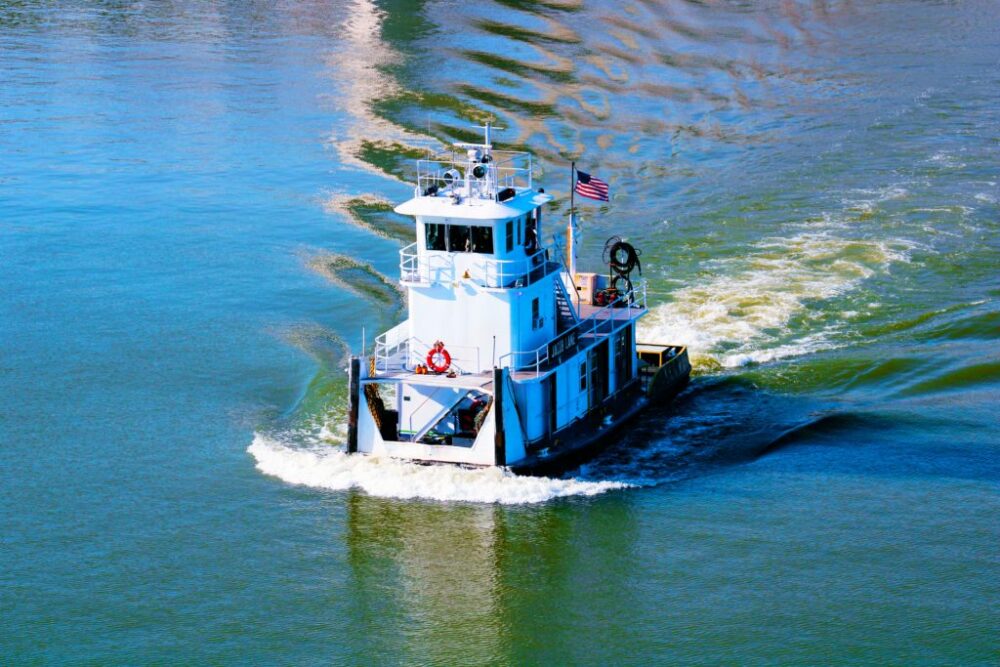
The workhorse of the New York fleet is the conventional harbour tug. These are vessels of 80–120 feet with a fixed or controllable-pitch propeller in a kort nozzle and engine output of 1,500 to 2,500 hp. They are designed for direct ship-assist work in confined harbour water, where response time and precise thrust control matter more than speed.
Hull forms are full and beamy, with high freeboard forward and a low aft deck for line handling at water level. Many older tugs that have appeared at the race are of conventional single-screw construction.
The W.O. Decker — a 1930-built wooden tug operated by the South Street Seaport Museum — participated in the race in 2019. It represents the type of tug that once worked New York Harbour in numbers too large to count. Single-screw tugs manoeuvre through engine direction changes and rudder angle, demanding genuine seamanship from their operators.
Tractor Tugs and Z-Drive Vessels
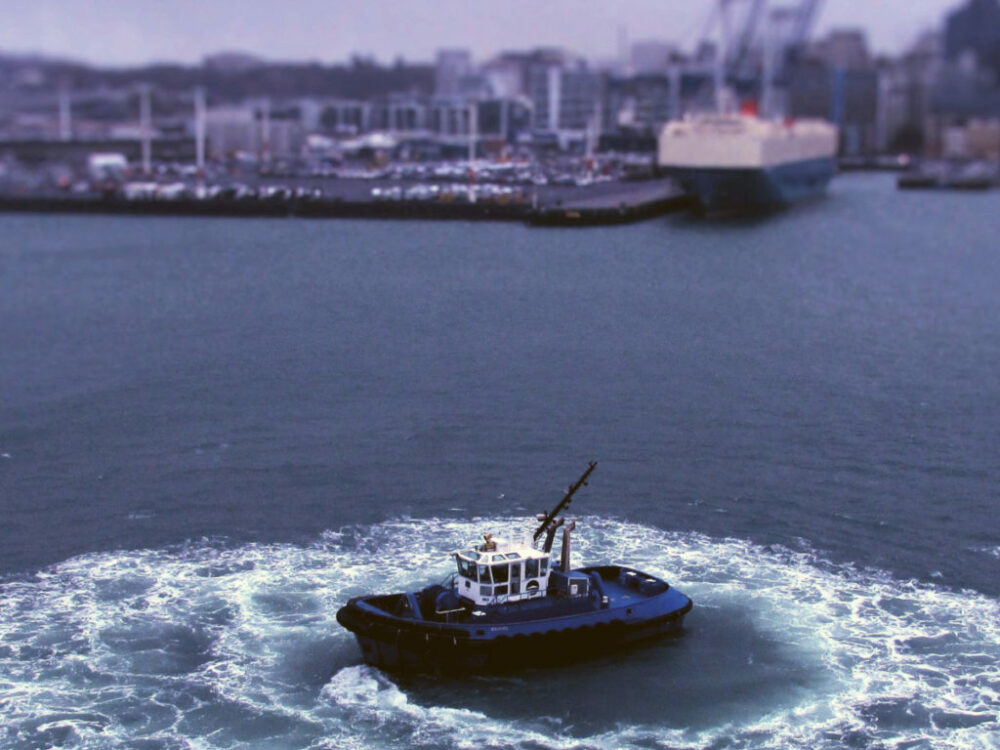
Modern ship-assist tugs increasingly use azimuthing drive systems. The most common is the Z-drive azimuth thruster; the Voith-Schneider propeller is the other main option. Vessels with drive units positioned forward of amidships are known as tractor tugs.
A Z-drive tug can produce thrust in any direction through 360 degrees of azimuth rotation. It can push, pull, or hold a position without repositioning. This has largely displaced conventional propeller designs in new construction.
For the race, this creates a structural challenge. A tractor tug and a conventional twin-screw tug of similar horsepower behave very differently in a pushing contest. Horsepower-class grouping partially addresses this, but the race committee must exercise judgment to produce competition between crews — not between propulsion technologies.
Historic and Heritage Tugs
The race consistently attracts heritage and preserved tugs, particularly when the event aligns with wider waterfront programming. The South Street Seaport Museum has brought the W.O. Decker into race proximity as part of its Seaport programming. A working 1930-built tug alongside modern Z-drive vessels makes harbour history concrete in a way that a display or exhibit cannot.
The race course runs approximately one nautical mile along the Hudson River between the 79th Street Boat Basin and Pier 84 at West 44th Street. This stretch is a designated navigable channel under US Army Corps of Engineers jurisdiction. Vessel traffic is managed by the USCG Vessel Traffic Service (VTS) New York.
On race day, a temporary safety zone is established under 33 CFR Part 165. This restricts unauthorised vessel access to the competition area during racing heats.
The Hudson River in this reach carries a tidal current of typically 1.5 to 2.5 knots at maximum flood or ebb. All vessels in a given class heat run under the same tidal conditions, maintaining fairness. A strong ebb assists the southbound course; a flood tide requires tug masters to apply more power for the same elapsed time.
The Circle Line vessel Sightseer VII — a 151-foot tour boat — accompanies the race with live narration for paying spectators. Its presence alongside competing tugs illustrates how the harbour works in practice: different vessel types sharing the same waterway under coordinated traffic management.
What the Race Reveals About New York Harbour Operations
The New York and New Jersey harbour complex handles approximately 4 million TEUs of container traffic annually. It also moves substantial petroleum, bulk, and breakbulk cargoes. Behind every large vessel call, there is a tug operation.
Ship-assist tugs work alongside longshoremen, linesmen, and port pilots to move vessels in and out of berths safely. They often work against wind, current, and the inertia of a loaded hull.
The race does not replicate this work directly, but it frames it. Watching a 2,000 hp tug hold its ground in a nose-to-nose contest makes visible the thrust normally applied invisibly against the flank of a 300-metre ship. The line toss competition demonstrates, in scored form, the first physical act of every mooring sequence.
For anyone interested in port operations and vessel movements, the race is a rare chance to see harbour equipment up close without a port security clearance. Spectators on the Circle Line vessel observe competing crews handling lines within a few metres. The ship hull markings and identifiers on competing tugs are legible at pier distance, and the WHC programme lists vessel particulars for each entrant.
The Race Through Interruption: Cancellations and Returns
Captain Jerry Roberts died in March 2014. The WHC continued the event without him. His absence marked a shift from a founder-driven initiative to an institutionally managed community event.
His role as chief announcer had been central to the event’s educational character for over two decades. He translated harbour operations into accessible commentary for a public audience.
The COVID-19 pandemic halted the race in 2020 and 2021. The WHC cited the impossibility of managing crowd volumes under public health restrictions. The cancellation mirrored interruptions to other New York Harbour maritime programming, including the Hidden Harbor tour series.
The race’s return after the pandemic was significant for the WHC and for participating operators. Tug companies do not profit directly from entering — it represents crew time and vessel availability given up on a working Sunday. Their continued participation reflects something genuine about how the harbour community relates to public engagement.
Attending the NYC Annual Tug Race: What to Expect
The race takes place on the Sunday before Labor Day, typically in early September. Spectators can watch from Pier 84 in Hudson River Park at no charge. The pier provides a direct line of sight to the finish line.
The Circle Line spectator vessel departs from Pier 83 at West 42nd Street at approximately 10:30 am. It runs alongside competing tugs for the duration of the racing heats. Tickets are available through the WHC and Circle Line in advance.
The dockside programme at Pier 84 runs throughout the event. It includes crew competitions, spectator skills events, and the awards ceremony. Vessels tie up at the pier between heats, giving onshore spectators close access to the tugs and crews.
The Race as Maritime Career Context
The WHC explicitly frames the race as a pipeline to maritime career awareness. It is positioned to introduce younger audiences to professional maritime employment. Students at the best maritime colleges and academies in the US who go on to work on harbour tugs are doing exactly the work demonstrated at the North River race.
Tug operations in New York Harbour employ deck officers licensed under 46 CFR Part 11. STCW-certified ratings and credentialled marine engineers fill out the crew complements. The career profile for a tug mate or master differs from deep-sea work mainly in operating pattern — harbour work is shift-based, with crew going home daily.
The foundational competencies are the same: ship handling, COLREGS, and seamanship skills every deck officer needs. Harbour work adds specific expertise in close-quarters manoeuvring and ship-assist technique.
Frequently Asked Questions about the NYC annual tugboat race
What is the NYC annual tugboat race officially called?
The full name is the Great North River Tugboat Race and Competition. It is also known as the New York Tugboat Race or the Hudson River Tugboat Race. The Working Harbor Committee, a New York-based non-profit, organises the event.
When and where does the NYC tugboat race take place?
The race is held on the Sunday before Labor Day, typically in early September. The course runs approximately one nautical mile southbound on the Hudson River from the 79th Street Boat Basin to Pier 84 at West 44th Street in Manhattan.
How are tugboats classified for the race?
Competing tugs are grouped by horsepower class. Entries typically range from around 1,500 hp to over 3,000 hp. Each class runs its own race heat and its own awards.
What competitions take place besides the main race?
The event includes a nose-to-nose pushing contest, a timed line toss, and a best mascot and crew costume contest. Spectators can also enter a knot-tying competition and an on-land line toss at Pier 84.
Who founded the NYC tugboat race?
Captain Jerry Roberts founded the event in 1991 in partnership with the Intrepid Sea, Air & Space Museum. He served as chief announcer for over two decades and was central to establishing the Working Harbor Committee as the primary organising body. Roberts passed away in March 2014.
Can spectators go aboard the tugs?
Tugs tie up at Pier 84 between heats, and crews often open vessels to dockside visitors. Spectators can also purchase tickets on the Circle Line vessel, which accompanies the race and provides a close-up water-level view of competing tugs.
What is the Working Harbor Committee?
The Working Harbor Committee (WHC) is a New York-based non-profit. Its mission is to educate the public about the commercial and historical importance of New York and New Jersey Harbour. It has organised the annual tugboat race since the mid-2000s and runs additional harbour education programmes throughout the year.
Has the race ever been cancelled?
The race was cancelled in 2020 and 2021 due to the COVID-19 pandemic. It has otherwise run continuously since 1991, with a location change period in 2005–2006 when the event moved away from its traditional Manhattan Hudson River course.

- Great Lakes Maritime Academy: Programs, Cost and Admission – October 14, 2026
- Bunker Delivery Note (BDN): Contents, MARPOL Rules and Checks – October 11, 2026
- Oil Record Book: Part I and Part II Entries, Rules and PSC Checks – October 11, 2026