Yes, pirates still exist. The International Maritime Bureau (IMB) recorded 137 attacks on ships in 2025, with 46 crew taken hostage and 25 kidnapped. Somali pirates hijacked merchant ships again in 2026.
This guide explains where piracy happens today, what modern pirates do, how the numbers have changed since the 2010 peak, and how ships defend themselves.
What Do Pirates Look Like Today?
Modern pirates are small armed gangs in fast boats, not sailors on tall ships. Most live ashore, carry automatic rifles, and attack from skiffs launched from the coast or from a larger mother ship.
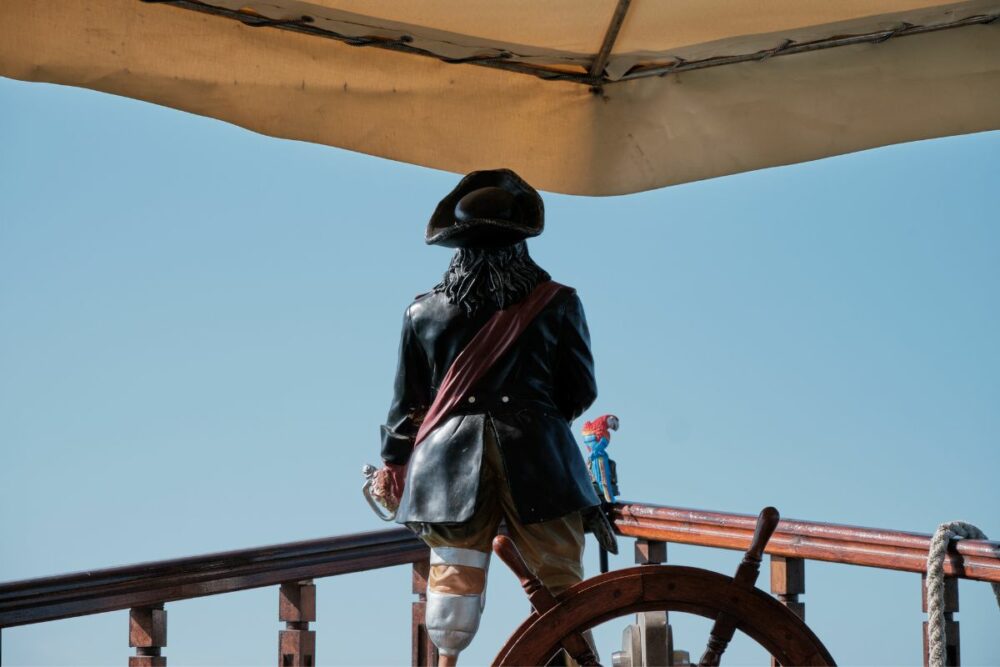
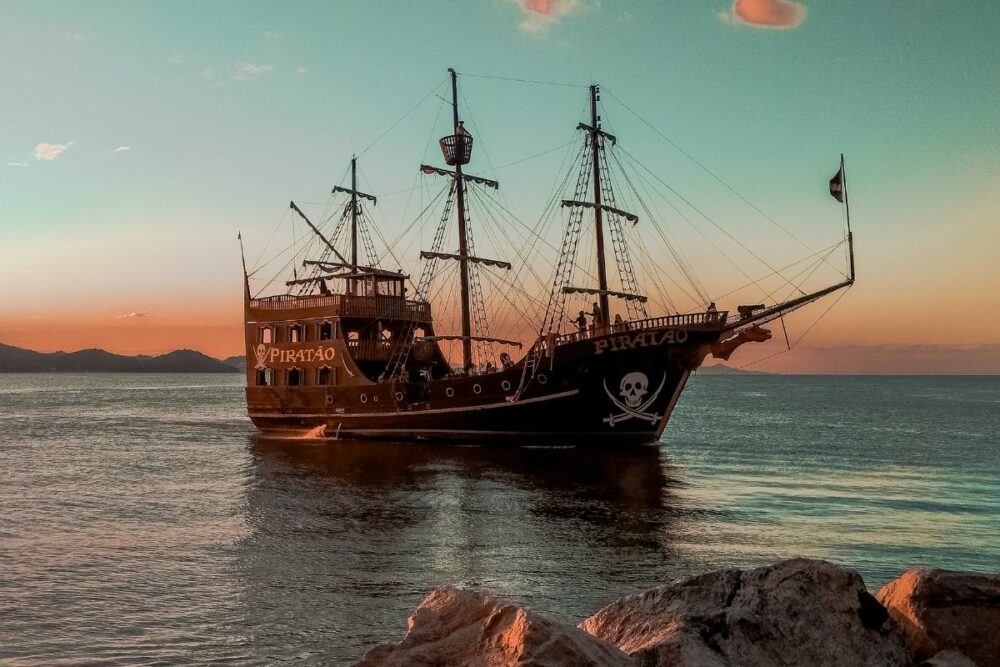
They look nothing like the pirates of films, costumes and LEGO pirate ship sets. There are no tall ships, swords, or hooks for hands.
Modern pirates are small armed gangs in fast boats. Most live ashore and attack from skiffs and speedboats, often launched from a larger mother ship. For a deeper look at the criminal networks behind them, see the overview of modern-day pirates and maritime crime.
What Counts as Piracy Under International Law?
UNCLOS Article 101 defines piracy as violence or detention for private ends, by a private ship’s crew, against another ship on the high seas. Inside a country’s waters, the same act is armed robbery.
The distinction matters for who may act. Any state may seize a pirate ship on the high seas under the UN Convention on the Law of the Sea. Armed robbery in territorial waters is a matter for the coastal state alone.
IMB statistics combine both categories. Most incidents counted each year are, legally, armed robbery at anchor or in straits, not piracy on the high seas.
Where Do Pirates Still Operate Today?
Today’s hotspots are the Singapore Strait, Somalia and the Gulf of Aden, the Gulf of Guinea, and anchorages in Indonesia and the Philippines. Each region has its own pattern of attack.
| Region | Recent activity (IMB) | Typical attack |
|---|---|---|
| Singapore Strait | 80 incidents in 2025, 58% of the world total; 12 in January–June 2026 | Night boardings of large ships under way; theft of stores and engine spares |
| Somalia, Gulf of Aden and Indian Ocean | Resurgence since late 2023; 10 incidents and 4 hijackings in January–June 2026 | Armed hijack of merchant ships and dhows for ransom |
| Gulf of Guinea (West Africa) | 21 incidents in 2025 with 23 crew kidnapped; 2 incidents in January–June 2026 | Boarding and kidnap of crew, who are taken ashore for ransom |
| Indonesia | 12 incidents in 2025, down from 22 in 2024 | Robbery of ships at anchor |
| Philippines | 8 incidents in January–June 2026, mostly at Manila anchorage | Theft from ships at anchor |
Some South American anchorages also report regular thefts from ships. Most of these are low-level robberies rather than violent hijackings.
How Many Pirate Attacks Happen Each Year?
Reported attacks peaked at 445 in 2010 and have fallen sharply since. The IMB recorded 116 incidents in 2024, 137 in 2025, and 38 in the first half of 2026.
| Year | Incidents reported to the IMB | Note |
|---|---|---|
| 2010 | 445 | Peak year, driven by Somali piracy |
| 2011 | 439 | Somali pirates behind 237 incidents |
| 2024 | 116 | 126 crew taken hostage |
| 2025 | 137 | Rise driven by the Singapore Strait |
| January–June 2026 | 38 | Lowest first-half figure since 1992; 67 crew taken hostage |
Fewer incidents does not mean less danger. In the first half of 2026, Somali pirates accounted for 94% of all crew taken hostage worldwide.
Real numbers are higher than reported ones. The IMB and coastal states both note that many attacks, especially in West Africa, are never reported.
What Do Modern Pirates Do?
Modern pirates rob ships, hijack them for ransom, or kidnap crew. The method depends on the region and on how close the attackers can get to a ship without being seen.
- Robbery: the most common type. Small groups board at night, steal stores, spares or crew valuables, and leave.
- Hijacking for ransom: the Somali model. Pirates take the whole ship and crew and hold them until a ransom is paid.
- Kidnap for ransom: the Gulf of Guinea model. Pirates take selected crew ashore and leave the ship.
- Cargo theft: tankers have been hijacked so their oil cargo could be pumped into another vessel and sold.
Attackers carry automatic rifles and sometimes rocket-propelled grenades. They approach in fast skiffs, use hooked ladders to board low-freeboard ships, and fire on the bridge to force a ship to stop.
Hostages can be held for months. Crew members on merchant ships have been assaulted, injured and, in some attacks, killed by their captors.
Do Pirates Attack Cruise Ships?
Rarely. Cruise ships are fast, have high sides and carry many people, which makes them a poor target. Attacks have happened, but they are unusual.
The best-known case is the Seabourn Spirit, attacked by pirates in skiffs off Somalia in November 2005. The crew outran the attackers, and the ship escaped without being boarded.
Today, cruise lines route ships away from high-risk areas or cancel those itineraries. Private yachts and small cargo ships face a higher risk than cruise ships.
Are Houthi Attacks in the Red Sea Piracy?
Mostly no. Houthi missile and drone attacks on ships since November 2023 are politically motivated attacks by an armed group, not acts for private gain. Legally, they fall outside the UNCLOS definition of piracy.
The exception was the car carrier Galaxy Leader, seized in November 2023 by Houthi fighters landed by helicopter. Ships such as the container ship MSC United VIII were later targeted by missiles.
In response, Operation Prosperity Guardian was set up under the Combined Maritime Forces, and the EU launched Operation Aspides. Many owners diverted ships around the Cape of Good Hope, adding days to voyages and raising freight and insurance costs.
The Red Sea situation changes quickly. Masters should check the latest advisories from UKMTO and the Joint Maritime Information Center before transit.
How Do Ships Defend Against Pirates?
Ships defend against pirates with a voyage risk assessment, reporting to naval authorities, physical hardening, speed and evasive manoeuvring, and a citadel for the crew. Industry guidance sets out these measures in detail.
Since April 2025, the main industry guide is BMP Maritime Security (BMP MS). It replaced BMP5, the Global BMP and BMP West Africa with a single document.
- Reporting: register with UKMTO and the naval authorities for the region before entering a high-risk area.
- Hardening: razor wire, fire hoses rigged along the rails, locked access points and protected bridge windows.
- Speed and watchkeeping: extra lookouts, radar watch for small craft, and full speed if a skiff approaches.
- Citadel: a protected room where the whole crew can shelter with communications, water and food.
- Armed guards: privately contracted armed security personnel, where the flag state allows them.
Ships also carry a Ship Security Alert System (SSAS), required by SOLAS Chapter XI-2. It sends a silent alarm to the company and the flag state. Security plans are approved under the ISPS Code, often by a recognized security organization.
Naval patrols, such as the EU’s Operation Atalanta off Somalia since 2008, are a major reason Somali piracy fell after 2011.
What Happened When Pirates Boarded the Lila Norfolk?
On 4–5 January 2024, armed men boarded the Liberian-flagged bulk carrier Lila Norfolk about 450 nautical miles off Somalia. The case shows the defensive measures working as intended.
- Alarm: the master raised the alarm as the attackers approached and boarded.
- Report: the ship reported the attack to UKMTO and activated the SSAS.
- Citadel: all 21 crew mustered in the citadel, out of reach of the attackers.
- Naval response: the Indian Navy sent the destroyer INS Chennai, aircraft and a marine commando team.
When the commandos boarded, the attackers had already left. The crew came out of the citadel unharmed, and the ship continued its voyage under naval escort.

Related Topics
Frequently Asked Questions
Are pirates real?
Yes. Piracy and armed robbery against ships are reported every year. The IMB recorded 137 incidents in 2025, including hijackings, kidnappings and robberies.
Are there still pirate ships?
Not in the traditional sense. Modern pirates use small fast skiffs, sometimes launched from a hijacked fishing vessel or dhow used as a mother ship.
Where are pirates most active today?
The Singapore Strait has the most incidents, mostly robberies. The most violent attacks happen off Somalia and in the Gulf of Guinea.
Are there pirates in the Caribbean today?
There is no organized piracy in the Caribbean like that off Somalia. Yachts at anchor in some areas report occasional robberies.
What weapons do modern pirates use?
Mostly automatic rifles, and sometimes rocket-propelled grenades. They board with hooked ladders and grappling hooks.
How many pirates are there in the world?
No reliable count exists. Pirate groups are small, loosely organized and change often, so agencies track attacks rather than individuals.
Do privateers still exist?
No. Privateering, where a state licensed private ships to attack enemy shipping, was abolished by the 1856 Declaration of Paris.
What should a ship do if pirates attack?
Raise the alarm, increase speed, report to UKMTO or the regional authority, activate the SSAS, and send the crew to the citadel if pirates board.

- Great Lakes Maritime Academy: Programs, Cost and Admission – October 14, 2026
- Bunker Delivery Note (BDN): Contents, MARPOL Rules and Checks – October 11, 2026
- Oil Record Book: Part I and Part II Entries, Rules and PSC Checks – October 11, 2026