A ship chandler is a company that supplies ships in port with food, bonded goods, deck, engine and cabin stores, and safety items. The chandler delivers to the ship alongside or at anchor, usually against an order placed before arrival.
This guide explains what a ship chandler supplies, how an order works, what IMPA codes and bonded stores are, and how the chandler is paid. It also covers the difference between a ship chandler and a boat chandlery.
What Is a Ship Chandler?
A ship chandler, or ship supplier, is a dealer that sources and delivers almost everything a ship consumes on a voyage except fuel. One delivery can cover hundreds of items from a single supplier.
The word comes from the medieval candle maker, the chandler, whose candles and tallow were among a ship’s first stores. Sailing ships later bought rope, canvas, tar and food from the same waterfront merchants.
Chandling is the trade, and a chandlery is the chandler’s warehouse or shop. Large chandlers keep bonded warehouses, cold stores and their own trucks and launches.
What Does a Ship Chandler Supply?
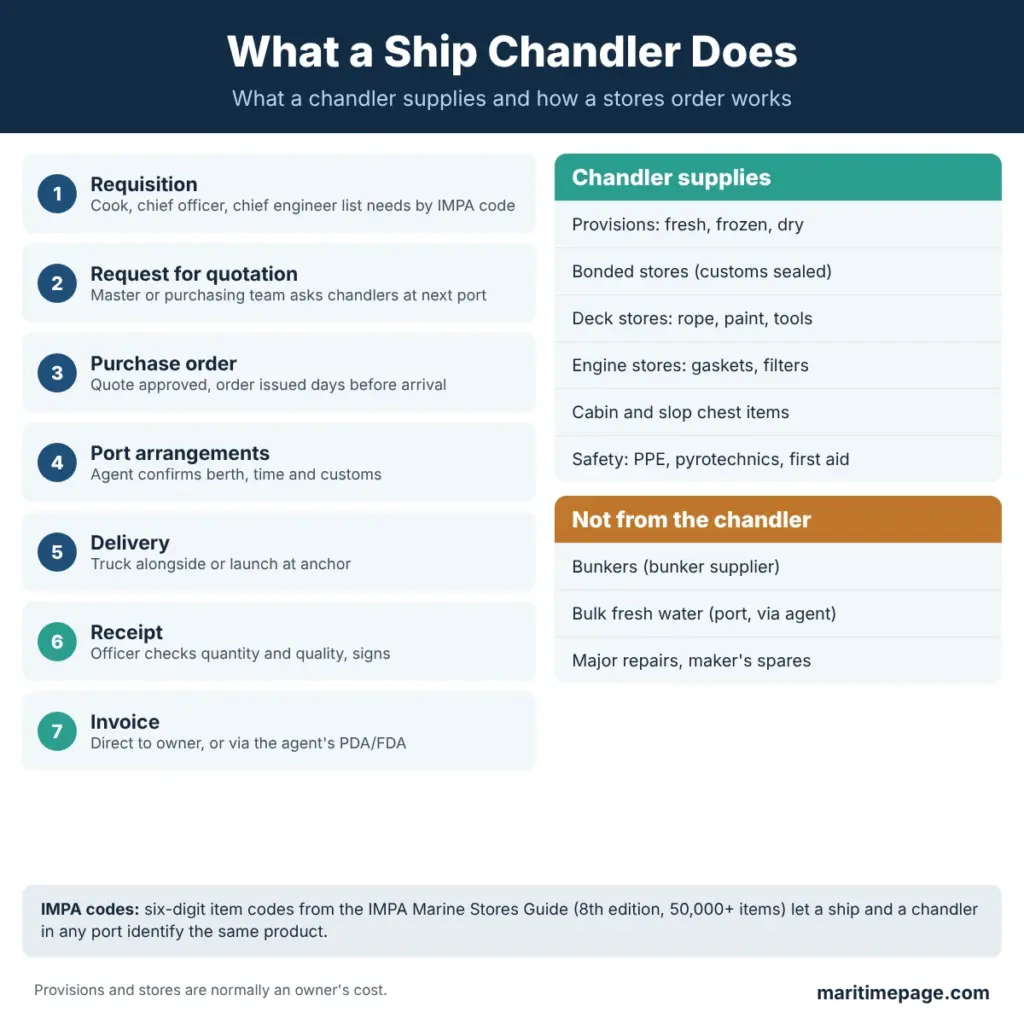
A ship chandler supplies provisions, bonded stores, deck stores, engine stores, cabin stores and safety items. Most orders mix fresh food for the galley with technical consumables for the deck and engine departments.
| Category | Typical items | Ordered by |
|---|---|---|
| Provisions | Fresh, frozen and dry food, drinking water in bottles | Chief cook or steward, master |
| Bonded stores | Tobacco, spirits, wine, beer, held under customs seal | Master |
| Deck stores | Rope, wire, paint, brushes, tools, cleaning chemicals | Chief officer or bosun |
| Engine stores | Hand tools, gaskets, fasteners, filters, small quantities of lubricants | Chief engineer |
| Cabin and slop chest | Linen, toiletries, workwear, crew personal items | Steward, master |
| Safety stores | PPE, pyrotechnics, first-aid and medical consumables | Master, chief officer |
What Does a Ship Chandler Not Supply?
- Fuel: bunkers come from licensed bunker suppliers by barge, truck or pipeline, not from the chandler. See bunkering on ships.
- Fresh water in bulk: the agent usually orders it from the port’s hydrant or a water barge.
- Major repairs and original spare parts: these come from service companies and equipment makers, although the chandler may receive and forward spares.
How Does Ordering From a Ship Chandler Work?
The ship raises a requisition, the owner or manager requests quotes, and the chosen chandler delivers at the next port. Orders are usually placed several days before arrival so the delivery is ready when the ship berths.
- Requisition: the cook, chief officer and chief engineer list what they need, usually by IMPA code.
- Request for quotation: the master or the manager’s purchasing team sends the list to one or more chandlers at the next port.
- Quotation and order: the chandler quotes price and availability; the buyer approves and issues a purchase order.
- Port arrangements: the port agent confirms the berth or anchorage, delivery time and any customs formalities.
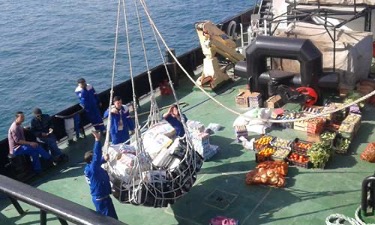
- Delivery: stores arrive by truck alongside, or by launch at anchor, and the crew loads them.
- Receipt: a responsible officer checks quantity and quality, then signs the delivery note.
- Invoice: the chandler invoices the owner or manager, or bills through the agent.
Galley orders come from the cook or steward, deck orders from the chief officer and engine orders from the chief engineer. The master approves the requisition; see shipboard ranks for who does what.

What Are IMPA Codes?
IMPA codes are six-digit product codes from the IMPA Marine Stores Guide, published by the International Marine Purchasing Association. They let a ship and a chandler in any country identify the same item without a description.
The guide was first introduced in 1978 and is now in its 8th edition, with more than 50,000 codes. Most purchasing systems on ships and in management offices use IMPA codes for requisitions and quotes.
The International Shipsuppliers & Services Association (ISSA) is the chandlers’ own trade body. It publishes the ISSA Ship Stores Catalogue and runs a quality standard for member suppliers.
What Are Bonded Stores?
Bonded stores are duty-free goods, mainly tobacco and alcohol, supplied to a ship for consumption outside the country’s customs territory. The chandler delivers them from a bonded warehouse under customs control.
In port, customs usually seals the ship’s bonded store room. The master declares the remaining bonded stock on arrival, and the seal is broken only after departure.
How Is a Ship Chandler Paid?
A ship chandler is paid by the shipowner or ship manager, either directly on invoice or through the port agent. The purchase order decides which route applies and who carries the cost under the charter.
When stores go through the agent, they appear on the proforma disbursement account (PDA) and the final account. Keeping stores as separate lines makes it easier to compare port costs between calls.
Provisions and stores are normally an owner’s cost, even under a time charter. They are part of running the ship, not part of employing it.
How Do Ship Chandlers Help Meet MLC 2006?
Under Regulation 3.2 of the Maritime Labour Convention (MLC 2006), the shipowner must provide food and drinking water of suitable quality, quantity and nutritional value. Chandler deliveries are how most ships meet that duty in practice.
The master, or an officer on the master’s behalf, must inspect food and drinking water supplies frequently and record the inspections. Port State control inspectors check provisions, storage temperatures and those records.
What Is the Difference Between a Ship Chandler and a Boat Chandlery?
A ship chandler supplies commercial ships in port by order and delivery. A boat chandlery is a retail shop, usually at a marina, selling equipment and parts to yacht and small-boat owners.
The term “chandlery” is used mainly in the UK and Commonwealth countries for these marine stores. In the US the same shops are more often called marine supply stores.
- Customers: ship chandlers serve shipowners and managers; boat chandleries serve private boat owners.
- Goods: provisions, bonded and technical stores for ships, versus rope, fittings, paint, electronics and safety gear for boats.
- Delivery: to the ship at berth or anchor, versus over the counter or online.

How Has Ship Chandling Changed?
Ship chandling has moved from buying at the quay after arrival to ordering electronically before the ship reaches port. Orders are now placed days ahead, so loading starts soon after the ship berths.
Large ship managers buy through e-procurement platforms and framework agreements with chandler networks across many ports. Smaller operators still order by email from local chandlers, often recommended by the agent.

Related Topics
Frequently Asked Questions
What is a ship chandler?
A ship chandler is a company that supplies ships in port with provisions, bonded stores, deck and engine stores and safety items. It delivers them alongside or at anchor.
What does chandler mean in shipping?
In shipping, a chandler is a ship supplier. The word comes from the medieval candle maker, whose candles were among a ship’s first stores; chandlers later sold rope, canvas and food to ships.
What is a chandlery?
A chandlery is a chandler’s warehouse or shop. For merchant ships it is a supplier’s store; for leisure boating, especially in the UK, it is a marina shop selling boat equipment.
Does a ship chandler supply fuel?
No. Ship fuel (bunkers) comes from licensed bunker suppliers. Chandlers may supply small quantities of lubricants and chemicals, but not bunkers.
What are IMPA codes?
IMPA codes are six-digit item codes from the IMPA Marine Stores Guide. Ships and chandlers use them so that an order means the same item in any port.
What are bonded stores on a ship?
Bonded stores are duty-free goods, mainly tobacco and alcohol, supplied under customs control. In port, customs usually seals the bonded store room until the ship sails.
Who pays the ship chandler?
The shipowner or ship manager pays, either directly on invoice or through the port agent’s disbursement account. Provisions and stores are normally an owner’s cost, even under a time charter.
What is the difference between a ship chandler and a ship agent?
The ship agent represents the ship in port and arranges services and formalities. The chandler is one supplier the agent or owner uses, delivering stores and provisions.

- Great Lakes Maritime Academy: Programs, Cost and Admission – October 14, 2026
- Bunker Delivery Note (BDN): Contents, MARPOL Rules and Checks – October 11, 2026
- Oil Record Book: Part I and Part II Entries, Rules and PSC Checks – October 11, 2026