The types of gas carriers under the IGC Code are defined in two ways. One is how the cargo is kept liquid: pressure, refrigeration or both. The other is the IGC ship type, 1G to 3G.
This guide explains both, the cargo tank types each carrier uses, LPG carrier sizes and the equipment that sets gas carriers apart. It is written for officers, cadets and surveyors moving into gas carriers.
What Are the Types of Gas Carriers?
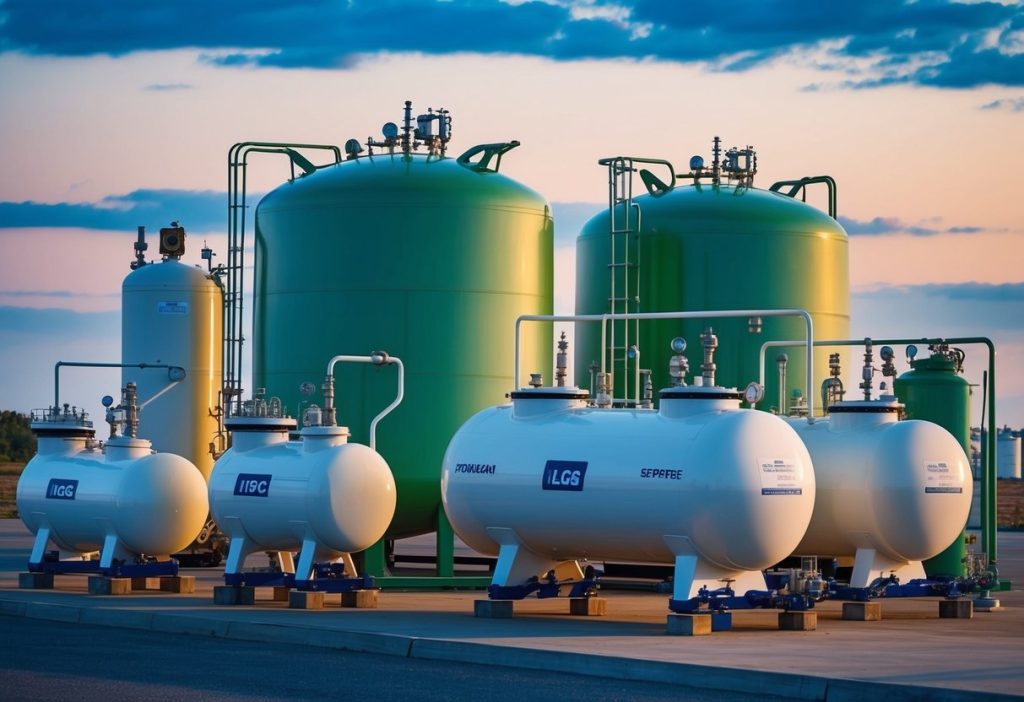
Gas carriers are grouped by how they keep cargo liquid: fully pressurised, semi-refrigerated, fully refrigerated, ethylene and ethane carriers, and LNG carriers. Colder cargoes need more refrigeration and lower-temperature tank steel.
| Carrier type | Tank type | Typical pressure | Typical temperature | Common cargoes |
|---|---|---|---|---|
| Fully pressurised | Type C | About 17–18 bar | Ambient | LPG, ammonia, butadiene |
| Semi-refrigerated | Type C, often bilobe | About 5–7 bar | Down to about -48°C | LPG, ammonia, VCM, propylene |
| Ethylene (LEG) | Type C | About 5–7 bar | Down to -104°C | Ethylene, plus LPG and ethane |
| Fully refrigerated LPG | Type A prismatic | Near atmospheric | About -50°C | LPG, ammonia |
| Ethane (VLEC) | Membrane or Type B | Near atmospheric | About -90°C | Ethane |
| LNG carrier | Membrane or Type B (Moss) | Near atmospheric | About -162°C | LNG |
The pressures and temperatures are typical design values. Each ship’s limits are on its IGC Certificate of Fitness.
How Does the IGC Code Classify Gas Carriers?
The IGC Code classifies gas carriers as ship type 1G, 2G, 2PG or 3G by cargo hazard. The ship type sets how far the cargo tanks sit from the shell and how much damage the ship must survive.
The “G” stands for gas. The IGC Code page covers the Code, its chapters and the Certificate of Fitness. This section explains what the ship types mean in practice.
| Ship type | Cargo hazard | Damage the ship must survive | Example cargoes |
|---|---|---|---|
| 1G | Greatest | Anywhere along its length; tanks set inboard of side damage | Chlorine, ethylene oxide |
| 2G | Significant | Anywhere along its length (over 150 m) | LNG, LPG, ethylene, ammonia |
| 2PG | Significant, on small ships | Anywhere, except bulkheads spaced wider than the damage | LPG, ammonia on pressurised ships |
| 3G | Lowest | Anywhere, except bulkheads spaced wider than the damage | Nitrogen, refrigerant gases |
What Is the Difference Between 2G and 2PG?
A 2PG ship carries 2G cargoes but is 150 m long or less. Its Type C tanks are rated to at least 7 bar gauge and -55°C, which allows slightly relaxed damage assumptions.
A 2PG design over 150 m is treated as a 2G ship. Most small fully pressurised and semi-refrigerated LPG carriers are certified as 2PG or 2G.
How Far Must Cargo Tanks Be From the Shell?
On a 1G ship, tanks sit inboard of side damage (B/5 or 11.5 m) and above bottom damage (B/15 or 2 m), whichever is less. Other ship types need only the bottom distance and 760 mm from the shell.
B is the ship’s breadth. These distances are why a 1G ship carries much less cargo than a 2G ship of the same size.
What Are the Cargo Tank Types on Gas Carriers?
Gas carriers use independent Type A, Type B or Type C tanks, or membrane tanks. The tank type decides the secondary barrier: complete for Type A and membrane, partial for Type B, and none for Type C.
Type A Tanks
Type A tanks are self-supporting prismatic tanks with flat walls, designed for a vapour pressure below 0.7 bar. They need a complete secondary barrier, usually provided by the inner hull, for cargoes colder than -10°C.
Fully refrigerated LPG carriers, including most VLGCs, use Type A tanks. The hold spaces around them are kept inerted or filled with dry air.
Type B Tanks
Type B tanks are self-supporting tanks designed with model tests and detailed fatigue analysis so that a crack leaks before it fails. That allows a partial secondary barrier, such as a spray shield and drip trays.
Moss spherical tanks and IHI’s prismatic SPB tanks are Type B. They are used mainly on LNG carriers and some very large ethane carriers.
Type C Tanks
Type C tanks are pressure vessels, cylindrical, bilobe or trilobe, built to pressure-vessel standards. They need no secondary barrier because their design makes a large leak very unlikely.
Fully pressurised and semi-refrigerated LPG carriers, ethylene carriers and small-scale LNG carriers use Type C tanks. They tolerate pressure build-up, which simplifies boil-off handling on short trades.
Membrane Tanks
Membrane tanks use a thin metal barrier supported by insulation fixed to the inner hull, with a complete secondary barrier. GTT’s Mark III uses corrugated stainless steel about 1.2 mm thick, while NO96 uses Invar.
Most large LNG carriers and many very large ethane carriers use membrane tanks. The types and sizes of LNG carriers guide compares membrane and Moss designs in detail.
What Is a Fully Pressurised Gas Carrier?
A fully pressurised gas carrier keeps LPG liquid by pressure alone, at ambient temperature, in Type C tanks designed for about 17–18 bar. It needs no reliquefaction plant or tank insulation.
- Size: mostly small coastal ships, because heavy pressure tanks waste space and weight.
- Cargoes: propane, butane, propylene, ammonia and butadiene.
- Operation: simple, with cargo handled at the shore terminal’s temperature and pressure.
The trade-off is cargo capacity. Thick-walled tanks carry far less cargo for their weight than refrigerated tanks.
What Is a Semi-Refrigerated Gas Carrier?
A semi-refrigerated gas carrier combines moderate pressure, about 5–7 bar, with refrigeration down to about -48°C. Its Type C tanks are insulated, and a reliquefaction plant keeps the cargo cold.
- Flexibility: these ships load from pressurised or refrigerated terminals and carry many grades.
- Cargoes: LPG, ammonia, propylene, VCM and butadiene, often several grades segregated on one voyage.
- Size: mostly coasters and handy-size ships.
They are the workhorses of regional petrochemical gas trades, and many are certified for chemical gases listed in both the IGC and IBC Codes.
What Is a Fully Refrigerated Gas Carrier?
A fully refrigerated gas carrier keeps cargo liquid at about atmospheric pressure by cooling it to its boiling point, about -50°C for LPG. It uses large Type A prismatic tanks and a reliquefaction plant.
- Size: mid-size, large and very large gas carriers, from about 25,000 m³ to over 70,000 m³.
- Cargoes: propane, butane and ammonia, usually in large single-grade or two-grade parcels.
- Trades: long-haul routes from the Middle East Gulf and the United States to Asia.
Fully refrigerated ships need refrigerated terminals at both ends. They give the lowest cost per tonne on long voyages.
What Are Ethylene and Ethane Carriers?
Ethylene carriers are semi-refrigerated gas carriers rated to -104°C, ethylene’s boiling point. Very large ethane carriers (VLECs) carry ethane at about -90°C in membrane or Type B tanks.
- Ethylene carriers: Type C tanks of low-temperature steel. The IGC Code limits 5% nickel steel to -105°C, which covers ethylene.
- VLECs: the first were 87,000 m³ ships delivered in 2016–2017 for Reliance, followed by 98,000 m³ ships that burn ethane as fuel.
- Ethane boiling point: -88.6°C for pure ethane, about -92°C for commercial ethane with a little methane.
Ethylene carriers can also carry LPG and ammonia, which makes them the most flexible gas carriers afloat.
What Are LNG Carriers?
LNG carriers keep liquefied natural gas at about -162°C near atmospheric pressure, in membrane or Moss tanks with full or partial secondary barriers. They are the largest gas carriers, up to 266,000 m³.
They burn or reliquefy the boil-off gas that forms during the voyage. Their designs, sizes and propulsion are covered in the LNG carrier guide linked above.
What Are the Sizes of LPG Carriers?
LPG carriers range from coasters under 15,000 m³ to very large gas carriers (VLGCs) of 70,000 m³ and above. The size class usually indicates the carriage type and the trade.
| Size class | Capacity (m³) | Usual carriage type | Typical trade |
|---|---|---|---|
| Coaster | Below 15,000 | Pressurised or semi-refrigerated | Coastal and regional |
| Handy gas carrier | About 15,000–25,000 | Semi-refrigerated or ethylene | Petrochemical gases, short to medium haul |
| Mid-size gas carrier (MGC) | About 25,000–50,000 | Fully refrigerated | Regional and medium haul |
| Large gas carrier (LGC) | About 50,000–70,000 | Fully refrigerated | LPG and ammonia, long haul |
| Very large gas carrier (VLGC) | About 70,000 and above | Fully refrigerated | Long-haul LPG |
Some brokers use slightly different boundaries. The difference between LNG and LPG page explains why the two cargoes need such different ships.
What Equipment Is Specific to Gas Carriers?
Gas carriers have equipment oil tankers lack: reliquefaction plants, cargo compressors, heaters, vaporisers, booster pumps and tank relief valves set to each tank’s limit. Water spray and dry powder systems protect the cargo deck.
- Reliquefaction plant: compresses and condenses cargo vapour, then returns it to the tanks.
- Cargo compressors: handle vapour return, reliquefaction and tank warm-up.
- Heaters and vaporisers: warm cargo for discharge into ambient-temperature shore tanks or to make vapour for purging.
- Deepwell and booster pumps: discharge cold cargo, with boosters adding pressure for pressurised terminals.
- Emergency shutdown (ESD): closes valves and stops pumps on ship and shore together.
- Gas detection: fixed and portable detectors for flammable and toxic gases.
- Inert gas or nitrogen: inerts hold and interbarrier spaces and purges tanks, much like the inert gas system on oil tankers.
The cargo carriage condition decides how much of this a ship has. A fully pressurised coaster has little more than pumps and compressors.
What Do Inspectors Check on Gas Carriers?
Inspectors check that each cargo is on the ship’s Certificate of Fitness. Tank pressures, temperatures and relief valve settings must match the certificate. They also test the ESD system, gas detection and water spray.
- Class and statutory surveys: renew the Certificate of Fitness. See types of ship surveys.
- Port State control: checks certificates, safety systems and crew competence under the port State control MoUs.
- Vetting: charterers inspect gas carriers through a vetting inspection before fixing cargo.
The IGC Code guide linked above lists the common inspection findings in detail.
Related Topics
Frequently Asked Questions
What does G mean in 1G, 2G and 3G ship types?
G stands for gas. The IGC Code uses 1G, 2G, 2PG and 3G for gas carriers. The IBC Code uses ship types 1, 2 and 3 for chemical tankers.
What is the difference between 2G and 2PG gas carriers?
Both carry the same cargoes. A 2PG ship is 150 m or less, with Type C tanks rated to at least 7 bar gauge and -55°C. That allows slightly relaxed damage assumptions.
What is the difference between Type A, Type B and Type C tanks?
Type A tanks are prismatic and need a complete secondary barrier. Type B tanks are designed to leak before failing and need a partial one. Type C tanks are pressure vessels and need none.
What ship type is an LNG carrier under the IGC Code?
LNG carriers are type 2G ships. Most use membrane tanks with a complete secondary barrier or Moss Type B tanks with a partial one.
What type of gas carrier carries LPG?
LPG travels on all three LPG carrier types. Fully pressurised ships take small coastal parcels, semi-refrigerated ships mixed grades, and fully refrigerated ships, including VLGCs, long-haul cargoes.
What is an MGC gas carrier?
MGC stands for mid-size gas carrier, an LPG carrier of about 25,000–50,000 m³. Most are fully refrigerated and carry LPG or ammonia on regional and medium-haul routes.
What pressure does a fully pressurised LPG carrier use?
Fully pressurised LPG carriers typically have Type C tanks designed for about 17–18 bar. That is enough to keep propane liquid at ambient temperature without refrigeration.
Can gas carriers carry chemicals?
Yes, some can. Chemical gases such as VCM, propylene and butadiene are listed in the IGC Code, and some products appear in both the IGC and IBC Codes.

- Great Lakes Maritime Academy: Programs, Cost and Admission – October 14, 2026
- Bunker Delivery Note (BDN): Contents, MARPOL Rules and Checks – October 11, 2026
- Oil Record Book: Part I and Part II Entries, Rules and PSC Checks – October 11, 2026