A ballast system is a critical part of a cargo ship’s stability and operational safety. It controls how seawater is taken in and discharged to adjust the vessel’s trim, list, and draft. These adjustments allow the ship to maintain optimal balance regardless of cargo load, weather conditions, or fuel consumption.
Why Do Cargo Ships Use a Ballast System?
Ballast systems help ships stay upright, safe, and efficient during all operational phases. Whether the ship is in ballast condition (empty) or fully laden, adjusting the internal water load helps counterbalance uneven cargo distribution or the effects of environmental forces.
Common reasons ballast systems are used include:
- Correcting trim and list to keep the ship level fore-and-aft and side-to-side.
- Reducing hull stress during heavy weather or uneven loading.
- Ensuring propeller immersion and rudder effectiveness.
- Optimizing fuel efficiency by reducing hull resistance.
⚓ SOLAS Chapter II-1 requires ships to maintain damage stability and adequate subdivision, which ballast systems help achieve in both intact and damaged conditions.
Main Components of a Ballast System
A cargo ship’s ballast system includes mechanical, structural, and electrical components. Each plays a role in safely transferring seawater to and from dedicated tanks.
The main components include:
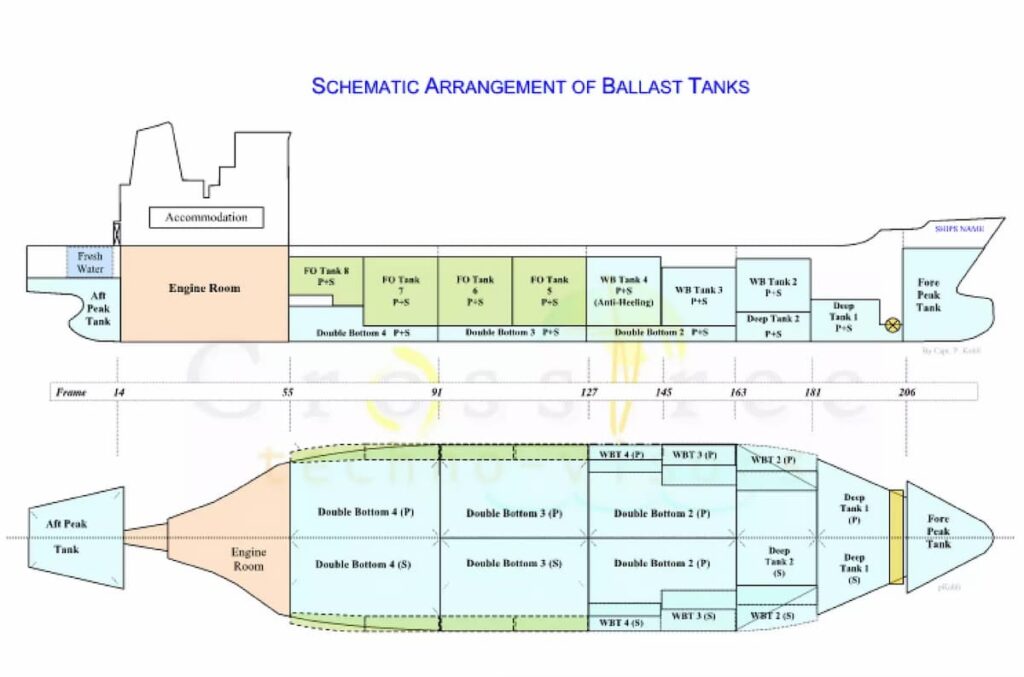
- Ballast Tanks: These are typically located in the double bottom, forepeak, and aft peak sections. Their arrangement ensures even water distribution and structural support.
- Ballast Pumps: These are centrifugal pumps powered by electric motors, designed to transfer large volumes of water quickly. Some vessels also have emergency or portable pumps.
- Piping and Valves: A network of pipelines connects the tanks, intake points, and overboard discharge. These pipes are fitted with remote- or manually-operated valves to control the flow.
- Tank Sounding and Monitoring Systems: Float-type, pressure sensor, or radar level indicators are used to measure the amount of water inside each tank, often connected to the ballast control panel.
- Ballast Control Panel: Modern vessels use PLC-based or SCADA-integrated control panels for real-time monitoring and automation of the entire system.
How Does the Ballast System Work?
A typical ballast operation follows a planned and logged sequence:
- Seawater enters through sea chests, where strainers prevent debris from entering the system.
- Ballast pumps transfer water into designated tanks, based on the required trim or list correction.
- Valve operations are executed either from a central control panel or manually at the valve station.
- Tank levels are monitored constantly using sounding sensors or visual indicators.
- De-ballasting is the reverse—tanks are emptied to adjust buoyancy when cargo is loaded or during port entry.
Automated systems allow ballasting to respond to sensor data in real-time, with safety interlocks to prevent overfilling, overboard discharge in port, or dangerous heel angles.
How Ballast Systems Influence Ship Stability
Ship stability depends on how the weight is distributed vertically and laterally. The ballast system helps adjust the following:
- Trim: Controlled by filling or emptying fore and aft peak tanks. Ballast is added or removed relative to the ship’s longitudinal center of flotation (LCF), which determines how much a given shift affects trim.
- List: Managed via port and starboard side tanks.
- Metacentric Height (GM): Ballasting alters the center of gravity and buoyancy, directly impacting GM.
These adjustments are crucial during operations like:
- Loading/discharging cargo unevenly across holds.
- Maneuvering in narrow channels or high seas.
- Meeting draft requirements for specific ports.
Ballast system use must be coordinated with cargo loading plans, draft surveys, and the vessel’s deadweight tonnage (DWT).
Ballast System in Shipbuilding and Installation
During construction, shipbuilders integrate the ballast system early in the design phase. The layout ensures weight distribution aligns with the vessel’s longitudinal center of gravity and damage stability requirements.
Installation steps include:
- Structural fabrication of tanks as part of hull assembly.
- Welding and routing of ballast piping through double bottom corridors.
- Electrical cabling for valve actuators, sensors, and pump starters.
- Protective coatings inside tanks to prevent corrosion from seawater exposure.
IACS URs (Unified Requirements) govern ballast piping design, welding standards, and tank access provisions:
SC227 Rev2 – The dedicated seawater ballast tanks in SOLAS Chapter II-1 (Regulation 3-2)
UR M74 Rev2 – Ballast Water Management Systems
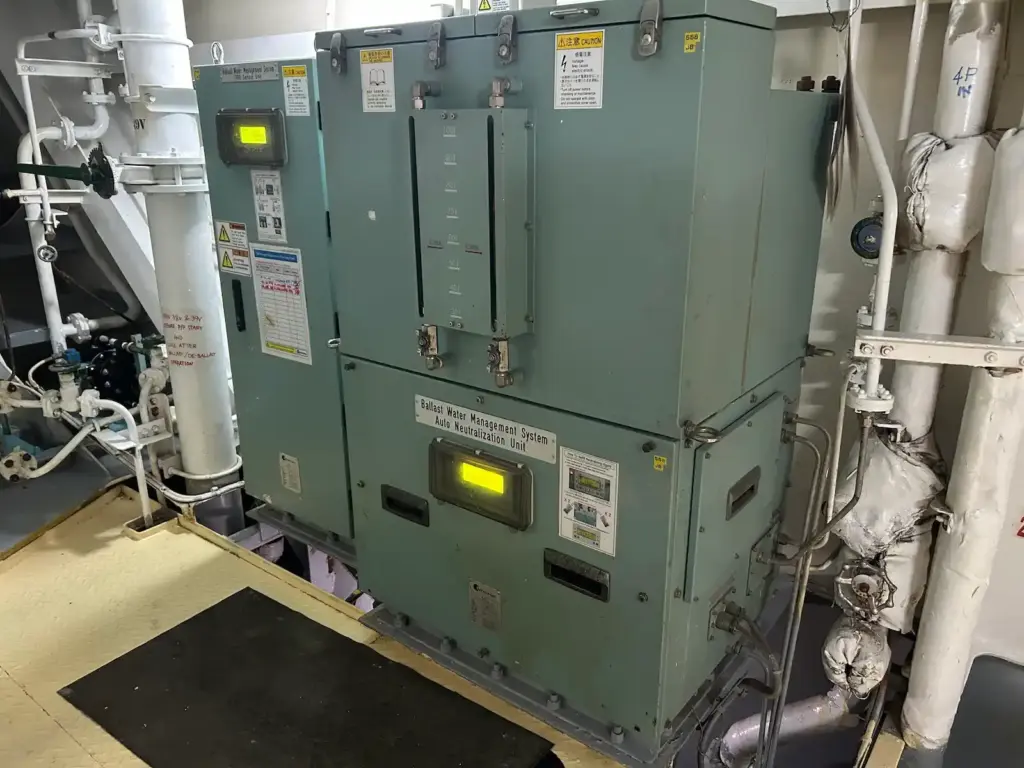
Ballast Water Treatment System (BWTS) Integration
Since the IMO Ballast Water Management Convention (2004), vessels must also prevent the spread of invasive marine species by treating discharged ballast water.
A Ballast Water Treatment System integrates with the ballast system in two main ways:
- Before tank entry (inflow treatment) – filters and treats water before it enters the tanks.
- Before discharge (outflow treatment) – disinfects water before it’s released into the sea.
Common treatment methods include:
- Filtration + UV sterilization (common in container and bulk ships).
- Electrochlorination (more common in tankers with higher flow rates).
The D-2 standard limits viable organisms in ballast discharge. Engineers must verify system performance during commissioning and port state inspections.
Operational Problems and Maintenance
Even robust ballast systems need regular maintenance to remain effective and compliant:
- Pump failure: Caused by cavitation, impeller wear, or clogging.
- Valve leaks: Lead to uncontrolled flow or tank cross-contamination.
- Sensor issues: Incorrect sounding may result in tank overfilling or list.
- Corrosion: Ballast tanks are high-risk zones for rust and must be coated and inspected routinely.
Maintenance schedules often follow class society guidelines, such as those from ABS, Lloyd’s Register, or DNV. These include:
- Annual inspections of pumps, valves, and sensors.
- Tank entry every 5 years for structural and coating inspection.
- Functional testing of control panels and alarm systems.

- Great Lakes Maritime Academy: Programs, Cost and Admission – October 14, 2026
- Bunker Delivery Note (BDN): Contents, MARPOL Rules and Checks – October 11, 2026
- Oil Record Book: Part I and Part II Entries, Rules and PSC Checks – October 11, 2026