This page answers one question: how long is a ship’s anchor cable, and how is the correct amount calculated for your vessel and anchorage? It is written for deck officers, mates, and maritime students who need operationally accurate information — not a general guide for recreational boaters.
What Is a Shackle of Anchor Cable and How Long Is It?
A shackle — also called a shot in American usage — is the standard unit of anchor cable length. One shackle measures 27.5 metres (15 fathoms or 90 feet). Individual shackles are connected by Kenter shackles (also called lugless joining shackles), which allow the cable to pass over the cable lifter without snagging.
Cables are marked at each shackle boundary so the officer of the watch can read scope visually from the bridge wing or forecastle. The marking convention varies by flag state and company SMS, but the standard method uses turnback links, paint, and wire seizing at 27.5m intervals. Most vessels carry two cables of 10–12 shackles each, giving a total cable length per anchor of 275–330 metres.
The bitter end is secured in the chain locker via a quick-release pelican hook or a senhouse slip, allowing emergency slipping of the cable. Never leave the bitter end unsecured — a dragging anchor with a free cable is a man-overboard and machinery hazard simultaneously.
How Many Shackles Does Each Vessel Class Carry?
Cable length is not arbitrary. IACS Unified Requirement A1 sets the minimum anchor and cable requirements for all sea-going vessels, using the Equipment Number (EN) as the governing parameter.
All IACS member societies — Lloyd’s Register, ABS, DNV, Bureau Veritas, and others — are obligated to implement UR A1 as a floor. Individual societies may enforce additional requirements for specific notations, such as ice class or offshore service, but no member society may class a vessel below the UR A1 minimums. The EN is derived from displacement, freeboard, and superstructure windage area.
VLCC and Large Tankers
A VLCC (Very Large Crude Carrier) with a displacement of 300,000 DWT and a high superstructure will generate an EN in the 3000–4000 range. Lloyd’s Register Rules for Ships, Part 3 Chapter 13, Table 1, assigns anchor and cable requirements against EN bands. At this EN, Lloyd’s requires each bower anchor cable to be 12 shackles (330m) of 130–150mm stud-link chain, Grade U3.
The anchor itself will weigh 20–25 tonnes per side. The windlass must hold a brake holding load equal to at least 45% of the chain cable’s minimum breaking force — a figure specified in the class rules and stamped on the windlass nameplate. On a VLCC, that figure exceeds 2,000 kN.
Panamax and Aframax Tankers
Panamax tankers (60,000–80,000 DWT) typically carry 11 shackles (302.5m) of 97–111mm chain per anchor. The EN falls in the 1800–2500 range. ABS Rules for Building and Classing Steel Vessels, Part 3 Chapter 4, uses identical EN bands and produces comparable cable lengths to Lloyd’s Register. There is no meaningful discrepancy between major classification societies for standard vessel types — they cross-certify each other’s EN calculations in port state control examinations.
Handysize Bulk Carriers and General Cargo Ships
A 28,000 DWT handysize vessel generates an EN of approximately 900–1200. The class requirement at this EN is typically 9–10 shackles (247.5–275m) of 76–84mm chain per anchor. These vessels anchor more frequently than VLCCs, their cables wear faster, and the chain locker inspection interval matters more operationally.
Coasters and Short-Sea Vessels
Coastal vessels of 2,000–5,000 DWT operate in shallower anchorages and carry 6–8 shackles (165–220m) of 42–54mm chain. The EN for this size ranges from 200–500. DNV-GL Rules for Classification: Ships, Part 3 Chapter 11, sets minimum cable lengths and grades for small vessels and explicitly covers vessels operating in restricted service. Flag state administrations sometimes accept reduced cable lengths for vessels with restricted trading certificates, but a port state control officer will check the class certificate for compliance regardless.
How Is Anchor Scope Calculated?
Scope is the ratio of cable paid out to the depth of water at the hawsepipe. The standard operational rule for a well-holding anchorage in moderate conditions is a minimum scope of 5:1 — five lengths of cable to every unit of depth. In deteriorating weather or on a lee shore, increase scope to 7:1 or beyond.
Depth Measurement
Depth for scope calculation is measured from the hawsepipe, not the keel. The hawsepipe on a laden VLCC sits approximately 10–14 metres above the waterline. Fail to account for this and you underpay cable in shallow water by a meaningful margin.
Water Depth vs Cable on the Bottom
Scope does not work the way most junior officers initially understand. The cable does not pull vertically from the anchor shank to the hawsepipe. At correct scope, the cable lies along the seabed for a horizontal lead length before rising in a catenary curve to the bow. For detail on anchoring in deep water and the forces involved, the catenary mechanics are covered in more depth there.
A VLCC with 8 shackles out in 25 metres of water will lay approximately 160–170 metres of cable along the seabed, depending on chain weight per unit length. The catenary absorbs surge loads from swell and prevents shock loading on the anchor. When scope is insufficient, the catenary flattens, shock loading increases, and the risk of dragging rises sharply — particularly during tidal turn when the vessel shears.
Tidal Height Correction
Add the predicted high water height to the present depth before calculating scope. If you are anchoring at low water in 15 metres and the tide rises 4 metres, your effective depth at high water is 19 metres. Pay scope against 19 metres — not 15. This is the single most common scope calculation error made by second officers during coastal passages.
What Grade of Stud-Link Chain Is Required?
Chain grade determines the minimum breaking force relative to the chain diameter. The principal grades in use on merchant vessels are U1, U2, and U3 under the ISO and classification society systems.
Grade U1 (Common or Ordinary): The legacy grade, no longer fitted on new vessels. Found on older tonnage. Breaking force is the lowest of the three grades. Class surveyors will check chain grade certificates against the class notation.
Grade U2 (High Tensile): Standard on most merchant vessels built from the 1990s onward. A 76mm Grade U2 chain has a minimum breaking force of approximately 3,700 kN.
Grade U3 (Extra High Tensile): Required by class on vessels with high EN values and on vessels where cable weight must be minimised for trim or stability reasons. A 97mm Grade U3 chain has a minimum breaking force exceeding 6,000 kN.
IACS UR A1 sets minimum proof load and breaking load values for each chain grade and diameter — all member societies apply these as a baseline. Lloyd’s Register, ABS, and DNV each require chain to be manufactured to their approved specifications, which implement the IACS minimums and may add further requirements.
The test certificate travels with the cable and must be available for class survey inspection. Certificates issued by one IACS member society are generally accepted by others for port state control purposes when properly endorsed.
What Does the Windlass Need to Lift the Cable?
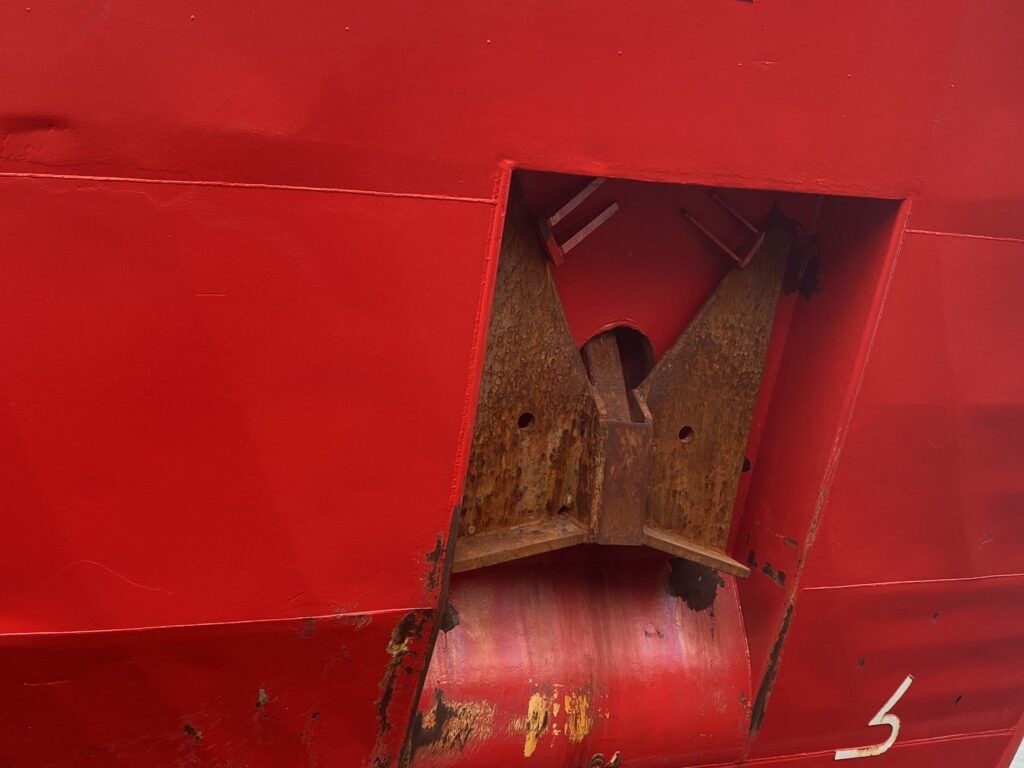
The windlass is the powered machinery unit that heaves and pays out the anchor cable. Its key components are the cable lifter (wildcat), the warping drum, the cable stopper, and the brake. The manual anchor windlass is the manual equivalent used on smaller vessels and is a useful reference for understanding the mechanical principles.
Cable Lifter Specification
The cable lifter is matched to the cable diameter — it must accept the stud-link chain without riding over the studs or jamming. Class rules require the cable lifter to heave at a specified rate, typically 9–12 metres per minute minimum, under a defined load condition. DNV rules specify the windlass must heave at 0.15 m/s under a load equal to 33% of the cable’s minimum aggregate breaking force.
A windlass on a Panamax tanker with 11 shackles of 97mm U2 chain is required to heave approximately 350 kN under continuous duty. A windlass that passes its class test and fails in service is almost always a maintenance failure — a worn brake band, seized cable lifter clutch, or motor insulation breakdown from water ingress through the spurling pipe.
Brake Holding Load
The brake must hold the cable against a load of at least 80% of the chain’s minimum breaking force in the worst case, per Lloyd’s Register. This is measured statically during the class survey. The brake is the only protection against runaway during letting go — a windlass with a worn brake will not stop a heavy cable running freely in deep water, and the result is loss of the anchor.
Check brake condition at every anchor detail. A thin layer of rust on the brake drum is acceptable. A glazed drum or oil-contaminated brake lining is not.
What Are the Class Society Rules for Anchor Cable Surveys?
Lloyd’s Register
LR surveys anchor cables and windlasses during Annual Survey and Special Survey (every five years). At Special Survey, cables are ranged on the quay or deck, inspected for wear, elongation, and corrosion, and recalibrated against the original diameter specification.
A cable worn by more than 12% of its original diameter must be replaced. For the broader context of types of surveys carried out on ships, the survey interval and scope differ significantly from port state control inspections.
LR surveyors check that joining shackles are correctly assembled — lead-filled pins, moused correctly — and that the bitter end quick-release functions freely. Cables can be turned end-for-end at Special Survey to equalise wear.
ABS
ABS requirements mirror LR in substance, consistent with the shared IACS UR A1 floor. The governing reference is ABS Rules for Survey After Construction, Part 7, Chapter 3, Section 2, clause 5.1.4 — Anchor Windlass, Anchor and Chain Cable.
At each Special Periodical Survey, the windlass is operated to verify braking, clutch function, lowering and hoisting, correct chain riding over the wildcat, and transit through the hawse pipe. Anchors and chain cables are ranged and examined, and the chain locker, holdfasts, hawse pipes, chain stoppers, and pumping arrangements are all inspected.
Chain gauging for renewal applies from Special Periodical Survey No. 2 onward. A link is condemned when its mean diameter at the worst cross-section — measured by caliper in two perpendicular directions and averaged — is 12% or more below the original required nominal size. Do not average the reading with other links; each link is assessed individually against the Rule diameter.
DNV
DNV follows its own class notation requirements and references EN 13411. DNV surveyors pay particular attention to the cable marking system — if the shackle marks are unreadable, the vessel will receive a deficiency. Cable markings must be legible at the hawsepipe from the bridge wing. Repaint them before every arrival at an anchorage where a port state control inspection is possible.
What Is the Correct Procedure for Letting Go an Anchor?
The following procedure reflects standard deck officer practice for a single anchor let go from the bridge-controlled windlass position. Adapt to your vessel’s SMS — these are operational reference points, not a substitute for your approved procedure.
First, confirm anchorage position, depth, and tidal height with the officer on the chart. Brief the forecastle team on the scope to be paid out, the speed of approach, and the abort signal. Ensure the chain stopper is open and the cable lifter clutch is engaged. Test the brake before the final approach — apply and release once to confirm it responds.
Second, approach the anchorage position at slow speed, heading into the tide or predominant wind. At the designated drop position, release the brake and allow the anchor to drop freely. Do not use the windlass motor to lower — free fall is faster and keeps the cable taut ahead of the anchor. Call out shackle marks as the cable runs.
Third, when the required scope is out, apply the brake firmly and bring the vessel up on the cable. Watch the bearing on a fixed object and the chain direction — a cable leading aft or with the vessel yawing suggests dragging. Secure with the chain stopper once the vessel has settled. Never rely on the brake alone for an extended anchorage.
What Is the Correct Procedure for Heaving Up Anchor?
Confirm depth and scope before commencing. Manoeuvre the vessel ahead to reduce load on the cable before heaving — do not heave against full load on a stopped ship in any tidal stream worth naming. Engage the cable lifter clutch and commence heaving at slow speed.
Call shackle marks as cable comes aboard and report each one to the bridge. At one shackle remaining, report ‘anchor aweigh’ the moment the anchor breaks clear of the seabed — this is when the vessel loses its fixed position reference. For comparison with how ships are handled during berthing and unberthing, the positional precision required at close quarters is directly analogous to the positional awareness needed during heaving operations near other traffic.
As the anchor comes to the hawsepipe, wash it down with the anchor wash system if fitted. Confirm both flukes and the shank are undamaged. Secure the anchor in the hawsepipe with the bottle screw or anchor lashing before manoeuvring. A loose anchor in a heavy swell is a structural hazard and a potential loss overboard.
Frequently Asked Questions
What is the difference between a shackle and a shot of anchor cable?
They are the same unit of length — 27.5 metres (15 fathoms or 90 feet). ‘Shackle’ is the term used in British and international merchant shipping; ‘shot’ is the American equivalent. Both refer to a single pre-assembled length of stud-link chain joined to the next by a Kenter shackle.
How deep can a ship anchor?
Most merchant vessels are designed to anchor in depths up to 80–100 metres based on cable length and scope requirements. Anchoring in 80m depth at 5:1 scope requires 400m of cable — more than most vessels carry on a single anchor. Practical commercial anchorage depth rarely exceeds 50–60m, with the majority of berths between 10m and 40m.
Does the Equipment Number change if a vessel is modified?
Yes. Any modification that increases superstructure windage area or changes displacement — new deckhouses, a lengthening operation, increased deadweight — requires re-calculation of the EN. The class surveyor must be notified, and anchor and cable requirements re-assessed against the new EN. Failure to do so is a class deficiency.
What chain grade should I specify when ordering a replacement cable?
Match the grade stamped on the existing class certificate. Upgrading from U2 to U3 at the same diameter increases breaking force and may allow a diameter reduction — but the windlass cable lifter must be re-matched to any diameter change. Consult the class surveyor and windlass manufacturer before specifying a non-identical replacement.
What does it mean when the cable leads to the bow?
A cable leading directly forward — toward the bow — indicates the anchor is holding and the vessel lies stably into the tide or wind. A cable leading to the beam or aft means the vessel is sheering or has dragged. In a tidal anchorage, cable direction reverses at tidal turn — watch for excessive sheer during the transition.
What is the purpose of the chain stopper?
The chain stopper (devil’s claw or compressor) takes the cable weight off the windlass brake during extended anchoring. The brake is designed for dynamic load control during letting go and heaving — not for static load over days or weeks. Always engage the chain stopper after anchoring and before leaving the forecastle.
Can two anchors be used simultaneously to reduce swing?
Yes — this is called a Moor, used in restricted anchorages where the vessel’s swing circle would overlap with other traffic or hazards. The classic configurations are the running moor (one anchor let go before the other, cables forming a V) and the standing moor (second anchor let go from a stopped position). Both require accurate position-fixing and careful attention to cable contact during tidal turn.

- 14 Marine Surveyors in Ohio – June 14, 2026
- Boat Salvage Yards in Alabama (2026): Used Marine Parts & Locations – June 14, 2026
- Boat Salvage Yards in Tennessee (2026): Used Marine Parts & Locations – June 14, 2026