A work permit on a ship, or permit to work, is a signed document that authorizes a specific hazardous job for a set time. It confirms that the risks have been assessed, the precautions are in place and a responsible officer has approved the work.
The main types of work permits on ships are hot work, cold work, enclosed space entry, working aloft, working overside, electrical isolation and underwater work. Each is part of the ship’s safety management system under the ISM Code.
What Is a Permit to Work System on a Ship?
A permit to work system is the formal procedure a ship uses to control high-risk jobs. It links the risk assessment, the safety checks, the officer’s authorization and the close-out of the job in one record.
The ISM Code requires companies to set out procedures for key shipboard operations, and permits to work are one of them. Industry guidance sets out how permits should work. Examples are the UK MCA’s Code of Safe Working Practices for Merchant Seafarers (COSWP) and ISGOTT for tankers.
A permit does not make a job safe by itself. It forces the team to stop, check and agree the precautions before starting, and it tells everyone on board that the work is in progress.
What Are the Types of Work Permits on Ships?
Ships use seven main work permits, one for each type of high-risk job. Company systems may add more, such as permits for small craft alongside or pressure testing, but these seven are standard.
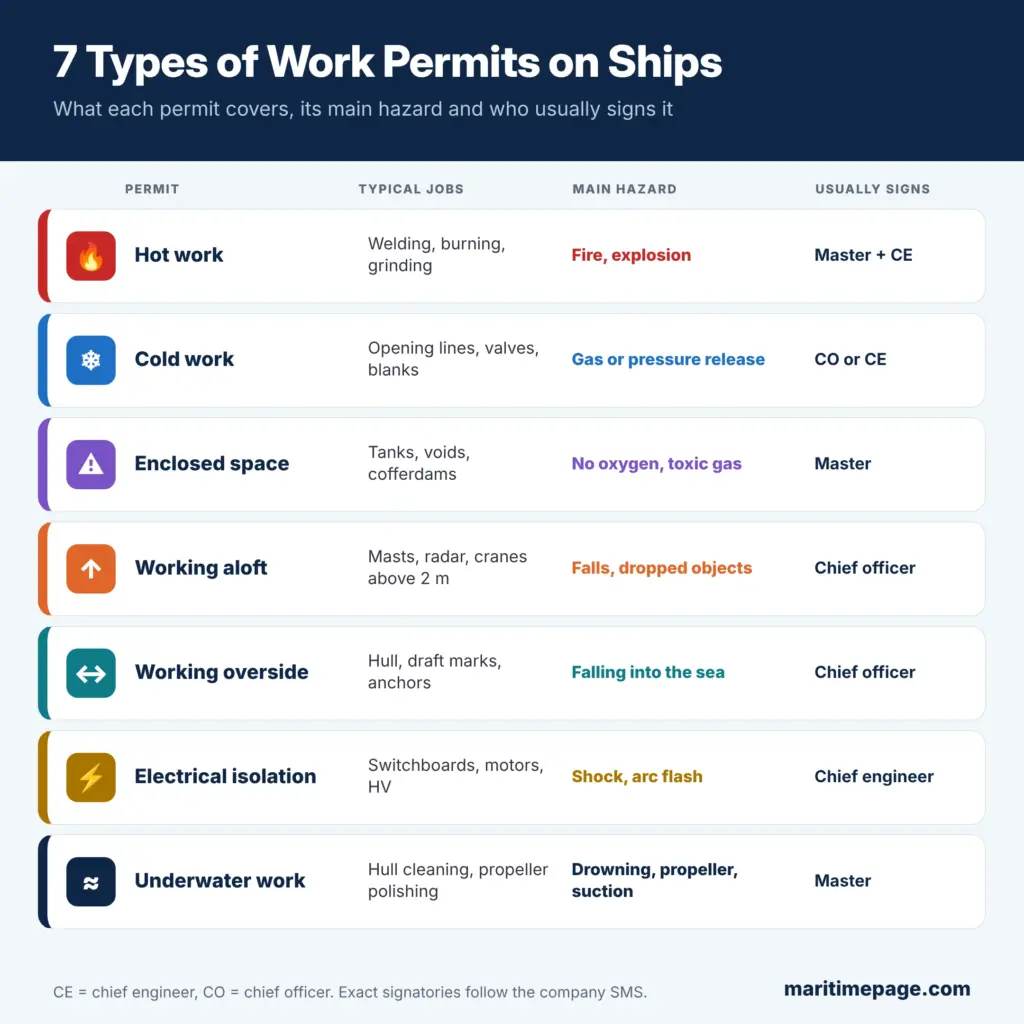
| Work permit | Typical jobs | Main hazards | Usually approved by |
|---|---|---|---|
| Hot work | Welding, burning, grinding, cutting | Fire, explosion, burns | Master, with chief engineer |
| Cold work | Opening pipelines, fitting blanks, valve work in hazardous areas | Release of cargo, gas or pressure | Chief officer or chief engineer |
| Enclosed space entry | Tank inspection, ballast tank cleaning, void space work | Lack of oxygen, toxic or flammable gas (asphyxiation) | Master |
| Working aloft | Mast, radar scanner, crane or funnel work above 2 m | Falls, dropped objects | Chief officer |
| Working overside | Hull painting, draft mark work, anchor maintenance | Falling into the water | Chief officer |
| Electrical isolation | Work on switchboards, motors, high-voltage systems | Electric shock, arc flash | Chief engineer |
| Underwater work | Hull cleaning, propeller polishing, diving inspections | Drowning, propeller or suction hazards | Master |
Where the senior officer is named in the table, the exact signatory is set by the company’s SMS. On many ships, the safety officer also countersigns.
What Is a Hot Work Permit on a Ship?
A hot work permit authorizes any job that creates heat or sparks capable of ignition, such as welding, gas cutting, or grinding. Outside the engine room workshop, it usually needs the master’s approval and often the company’s.
- Remove or protect combustible material near the job, including on the other side of bulkheads and decks.
- Test the atmosphere for flammable gas; on tankers, the area must be gas-free.
- Isolate and blank pipelines and tanks that could release vapour.
- Keep firefighting equipment ready and post a fire watch during the work and for a set time after it.
- In port, get permission from the terminal or port authority before starting.
On tankers, ISGOTT sets stricter rules for hot work in hazardous areas. Tanks must be cleaned and gas-freed, often after inerting with the inert gas system.
What Is a Cold Work Permit?
A cold work permit covers jobs that cannot create a source of ignition, but where the work itself could release something hazardous. Typical examples are opening cargo lines, changing valves or fitting blanks.
Cold work permits are most common on tankers and gas carriers. In the engine room, routine cold work is usually covered by the planned maintenance system. It needs a permit only if the SMS requires one.
What Is an Enclosed Space Entry Permit?
An enclosed space entry permit authorizes entry into any space with limited openings and poor ventilation, such as tanks, voids, cofferdams and cargo holds. Many fatal accidents in enclosed spaces happen when these checks are skipped.
IMO adopted revised recommendations for entering enclosed spaces in June 2025, under Resolution MSC.581(110). Ships should now keep an Enclosed Space Register listing each space, its hazards and the controls needed before entry.
- Ventilate the space and test the atmosphere from outside, at several levels.
- Oxygen should read 21% by volume, flammable gas not more than 1% of the lower flammable limit, and toxic gases below their exposure limits.
- Post an attendant at the entrance, in contact with the officer on watch.
- Keep rescue and resuscitation equipment ready at the entrance.
- Carry a personal gas detector inside and keep testing during the work.
SOLAS Regulation XI-1/7 requires a portable atmosphere-testing instrument on board, and SOLAS Chapter III requires enclosed space rescue drills at least every two months. Drill requirements are covered in types of ship drills.
Common enclosed spaces include double-bottom tanks, the aft peak tank and chain lockers. Cargo holds can also become enclosed spaces when cargo consumes oxygen.
When Is a Working Aloft or Overside Permit Needed?
A working aloft permit is needed for work at a height, usually above 2 meters, where a fall could cause injury. A working overside permit is needed for work outside the ship’s rail, over the water.
- Wear a full-body harness with a lifeline secured to a strong point.
- Inspect bosun’s chairs, stages and ladders before use.
- Switch off and isolate radars, whistles and aerials near the work.
- For overside work, keep a lifebuoy with a line ready and make sure the ship is not underway.
- Do not work aloft or overside in bad weather or heavy rolling.
The bosun usually leads this work and checks the rigging. The officer of the watch must be told before work starts near radars or whistles.
What Is an Electrical Isolation Permit?
An electrical isolation permit authorizes work on electrical equipment after it has been isolated, locked and tagged so it cannot be switched on. Ships with high-voltage systems, above 1,000 V, use a separate high-voltage permit.
The permit records which breakers are isolated, who holds the locks and the test proving the circuit is dead. Only the person who applied a lock may remove it, when the work is finished.
What Is an Underwater Work Permit?
An underwater work permit covers diving operations alongside the ship, such as hull cleaning, propeller polishing and underwater inspections. It must be agreed with the dive team and, in port, with the port authority.
- Immobilize the main engine, propeller and rudder, and display a sign at the controls.
- Close sea chests and stop pumps that draw water near the divers.
- Switch off the impressed current cathodic protection system.
- Show the diving signal and keep a boat or ladder ready for the divers.
How Does the Work Permit Process Work?
Every permit follows the same cycle: plan, prepare, authorize, monitor and close. The permit stays valid only for the job, place and time written on it.
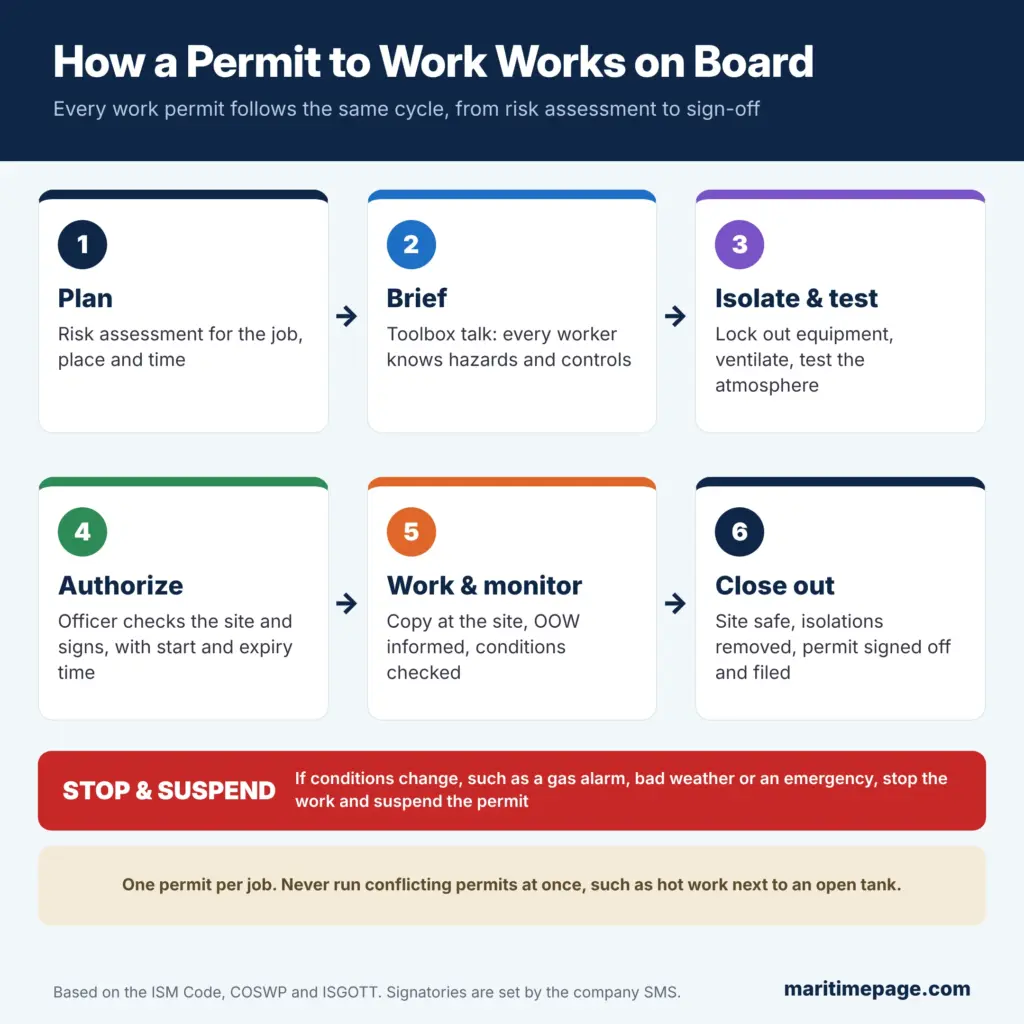
- Plan the job and complete a risk assessment.
- Hold a toolbox talk so every worker knows the hazards and controls.
- Isolate equipment and test the atmosphere where needed.
- The responsible officer checks the site and signs the permit, with a start and expiry time.
- Display a copy at the work site and inform the officer of the watch.
- Stop the work and suspend the permit if conditions change, such as a gas alarm or a change in weather.
- On completion, the person in charge confirms the site is safe, isolations are removed and the permit is closed.
A permit should never cover more than one job. Conflicting permits, such as hot work next to an open tank, must not run at the same time. Completed permits are kept on board for audit.
In hot weather, permits can also include heat stress checks, as described in extreme heat hazards faced by seafarers.
What Do Inspectors Check in a Permit to Work System?
Port state control officers, vetting inspectors and ISM auditors check that permits are used, not just filed. Common findings include:
- Permits signed after the work had started, or not signed by the authorized officer.
- Gas readings missing, out of range, or taken with an uncalibrated detector.
- Permits left open after the job ended, or valid far longer than the job.
- No risk assessment or toolbox talk record matching the permit.
- Enclosed space drills not done at the required interval.
- Isolation and lock-out records that do not match the equipment worked on.
Enclosed space and hot work failures are behind many fatal accidents at sea. They also feature in maritime safety standards audits.
Related Topics
- Bunkering on ships: procedures and checks
- What SOLAS requires
- MLC 2006 health and safety requirements for seafarers
Frequently Asked Questions
What are the types of work permits on ships?
Hot work, cold work, enclosed space entry, working aloft, working overside, electrical isolation and underwater work.
Who issues work permits on a ship?
A responsible officer named in the SMS, usually the master, chief officer or chief engineer, depending on the permit.
How long is a work permit valid?
Only for the job, place and time written on it, usually no longer than one shift. A new permit is needed if the job changes.
What is the difference between hot work and cold work?
Hot work creates heat or sparks that can ignite, such as welding. Cold work cannot ignite but may release cargo, gas or pressure.
Is a risk assessment needed for a work permit?
Yes. The risk assessment comes first, and the permit confirms its controls are in place before the work starts.
What oxygen level is safe for enclosed space entry?
21% by volume, with flammable gas not above 1% of the lower flammable limit and toxic gases below their exposure limits.
At what height is a working aloft permit required?
Usually above 2 meters, or wherever a fall could cause injury, as set by the company SMS.
Which regulation requires work permits on ships?
The ISM Code requires procedures for hazardous work. COSWP, ISGOTT and IMO’s enclosed space recommendations set out how permits should work.

- Great Lakes Maritime Academy: Programs, Cost and Admission – October 14, 2026
- Bunker Delivery Note (BDN): Contents, MARPOL Rules and Checks – October 11, 2026
- Oil Record Book: Part I and Part II Entries, Rules and PSC Checks – October 11, 2026