A ship main engine is the primary propulsion engine that powers large vessels by generating mechanical energy. Most merchant ships use low-speed marine diesel engines, though modern designs increasingly adopt dual-fuel systems capable of burning LNG, methanol, or other alternatives.
The engine drives the shafting system, which rotates the propeller and moves the ship through water. Gas turbines are also used in some specialized vessels but remain rare in commercial shipping.
The largest ship main engines exceed 80,000 kW and stand taller than a three-story building. As the heart of propulsion, they define a vessel’s efficiency, fuel choice, and compliance with international rules.
What Types of Main Engines Are Used on Ships?
Ship engines differ by design, operating cycle, and speed range, which determines their suitability for various vessel types.
- Two-stroke engines run at 60–100 RPM. They deliver high torque at low speeds, making them ideal for large bulk carriers, container ships, and tankers on long voyages. Their ability to burn heavy fuel oil (HFO) keeps operating costs low.
- Four-stroke engines run at 400–1,000 RPM. Their higher speeds and compact design suit smaller cargo ships, ferries, and auxiliary power applications. They typically use marine diesel oil (MDO), offering easier handling and maintenance.
- Dual-fuel engines operate on both liquefied natural gas (LNG) and conventional fuels. These systems allow vessels to switch fuels in Emission Control Areas (ECAs) and remain compliant with MARPOL Annex VI. For more details, see our full guide on dual-fuel engines in ships.
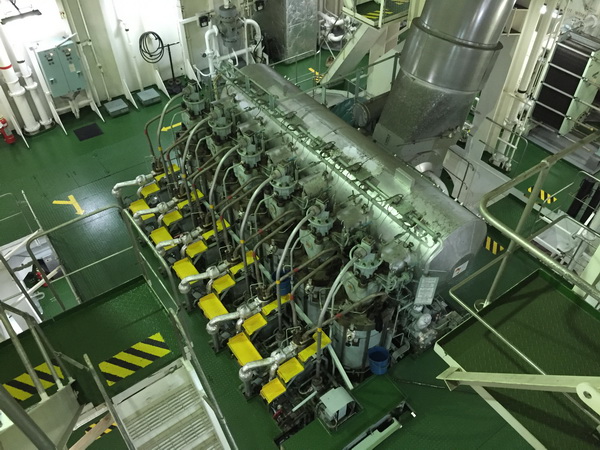
Major propulsion engine manufacturers include MAN Energy Solutions, Wärtsilä, WinGD (formerly Sulzer), and Mitsubishi, which together dominate the global market for two-stroke and four-stroke marine engines.
What Are the Main Components of a Ship Main Engine?
A ship’s main engine is built from multiple parts that work together to generate propulsion power. The most important components are:
- Cylinders and pistons form the combustion chamber where fuel ignites and generates power.
- Fuel injection pump ensures the precise timing and delivery of fuel into each cylinder.
- Turbocharger increases air supply using exhaust gases, improving efficiency.
- Governor regulates load and speed to ensure stable operation.
- Crankshaft converts piston motion into rotary power, transferred to the shafting system. The crankshaft rests on the engine bedplate, a structural foundation explained in detail in our article on marine engine bedplates.
- Remote control system allows operators on the bridge or in the control room to start, stop, and adjust the main engine without manual intervention.
Safety Systems in Main Engines
Modern main engines also include safety systems that protect both machinery and crew:
- Engines are fitted with crankcase safety devices, including oil mist detectors and relief valves, which are critical for preventing explosions.
- Automatic trips and alarms that shut down the engine or warn operators if parameters such as lubrication pressure, exhaust temperature, or cooling water flow exceed safe limits.
- Emergency stop devices are accessible from the engine control room and bridge.
- Cylinder relief valves are used to safely release excess pressure.
What Fuels Do Ship Main Engines Use?
Ship main engines can run on several types of fuel, and many vessels are designed to operate on more than one. Fuel selection depends on cost, efficiency, and emission limits.
- Heavy Fuel Oil (HFO) is the most common fuel for large ocean-going vessels. It is inexpensive but produces high levels of sulfur and particulates.
- Marine Diesel Oil (MDO) contains less sulfur and burns cleaner than HFO, but its higher cost makes it less economical for long voyages.
- Liquefied Natural Gas (LNG) is used in dual-fuel engines. It significantly reduces sulfur oxides, nitrogen oxides, and CO₂ emissions, helping ships comply with IMO Tier III rules.
Ships trading internationally often switch fuels in response to changing regulations. For example, vessels change over from HFO to MDO or LNG when entering Emission Control Areas (ECAs) to comply with MARPOL Annex VI limits. Modern dual-fuel engines allow seamless operation on both LNG and conventional fuels.
How Do Regulations Affect Main Engines?
Environmental regulations and technical standards significantly impact the design and operation of ship engines.
- IMO NOx Tier II and Tier III standards limit nitrogen oxide emissions, forcing the adoption of advanced engine tuning, exhaust after-treatment, and cleaner fuels.
- EEXI (Energy Efficiency Index) applies to existing ships, requiring modifications such as engine power limitation, propeller upgrades, or retrofits to improve efficiency.
- MARPOL Annex VI enforces global sulfur limits, pushing shipowners to adopt low-sulfur fuels, LNG, or exhaust gas scrubbers.
- Class society rules set additional requirements for design, safety systems, remote control installations, and testing of trips and alarms before a vessel can be certified.
Compliance also increases operating costs, as low-sulfur fuels and emission equipment are significantly more expensive than conventional options.
For the merchant fleet today, these regulations also mean:
- CO₂ emission reporting through schemes like the IMO Data Collection System (DCS) and EU MRV.
- Carbon intensity targets and quotas that affect operational profiles and fuel strategies.
- Newbuilding designs increasingly focus on dual-fuel engines, LNG-ready installations, and alternative fuels such as methanol or ammonia to meet future decarbonization goals.
What Are the Common Main Engine Failures?
Main engines operate under high loads for thousands of hours, which makes them vulnerable to wear and breakdowns. Some of the most frequent failures include:
- Scavenge fires often occur due to poor air cleaning during the scavenging process in marine engines. Excessive deposits and poor maintenance increase the risk.
- Crankcase explosions result from oil mist inside the crankcase catching fire. Early warning systems and proper lubrication management are vital to prevent them.
- Piston ring failures cause gas blow-by, loss of compression, and reduced efficiency. They usually occur due to wear, poor lubrication, or incorrect assembly.
- Turbocharger failures happen when fouling, imbalance, or overheating reduces airflow and leads to poor combustion and increased emissions.
Engineers reduce these risks through strict maintenance routines, condition monitoring, and regular inspections of moving parts. Planned overhauls are scheduled according to manufacturer guidelines and operating hours.
Why Is Maintenance Important for Ship Main Engines?
Maintenance is essential to keep a ship’s main engine reliable, efficient, and compliant with international regulations. Neglecting routine care increases the risk of costly failures, extended downtime, and even safety hazards.
Planned maintenance typically includes:
- Cylinder inspections every 2,000 operating hours to check piston rings and liner condition.
- Crankshaft checks every 5,000 hours to detect wear, cracks, or misalignment.
- Turbocharger overhauls every 10,000 hours to prevent efficiency loss and overheating.
- Lubrication and cooling system checks to ensure proper oil flow and stable engine temperatures.
Modern vessels also use condition monitoring systems that track vibration, pressure, and exhaust temperatures to predict failures before they happen.
Class societies require evidence of completed maintenance and surveys, making documentation a legal and commercial necessity.
Key Takeaways on Ship Main Engines
- Ship main engines are the heart of propulsion, converting fuel combustion into thrust through pistons, crankshaft, and shafting systems.
- Most are still marine diesel engines, but dual-fuel and alternative fuel designs (LNG, methanol, ammonia) are rapidly emerging.
- Safety depends on systems such as remote control, trips, alarms, and crankcase protection devices.
- Regulations from IMO, MARPOL, and class societies shape both daily operations and future engine designs.
- Preventive maintenance, condition monitoring, and inspections reduce failures and extend engine life.
- Future propulsion may also include gas turbines and hybrid solutions in niche shipping segments.

- Great Lakes Maritime Academy: Programs, Cost and Admission – October 14, 2026
- Bunker Delivery Note (BDN): Contents, MARPOL Rules and Checks – October 11, 2026
- Oil Record Book: Part I and Part II Entries, Rules and PSC Checks – October 11, 2026