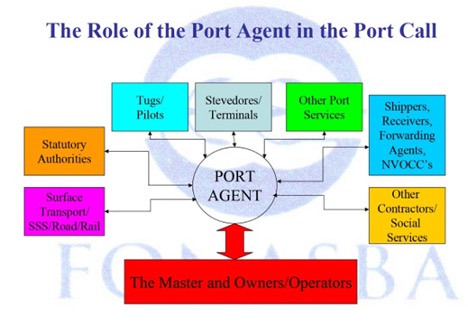
A ship agent, also called a port agent or shipping agent, represents the shipowner or charterer (the principal) during a port call. The agent books the berth, arranges pilots, tugs and services, clears the ship with the authorities and pays local costs on the principal’s behalf.
This guide covers the types of ship agent, their duties, who appoints them, how they are paid and what changes in a US port.

What Is a Ship Agent?
A ship agent is a person or company appointed to act for a shipowner, operator or charterer in a port. The agent acts in the principal’s name, at the principal’s expense and within the authority given.
The agent is the ship’s single point of contact ashore. Port authorities, customs, immigration, terminals, suppliers and the master all deal with the ship through the agent.
In practice, “ship agent”, “port agent” and “shipping agent” are used for the same role. “Shipping agent” is also used loosely for liner agents and freight forwarders, which do different jobs.
What Are the Types of Ship Agents?
There are five main types: the port agent, the liner or cargo agent, the husbanding agent, the protecting agent and the general agent. Each works for a different principal or covers a different part of the call.
| Type | Works for | Main job |
|---|---|---|
| Port agent | Owner, operator or charterer | Organises one ship’s call from arrival to departure |
| Liner (cargo) agent | A shipping line | Sells space, takes bookings, issues documents, collects freight |
| Husbanding agent | Owner, operator or a navy | Crew changes, stores, spares, repairs and cash to master, without cargo work |
| Protecting agent | The shipowner | Watches the owner’s interests when the charterer appointed the port agent |
| General agent | A principal for a whole country or region | Represents the line or owner nationally and appoints sub-agents |
The US Navy contracts husbanding service providers for warship port visits, which is the best-known use of the term. In merchant shipping, husbanding means the owner’s matters at a call where no cargo is worked.
Port Agent
The port agent organises the whole call: berth, pilotage, towage, clearance, cargo coordination and the final accounts. Before the call, the agent sends the principal a proforma disbursement account (PDA) estimating every port cost.
Liner or Cargo Agent
A liner agent works for a shipping line in the container and break-bulk trades. It publishes schedules and rates to local shippers, takes bookings, prepares booking lists and delivery orders, and collects freight.
Many liner agents also offer inland transport and customs clearance as door-to-door services. Some represent several lines, but most work for one line or are its subsidiary.
What Does a Port Agent Do During a Port Call?
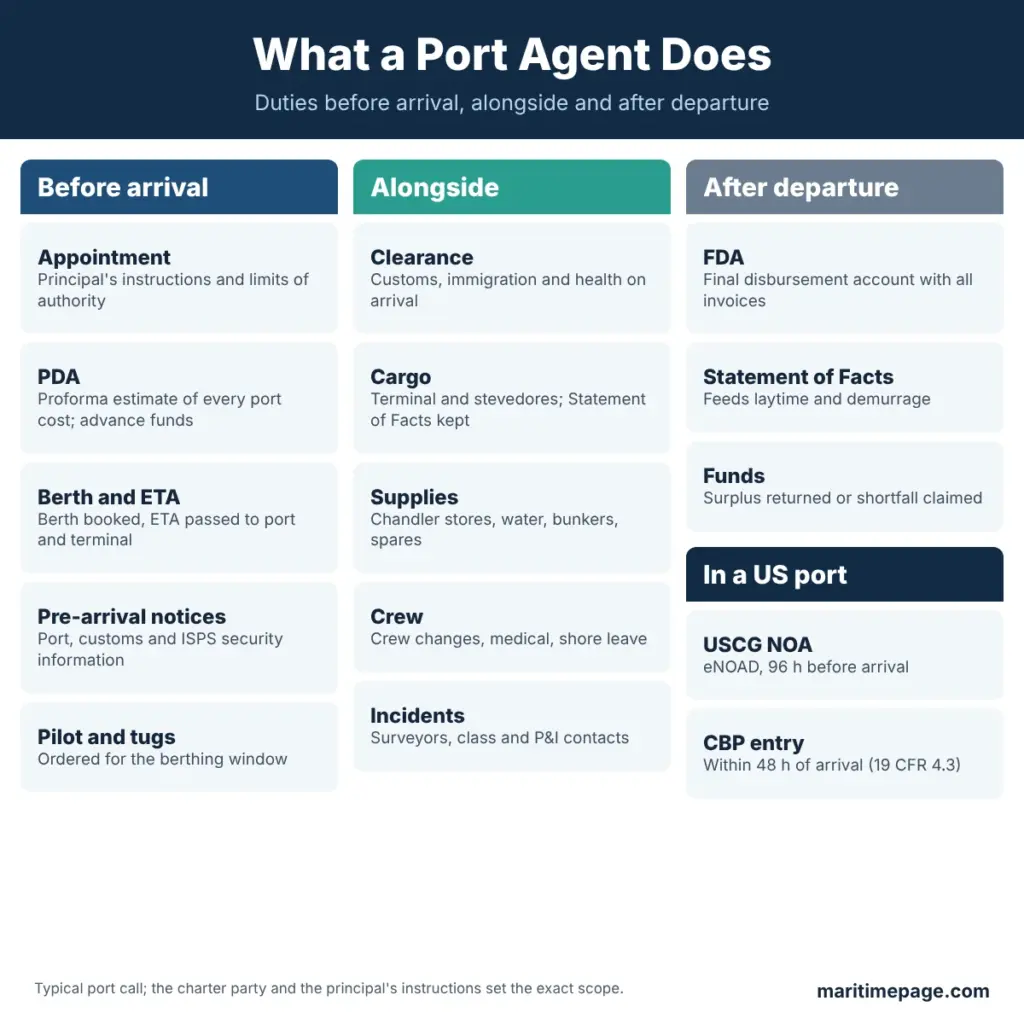
A port agent’s duties run in three stages: before arrival, alongside and after departure. They cover the berth and notices, clearance, cargo, crew and supplies, then the final accounts.
Before Arrival
- Receive the appointment and the principal’s instructions, and send the PDA.
- Book the berth and pass the ship’s ETA to the port, terminal and authorities; many agents follow the approach on AIS tracking platforms.
- File pre-arrival notices, including the security information required under the ISPS Code.
- Order the pilot and tugs and confirm the berthing window.
Rules differ by port. In Ghana, for example, the agent books Tema berths online and gives 72 hours’ notice; see the Tema Port arrival rules.
Alongside
- Clear the ship with customs, immigration and health on arrival, and coordinate berthing with the pilot and terminal.
- Coordinate cargo work with the terminal and stevedores, and keep the Statement of Facts.
- Arrange stores, provisions and spares through a ship chandler, plus fresh water and bunkers if ordered.
- Handle crew changes, medical visits and shore leave, which the MLC 2006 protects for seafarers.
- Arrange surveyors, class and P&I contacts if there is damage, and survey attendance when needed.
After Departure
- Collect every supplier invoice and send the final disbursement account (FDA) to the principal.
- Send the Statement of Facts, which feeds laytime and demurrage calculations.
- Return any surplus funds or claim any shortfall against the advance the principal sent.

Who Appoints the Port Agent: Owner or Charterer?
The charter party decides. Under a time charter, the charterer usually appoints and pays the port agent. Under a voyage charter, the owner pays, but the charter often lets the charterer nominate the agent.
- Owner’s agent: appointed and paid by the owner; acts only for the owner.
- Charterer’s agent: appointed and paid by the charterer, typically under a time charter.
- Charterer-nominated agent at owner’s expense: common in voyage charters; the owner pays, but the charterer chose the agent.
- Protecting agent: a second agent the owner appoints, at its own cost, to watch its interests when the charterer controls the port agent.
Can One Agent Act for Both Owner and Charterer?
Yes, if both principals agree. Dual agency is common, but it puts the agent in conflict if the owner and charterer disagree, for example over unpaid port bills.
An agent who takes on both roles must disclose it to both principals at the start. A court is unlikely to protect an agent with an undisclosed conflict of interest.
How Are Ship Agents Paid?
Port agents usually charge a flat agency fee per call, agreed in advance and shown on the PDA. Liner agents are usually paid commission on the freight they book, and husbanding work is often charged per service.
Port costs themselves, such as port dues, pilotage and towage, are not the agent’s income: the agent pays them from the principal’s advance. See port costs, dues and fees for what those charges are.
What Authority Does a Ship Agent Have?
The principal sets the services required and the limits of the agent’s authority at appointment. Within those limits, the agent can sign contracts, order services and spend funds that bind the principal.
To avoid personal liability, the agent signs as “as agents only” for the named principal. An agent who exceeds its authority, or fails to name the principal, can be held liable itself.
What Does a Ship Agent Do in a US Port?
In a US port, the agent’s main extra tasks are the US Coast Guard Notice of Arrival and CBP vessel entry and clearance. Both must be filed on time, or the ship can be delayed or fined.
- Notice of Arrival (NOA): filed through the Coast Guard’s eNOAD system at least 96 hours before arrival. Shorter voyages file before departure and at least 24 hours ahead; the NOA lists crew, passengers and cargo.
- CBP entry: a ship arriving from a foreign port must make formal entry within 48 hours of arrival (19 CFR 4.3). The agent can deliver the documents signed by the master to CBP.
- Port security: US port facilities operate under the Maritime Transportation Security Act (MTSA), which applies the ISPS Code in US law.
US agents are represented nationally by the Association of Ship Brokers and Agents (ASBA). Internationally, national associations belong to FONASBA, founded in 1969, which runs a Quality Standard for agents.
What Does a Ship Agent’s Job Involve Day to Day?
A ship agent’s day is coordination with the master, principal, port and suppliers, plus boarding ships and keeping documents and accounts in order. Ships arrive at all hours, so agents work on call.
- Skills: port regulations, charter party terms, customs procedures, accounting and clear communication.
- Qualifications: no single licence applies everywhere. Many agents train through national associations or take Institute of Chartered Shipbrokers (ICS) qualifications.
- Pressure points: late ETAs, port congestion, crew emergencies and principals slow to send funds.
Related Topics
- Port State Control inspections and MOUs
- Ship detention: procedure and common reasons
- What does a longshoreman do
Frequently Asked Questions
What is a ship agent?
A ship agent represents the shipowner or charterer during a port call. The agent books the berth, arranges pilots, tugs and services, clears the ship with the authorities and pays local costs on the principal’s behalf.
What is the difference between a port agent and a shipping agent?
A port agent handles one ship’s call in one port. “Shipping agent” often means the same, but it also covers liner agents selling cargo space and is sometimes confused with freight forwarders.
Who appoints the port agent?
The charter party decides. Under a time charter the charterer usually appoints and pays the agent. Under a voyage charter the owner pays, but the charterer often nominates the agent.
What is a protecting agent?
A protecting agent is a second agent the shipowner appoints at its own cost when the charterer controls the port agent. It watches the owner’s interests, such as crew, repairs and any disputes.
What is a husbanding agent?
A husbanding agent handles a ship’s needs at a call with no cargo work: crew changes, stores, spares, repairs and cash to master. The US Navy also contracts husbanding service providers for warship port visits.
How much does a ship agent charge?
Port agents usually charge a flat agency fee per call, agreed in advance and shown on the proforma disbursement account. Port dues, pilotage and towage are paid from the principal’s advance and are not the agent’s fee.
What documents does a ship agent handle?
The proforma and final disbursement accounts, pre-arrival notices, crew and cargo declarations, customs entry and clearance, the Statement of Facts and supplier invoices. Liner agents also issue booking lists and delivery orders.
Does a ship agent need a licence?
It depends on the country. Some countries license ship agents, while others leave it to national associations. Internationally, FONASBA’s Quality Standard identifies agents that meet its financial and service criteria.

- Great Lakes Maritime Academy: Programs, Cost and Admission – October 14, 2026
- Bunker Delivery Note (BDN): Contents, MARPOL Rules and Checks – October 11, 2026
- Oil Record Book: Part I and Part II Entries, Rules and PSC Checks – October 11, 2026