What Is the Shafting System on a Ship?
The shafting system connects the ship’s main engine and propeller, transferring torque that turns fuel energy into thrust that moves the vessel through water. It forms a vital part of a ship’s propulsion line and directly affects efficiency, vibration, and reliability.
A typical system consists of several rotating shafts — the thrust shaft, intermediate shaft, and tail shaft — supported by bearings and connected through couplings. Together, they ensure smooth power transmission and precise alignment between the crankshaft and the propeller hub.
Because the shafting system connects directly to the ship’s main engine, which generates the torque required to rotate the propeller, any imbalance or misalignment can cause energy loss, excessive vibration, or bearing wear. In simple terms, it’s the mechanical backbone of the ship’s propulsion system.
In practical terms, the shafting system transmits torque from the main engine to the propeller, while the shaft itself connects the crankshaft and the propeller hub.
Class societies such as ABS and DNV include detailed requirements for shafting design, alignment, and testing to maintain propulsion safety and performance.
For a deeper look at how torque is created and transferred to the propulsion line, read our guide to the ship’s main engine
Components of the Shafting System
The shafting system is made up of several interconnected parts that work together to transmit power efficiently and safely. Each component — from the thrust block to the tail shaft — plays a precise role in transmitting torque, absorbing thrust, and maintaining alignment.
Thrust Shaft and Thrust Block
The thrust shaft connects the main engine to the thrust block, which transfers the propeller’s axial thrust to the ship’s hull structure. This prevents the force generated by the propeller from overloading the engine bearings.
According to ABS Rules for Building and Classing Marine Vessels (Pt 4 Ch 3 Sec 2), the thrust block must be precisely aligned and supported to maintain continuous contact with its bearing surfaces.
In essence, the thrust block transmits axial load to the hull structure, ensuring stability and preventing vibration.
For a detailed view of thrust blocks, bearing types, and their construction, see our article on the ship’s propeller shaft and thrust block.
Intermediate Shaft
The intermediate shaft connects the thrust shaft and the tail shaft, maintaining power continuity along the propulsion line. It is supported by one or more bearings that keep it aligned and reduce bending stress.
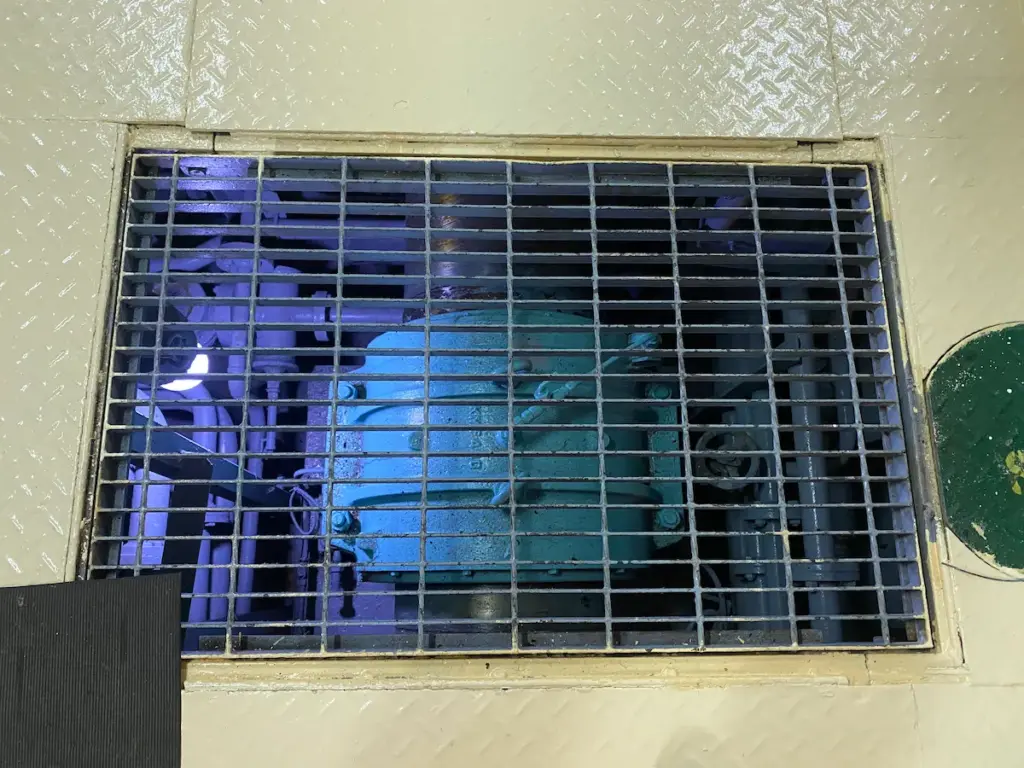
These shafts are usually made of forged steel and equipped with couplings that allow easy assembly and maintenance. Proper bearing spacing is critical to avoid misalignment and vibration.
In some modern vessels, hollow or composite shafts are used to reduce weight and improve vibration damping.
Tail Shaft and Stern Tube
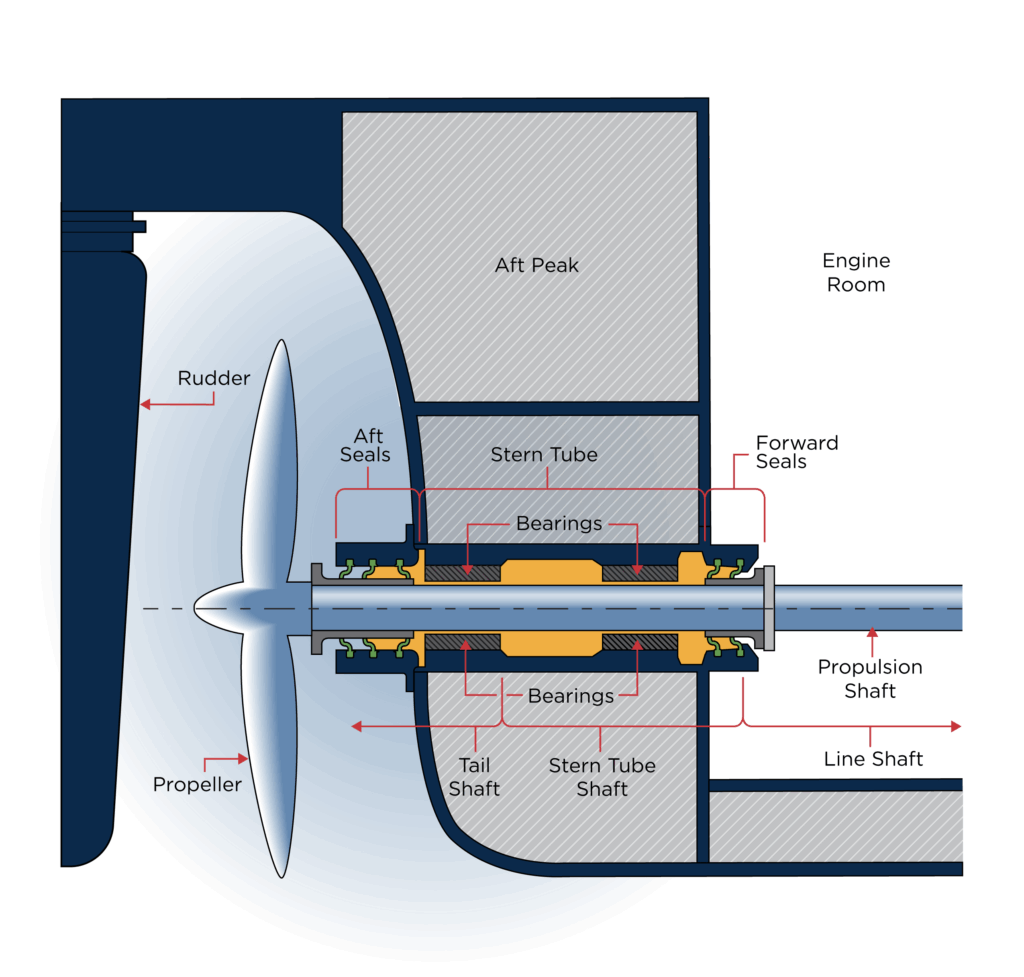
The tail shaft passes through the ship’s stern tube and connects directly to the propeller. The stern tube houses seals and bearings that protect against seawater ingress and maintain lubrication.
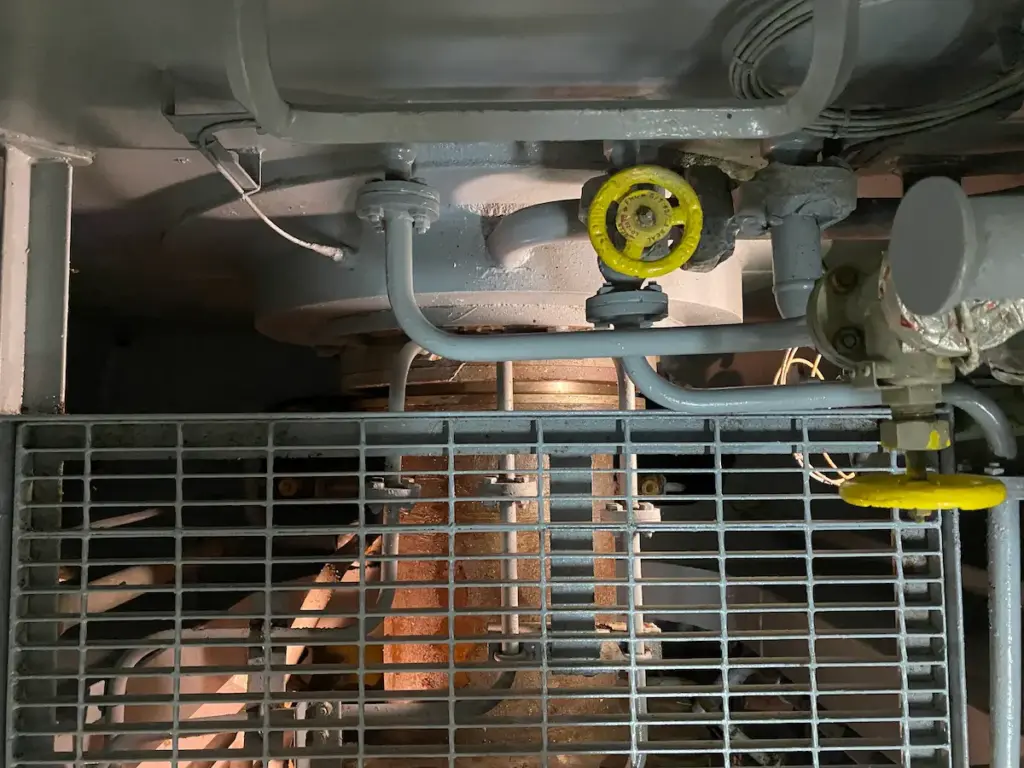
In practical terms, the stern tube seal prevents seawater ingress, protecting the shaft bearings and minimizing corrosion.
Stern tube bearings are lubricated using either oil-lubricated or water-lubricated systems, described in detail in our guide to ship lubrication systems.
Shaft Bearings
Shaft bearings support the rotating shafts and ensure smooth torque transmission. They reduce friction, absorb load, and maintain alignment.
Common bearing materials include white metal, composite liners, or oil-lubricated shells. Sensors continuously monitor temperature, oil pressure, and vibration to detect potential faults early.
Shaft Alignment and Vibration
Correct shaft alignment ensures efficient power transmission while minimizing vibration and bearing wear. Even a small misalignment can increase stress on bearings, couplings, and the engine crankshaft, leading to premature failure or reduced propulsion efficiency.
Alignment means positioning all shafts — thrust, intermediate, and tail — so that they form a continuous straight line under working conditions. Engineers must account for hull deflection, temperature change, and load distribution.
This process ensures that torque transfer remains smooth even under hull flexing and varying load conditions.
Static and Dynamic Alignment
- Static alignment (cold alignment): Measured when the ship is idle, typically during installation or dry dock.
- Dynamic alignment (hot alignment): Accounts for temperature and hull deformation when the vessel operates at sea.
Modern laser-based measurement systems achieve micron-level precision. These tools reduce bearing loads and extend machinery life.
To understand how engine torque variations influence vibration behavior, refer to our detailed guide on the ship’s main engine.
Class Society Requirements
Classification societies define the acceptable limits for alignment, bearing load, and inspection intervals.
For example, ABS Marine Vessel Rules (Pt 4 Ch 3 Sec 2 “Propulsion Shafting”) specifies:
- Maximum allowable misalignment at coupling flanges
- Bearing slope limits and contact area percentages
- Procedures for alignment verification during sea trials
DNV Rules (Pt 4 Ch 4) require analysis of bending moments and deflection curves to ensure even load distribution across bearings.
For broader context on certification and propulsion safety standards, see class society rules for marine machinery.
Common Shafting Failures and Their Causes
Because the shafting system runs continuously under heavy load, understanding common failure modes helps prevent costly downtime. Regular monitoring and early detection can prevent these typical shafting issues.
The shafting system operates under constant torsional, bending, and axial loads — often for thousands of hours between dockings. Over time, wear, corrosion, and fatigue can lead to failures that threaten propulsion reliability.
1. Misalignment and Bearing Wear
Improper alignment between the main engine, intermediate shaft, and propeller shaft leads to uneven bearing loads and accelerated wear.
Symptoms include increased vibration, localized heating, and high bearing oil temperatures.
Class rules (ABS MVR Pt 4 Ch 3 Sec 2/7) require verification after installation or overhaul.
2. Corrosion and Pitting
The stern tube area is highly exposed to seawater. Pitting corrosion weakens the shaft surface and increases the risk of cracking. Protective sleeves and proper seals are vital.
3. Fatigue Cracks and Fractures
Cyclic loading causes fatigue cracks, especially at fillets or bolt holes.
Non-destructive testing (ultrasonic and magnetic particle) is required during major surveys.
Learn how torque fluctuations contribute to shaft stress in our ship main engine article.
4. Thrust Block and Bearing Failures
If the thrust block fails to transmit axial loads evenly, excessive end thrust can damage bearings and couplings. Regular monitoring of bearing oil temperature and pressure is essential for early detection.
5. Torsional Vibration Damage
Improperly tuned dampers can lead to resonances at certain RPMs, causing shaft or coupling fractures.
6. Stern Tube Seal Failures
Seal wear or contamination can allow seawater ingress, leading to corrosion and bearing seizure.
Air guard sealing or water-lubricated systems reduce these risks.
Maintenance and Survey Requirements for Shafting Systems
The shafting system works under continuous stress and must remain precisely aligned for efficient propulsion and safety.
Regular maintenance and surveys confirm that components perform within design tolerances and that no hidden defects compromise reliability.
Routine Maintenance
The shafting system operates continuously under stress, so regular maintenance ensures long-term propulsion efficiency and safety.
Key maintenance tasks include:
- Alignment checks:
Engineers use laser alignment systems or dial gauges to verify that shaft deflection and bearing loads stay within approved class limits. - Bearing inspection:
Bearings are examined for wear, uneven loading, and temperature changes. Any deviation can indicate misalignment or lubrication issues. - Lubrication system monitoring:
Oil systems are inspected for pressure, flow rate, contamination, and metal particle content — all indicators of bearing condition. - Stern tube seal inspection:
Seals are checked for leaks or wear to prevent seawater ingress and oil contamination. - Vibration and temperature trending:
Continuous monitoring helps identify imbalance or bearing degradation before failures occur. These parameters form the core of condition-based maintenance programs.
Proper lubrication prevents metal-to-metal contact and reduces heat within the bearings — a critical factor in extending shaft and bearing life.
Survey and Class Requirements
Classification societies such as ABS, DNV, and Lloyd’s Register define inspection intervals and acceptance criteria.
- During the five-year special survey, the tail shaft is usually withdrawn for inspection, dimensional checks, and non-destructive testing (NDT).
- Ships with certified oil analysis and vibration monitoring systems may qualify for extended intervals under class approval.
- Surveyors review alignment data, oil reports, and maintenance logs to verify mechanical integrity and compliance with certification requirements.
Maintaining up-to-date records ensures both class certificate renewal and insurance validity.
Predictive Maintenance and Documentation
Modern vessels integrate continuous condition monitoring systems that record vibration, temperature, and oil quality.
Predictive analytics detect early wear patterns — see our guide to marine condition monitoring systems
Key Takeaways on Shafting Systems in Ships
- The shafting system transmits torque from the ship’s main engine to the propeller, converting mechanical energy into thrust.
- Key components include the thrust block, intermediate shaft, tail shaft, stern tube, and bearings — all essential for alignment and vibration control.
- Proper lubrication and alignment reduce bearing load and prevent wear.
- ABS, DNV, and Lloyd’s Register define strict design, material, and inspection standards.
- Condition-based monitoring enhances reliability and may extend survey intervals with class approval.
- Accurate documentation of inspections, oil analysis, and alignment checks is required for maintaining class certification.

- What Is SOLAS? Chapter-by-Chapter Overview and Enforcement – September 9, 2026
- What Is MARPOL? Guide to All Six Annexes and Enforcement – September 9, 2026
- 14 Marine Surveyors in Ohio – June 14, 2026