This page ranks the world’s largest LNG carrier operators by operated fleet size as of April 2026. Ownership and operation frequently differ in LNG shipping — the rankings here reflect operational control of vessels, not legal title, which is why some large shipowners like Nakilat rank lower than fleet managers who operate vessels on long-term charters.
What Is the Global LNG Carrier Fleet Size in 2026?
The global LNG carrier fleet exceeded 700 vessels by the end of 2021 and has grown significantly since. The post-2022 European energy crisis — driven by the reduction of Russian pipeline gas following the invasion of Ukraine — accelerated both LNG trade volumes and newbuilding orders at a pace not seen since the mid-2000s Qatar fleet expansion. LNG trade volumes reached 488 billion cubic metres in 2020; European import demand has pushed that figure substantially higher since 2022.
The LNG carrier order book entering 2026 remains one of the largest in shipbuilding history. Over 288 newbuildings were ordered for delivery from 2023 onwards, with delivery peaks in 2025 and 2026. Total investment in the LNG fleet order book is estimated at $72–$92 billion, with individual vessel construction costs ranging from $250–$320 million depending on capacity and propulsion specification.
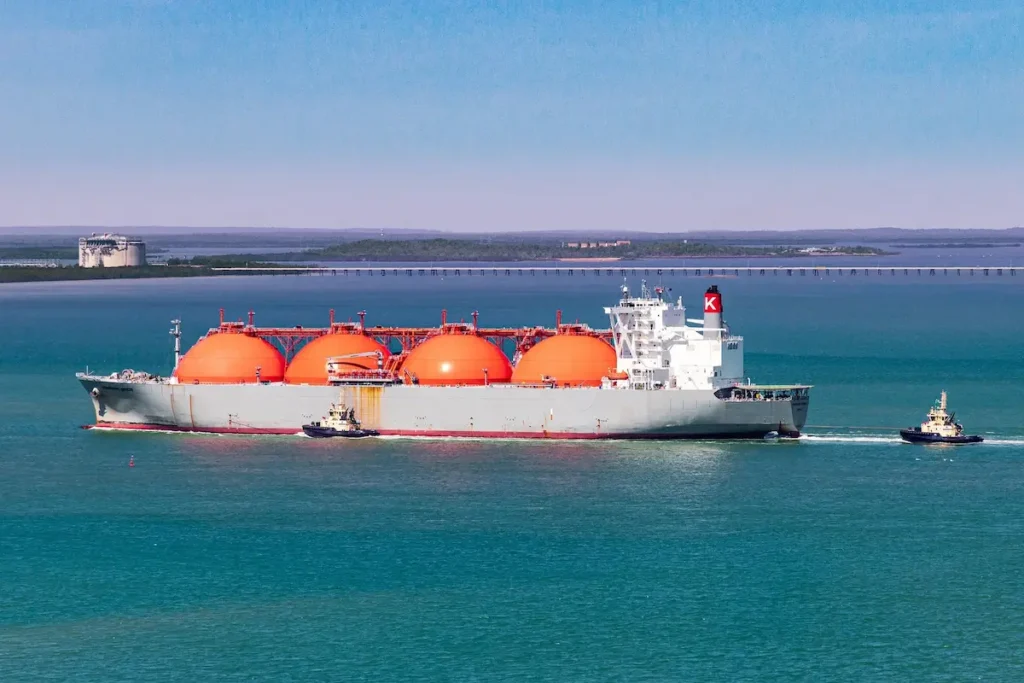
World LNG carriers range from small-scale coastal units of under 30,000 cubic metres to the Q-Max class operating at 266,000 cubic metres. The largest floating storage units reach 354,000 cubic metres — the Saam FSU and Koryak FSU, both built by Daewoo Shipbuilding & Marine Engineering. Understanding LNG carrier types and their size classifications is essential context before comparing operators.
Who Are the Top LNG Carrier Operators by Fleet Size?
The rankings below are based on operated fleet data collected across 715 LNG tankers and FSRUs. Fleet counts reflect primary operators — vessels where a company directs commercial and technical operations — and include long-term chartered tonnage alongside owned vessels. Joint venture arrangements make precise attribution difficult in some cases; where uncertainty exists, this is noted per entry.
1. MOL LNG Transport Ltd.
MOL LNG Transport Ltd. is a subsidiary of Mitsui O.S.K. Lines (MOL), one of Japan’s largest diversified shipping companies. MOL LNG Transport specialises exclusively in LNG carrier operations and has extended its lead at the top of the operator rankings significantly since 2023.

The company operated 107 LNG carriers as of 31 December 2025, per MOL’s published Business Performance Report — a figure that more than doubled from 51 vessels in January 2023 and reflects aggressive fleet growth through newbuilding deliveries and expanded long-term charter intake. Total fleet capacity exceeds 16 million cubic metres. The largest vessel in the fleet is the MOL FSRU Challenger at 263,000 cubic metres, currently operating in Singapore.
MOL’s growth reflects its strategic positioning as the preferred fleet management and operational partner for new LNG projects across Australia, the Middle East, and Southeast Asia. Newbuilding deliveries through 2024–2025 have been driven primarily by long-term charter demand from European import terminals responding to the post-2022 demand surge.
2. Shell International Trading and Shipping Co. Ltd.
Shell International Trading and Shipping Co. Ltd. (STASCO) manages the LNG carrier fleet of Shell, one of the world’s largest integrated LNG companies operating across the full value chain from upstream production through liquefaction, shipping, regasification, and downstream sales.
Shell operated 65 LNG tankers as of early 2026 — up from 25 vessels in early 2023 — making it the second-largest operator by fleet count and the most dramatic riser in the rankings over this period.
The expansion reflects both the post-2022 European LNG demand surge and Shell’s significantly increased intake of chartered tonnage, particularly from Nakilat under long-term agreements tied to Qatari LNG export growth. A significant portion of the operated fleet is owned by Qatar Gas Transport Company (Nakilat) and chartered to Shell — a structure that reflects Qatar’s strategy of retaining vessel ownership while contracting operations to major energy traders.
The largest vessel in Shell’s fleet is the Prelude FLNG — a floating liquefied natural gas production unit, not an FSRU. This distinction matters operationally: an FLNG liquefies gas offshore and loads LNG carriers for export; an FSRU imports LNG and regasifies it for onshore distribution.
Prelude has a displacement of approximately 600,000 tonnes and is the world’s largest floating offshore structure. The largest conventional LNG carrier in Shell’s operated fleet is the Nakilat-owned Al Mayeda at 261,988 cubic metres. The IGC Code governs construction and equipment requirements for all vessels in this fleet regardless of ownership structure.
3. NYK LNG Shipmanagement Ltd.
NYK LNG Shipmanagement Ltd. is a subsidiary of Nippon Yusen Kabushiki Kaisha (NYK), operating one of the world’s largest LNG carrier fleets under long-term charters to major LNG producers and utilities.

The company operated 60 LNG tankers as of January 2026 — 33 directly managed and 27 through indirect participation in joint ventures and project companies. The largest vessel in the fleet is the Al Thumama at 211,910 cubic metres capacity and 104,700 DWT, operating under long-term charter to Qatar Gas. NYK LNG Shipmanagement has deep structural relationships with Qatari LNG export projects and Japanese utility importers, giving it stable, long-duration charter coverage across the fleet.
NYK’s LNG bunkering vessel is a strategically significant addition to the fleet, positioning the company in the growing ship-to-ship LNG bunkering market as dual-fuel engine technology proliferates across the commercial fleet. Demand for LNG bunkering infrastructure has grown in step with dual-fuel newbuilding deliveries across container ship, bulk carrier, and tanker sectors.
4. K Line (Kawasaki Kisen Kaisha Ltd.)
K Line, formally Kawasaki Kisen Kaisha Ltd., is one of Japan’s major diversified shipping companies, founded in 1919. Its LNG carrier division has expanded dramatically since 2023, transforming K Line from a notable mid-tier operator into the fourth-largest LNG fleet operator in the world by vessel count.

The company operated 50 LNG carriers and 1 LNG bunkering tanker as of April 2026, with total deadweight exceeding 4 million tonnes — a fleet count that grew from 13 LNG carriers in early 2023. This growth reflects a combination of newbuilding deliveries under long-term charters and expanded operational participation in LNG project vessels tied to Australian, Middle Eastern, and North American export projects. K Line’s LNG carrier operations are closely integrated with Japanese utility import contracts and the long-term supply agreements that underpin Japan’s LNG import dependency.
K Line’s LNG bunkering vessel mirrors the strategy seen at NYK — positioning the company for the emerging ship-to-ship bunkering market as boil-off gas management requirements and dual-fuel vessel numbers increase across the global fleet.
5. Seapeak Maritime (Glasgow) Ltd.
Seapeak Maritime is the renamed successor to Teekay LNG Partners L.P., following its acquisition by Stonepeak Infrastructure Partners in 2022. The transition from a publicly traded MLP to private equity ownership marked a structural shift toward infrastructure-style investment — stable long-term contracted cash flows rather than the distribution-focused model of the Teekay LNG partnership era.
The company operates approximately 45–50 LNG carriers based on the current fleet list, alongside LPG, ethane, and multi-gas vessels. The LNG segment is centred on modern tonnage in the 160,000–174,000 cubic metre range, with a mix of legacy steam vessels from the early fleet and a growing cohort of X-DF and ME-GI newbuildings delivering through 2027–2028. Most vessels have been rebranded under the Seapeak name, though some joint venture and project-linked ships retain legacy naming structures reflecting partial ownership arrangements.
Seapeak’s LNG carriers are primarily employed on long-term charters to major energy companies with exposure to both Atlantic and Pacific basin trades. Under Stonepeak ownership, the company has continued fleet renewal, maintained newbuilding commitments, and explored potential expansion into FSRU and adjacent gas infrastructure assets consistent with the broader infrastructure investment thesis.
6. Maran Gas Maritime Inc.
Maran Gas Maritime Inc. is a subsidiary of the Angelicoussis Shipping Group, one of Greece’s largest independent shipowning conglomerates alongside Maran Tankers and Maran Dry Management. Maran Gas focuses on long-term charter employment with major LNG producers rather than spot market exposure — a conservative commercial strategy that provides stable fleet utilisation across market cycles.

As of 2026 the company operates a fleet in the mid-40s of LNG carriers, growing from approximately 40 vessels in 2023 through continued newbuilding deliveries. The fleet is largely standardised around modern vessels of 170,000–174,000 cubic metres, with a smaller number of older units. Flagship vessels John A. Angelicoussis and Maran Gas Amorgos represent the upper end of the fleet’s capacity range. All vessels sail under the Greek flag.
With an average fleet age of approximately 9–11 years and continued newbuilding deliveries, Maran Gas maintains a comparatively young and commercially competitive fleet. Its consistent investment in large-capacity, efficient tonnage positions it as a core long-term operator aligned with growing LNG demand across European and Asian import markets.
7. Knutsen OAS Shipping AS
Knutsen OAS Shipping AS is a Norwegian independent owner and operator headquartered in Haugesund, founded in 1897. Its LNG carrier fleet has grown from 17 vessels in early 2023 to 37 in April 2026 — the largest percentage increase of any operator in this ranking — driven by newbuilding deliveries under long-term charters to Shell, Repsol, Naturgy, PGNiG, Equinor, Total, and Petrobras, among others.
The fleet of 37 LNG carriers operates across Atlantic and Pacific basin trade routes, primarily on long-term charters to investment-grade counterparties. Knutsen’s commercial model — owner-operator with diversified customer relationships across major LNG traders and utilities — has proven particularly well-suited to the post-2022 market environment where European LNG importers sought to underpin long-term supply security with long-term shipping commitments. Knutsen’s flexibility across LNG, shuttle tanker, and product carrier operations also gives it commercial resilience that pure-play LNG operators lack.
Knutsen’s rise from notable operator to seventh-largest in the rankings over a three-year period reflects the scale of fleet investment triggered by the European energy transition. The company’s combination of long-term customer relationships and continued newbuilding programme positions it for further fleet growth through the remainder of the decade.
8. MISC Berhad
MISC Berhad, formally the Malaysia International Shipping Corporation, is a subsidiary of Petronas — Malaysia’s national oil and gas company — and one of Asia’s largest integrated maritime groups. The company’s LNG fleet serves the strategic interests of its parent across the full Petronas LNG value chain.
The company operated 36 LNG carriers and 1 LNG bunkering tanker as of early 2026. The largest vessels in the fleet are the Seri Damai and Seri Daya at 174,000 cubic metres capacity each. MISC’s LNG fleet is structurally tied to Petronas upstream production and the MLNG liquefaction complex at Bintulu, Sarawak — one of the world’s largest LNG export facilities by volume.
MISC and Knutsen tie on fleet count at 37 vessels as of April 2026. MISC ranks eighth on the basis of fleet average capacity — the 174,000 cubic metre standardised Seri-class vessels give a higher aggregate cubic metre total per vessel than Knutsen’s more mixed fleet. MISC represents a vertically integrated model where the shipping subsidiary directly serves the production and trading interests of its national oil company parent — a structural arrangement that differs fundamentally from independent commercial operators.
9. BW Fleet Management AS
BW Fleet Management AS is a Norwegian subsidiary of BW Group Limited, one of the world’s largest diversified maritime groups with historical roots in the Bergesen shipping dynasty. BW Group operates across LNG, LPG, product tankers, dry bulk, and offshore wind — its LNG carrier fleet should not be aggregated with its much larger LPG and product tanker operations when assessing LNG fleet rankings.
The LNG carrier fleet managed by BW Fleet Management consists of approximately 26 LNG vessels with total capacity exceeding 4.3 million cubic metres, alongside 4 FSRUs. Two further newbuildings of 174,000 cubic metres each are scheduled for delivery in 2028, with BW Borealis and BW Nivalis already delivered in 2026. BW Fleet Management has invested in bio-LNG and alternative fuel compatibility across the fleet, consistent with BW Group’s stated decarbonisation targets and obligations under the CII rating scheme that applies to vessels above 5,000 GT.
10. GasLog Ltd.
GasLog Ltd. was a Monaco-based LNG carrier owner and operator founded in 2003 and formerly listed on the New York Stock Exchange under the ticker GLOG. The company was taken private by BlackRock in 2021 and is no longer publicly traded — this reflects the broader trend of infrastructure capital targeting LNG shipping for its long-term contracted cash flow characteristics, consistent with the Stonepeak acquisition of Teekay LNG Partners in the same period.

The company’s LNG fleet consists of approximately 24–26 vessels based on the current list. The fleet spans three generations of LNG carrier technology: early steam and TFDE vessels in the 145,000–155,000 cubic metre range from 2007–2015 builds; a large core of modern X-DF vessels at 174,000–180,000 cubic metres delivered from 2018 onward; and a smaller number of latest-generation ME-GI newbuildings delivering through 2024–2025. Most vessels carry the GasLog prefix and can be located via MarineTraffic or VesselFinder. GasLog vessels are primarily chartered to Shell and other major LNG traders under long-term agreements.
GasLog’s drop from sixth to tenth in the rankings reflects a modest fleet reduction under BlackRock ownership rather than any commercial deterioration — the company’s charter coverage and counterparty quality remain among the strongest in the sector. Under private equity ownership, the focus is on return on invested capital from existing contracted assets rather than fleet growth for its own sake.
What Are the Notable LNG Operators Outside the Top 10?
Several operators merit attention for their fleet size, strategic positioning, or market niche in 2026.
Nakilat Shipping (Qatar) Ltd. is the world’s largest LNG shipowner by vessel count with a fleet exceeding 69 vessels — including conventional carriers at 145,000–170,000 cubic metres, Q-Flex class at 210,000–217,000 cubic metres, and Q-Max class at 263,000–266,000 cubic metres, the largest LNG carriers in commercial operation.
Nakilat ranks outside the top 10 operators because its structure deliberately separates ownership from commercial operation — of those 69 owned vessels, approximately 19 are directly operated by Nakilat with the remainder chartered to Shell, Total, and ExxonMobil. Nakilat also provides technical ship management services to other LNG shipowners, creating a dual revenue stream from vessel ownership and management fees. The Q-Max class is too large to transit the Panama Canal and was designed specifically for Qatar-to-Asia and Qatar-to-Europe trade routes.
TMS Cardiff Gas Ltd. (United Kingdom) operated 16 LNG tankers in early 2026, all under the Maltese flag, with a notably young average fleet age of approximately 6 years, driven by aggressive newbuilding investment in 2020–2021.
Cool Company Management AS (Norway) operates 15 LNG carriers, including the LNG Croatia, an FSRU serving the Krk Island regasification terminal in Croatia — a terminal that became strategically critical for Central European gas supply security after 2022.
Dynagas Ltd. has contracted sharply from 18 LNG carriers in 2023 to 6 vessels in April 2026. Dynagas specialises in ice-class LNG carriers serving Arctic trade routes tied to Russian LNG export projects. The reduction reflects the commercial impact of sanctions and project disruptions following 2022 — vessels previously employed on Russian project charters have been redelivered or repositioned, significantly reducing the operated fleet. The company remains listed on the New York Stock Exchange under DLNG. Its remaining fleet includes the Lena River, an Ice Class 1A FS fully winterised vessel at 155,000 cubic metres.
What LNG Carrier Newbuildings Are Expected in 2026?
The LNG carrier order book entering 2026 remains exceptionally large by historical standards. Over 101 LNG carriers were scheduled for delivery in 2025, with significant numbers continuing into 2026. Most are 174,000 cubic metre two-tank vessels with two-stroke dual-fuel main engines — the current industry standard for newbuildings.
Construction is concentrated at four South Korean yards: Hyundai Heavy Industries, Samsung Heavy Industries, Daewoo Shipbuilding & Marine Engineering, and Hanwha Ocean (formerly DSME after the Hanwha acquisition). China’s Hudong-Zhonghua shipyard has taken an increasing share of the order book, particularly for Qatari and Chinese operator orders.
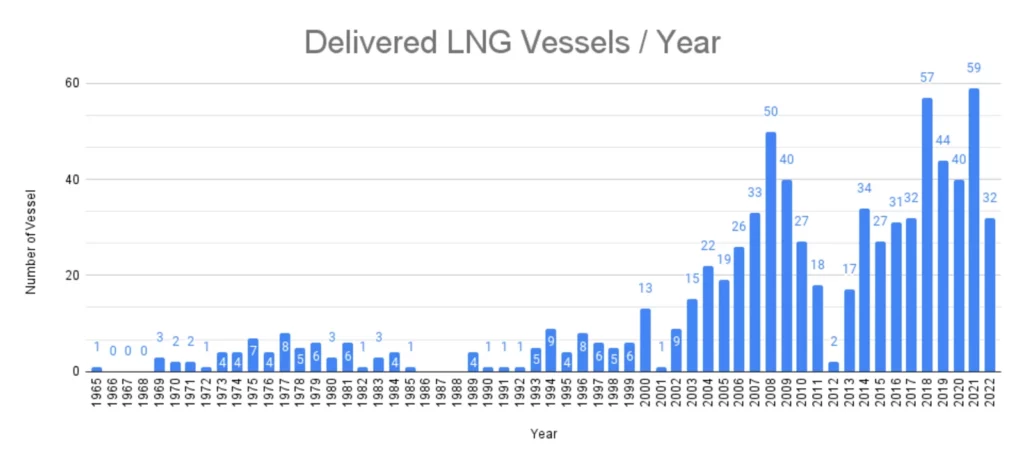
The economics of LNG carrier construction have changed significantly since 2021. Orderbook backlogs have extended delivery windows to 4–5 years and pushed construction prices above $320 million per vessel. Operators placing orders in 2026 should expect delivery no earlier than 2029–2030 in most cases.
Frequently Asked Questions
Who is the largest LNG carrier operator in the world?
MOL LNG Transport Ltd. is the largest LNG carrier operator by operated fleet size, with 107 vessels under operational control as of December 2025 — more than double its fleet count of 51 vessels in January 2023. MOL holds this position through a combination of owned vessels and long-term chartered tonnage serving LNG producers across Australia, the Middle East, and Southeast Asia.
What is the difference between an LNG carrier owner and an LNG carrier operator?
An LNG carrier owner holds legal title to the vessel; an operator controls its commercial and technical management. In LNG shipping, these roles are frequently separated — Nakilat owns over 60 vessels but commercially operates only a fraction, with the majority chartered to Shell, Total, and ExxonMobil. Fleet operator rankings reflect who directs the vessel’s employment, not who owns it.
How large is the world LNG carrier fleet in 2026?
The global LNG carrier fleet exceeded 700 vessels by the end of 2021 and has grown substantially since. The post-2022 European LNG demand surge drove the largest single ordering wave since the Qatar fleet expansion of the mid-2000s, with over 288 newbuildings ordered for delivery from 2023 onwards.
What is the largest LNG carrier ever built?
The Q-Max class, built for Nakilat and Qatar Gas, are the largest LNG carriers in commercial operation at 263,000–266,000 cubic metres capacity. The largest floating LNG structure is Shell’s Prelude FLNG at approximately 600,000 tonnes displacement, though this is a production unit rather than a transport carrier.
What regulations govern LNG carrier construction and operation?
LNG carriers are governed by the IGC Code — the International Code for the Construction and Equipment of Ships Carrying Liquefied Gases in Bulk — which is incorporated into SOLAS Chapter VII. The IGC Code sets requirements for cargo containment systems, instrumentation, fire protection, and crew safety. The IGC Code and its application to gas carriers is the primary regulatory references for LNG and LPG carrier design and operation. Boil-off gas management, a key operational challenge on LNG carriers, is covered under BOG management on LNG carriers.
What is an FSRU and how does it differ from an LNG carrier?
A Floating Storage and Regasification Unit (FSRU) receives LNG from carriers, stores it in cryogenic tanks, and regasifies it for delivery to onshore pipeline networks. An LNG carrier transports LNG between a liquefaction terminal and either an import terminal or an FSRU. FSRUs can be purpose-built or converted from existing LNG carriers — conversion is faster and cheaper than building a new import terminal, which drove FSRU demand significantly in Europe after 2022.

- VLCC Meaning: Very Large Crude Carrier Specs, Owners, Rates – September 21, 2026
- What Is SOLAS? Chapter-by-Chapter Overview and Enforcement – September 9, 2026
- What Is MARPOL? Guide to All Six Annexes and Enforcement – September 9, 2026