No, the United States as a country is not “under maritime law”. The US has a body of maritime law, also called admiralty law. It applies only to maritime matters: ships, cargo, seafarers and accidents on navigable waters.
Everything else, from contracts on land to criminal cases and taxes, falls under ordinary federal and state law. Federal courts hear admiralty cases under Article III of the Constitution and apply admiralty rules only to cases with a real link to shipping.
Is America Under Maritime Law?
America is not governed by maritime law. Admiralty law is one specialist branch of US law, like tax or bankruptcy law. It covers only cases on navigable waters with a link to maritime activity.
The idea that the whole country secretly runs on admiralty law comes from “sovereign citizen” theories. They claim that gold-fringed flags in courtrooms or capital letters in names prove a court is an admiralty court. US courts have rejected these arguments every time they have been raised.
The fringe on a flag is decorative and has no legal meaning, as the federal court held in McCann v. Greenway in 1997. A traffic, tax or family case is decided under ordinary law, whatever flag stands in the courtroom.
What Is US Maritime Law?
US maritime law is the federal law that governs shipping and navigation. It combines general maritime law made by court decisions with statutes passed by Congress and international conventions the US has joined.
| Source | Examples |
|---|---|
| Constitution | Article III, Section 2: federal judicial power extends “to all Cases of admiralty and maritime Jurisdiction” |
| Federal statutes | Jones Act 1920, Carriage of Goods by Sea Act 1936, Limitation of Liability Act 1851, Oil Pollution Act 1990 |
| General maritime law | Court-made rules on unseaworthiness, maritime liens, salvage and general average |
| International conventions | SOLAS, MARPOL, COLREGs, STCW and the ISPS Code |
| Federal regulations | Coast Guard rules in Titles 33 and 46 of the Code of Federal Regulations |
The US has not ratified UNCLOS, though it follows most of its rules as customary law. It is also not a party to the CLC and Fund oil pollution conventions. Its own Oil Pollution Act of 1990 covers that ground instead.
Where Does Maritime Law Apply in the United States?
US maritime law applies on navigable waters: the sea and any river, lake or canal used for interstate or foreign commerce. It also covers maritime contracts, such as charters and bills of lading, wherever they are signed.
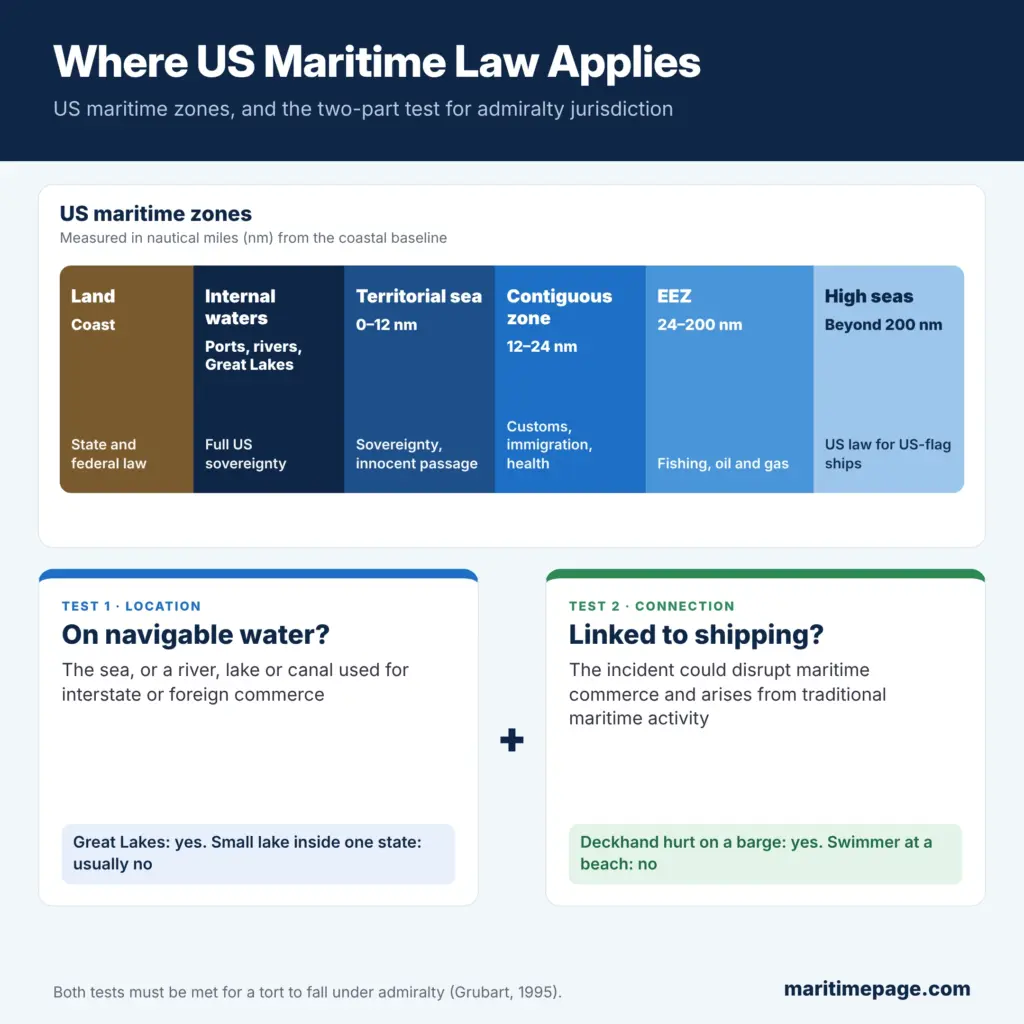
| Zone | Distance from the coast | What the US controls |
|---|---|---|
| Internal waters | Ports, bays, rivers, Great Lakes | Full sovereignty |
| Territorial sea | Up to 12 nautical miles | Sovereignty, with innocent passage for foreign ships |
| Contiguous zone | 12 to 24 nautical miles | Customs, immigration, health and pollution enforcement |
| Exclusive Economic Zone | Up to 200 nautical miles | Fishing, oil, gas and other resources |
| High seas | Beyond 200 nautical miles | US law applies to US-flag ships |
Under the 1995 Grubart test, a tort falls under admiralty only if it happened on navigable water and had a real link to maritime activity. A swimmer injured at a beach is usually outside it; a deckhand injured on a barge is inside it.
Does Maritime Law Apply to Lakes?
Yes, if the lake is navigable in the legal sense. Since The Genesee Chief case of 1851, admiralty covers the Great Lakes and inland waters used for interstate or foreign commerce, not just tidal waters.
Lake Superior, Lake Michigan and Lake Erie are clearly covered, and the Coast Guard enforces federal rules on them. A small lake wholly inside one state, with no commercial link to other states, is usually outside admiralty jurisdiction, so state boating law applies there.
What Does US Maritime Law Cover?
US maritime law covers the main legal risks of shipping: injuries to seafarers, cargo damage, collisions, pollution, salvage, liens and the right to limit liability.
| Area | Main US law |
|---|---|
| Seafarer injuries | Jones Act negligence claims, unseaworthiness, maintenance and cure |
| Dock and harbor workers | Longshore and Harbor Workers’ Compensation Act |
| Deaths at sea | Death on the High Seas Act, beyond 3 nautical miles |
| Cargo damage | COGSA for shipments under a bill of lading to or from US ports |
| Collisions and allisions | General maritime law and the Inland and International Navigation Rules |
| Oil pollution | Oil Pollution Act 1990: owner liability and vessel response plans |
| Coastal trade (cabotage) | Jones Act: US-built, US-owned, US-crewed ships only |
| Liability limits | Limitation of Liability Act: owner liability capped at the post-voyage value of the ship |
| Maritime liens | Commercial Instruments and Maritime Liens Act: crew wages, supplies and repairs |
A collision is between two moving ships. An allision is when a moving ship strikes a fixed object, such as a pier or bridge. Shipowners usually insure these liabilities through P&I clubs.
Which Courts Hear Maritime Cases in the US?
Federal district courts hear admiralty cases under 28 USC Section 1333, which comes from the Judiciary Act of 1789. Many maritime claims can also be brought in state courts under the “saving to suitors” clause.
Admiralty cases in federal court have some special features. They are usually decided by a judge without a jury, and a claimant can arrest the ship itself as security for the claim.
Jones Act claims by injured seafarers are an exception: the seafarer may choose a jury trial, in federal or state court.
How Does US Maritime Law Affect Ships and Crew?
For a ship calling at a US port, maritime law decides who pays when something goes wrong. It also sets the security rules under the Maritime Transportation Security Act and pollution rules under OPA 90.
- A foreign ship is subject to US law in US waters, whatever its flag.
- A US court can arrest the ship to secure claims for crew wages, supplies, repairs or cargo damage.
- Seafarers on US-flag ships can sue the employer under the Jones Act; crew on foreign ships generally cannot.
- Tankers trading to the US need an OPA 90 Certificate of Financial Responsibility and an approved vessel response plan.
- Cargo claims under bills of lading are usually limited to 500 US dollars per package under COGSA, unless a higher value is declared.
For the master and officers, the practical lesson is to keep logbooks, statements and records complete. In a US maritime claim, those records are the first evidence the courts and insurers will ask for.
Related Topics
Frequently Asked Questions
Is the United States under maritime law?
No. The US has maritime law, but it applies only to maritime cases such as shipping, cargo and accidents on navigable waters.
Is America under admiralty law?
No. Admiralty law is a specialist branch of federal law. Claims that all US courts secretly run on admiralty law have been rejected by the courts.
Does a gold-fringed flag mean a court is an admiralty court?
No. Flag fringe is decorative. Courts have ruled it has no effect on a court’s jurisdiction.
Where does maritime law apply in the US?
On navigable waters used for interstate or foreign commerce, including the sea, the Great Lakes and major rivers, and to maritime contracts.
Does maritime law apply to lakes?
Yes, to navigable lakes such as the Great Lakes. Small lakes wholly within one state and not used for interstate commerce are usually outside it.
Who has jurisdiction over maritime cases in the US?
Federal district courts, under Article III of the Constitution and 28 USC 1333. Many claims may also go to state courts.
What is the Jones Act?
A 1920 federal law that lets injured seafarers sue their employer and reserves US coastal trade for US-built, US-owned, US-crewed ships.
Where do international waters start for the United States?
The territorial sea ends 12 nautical miles from the coast. Beyond 200 nautical miles, the EEZ ends and the high seas begin.

- Great Lakes Maritime Academy: Programs, Cost and Admission – October 14, 2026
- Bunker Delivery Note (BDN): Contents, MARPOL Rules and Checks – October 11, 2026
- Oil Record Book: Part I and Part II Entries, Rules and PSC Checks – October 11, 2026