A drillship, also called a drilling ship or oil rig ship, is a self-propelled vessel that drills oil and gas wells in deep water. It drills through an opening in its hull and holds position over the well with thrusters. This guide explains how drillships work, their main parts, how deep they drill and who operates them.
What Is a Drillship?
A drillship is a mobile offshore drilling unit with a single ship-shaped hull. US rules define it as “a surface type unit with a single shipshape displacement hull”. Its derrick stands over an opening in the hull.
Dynamic positioning keeps the ship over the well, so it needs no anchors in deep water.
Drillships drill exploration and development wells; they do not produce oil for years like a platform. Once a well is drilled and tested, it is suspended, abandoned or completed for later production through a platform or subsea tie-back.
Among the types of offshore oil rigs, drillships suit the deepest water. In shallow water, the usual bottom-founded alternative is a jack-up rig.
How Does a Drillship Work?
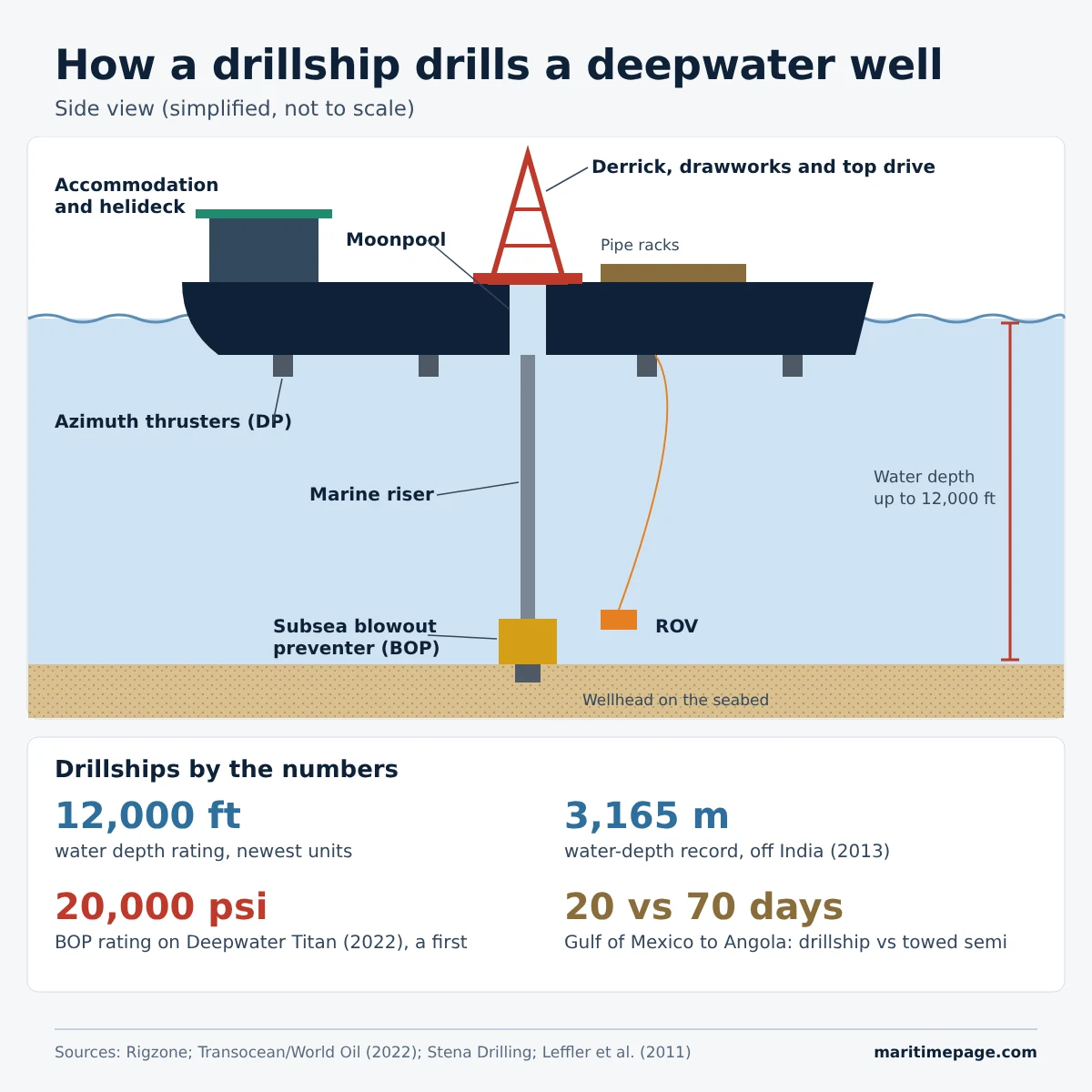
A drillship sails to the site, holds position with dynamic positioning and lowers a blowout preventer and marine riser to the wellhead. It then drills through the riser, running casing and cement in stages until the well reaches its target.
- Transit and set-up: the ship sails under its own power, then switches to dynamic positioning over the well location.
- Seabed survey: a remotely operated vehicle (ROV) checks the seabed and the wellhead position.
- Top-hole section: the crew drills and sets the conductor and first casing before the BOP is installed.
- BOP and riser: the subsea blowout preventer (BOP) and marine riser are run through the moonpool, latched on the wellhead and pressure-tested.
- Drilling: a top drive turns the drill string while drilling mud circulates down the pipe and back up the riser, carrying the cuttings.
- Casing and evaluation: each section is cased and cemented, then the well is logged and, if needed, flow-tested.
- Finishing the well: the well is suspended for later development, completed or permanently plugged and abandoned.
Heave compensation keeps the weight on the drill bit steady while the ship moves in the waves. Riser tensioners keep the riser taut and isolate the well from the vessel’s heave.
What Are the Main Parts of a Drillship?
A drillship combines a ship hull with a full drilling plant. Its key parts are the derrick, moonpool, marine riser, subsea BOP, dynamic positioning system and storage for mud and cement.
Derrick, drawworks and top drive
The derrick carries the hoisting system: the drawworks winch lifts and lowers the drill string, and the top drive turns it. Many modern drillships have two derricks or well centres, so pipe can be assembled offline while drilling continues.
Moonpool
The moonpool is the vertical opening through the hull below the drill floor. The riser, BOP, and drill string pass through it to the sea.
Marine riser and tensioners
The marine riser is a large pipe between the wellhead and the ship. It returns drilling mud and cuttings to the vessel and carries the choke and kill lines used for well control. Tensioners hold it at a steady tension as the ship moves.
Subsea blowout preventer
The subsea BOP stack sits on the wellhead and is the main well-control barrier on the seabed. It can close around or shear the drill pipe to shut in the well. After the 2010 Deepwater Horizon blowout on a semi-submersible rig, BOP design and testing rules were tightened.
Dynamic positioning and thrusters
Azimuth thrusters under the hull hold the ship over the well. The DP system uses satellite and acoustic position references, and the operators work within set watch circles that limit how far the ship may drift.
Storage and deck space
A ship-shaped hull gives large deck payload and bulk tanks for barite, cement and drilling mud. That lets a drillship work for long periods with fewer supply runs.

How Deep Can a Drillship Drill?
Modern drillships are rated for 10,000 to 12,000 ft of water (about 3,050 to 3,660 m). The newest can drill wells about 40,000 ft deep. The water-depth record, 3,165 m, was set off India in 2013.
- Water depth: Stena Drilling lists its drillships at up to 10,000 or 12,000 ft; Transocean’s Deepwater Titan is rated for 12,000 ft.
- Well depth: Deepwater Titan can drill to 40,000 ft and carries two 20,000 psi BOPs, a first for a drillship.
- Record: Transocean’s Dhirubhai Deepwater KG1 drilled in 10,385 ft (3,165 m) of water for ONGC, announced in February 2013.
What Are the Types of Drillships?
Drillships are grouped by how they hold position, the conditions they are built for and their generation. Almost all modern units use dynamic positioning; harsh-environment and ice-class designs work in cold, rough waters; scientific drillships drill for research.
- Moored vs DP: early drillships such as Discoverer I (1962) used anchor moorings and had no main engines, so they were towed. Modern drillships use DP and sail under their own power.
- Harsh environment and ice class: Stena Drilling’s DP3 drillships are built for harsh environments. Stena IceMAX is described as the first DP, dual-mast ice-class drillship.
- Generations: newer generations add deeper water ratings, dual derricks, dual BOPs and higher pressure ratings. Deepwater Atlas and Deepwater Titan (2022) are called the first eighth-generation drillships.
- Scientific drillships: JOIDES Resolution drilled for ocean science from 1985 until its retirement at the end of 2024. Japan’s Chikyu is a research drilling vessel built to drill deep below the seabed.
What Is the Difference Between a Drillship and a Semi-Submersible?
Both are floating drilling units for deep water. A drillship is a self-propelled ship with a single hull, so it moves faster and carries more. A semi-submersible floats on submerged pontoons and columns, so it moves less in waves.
| Feature | Drillship | Semi-submersible |
|---|---|---|
| Hull | Single ship-shaped hull | Deck on columns above pontoons |
| Moving between regions | Sails itself; about 20 days Gulf of Mexico to Angola | Often towed; about 70 days on the same route |
| Motion in waves | More roll and heave | More stable platform |
| Station-keeping | Dynamic positioning | Moorings or dynamic positioning |
| Deck load and storage | Large | Smaller |
The transit times are from Leffler and co-authors’ Deepwater Petroleum Exploration and Production (2011). The same source notes that drillships cost more to build but earn higher day rates.
When Was the First Drillship Built?
The first drilling vessels date from the 1950s and early 1960s. CUSS I drilled for Project Mohole in 1961, and CUSS II, the first newbuild drillship, sailed in 1962. SEDCO 445 (1971) was the first purpose-built DP drillship.
- CUSS I: a converted barge with four steerable propellers; it drilled in 3,500 m of water for Project Mohole in 1961.
- Glomar Challenger: launched in 1968 for the Deep Sea Drilling Project; it investigated 624 sites before retiring in 1983.
- SEDCO 445: the first purpose-built DP drillship, controlled by a Honeywell station-keeping system.
- JOIDES Resolution: replaced Glomar Challenger in 1985 and served ocean science for nearly 40 years.
Who Owns and Operates Drillships?
Drillships are owned by offshore drilling contractors and hired by oil and gas companies on contracts. The largest drillship owners include Transocean, Noble Corporation and Stena Drilling, with fleets shaped by recent mergers.
- Transocean: operates ultra-deepwater and harsh-environment drillships, including Deepwater Asgard, Deepwater Invictus and the eighth-generation Deepwater Atlas and Deepwater Titan.
- Noble Corporation: combined with Maersk Drilling in October 2022 and acquired Diamond Offshore in September 2024. Noble described the result as the largest fleet of seventh-generation dual-BOP drillships.
- Stena Drilling: operates DP3 drillships, including Stena Carron, Stena Forth, Stena DrillMAX, Stena Evolution and the ice-class Stena IceMAX.
- Other contractors: Seadrill and Valaris also operate drillship fleets.
How Many Drillships Are There?
The world drillship fleet passed 80 ships by 2013, more than double its 2009 size. In September 2025, analysts at Esgian counted 12 cold-stacked drillships, about 11% of the fleet. Long-idle units rarely return to work.
Deepwater drilling demand has been recovering since then. The market outlook is covered in the drillship section of the oil rig types guide.
What Are the Pros and Cons of Drillships?
Drillships are fast to move, carry large loads and work in the deepest water. In return they cost more to build and run, and their ship-shaped hull moves more in heavy seas than a semi-submersible.
- Pro: mobility: they sail between regions under their own power.
- Pro: water depth: modern units drill in 10,000 to 12,000 ft of water.
- Pro: capacity: large deck load and storage mean fewer supply runs.
- Con: cost: high build and day-rate costs.
- Con: motion: more roll and heave than a semi-submersible in rough water.
- Con: reliance on DP: losing power or thrust can push the ship off the well, so DP redundancy and procedures are critical.
Related Topics
- Oil rigs in the Gulf of Mexico: where deepwater drillships work in the US Gulf.
- How much oil rig workers make: pay for drilling crews offshore.
- How to become an oil rig worker: training and certificates for drilling jobs.
What is a drillship?
A drillship is a self-propelled, ship-shaped vessel that drills oil and gas wells in deep water. It drills through a moonpool in its hull and holds position with dynamic positioning.
How does a drillship stay in place?
Modern drillships use dynamic positioning. Computer-controlled azimuth thrusters hold the ship over the well, using satellite and acoustic position references.
How deep can a drillship drill?
Modern drillships are rated for 10,000 to 12,000 ft of water, and the newest can drill wells about 40,000 ft deep. The water-depth record is 3,165 m, set off India in 2013.
What is a moonpool on a drillship?
The moonpool is an opening through the hull below the drill floor. The riser, blowout preventer and drill string pass through it to the sea.
Is a drillship the same as an oil rig?
A drillship is one type of offshore oil rig, also called a mobile offshore drilling unit. Other types include jack-ups and semi-submersibles.
What is the difference between a drillship and a semi-submersible?
A drillship has a single ship hull and sails itself, so it moves faster and carries more. A semi-submersible floats on pontoons and columns and is more stable in waves.
Do drillships produce oil?
No. Drillships drill and test wells, then leave. Production comes later through platforms, FPSOs or subsea tie-backs.
Who owns the most drillships?
Offshore drilling contractors such as Transocean and Noble Corporation own the largest drillship fleets. Noble grew by combining with Maersk Drilling in 2022 and Diamond Offshore in 2024.

- What Is a Jack-Up Rig? Legs, Preloading and Punch-Through Explained – October 31, 2026
- Great Lakes Maritime Academy: Programs, Cost and Admission – October 14, 2026
- Bunker Delivery Note (BDN): Contents, MARPOL Rules and Checks – October 11, 2026