Hatch cover failure is the leading cause of water ingress damage to bulk cargo. The weathertight condition of rubber seals, cleating systems, and drain channels at the time of loading determines both whether the cargo arrives in sound condition and who pays when it does not.
This article covers hatch cover types, the three standard test methods, what a pre-loading survey involves, and how the surveyor’s findings become evidence in cargo damage claims.
What does weathertight integrity mean for hatch covers?
Watertight integrity means the hatch cover prevents seawater ingress under all foreseeable weather and sea conditions encountered during the voyage. For cargo hatches, the standard is weathertight — not fully watertight — which means resistant to water in the conditions likely to be met at sea, not pressure-tight to a defined head of water.
The distinction matters in cargo claims. SOLAS Chapter II-1 Regulation 15 defines weathertight as a fitting that, in any sea conditions, will not admit water. Hatch covers on cargo ships must meet this standard — not the more demanding watertight standard that applies to subdivision bulkheads and shell plating.
Classification society rules implement the weathertight standard through structural and sealing requirements. IACS Unified Requirement S14 sets the minimum design loads and construction standards for cargo hatch covers across all member societies. Individual class rules — Lloyd’s Register, DNV, BV, ClassNK — implement S14 as a minimum and may apply additional requirements for specific vessel types or trades.
What are the main types of hatch covers on bulk carriers?
The three dominant types on bulk carriers and general cargo ships are folding (MacGregor) covers, single-pull covers, and pontoon covers. Each has different operating mechanisms, sealing arrangements, and survey findings. Hatch cover types differ significantly in their failure modes — a finding that is routine on a folding cover may indicate a serious defect on a pontoon.
Folding (MacGregor) hatch covers
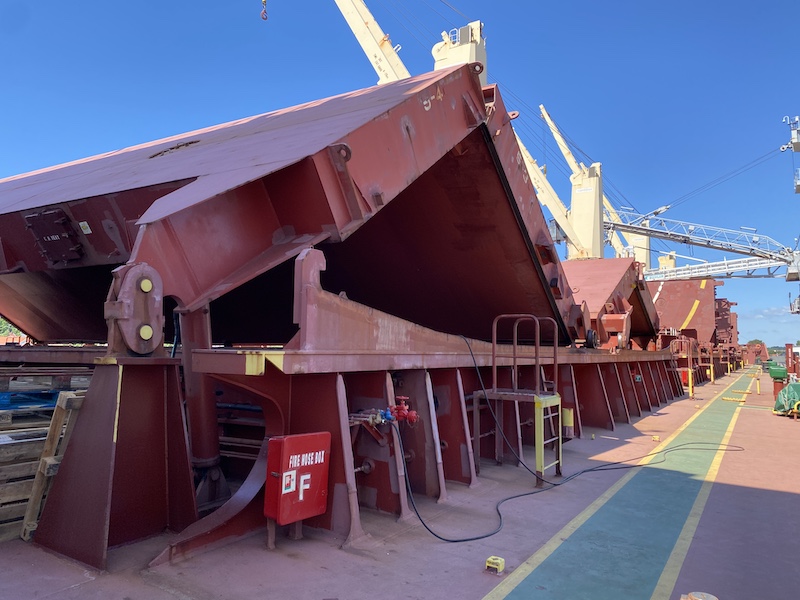
Folding covers operate on a pivot-and-fold mechanism: individual panels fold over each other and stow at one or both ends of the hatch opening. MacGregor is the dominant manufacturer, and the name is used generically for the type across the industry.
The sealing arrangement uses a rubber packing strip compressed against a compression bar welded to the coaming. Cleats draw the panels down and maintain compression. Cross-joint seals between adjacent panels are the highest-risk point — they experience differential movement at sea and are the first location a surveyor checks.
Drain channels run along the inside of the compression bars and collect any water that penetrates the outer seal. Blocked drain channels allow water to accumulate and overflow into the hold — a finding that constitutes hatch cover failure even if the primary seal is intact.
Single-pull hatch covers
Single-pull covers slide horizontally on rails to open, driven by hydraulic rams or wire pulls. They are common on older bulk carriers and some general cargo ships. The entire cover moves as a unit, which means the sealing perimeter is simpler, but structural loads on the running gear are higher.
Wear on rolling wheels and tracks causes the cover to sit unevenly on the coaming. An uneven seating breaks the compression seal at low points. A cover that opens and closes freely may still leak at a corner where the wheel flange has wor,n and the panel has dropped by two or three millimetres.
Pontoon hatch covers
Pontoon covers are individual steel panels lifted by crane or derrick and stowed on deck or on adjacent hatches. They have no moving mechanical parts — weathertightness depends entirely on rubber sealing packing condition, coaming top plate flatness, and the tarpaulin and lashing arrangements used in addition.
Pontoon covers are most common on older tonnage. Tarpaulins are mandatory as a secondary weatherproofing measure. The surveyor inspects tarpaulin condition, wedge and batten arrangement, and cleat tightening — a failed tarpaulin is a hatch cover failure for P&I purposes, regardless of the steel panel condition underneath.
What does SOLAS require for hatch cover weathertightness?
SOLAS Chapter II-1 Regulation 16 requires exposed decks to have hatch covers of sufficient strength and weathertightness for the positions in which they are fitted. The freeboard zone determines the standard — Position 1 covers (forward of 0.25L on the freeboard deck) face higher design loads than Position 2 covers further aft.
The Load Line Convention, implemented through SOLAS and national load line regulations, specifies hatch cover construction requirements by position. Regulation 16 of the 1966 Load Line Convention sets the detailed requirements for steel covers, coaming heights, cleating intervals, and the type of sealing arrangement required.
IACS Unified Requirement S14 defines minimum design loads for cargo hatch covers. Position 1 covers must withstand 1.75 t/m², and Position 2 covers must withstand 1.30 t/m². These requirements apply to ships contracted for construction on or after 1 July 1998, with later revisions incorporated by classification societies. DNV, Lloyd’s Register, and ABS implement S14 as a minimum and may apply higher design pressures depending on vessel type, size, and service area.
Class surveys verify hatch cover condition at annual and special surveys. Annual surveys include a visual examination and operational test of all hatch covers. Special surveys — conducted every five years — require a more thorough examination, including cleating, seals, and drain arrangements. A hatch cover deficiency noted ata special survey must be rectified before the vessel receives its classification certificate.
What are the three standard methods for testing hatch cover tightness?
The three accepted test methods are the chalk and batten test, the ultrasonic test, and the hydraulic hose test. Each method detects different types of failure and carries different evidential weight. A comprehensive pre-loading survey uses ultrasonic testing as the primary method, with chalk and batten and hose testing applied to confirm or localise findings.
| Test Method | What It Detects | Limitation | Primary Use |
| Ultrasonic | Micro leaks at seals, cross-joints, penetrations | Equipment calibration required; operator-dependent | Primary pre-loading survey tool |
| Hydraulic hose | Gross leaks under water pressure | Labour-intensive; two surveyors required | Repair verification at class survey |
| Chalk and batten | Seal contact — presence or absence | Cannot quantify compression; misses cross-joints | Quick supplementary check; not standalone |
What is the chalk and batten test?
The chalk and batten test applies chalk or grease to the compression bars around the hatch coaming. When the cover is closed and reopened, the imprint on the rubber seal shows where contact was made and where it was absent. A continuous chalk line indicates a sound seal; gaps indicate loss of compression.
The test is simple, requires no equipment, and identifies gross sealing failures on the primary seal perimeter. It does not detect leaks at cross-joints, drain channels, or access hatches. It also cannot quantify compression — a faint chalk mark and a clear mark both register as contact, even if one indicates near-zero pressure.
For P&I purposes, a chalk and batten test is supporting evidence rather than conclusive proof of weathertightness. A surveyor who conducts only this test will have difficulty defending a certificate of condition in a subsequent claim. The standard of care now requires ultrasonic testing as the primary method.
What is the ultrasonic hatch cover test?
The ultrasonic test detects leaks by measuring sound escaping through defective seals. A transmitter placed inside the closed hold generates a continuous ultrasonic signal; a receiver held by the surveyor on deck detects where that signal escapes through the cover. The method locates leak paths to within a few centimetres.
Ultrasonic testing detects failures at cross-joints, drain channel overflow points, access hatch seals, ventilator covers, and any other penetration — not just the primary compression seal. This makes it significantly more comprehensive than chalk and batten testing. The test produces a traceable record of readings rather than relying on the surveyor’s visual judgement.
Equipment such as the Cygnus Hatch-Sure or Furmanite ultrasonic leak detector is widely used. Results are recorded by hold panel, cross-joint, and coaming position. The surveyor produces a sketch plan showing reading values and their locations. High readings — typically above 85–90% of full scale depending on the equipment calibration — indicate a significant leak path requiring repair before loading.
What is the hydraulic hose test?
The hydraulic hose test applies a pressurised water jet — typically at 1 bar from a 20mm nozzle — along all hatch cover joints from outside, while an observer inside the hold watches for water ingress. The test replicates the effect of heavy seas on deck and is effective at identifying leaks in cross-joints and coaming interfaces.
The hydraulic hose test requires two surveyors and cannot be conducted in freezing conditions. Water ingress during the test must be distinguished from pre-existing bilge water in the hold. Findings are recorded by location and severity — a drip, a stream, and a flow carry different weight in a subsequent claim assessment.
Class society requirements specify the hose test as the standard method for verifying hatch cover repairs at survey. The ultrasonic test is accepted as a condition assessment tool but does not replace the hose test for demonstrating satisfactory repair completion.
What does a pre-loading hatch cover survey involve?
A pre-loading hatch cover survey establishes the condition of the hatch covers at the time loading commences, creating a baseline for any subsequent damage claim. It is conducted on behalf of the cargo interests, the shipowner, or both — typically instructed through a P&I club or cargo underwriter before bulk cargo is loaded.
The survey is a condition assessment at a specific point in time, distinct from a class certification survey. Types of surveys carried out on ships include condition surveys, damage surveys, and on-hire / off-hire surveys — the pre-loading hatch survey falls within the condition survey category and carries no class authority.
What does the surveyor examine during a pre-loading hatch survey?
- Rubber packing seals — condition, continuity, compression set, repairs or splices
- Compression bars — corrosion, deformation, weld condition, missing sections
- Cleating systems — number of cleats per panel, operating condition, correct adjustment
- Cross-joint seals — condition at each panel junction, presence of filler pieces
- Drain channels — clear of debris, drain plugs present and operative, no blockages
- Coaming top plate — flatness, corrosion, weld repairs, any deformation
- Hydraulic operating system (folding covers) — rams, hoses, pressure, panel alignment
- Rolling wheels and tracks (single-pull covers) — wear, alignment, panel seating
- Access hatches, vent covers, sounding pipe caps — seals intact and secured
- Previous repairs — assess whether compliant with class requirements
After the visual inspection, the surveyor conducts ultrasonic testing on all panels. Readings are taken at the primary sealing perimeter, at each cross-joint, and at any point where the visual examination raised concern. The chalk and batten test supplements ultrasonic results where access permits.
Where deficiencies are found, the surveyor prepares a list of required remedial works. Loading should not commence until repairs are completed and re-tested. A surveyor who permits loading before repairs are confirmed sound bears professional liability for any subsequent damage attributable to the known deficiency.
What does a pre-loading hatch survey report contain?
- Vessel name, IMO number, port, date, and hold numbers surveyed
- Instructing party and purpose of the survey
- Description of hatch cover type, manufacturer, and approximate age
- Visual findings by hold — itemised deficiencies with location reference
- Ultrasonic test results — reading values by panel and joint, with sketch plan
- Chalk and batten findings where applicable
- Hydraulic hose test results where conducted
- List of required repairs before loading
- Surveyor’s conclusion — covers found weathertight, deficient, or satisfactory, subject to specified repairs
- Photographs — each deficiency, each hatch closed, each test in progress
The report is timed and dated at completion. Where both shipowner and cargo interests appoint surveyors, both parties sign a single joint report. Where surveys are conducted separately, the two reports become competing documents of record in any claim.
How does hatch cover failure lead to cargo damage?
Water ingress through a defective hatch cover contacts the top layers of bulk cargo first. The damage mechanism depends on the cargo type. Grain absorbs water and develops mould, heat, and germination damage. Iron ore is not moisture-sensitive, but water pooling at the hold bottom causes long-term structural damage to double-bottom tank tops.
Coal cargo presents a different risk — water contact accelerates self-heating in certain coals and can contribute to spontaneous combustion. For cargoes close to their transportable moisture limit (TML), water ingress through hatch covers can push the cargo into a liquefied state and cause loss of stability. This is simultaneously a cargo and a safety issue.
Hygroscopic cargoes — sugar, fertilisers, certain grains — absorb moisture from air as well as from direct water contact. A hatch cover that admits humid air rather than liquid water can still cause significant damage to hygroscopic cargo over a long voyage. The surveyor must consider both direct ingress and condensation as distinct damage pathways.
Caking and clumping in fertiliser and cement cargoes is frequently caused by moisture ingress. The cargo arrives at discharge in a solidified state requiring expensive mechanical excavation. The cargo receiver’s claim goes to the shipowner, who seeks recovery from the P&I club — and the pre-loading hatch survey becomes the primary document in the coverage assessment.
Where do hatch covers most commonly fail?
The most consistent failure points across all hatch cover types are the rubber sealing packings, the cross-joint seals, the drain channel system, and the cleating arrangement. These are the areas the surveyor examines first and the areas most frequently cited in cargo damage surveys.
Rubber sealing packings
The rubber packing runs continuously around each hatch panel perimeter and compresses against the compression bar when the cover is closed. Rubber hardens and loses elasticity with age and UV exposure. A packing that appears visually intact but has lost resilience will not seal under wave load — the chalk test registers contact but the ultrasonic test still detects a leak path.
Splices in the rubber packing are a known weak point. The vulcanised joint between two packing lengths is harder than the surrounding material and compresses differently. Surveyors mark every splice location on the sketch plan. A high ultrasonic reading at a splice position is a predictable finding and a standard repair item.
Cross-joint seals
Cross-joints are the interfaces between adjacent panels on a multi-panel cover. They experience differential movement at sea as panels flex under wave load. The sealing arrangement uses an H-section rubber profile fitted between panel edges, backed by a steel filler piece.
Cross-joint failure produces a linear leak path running across the full width of the hatch. Water ingress at a cross-joint contacts cargo over a wide area. A single failed cross-joint on a Panamax bulk carrier can admit several tonnes of water in a single heavy weather event.
Drain channels and drain plugs
Drain channels collect water that penetrates the primary seal and route it to drain plugs at the coaming corners. Missing drain plugs discharge water directly into the hold. Blocked drain channels — clogged with scale, rubber debris, or cargo dust — overflow and back water past the compression bar into the hold.
Blocked drain channels are one of the most common pre-loading findings and one of the simplest to rectify. The surveyor probes every drain channel during inspection. A blocked channel costs minutes to clear — left unaddressed, the resulting cargo damage costs thousands to settle.
Cleating systems
Cleats draw the hatch panel down onto the compression bar and maintain the seal under sea conditions. Worn, missing, or incorrectly adjusted cleats produce insufficient compression. The number of cleats per panel and their spacing is specified by the hatch cover manufacturer — deviations from the design arrangement are a class non-conformity.
Hydraulic cleating systems apply compression through a central hydraulic circuit. A pressure loss anywhere in the circuit — a failed ram seal, a leaking hose — reduces compression across the entire panel simultaneously. The surveyor checks operating pressure and confirms all rams extend to full travel during the pre-loading inspection.
Who bears liability when hatch cover failure causes cargo damage?
The shipowner’s liability for cargo damage caused by hatch cover failure arises under the Hague-Visby Rules, which require the carrier to exercise due diligence to make the ship seaworthy before and at the commencement of the voyage. A vessel with defective hatch covers is unseaworthy. The carrier cannot limit liability on grounds of navigation error if unseaworthiness is the proximate cause of the loss.
The P&I club covers the shipowner’s liability for cargo damage where the vessel exercised due diligence and the damage was not caused by a failure to make the ship seaworthy. A pre-loading survey finding that hatch covers were deficient, combined with evidence that loading proceeded regardless, destroys the due diligence defence — the P&I club may refuse cover on that basis.
The bill of lading is the contract of carriage and the document of title. If the bill of lading is claused — noting hatch covers were found deficient at loading — the shipper’s claim against the carrier is weakened. A clean bill of lading issued when hatch covers were known to be deficient creates personal liability for the master and may constitute fraud against the cargo receiver.
Charterer liability arises where the charter party requires the charterer to maintain the vessel in seaworthy condition, or where the charterer directed loading to proceed despite a surveyor’s deficiency finding. Allocation of liability between shipowner and charterer is frequently disputed and resolved by reference to charter party terms and contemporaneous survey reports.
How is the hatch cover survey report used in cargo damage claims?
The pre-loading hatch survey report establishes hatch cover condition at the beginning of the voyage. The discharge survey report — prepared at the destination port by a surveyor examining the damaged cargo — establishes the condition and extent of the damage. Together, these two documents form the evidential backbone of a cargo damage claim.
Causation is the critical issue. A claimant must show that water entered the holds through a defective hatch cover rather than through another source — bilge overflow, condensation, or deck drainage. A pre-loading survey identifying specific deficiencies allows the claimant to argue those deficiencies were the proximate cause of the specific damage pattern found at discharge.
A joint survey conducted by surveyors representing both cargo interests and the shipowner carries greater evidential weight than a unilateral survey. Most bulk cargo damage disputes are resolved through P&I club correspondence and ship survey documentation before reaching formal arbitration — but the quality of the pre-loading report determines the negotiating position of each party.
Sea protest — a formal declaration by the master that the vessel encountered adverse weather — is frequently used to rebut cargo damage claims. A pre-loading survey finding poor cover condition, combined with weather routing data showing a normal weather track, will defeat a sea protest defence. The survey report is the instrument that makes sea protest rebuttal possible.
Frequently Asked Questions
What is the difference between watertight and weathertight for hatch covers?
Weathertight means the hatch cover prevents water ingress under all sea conditions likely to be encountered during the voyage, per SOLAS Chapter II-1 Regulation 15. Watertight is a more demanding standard — sealed against water at a defined pressure head — and applies to subdivision bulkheads and shell penetrations. Cargo hatch covers must be weathertight, not watertight.
How often should hatch cover rubber seals be replaced?
There is no fixed regulatory replacement interval — replacement is on condition. Class guidance recommends inspection at annual survey and replacement when hardness testing or visual inspection reveals loss of resilience. In practice, seals on heavily worked hatches may require replacement every three to five years. Delay beyond this risks cargo damage claims that exceed the seal replacement cost many times over.
Can a vessel sail with a hatch cover deficiency noted at survey?
A class surveyor may issue a condition of class requiring rectification within a specified period — typically before the next port or within three months — while permitting continued trading. Whether the vessel can accept cargo in that condition is a separate question. Loading bulk cargo with a known hatch deficiency creates unseaworthiness under the Hague-Visby Rules and may void P&I cover for any resulting cargo damage.
What defects invalidate a hatch cover certificate of condition?
A certificate of condition is invalidated by any deficiency that prevents the cover from maintaining weathertightness — failed cross-joint seals, missing cleats, blocked drain channels, or rubber packing with compression set below the manufacturer’s minimum. A certificate issued despite known deficiencies is professionally untenable and exposes the surveyor to personal liability in subsequent cargo damage proceedings.
What is a condition of class for hatch covers?
A condition of class is a notation attached to the vessel’s class certificate requiring a specified deficiency to be rectified within a defined period. For hatch covers, it is typically issued at annual or special survey when a deficiency is found that does not prevent the vessel from trading but requires prompt attention. The condition of class is recorded on Lloyd’s List Intelligence, Equasis, and similar databases — it is visible to PSC officers and cargo interests.
Can ultrasonic testing replace the hydraulic hose test?
Ultrasonic testing replaces the hose test for pre-loading condition assessment — it is more sensitive, faster, and does not require two surveyors. It does not replace the hose test for verifying completed repairs at class survey. Classification society requirements specify the hose test as the method of proof for repair verification. A repair confirmed only by ultrasonic re-test at class survey may not satisfy the surveyor’s requirement.
What is the purpose of the ultrasonic transmitter position during testing?
The transmitter is placed inside the closed hold, usually on the tank top near the centreline. Any leak path allows sound to escape through the hatch cover to the receiver on deck. The transmitter does not need to be positioned close to the seal being tested — the method is effective across the full cover area from a single central position.
What cargo types are most sensitive to hatch cover failure?
Grain, sugar, fertiliser, and cement are the most sensitive to direct water contact. Coal requires careful assessment due to self-heating risk when wet. Iron ore and steel products suffer surface rust from moisture contact — a claim straightforward to quantify. Cargo hold ventilation interacts with hatch cover condition: a hold that breathes correctly through properly sealed ventilators manages condensation; one with failed hatch seals admits both liquid water and humid air simultaneously.
Who instructs a pre-loading hatch cover survey?
The survey is instructed by the cargo shipper, the cargo underwriter, or the shipowner’s P&I club. On dry bulk carriers loaded under voyage charter, it is common for both shipowner and charterer to appoint surveyors simultaneously, producing a joint report both parties sign. On time charter tonnage, the charterer typically instructs the survey to demonstrate that on-hire condition included satisfactory hatch covers.

- Great Lakes Maritime Academy: Programs, Cost and Admission – October 14, 2026
- Bunker Delivery Note (BDN): Contents, MARPOL Rules and Checks – October 11, 2026
- Oil Record Book: Part I and Part II Entries, Rules and PSC Checks – October 11, 2026