
A jack-up rig is a mobile offshore unit that lowers its legs to the seabed and lifts its hull clear of the waves. This guide explains how a jack-up rig stands on the seabed, why it is preloaded, and what punch-through is.
It is written for cadets, students and newcomers to offshore and marine engineering. Definitions follow the IMO MODU Code, ISO 19905-1 and published industry guidance.
What Is a Jack-Up Rig?
A jack-up rig is a self-elevating unit: a buoyant hull with movable legs that can raise the hull above the sea and lower it back. Once elevated, it stands on the seabed rather than floating.
The IMO MODU Code (2009) calls this a self-elevating unit. It defines one as “a unit with movable legs capable of raising its hull above the surface of the sea and lowering it back into the sea.”
Most drilling jack-ups have three legs, and some have four. SPE’s PetroWiki notes many units for water depths of 25 to 300 feet, with some able to work deeper than 400 feet.
Jack-ups are one of the main types of offshore oil rig, used mainly for drilling in shallow water. The same principle is used by self-propelled lift boats, accommodation jack-ups and jack-ups working in offshore wind.

What Is the Difference Between Independent-Leg and Mat-Supported Jack-Ups?
An independent-leg jack-up stands each leg on its own footing, usually a spudcan, and must be preloaded. A mat-supported jack-up has its legs fixed to one large mat that rests on the seabed.
Because the mat spreads the load over a wide area, bearing pressure is low and the hull can be raised without a preload sequence. Mat units tow slowly, because the large mat and hull create a lot of drag.
What Are Jack-Up Legs Made Of?
Independent-leg units usually have truss (lattice) legs made of chords and bracing. Some mat units use columnar legs, solid cylinders that PetroWiki gives as 8 to 12 feet in diameter and that suit shallower water.
The RenewableUK jack-up guidelines (2013) require leg-height marks on each leg at intervals of no more than one meter. Crews use these marks to record how far each leg has penetrated the seabed.
How Does the Jacking System Work?
The jacking system moves the legs relative to the hull. Patent literature describes two broad families of jacking systems:
- Continuous systems, such as rack and pinion, where motor-driven pinions climb a toothed rack on the leg chords.
- Discontinuous systems, where hydraulic cylinders lift the load in strokes while the leg is locked to the hull between strokes.
How Does a Jack-Up Stand on the Seabed?
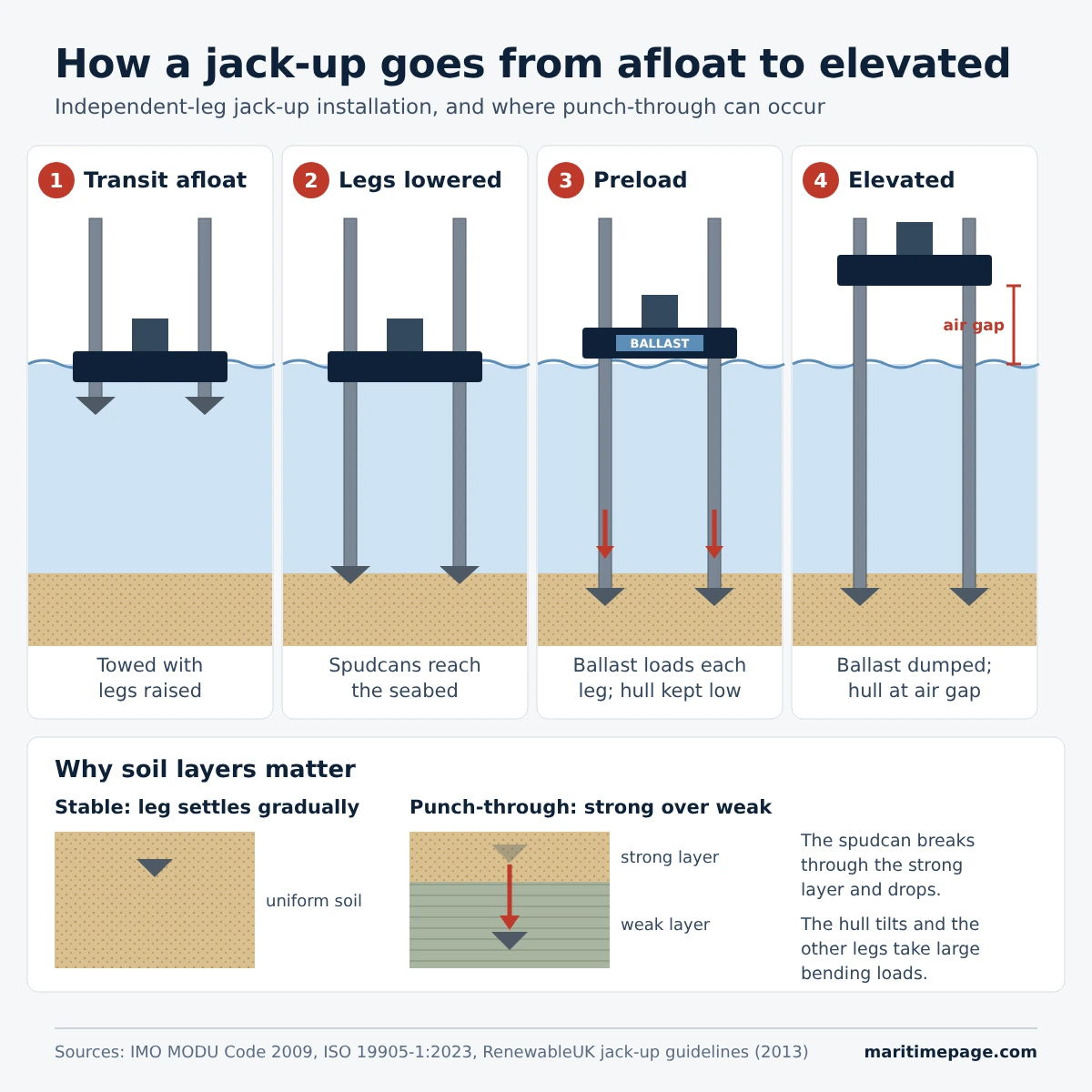
A jack-up is towed to the site afloat with its legs raised, lowers the legs until the footings reach the seabed, then preloads them. Only then is the hull jacked up to its operating air gap.
- Transit afloat. The unit floats as a vessel, usually towed by tugs or anchor handling tug supply (AHTS) vessels, with the legs raised.
- Leg lowering. The jacking system lowers the legs until each footing touches the seabed.
- Preloading. The legs are loaded beyond their expected service loads to drive the footings to a stable depth.
- Elevation. The hull is raised to its operating height so that waves pass beneath it.
Afloat, the unit must meet the intact and damage stability criteria in Chapter 3 of the MODU Code, like any other vessel. Elevated, its stability depends on the legs and the soil beneath them.
What Is a Spudcan?
ISO 19905-1 defines a spudcan as a “structure at the base of a leg supported by the soil.” ABS guidance describes it as a large, roughly circular inverted cone with a shallow conical underside and a sharp protruding spigot.
The spudcan spreads the leg load into the seabed and resists both vertical and sliding loads. How deep it sinks is called leg penetration.
What Is the Air Gap on a Jack-Up?
The air gap is the clearance between the sea surface and the underside of the hull. It must be large enough that the largest wave crest does not strike the hull.
The MODU Code requires the elevated hull to clear the highest design wave, including astronomical and storm tides. It adds a margin of 1.2 meters or 10% of the combined tide and wave height, whichever is less.
What Is Preloading and Why Is It Done?
Preloading loads each leg beyond the load it should see in service, so the footings settle before the hull is fully raised. Any soil failure should then happen while the hull is still close to the water.
The MODU Code (paragraph 2.6.11) requires each leg to be preloaded to its maximum applicable combined load after initial positioning at a site. Units on a bottom mat are excepted. The procedure must be in the unit’s operating manual.
Seawater is pumped into dedicated preload tanks to add weight, and the load is held while the legs penetrate. On many units the water is then dumped and the cycle repeated until the legs stop moving. Newer units can often complete preloading in one cycle.
Preloading is done with only a small air gap. An insurance-market screening guide (JR2019-004, 2019) cites a typical maximum preload air gap of 1.5 m (5 ft) for good soils. For poor soils or poor data, it gives zero.
What Is Punch-Through on a Jack-Up Rig?
Punch-through is a “rapid, uncontrolled vertical leg movement due to soil failure in strong soil overlying weak soil” (ISO 19905-1). The footing breaks through a stronger layer and drops into the weaker soil below.
Because one leg drops while the others hold, the hull tilts and the remaining legs take large bending loads. ABS guidance calls punch-through a major risk to the stability and equilibrium of the jack-up structure. A 2025 geotechnical paper notes it can cause substantial structural damage and significant downtime.
Punch-through is most likely during preloading, when leg loads are at their highest. That is also why the hull is kept close to the water at that stage.
How Is Punch-Through Different From Squeezing and Settlement?
- Punch-through: strong soil over weak soil fails, and the leg moves suddenly and uncontrollably.
- Squeezing: ISO 19905-1 describes lateral movement of weak soil beneath a spudcan, or within a weak layer between two firmer layers.
- Rapid settlement: fast leg penetration, sometimes called a “leg run”, that preload plans must also cover.
- Gradual settlement: slow, controlled penetration that preloading is meant to complete before operations start.
Which Seabed Conditions Need Special Assessment?
Layered soils, old spudcan footprints and scour-prone seabeds need the closest attention. Each can make leg penetration less predictable than a uniform soil profile.
- Layered soils. A strong layer over a weak one is the classic punch-through profile.
- Existing footprints. Spudcans tend to slide toward depressions left by earlier rigs. A 2002 industry study found this can damage the rig, the platform and nearby infrastructure.
- Scour. The MODU Code requires the effect of scour, or loss of bottom support, to be considered. RenewableUK notes that scour removing surface sand can lead to punch-through.
- Nearby subsea assets. Plans need clearance between spudcans and pipelines or cables.
How Is a Site Assessed Before a Jack-Up Arrives?
A site-specific assessment checks that a particular jack-up can safely stand at a particular location. It combines seabed data, a leg penetration prediction, punch-through checks and an air gap check.
The main international standard for the elevated condition is ISO 19905-1:2023 (edition 3, amended in 2025), covering independent-leg jack-ups at a site. Installation and removal at a site are covered by a separate Part 4, ISO 19905-4. ISO 19905-1 also notes that a jack-up without a valid classification certificate is assessed under ISO 19902 instead.
What Seabed Data Is Needed?
The RenewableUK guidelines set out a typical data set:
- A bathymetric survey of about 1 km², centered on the site.
- Shallow seismic able to identify soil layers of 0.5 m and thicker to 30 m depth.
- Boreholes or cone penetration tests (CPTU), placed to capture lateral variation in the soil.
- Geotechnical information to at least 30 m below the seafloor.
The same guidelines state that geophysical data alone is not enough for a site-specific foundation assessment. Insurance-market guidance also points to the InSafe JIP guidelines on spudcan foundation performance for soils data.
What Does the Assessment Check?
- Leg penetration: how far each spudcan is expected to sink under preload.
- Punch-through risk: whether a strong-over-weak profile lies within the predicted penetration range.
- Air gap sufficiency: whether the hull can reach a safe elevation for the site’s design waves.
- Spare leg length: JR2019-004 cites at least 1.5 m (5 ft) of leg above the jack-house after penetration.
- Leg extraction: whether the footings can be pulled free when the unit leaves.
How Is Punch-Through Risk Managed in Operation?
Punch-through risk is managed by planning the preload, keeping the hull low while preloading, and monitoring each leg as it penetrates. Industry guidance sets these as planning requirements rather than one fixed procedure.
- A written preload plan with a clear response to rapid settlement and leg runs, as JR2019-004 recommends.
- A minimal air gap during preload, so that a sudden leg drop does not cause a large fall.
- Penetration records for each leg, examined by a competent person (RenewableUK).
- Rack phase difference (RPD) monitoring on individual leg chords, an early sign of uneven leg loading.
- Extra caution where the soil profile shows punch-through risk, especially when maximum preload gives little margin over operating or survival loads.
RenewableUK also states that assessing punch-through risk needs a high level of expertise and sound engineering judgment. The figures in a site assessment depend on the unit, the site and the standard used.
How Do Safety Management and Approvals Apply to Jack-Ups?
A jack-up falls under flag-state rules as a vessel and classification rules for its design. Where insurers require it, a marine warranty surveyor also reviews each location and move. Its own safety management system ties the procedures together.
- Safety management. MODUs of 500 gross tonnage and above have been within the ISM Code under SOLAS Chapter IX since July 1, 2002.
- Operating manual. The MODU Code requires the manual to state the design motions, sea state and bottom conditions for raising or lowering the hull.
- Classification. ISO 19905-1 refers to recognized classification society rules and the MODU Code for design.
- Marine warranty. The marine warranty surveyor reviews the location and move and may issue a certificate of approval.
When a reviewer looks at a jack-up installation, the key records are the site assessment and the preload plan. Penetration and leg-height records, RPD readings and the air gap reached complete the picture. These show whether the unit was installed as the assessment assumed.
How Is a Jack-Up Different From a Semi-Submersible or Drillship?
A jack-up is bottom-founded: once elevated, its legs carry the load into the seabed. Semi-submersibles and drillships float throughout and hold position with moorings or dynamic positioning, which lets them work in much deeper water.
| Feature | Jack-up | Semi-submersible | Drillship |
|---|---|---|---|
| Support at site | Legs on the seabed | Floating on columns and pontoons | Floating ship-shaped hull |
| Station keeping | Fixed by legs | Moorings or dynamic positioning | Usually dynamic positioning |
| Water depth | Shallow water | Deep water | Deep water |
| Main foundation risk | Punch-through, scour, footprints | Mooring or position loss | Position loss |
| MODU Code term | Self-elevating unit | Column-stabilized unit | Surface unit |
Floating units depend on the dynamic positioning system or moorings to stay on station. Drillships also move between sites under their own power, while drilling jack-ups are normally towed.
Related Topics
- Oil platforms in the Gulf of Mexico
- How to become an oil rig worker, including BOSIET safety training
- Deepwater Horizon: a well control case study from a floating rig
Frequently Asked Questions
What is a jack-up rig?
A jack-up rig is a self-elevating offshore unit with movable legs. It floats to a site, lowers its legs to the seabed and raises its hull above the waves.
What is a spudcan?
A spudcan is the footing at the base of a jack-up leg. It is usually a large inverted cone that spreads the leg load into the seabed and resists vertical and sliding loads.
What is preloading on a jack-up?
Preloading loads each leg beyond its expected service load by filling preload tanks with seawater. The footings settle to a stable depth before the hull is raised to its working height. The MODU Code requires it for independent-leg units.
What is punch-through?
Punch-through is a rapid, uncontrolled leg movement when a spudcan breaks through strong soil into weaker soil below. The hull tilts and the other legs take large bending loads, which can cause serious structural damage.
What is leg penetration?
Leg penetration is how far a jack-up’s footing sinks into the seabed. It is predicted in the site-specific assessment, then measured on site using leg-height marks and recorded for each leg.
How deep can a jack-up rig work?
Most jack-ups work in shallow water. SPE’s PetroWiki notes many units for depths of 25 to 300 feet, with some able to operate in more than 400 feet. Each unit’s limit depends on its leg length and the site.
Can a jack-up move under its own power?
Drilling jack-ups are normally towed between sites with their legs raised, often by tugs or AHTS vessels. Lift boats, a smaller type of self-elevating vessel, are self-propelled.
What is the air gap on a jack-up?
The air gap is the clearance between the sea surface and the underside of the elevated hull. It must keep the hull clear of the largest design wave, including tides, with a margin set by the MODU Code.

- What Is a Jack-Up Rig? Legs, Preloading and Punch-Through Explained – October 31, 2026
- Great Lakes Maritime Academy: Programs, Cost and Admission – October 14, 2026
- Bunker Delivery Note (BDN): Contents, MARPOL Rules and Checks – October 11, 2026