The ISM Code is the International Safety Management Code. It requires every shipping company to run a documented safety management system, ashore and on board, and to prove it through certification and audits.
This guide is written for deck and engine officers, designated persons ashore, superintendents and cadets. It explains what the Code requires, how the DOC and SMC are issued, and what auditors and inspectors check.
What Is the ISM Code?
The ISM Code is IMO’s standard for safe ship management and pollution prevention. Adopted in 1993, it became mandatory under SOLAS Chapter IX in 1998 for most ships of 500 GT and above on international voyages.
Its full title is the International Management Code for the Safe Operation of Ships and for Pollution Prevention. IMO adopted it on 4 November 1993 by Resolution A.741(18), and it became mandatory on 1 July 1998.
| ISM Code at a glance | |
|---|---|
| Full title | International Management Code for the Safe Operation of Ships and for Pollution Prevention |
| Adopted | 4 November 1993, IMO Resolution A.741(18) |
| Mandatory since | 1 July 1998, via SOLAS Chapter IX |
| Applies to | Passenger ships, and cargo ships and MODUs of 500 GT and above, on international voyages |
| Certificates | Document of Compliance (company) and Safety Management Certificate (ship) |
| Certificate validity | Up to 5 years, with annual (DOC) and intermediate (SMC) verification |
| Internal audits | At least every 12 months, ashore and on board |
The Code does not tell a company how to load cargo or maintain an engine. It tells the company to write its own procedures, follow them, record the results and correct what goes wrong.
When Did the ISM Code Become Mandatory?
SOLAS Chapter IX, Regulation 2 brought the Code in by ship type, in two phases. Both apply to ships of 500 gross tonnage and upwards on international voyages.
| Date | Ships covered |
|---|---|
| 1 July 1998 | Passenger ships including high-speed passenger craft, oil tankers, chemical tankers, gas carriers, bulk carriers and cargo high-speed craft |
| 1 July 2002 | Other cargo ships and mobile offshore drilling units (MODUs) |
Chapter IX does not apply to government-operated ships used for non-commercial purposes. Many flag states also apply ISM rules, or a reduced version, to smaller domestic ships.
Who Is the “Company” Under the ISM Code?
The Company is the shipowner, or a manager or bareboat charterer that has taken over responsibility for operating the ship. By doing so, it accepts every duty the Code imposes (section 1.1.2).
The Company holds the DOC and answers for the SMS. Flag states and port states do not comply with the Code as companies; they certify, audit and inspect.
How Has the ISM Code Been Amended?
The Code has been amended five times since 1993. The current text is A.741(18) as amended, last by Resolution MSC.353(92), in force since 1 January 2015.
| Resolution | In force | Main changes |
|---|---|---|
| MSC.104(73) | 1 July 2002 | New definitions in Part A, section 1.1; Part B rewritten as sections 13 to 16; certificate forms |
| MSC.179(79) | 1 July 2006 | Revised DOC and SMC forms |
| MSC.195(80) | 1 January 2009 | Revised forms of full-term and interim certificates |
| MSC.273(85) | 1 July 2010 | Risk assessment in section 1.2.2; changes to sections 5, 7, 8, 9, 10 and 12, and to Part B |
| MSC.353(92) | 1 January 2015 | Seafarers to be medically fit (6.2); training procedures (6.5); footnotes updated |
Why Was the ISM Code Introduced?
The Code grew out of accidents where the root cause sat in the office, not on the bridge. The best known is the capsize of the ro-ro ferry Herald of Free Enterprise off Zeebrugge in March 1987, in which 193 people died.
The UK inquiry into that loss blamed shore management as well as the crew. IMO responded with voluntary guidelines in 1989, Resolution A.647(16). These were replaced by the ISM Code in 1993.
What Are the Objectives of the ISM Code?
The ISM Code has three objectives, set out in section 1.2.1. They are safety at sea, prevention of human injury or loss of life, and avoidance of damage to the environment and to property.
Section 1.2.2 then sets three safety management objectives for the company:
- Provide safe practices in ship operation and a safe working environment.
- Assess all identified risks to its ships, personnel and the environment, and set safeguards against them.
- Improve the safety management skills of personnel ashore and on board, including preparing for emergencies.
Section 1.2.3 adds that the system must achieve compliance with mandatory rules and regulations. It must also take account of IMO codes, guidelines and standards, and those of Administrations, classification societies and industry bodies.
What Must a Safety Management System Contain?
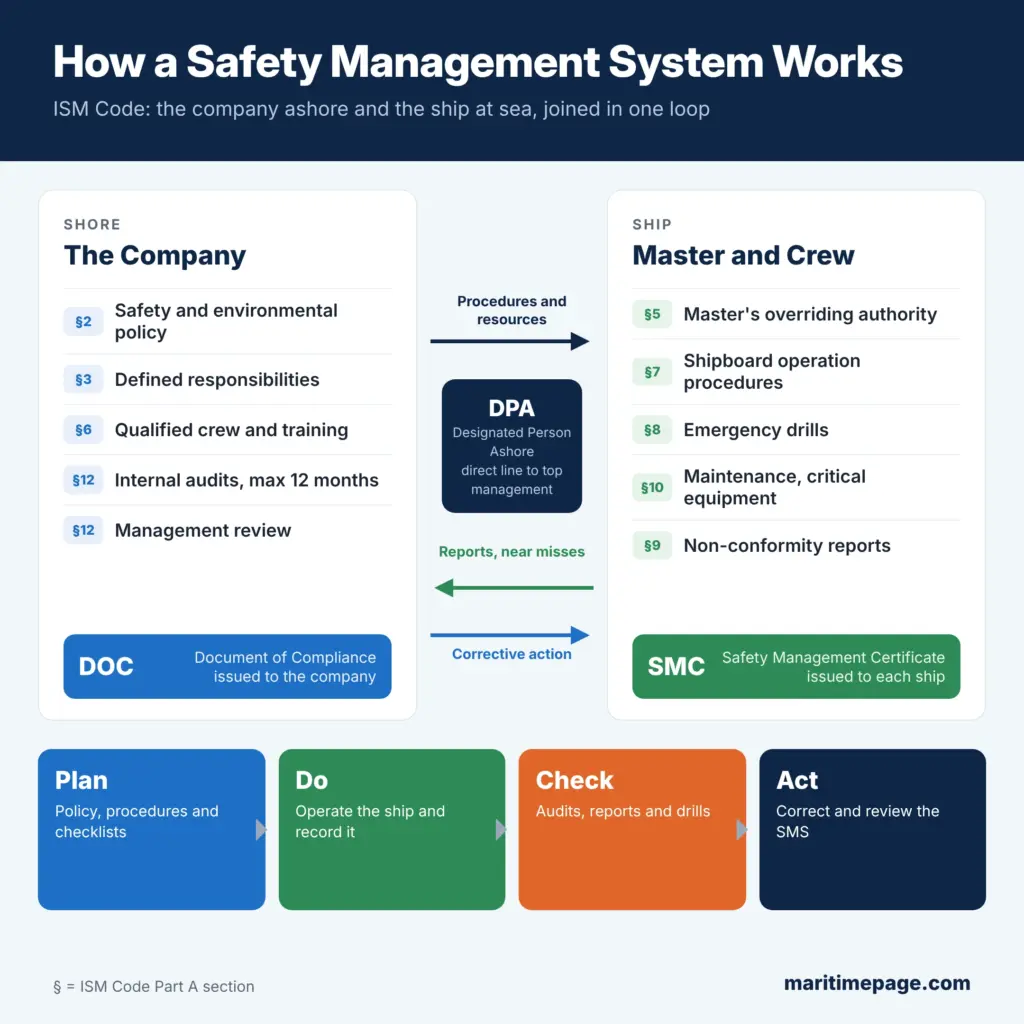
A safety management system (SMS) is a structured, documented system that lets company staff carry out the safety and environmental-protection policy. Section 1.4 lists six functional requirements every SMS must meet.
- A safety and environmental-protection policy.
- Instructions and procedures for safe operation and environmental protection, in line with international and flag-state law.
- Defined levels of authority and lines of communication between shore and ship personnel.
- Procedures for reporting accidents and non-conformities with the Code.
- Procedures to prepare for and respond to emergencies.
- Procedures for internal audits and management reviews.
The SMS normally lives in a safety management manual, split into an office manual and shipboard manuals. Procedures, checklists, forms and records sit under it.
IMO Resolution MSC.428(98), adopted in 2017, expects cyber risks to be addressed in the SMS. Administrations check this from the first annual DOC verification after 1 January 2021.
What Are the 12 Elements of the ISM Code?
The 12 elements are the sections of Part A, from general provisions and the safety policy to company verification and review. Part B, sections 13 to 16, covers certification and verification.
| Section | Title | What it requires in practice |
|---|---|---|
| 1 | General | Definitions, objectives, application and functional requirements |
| 2 | Safety and environmental-protection policy | A written policy, implemented and maintained at all levels ashore and afloat |
| 3 | Company responsibilities and authority | Who the company is, and the defined authority of all personnel who affect safety |
| 4 | Designated person(s) | A person ashore with direct access to the highest level of management |
| 5 | Master’s responsibility and authority | The master’s duties under the SMS and the master’s overriding authority |
| 6 | Resources and personnel | Qualified, certificated, medically fit crew; familiarization and training |
| 7 | Development of plans for shipboard operations | Procedures and checklists for key shipboard operations |
| 8 | Emergency preparedness | Identified emergencies, response procedures, drills and exercises |
| 9 | Reports and analysis of non-conformities, accidents and hazardous occurrences | Reporting, investigation, analysis and corrective action |
| 10 | Maintenance of the ship and equipment | Planned maintenance, inspections, and critical equipment |
| 11 | Documentation | Control of SMS documents and the manual kept on board |
| 12 | Company verification, review and evaluation | Internal audits at least every 12 months and management review |
Part B contains section 13 on certification and periodical verification, section 14 on interim certification, section 15 on verification, and section 16 on certificate forms.
What Counts as a Key Shipboard Operation?
Section 7 does not list operations. In practice, companies write procedures for navigation and passage planning, cargo and ballast handling, bunkering, mooring, and engine-room watchkeeping.
High-risk jobs, such as hot work and enclosed space entry, are usually controlled through a permit-to-work system inside the SMS.
What Is Critical Equipment Under the ISM Code?
Section 10.3 requires the company to identify equipment and systems whose sudden failure may cause a hazardous situation. The SMS must set specific measures to keep that equipment reliable.
Typical critical items are the steering gear, main engine, emergency generator, navigation equipment and fire pumps. Measures include regular testing of standby and seldom-used equipment.
Who Is the Designated Person Ashore?
The designated person ashore (DPA) is the link between the ship and the top of the company. Section 4 requires a person, or persons, ashore with direct access to the highest level of management.
The DPA monitors the safety and pollution-prevention side of each ship’s operation. The DPA also checks that the ships get enough resources and shore support.
- Receives safety concerns, near-miss and non-conformity reports directly from ships.
- Follows up corrective actions until they are closed.
- Often plans and leads internal audits and reports findings to management review.
- Acts as a contact the crew can reach without going through the commercial chain.
IMO guidance on DPA qualifications, training and experience is in MSC-MEPC.7/Circ.6 (2007). The company must give the DPA real authority to act, not just a title.
What Is the Master’s Overriding Authority?
Section 5.2 states that the master has the overriding authority and responsibility to make decisions on safety and pollution prevention. The company must state this clearly in the SMS.
In practice, the master can stop an operation, refuse to sail, or request shore help without commercial approval first. The SMS should protect that decision, not penalize it.
Section 5.1 also makes the master responsible for running the SMS on board. This includes motivating the crew, issuing clear orders, verifying compliance and reviewing the SMS. The master reports any deficiencies to the shore management.
How Does ISM Certification Work?
ISM certification has two levels. The company receives a Document of Compliance (DOC), and each ship receives a Safety Management Certificate (SMC). Both are issued by the flag Administration or a recognized organization acting for it.
What Is the Document of Compliance?
The DOC is issued to a company whose SMS meets the ISM Code. It is specific to ship types: a DOC for oil tankers does not cover bulk carriers operated by the same company.
A copy of the DOC must be kept on board each ship, so inspectors can see that the company is certified. The original stays with the company.
What Is the Safety Management Certificate?
The SMC is issued to a ship after an audit confirms that the company and the ship’s crew operate the approved SMS. A ship cannot hold a valid SMC unless the company holds a valid DOC for that ship type.
How Long Are ISM Certificates Valid?
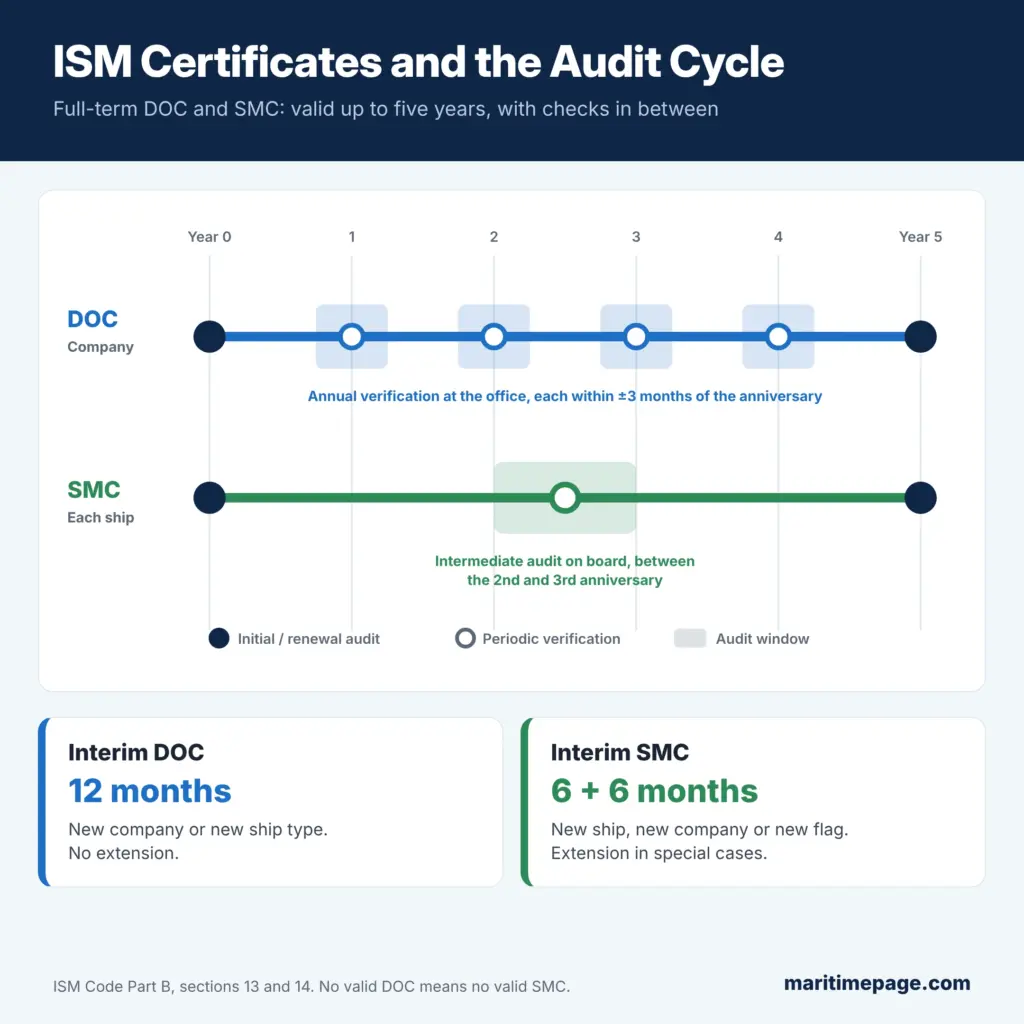
Both full-term certificates are valid for up to five years, with verification audits in between. The table below follows Part B, sections 13 and 14.
| Certificate | Validity | Verification in between |
|---|---|---|
| DOC (company) | Up to 5 years | Annual verification within 3 months before or after each anniversary date |
| SMC (ship) | Up to 5 years | At least one intermediate verification; if only one, between the second and third anniversary dates |
| Interim DOC | Up to 12 months | Issued to a new company or for a new ship type; no extension |
| Interim SMC | Up to 6 months | Issued on delivery, on change of company or on change of flag; may be extended by up to 6 months in special cases |
If the annual DOC verification is not carried out, the DOC can be withdrawn. Every SMC linked to it is then withdrawn as well, so one missed office audit can stop the whole fleet.
How Do ISM Audits Work?
ISM audits compare what the SMS says with what actually happens ashore and on board. Internal audits are run by the company itself. External audits are run by the flag Administration or a recognized organization.
What Is an Internal ISM Audit?
Section 12.1 requires internal safety audits on board and ashore at intervals not exceeding 12 months. In exceptional circumstances, the interval may be exceeded by up to three months.
Auditors must be independent of the area they audit, unless the company is too small to allow it. Results go to the staff responsible for that area, and to management review under section 12.3.
What Are the Stages of External Audit?
- Initial audit: before the DOC or SMC is issued, after the SMS has run on board long enough to produce records.
- Annual audit: DOC only, at the company’s office.
- Intermediate audit: SMC, on board, between the second and third anniversary.
- Renewal audit: before the five-year certificates expire.
- Additional audit: when the flag or recognized organization requires it, for example after a detention or a serious accident.
What Is the Difference Between an Observation, a Non-Conformity and a Major Non-Conformity?
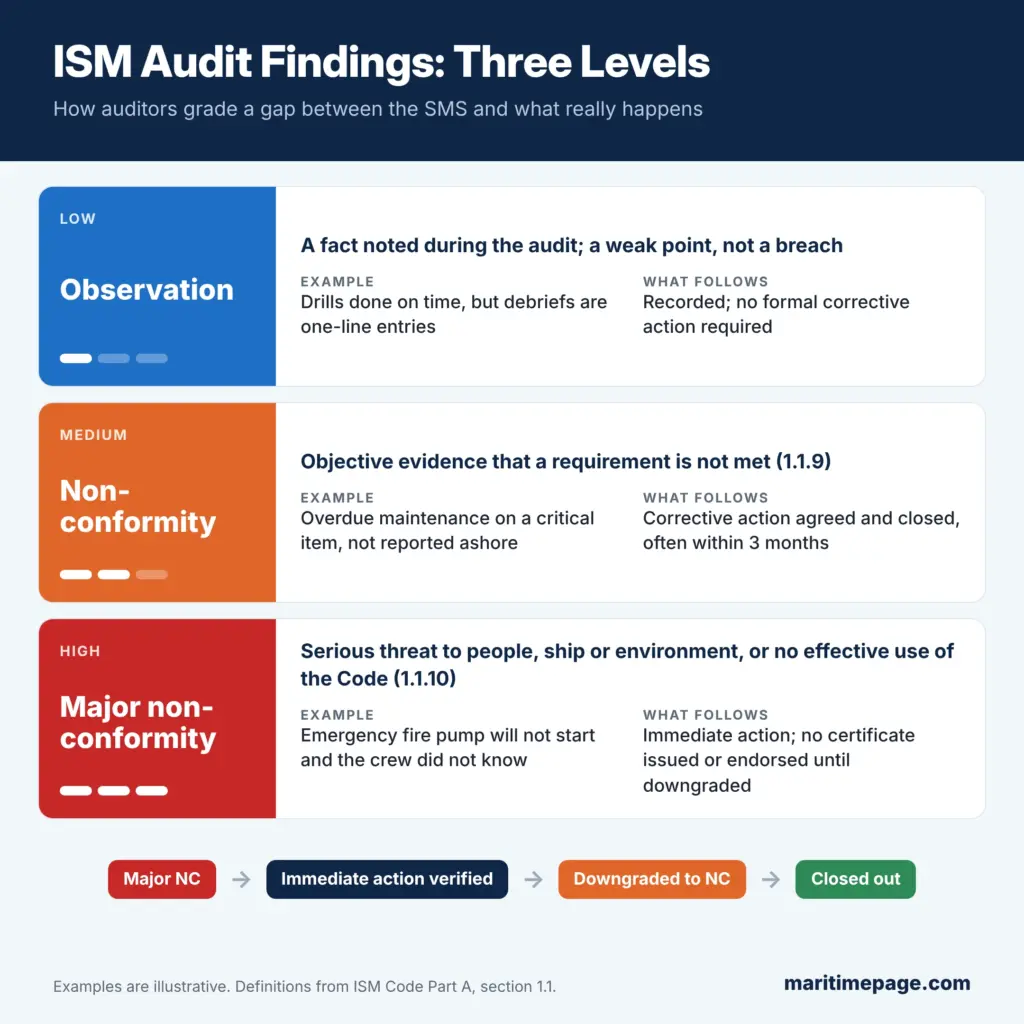
Audit findings are graded by how far they depart from the SMS and how much risk they carry.
| Finding | Meaning | Typical consequence |
|---|---|---|
| Observation | A statement of fact made during the audit, often a weakness that could become a non-conformity | Recorded; no formal corrective action required |
| Non-conformity | Objective evidence that a specified requirement has not been met (Part A, 1.1.9) | Corrective action agreed and closed within a set time, often three months |
| Major non-conformity | A deviation posing a serious threat to people, the ship or the environment, or a lack of effective and systematic implementation of the Code (1.1.10) | Immediate corrective action; the certificate cannot be issued or endorsed until it is downgraded |
A major non-conformity is normally downgraded once immediate action is verified. The remaining non-conformity then follows the normal corrective-action process.
What Do ISM Auditors Look For on Board?
Auditors look for evidence that the SMS is used, not just filed. Records are compared against the actual condition of the ship and against what the crew say and do.
- Crew who know the emergency procedures relevant to their duties and can show them.
- Drill records that match the logbook and the drill scenarios in the manual.
- Planned maintenance records that match the condition of the equipment.
- Near-miss reports being raised, investigated and fed back, not stopping at zero.
- Superseded documents removed and controlled copies up to date.
A common gap is an SMS that reads well in the office but is too long or too generic to use on board. Checklists completed in advance, or signed by one person for the whole team, are another warning sign.
What Do PSC and Vetting Inspectors Check for ISM?
Port state control inspectors check that the DOC copy and SMC are valid and match the ship. They then judge whether the deficiencies they find show that the SMS is not working.
Under Paris MoU guidelines, ISM deficiencies are recorded under code 15150, referencing SOLAS Chapter IX, Regulation 3. The inspector uses professional judgement to link other deficiencies to an ISM failure.
- Certificates: DOC copy and SMC present, valid, endorsed, and for the correct ship type and company.
- Drills: fire and abandon-ship drills done at the required intervals and recorded honestly.
- Maintenance: no overdue jobs on critical equipment, and defects reported to the company.
- Non-conformities: previous PSC and audit findings closed, with evidence.
- Procedures: current versions on board, in a language the crew understands.
- Crew familiarity: officers and ratings able to carry out their SMS duties, such as starting the emergency fire pump.
Where deficiencies show a serious failure of the SMS, the ISM deficiency becomes a ground for detention. The flag Administration, or its recognized organization, must then carry out an additional audit before the ship sails.
For less serious ISM failures, PSC usually requires the company to take corrective action on the SMS within three months.
How Is ISM Checked During Vetting?
Oil majors check the SMS in a vetting inspection of tankers and gas carriers. Inspectors look at the same evidence as PSC, but in more depth, and assess the company through its tanker management self-assessment.
Class and flag also touch ISM during statutory surveys carried out on ships. Surveyors often find SMS failures through defects that the crew should already have reported.
How Does the ISM Code Connect to Other IMO Conventions?
The ISM Code is the management system that delivers compliance with the other conventions. SOLAS, MARPOL, STCW and the Load Lines Convention set the technical rules; the SMS sets out who does what to meet them.
- SOLAS: the Code is mandatory under Chapter IX. Drills, maintenance and navigation procedures in the SMS reflect other SOLAS chapters.
- MARPOL: the environmental-protection policy and procedures cover oil, garbage, sewage and air emissions under the MARPOL Annexes.
- STCW: section 6 requires qualified, certificated crew; STCW sets what qualified means.
- MLC 2006: a separate certification system for seafarers’ working and living conditions, though many companies combine the procedures.
- ISPS Code: a separate security regime with its own ship security plan, often verified by a recognized security organization.
Many companies run an integrated management system that combines ISM with ISO 9001, ISO 14001 and ISO 45001. Integration is allowed, but the ISM elements must still be identifiable for the ISM auditor.
What Role Does the ISM Code Play After an Accident?
After an accident, the SMS becomes evidence. Investigators, insurers and courts examine whether procedures existed, whether the crew followed them, and whether the company acted on earlier warnings.
- Earlier near-miss reports and non-conformities on the same issue.
- Training and familiarization records for the people involved.
- Maintenance history of the equipment that failed.
- Communication between the ship, the DPA and the technical superintendent.
A company cannot hide behind the crew when its own records show a known risk was left open. That link between shore management and shipboard outcome is the core of the Code.
A safety culture cannot be certified on paper. Section 9 only works when crews report hazards and the company treats reports as information, not as blame.
For the full text, the IMO publication ISM Code and Guidelines on Implementation of the ISM Code is the standard reference. It contains the Code, the guidelines for Administrations and the related circulars.
The official IMO overview is on the IMO ISM Code page.
Related Topics
- Types of drills on board merchant ships
- How many crew members modern ships need
- The IGC Code for gas carriers
- Ship registries and flags of convenience
Frequently Asked Questions
What does ISM Code stand for?
International Safety Management Code. Its full title is the International Management Code for the Safe Operation of Ships and for Pollution Prevention, adopted by IMO in 1993.
Who must comply with the ISM Code?
Companies operating passenger ships, and cargo ships and mobile offshore drilling units of 500 GT and above, on international voyages. Many flag states extend ISM rules to smaller domestic ships.
What is the difference between the DOC and the SMC?
The Document of Compliance is issued to the company for the ship types it operates. The Safety Management Certificate is issued to each ship. A ship’s SMC is only valid while the company holds a valid DOC.
What is a non-conformity under the ISM Code?
An observed situation where objective evidence shows a specified requirement has not been met. A major non-conformity poses a serious threat to people, the ship or the environment and needs immediate action.
Who is the designated person ashore?
A person, or persons, ashore with direct access to the highest level of management, required by section 4 of the ISM Code. The DPA monitors safety and pollution prevention on each ship.
How often are ISM audits carried out?
Internal audits at least every 12 months, extendable by three months in exceptional cases. Externally, the DOC is verified annually and the SMC at an intermediate audit, with renewal every five years.
Does the ISM Code apply to yachts and small vessels?
Not under SOLAS, unless the yacht is a commercial vessel of 500 GT or more on international voyages. Private pleasure yachts are outside SOLAS, but some flag states apply ISM rules to smaller vessels.
Can a ship be detained for ISM failures?
Yes. If deficiencies show a serious failure of the SMS, port state control can detain the ship. The flag Administration or its recognized organization must then audit the ship before release.

- Great Lakes Maritime Academy: Programs, Cost and Admission – October 14, 2026
- Bunker Delivery Note (BDN): Contents, MARPOL Rules and Checks – October 11, 2026
- Oil Record Book: Part I and Part II Entries, Rules and PSC Checks – October 11, 2026