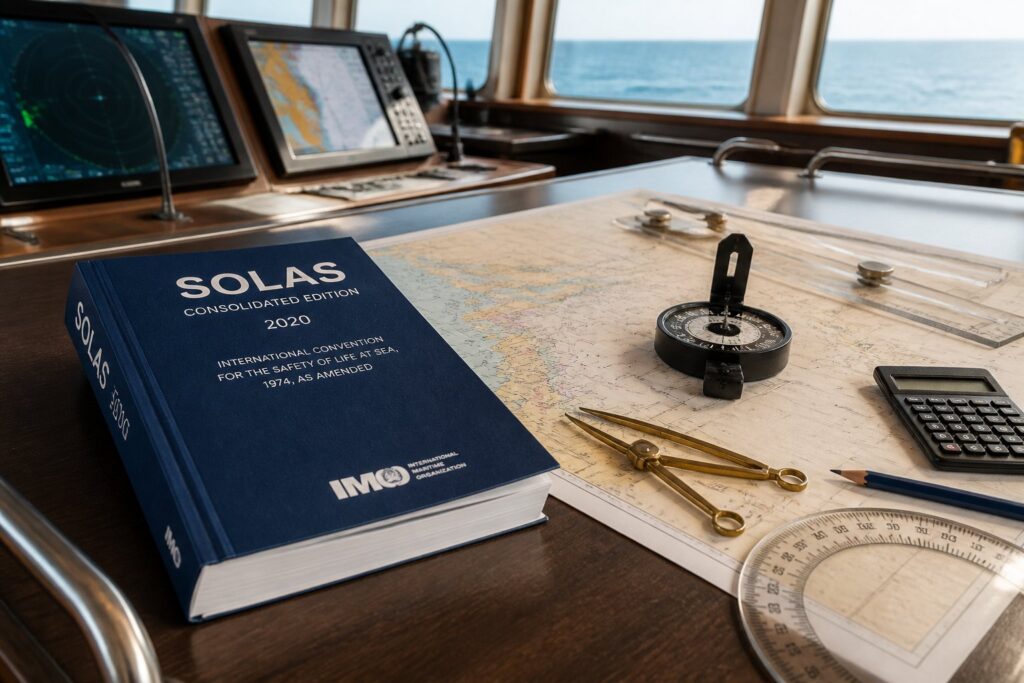
SOLAS is the International Convention for the Safety of Life at Sea — the IMO treaty setting minimum construction and safety standards for merchant ships. Adopted in 1974 and in force since 1980, it’s organized into fourteen chapters covering everything from lifeboats to shipboard security. This guide breaks down what each chapter requires and which of your ship’s systems, certificates, and daily operations it touches.
What Are the SOLAS Chapters?
SOLAS is organized into fourteen chapters, each covering a different aspect of ship safety — from construction and firefighting to navigation, security, and polar operations. The table below shows what every chapter covers.
| Chapter | Title | Covers |
|---|---|---|
| I | General Provisions | Surveys and certification framework |
| II-1 | Construction — Subdivision, Stability, Machinery, Electrical | Structural safety, stability, steering gear, power systems |
| II-2 | Fire Protection, Detection and Extinction | Firefighting equipment and fire safety design |
| III | Life-Saving Appliances | Lifeboats, liferafts, life jackets, drills |
| IV | Radiocommunications | GMDSS equipment and distress communications |
| V | Safety of Navigation | Navigation equipment, watchkeeping, voyage planning |
| VI | Carriage of Cargoes and Oil Fuels | Cargo stowage and securing |
| VII | Carriage of Dangerous Goods | IMDG Code, packaged and bulk dangerous cargo |
| VIII | Nuclear Ships | Nuclear-powered vessel safety |
| IX | Management for the Safe Operation of Ships | ISM Code, safety management systems |
| X | Safety Measures for High-Speed Craft | HSC Code |
| XI-1 | Special Measures to Enhance Maritime Safety | Enhanced surveys, enclosed space entry |
| XI-2 | Special Measures to Enhance Maritime Security | ISPS Code, ship and port security |
| XII | Additional Safety Measures for Bulk Carriers | Structural strength requirements |
| XIII | Verification of Compliance | IMO Member State Audit Scheme |
| XIV | Safety Measures for Ships Operating in Polar Waters | Polar Code |
What Does SOLAS Chapter I Cover?
SOLAS Chapter I sets the general framework — survey and certification requirements every SOLAS ship has to meet before it’s allowed to trade. It’s the administrative backbone the other thirteen chapters build on.
Classification societies carry out the surveys Chapter I requires on behalf of the flag state, issuing the certificates that prove a ship meets SOLAS standards. Those surveys run on fixed cycles — annual, intermediate, and renewal — the same pattern MARPOL certification follows.
What Does SOLAS Chapter II-1 Cover?
SOLAS Chapter II-1 covers a ship’s construction — subdivision and damage stability, machinery, and electrical systems. It’s the broadest chapter in the convention, and the one that shapes how a ship is actually built.
Emergency generator cut-in times after a total blackout are set here, along with the backup power a ship needs to restart itself. Steering gear requirements — response time and redundancy, including the telemotor systems that transmit helm orders — also live in this chapter.
So do watertight subdivision rules, and the stability calculations behind them. Intact stability criteria come from the IS Code, made mandatory through this chapter. A ship’s center of buoyancy and flotation determine how much damage she can take before capsizing.
What Does SOLAS Chapter II-2 Cover?
SOLAS Chapter II-2 sets fire protection, detection, and extinction standards — the design and equipment that stop a shipboard fire from becoming a total loss. It’s one of the most detailed and frequently cited chapters on this site.
Fire hose requirements under Chapter II-2 Regulation 10 specify hose length, diameter, and coverage — one of the most specifically cited regulations on the site. Fire pump testing, required under the same chapter, is one of the checks built into routine emergency drills.
The same regulation also requires an international shore connection on every ship of 500 gross tonnage and upwards, so shore or another vessel’s pumps can feed the fire main in an emergency.
What Does SOLAS Chapter III Cover?
SOLAS Chapter III regulates life-saving appliances — lifeboats, liferafts, life jackets, and the drills that keep crews able to use them under pressure. It’s the chapter most directly tied to abandon-ship survival.
Lifeboat regulations under Chapter III cover launch time, davit systems, free-fall lifeboats, and the hydrostatic release units required on liferafts. The same chapter governs simpler equipment too — a ship’s throwable flotation devices are SOLAS life-saving appliances, not just recreational safety gear.
Regulation 19 sets the actual drill schedule: abandon-ship and fire drills at least monthly. Every crew member trains on the specific equipment they’d use in a real emergency.
What Does SOLAS Chapter IV Cover?
SOLAS Chapter IV covers radiocommunications — the Global Maritime Distress and Safety System (GMDSS) equipment every SOLAS ship has to carry and keep operational. It’s the chapter behind a ship’s ability to call for help.
GMDSS equipment lists — EPIRBs, SARTs, NAVTEX, DSC radios — are Chapter IV territory. So is the Safety Radio Certificate that proves it’s all fitted and working. Modern satellite communications now sit alongside the traditional GMDSS network, adding cyber-risk considerations the original chapter never anticipated.
What Does SOLAS Chapter V Cover?
SOLAS Chapter V covers safety of navigation — the equipment, watchkeeping standards, and voyage planning rules that apply to every ship, not just SOLAS-convention vessels. It’s one of the few chapters with real reach beyond the convention’s usual scope.
The Bridge Navigational Watch Alarm System (BNWAS), required under Regulation V/19, monitors officer alertness on the bridge. AIS carriage is a Chapter V requirement too. So is the full suite of navigation equipment — radar, ECDIS, gyrocompass — every SOLAS ship has to fit.
Chapter V also sets the equipment standard marine radar has to meet. It doesn’t cover every real-world limitation a radar has in poor weather or heavy traffic, though. That’s a training and judgment gap, not a compliance one.
What Does SOLAS Chapter VII Cover?
SOLAS Chapter VII regulates the carriage of dangerous goods, requiring compliance with the IMDG Code for packaged cargo and equivalent codes such as the IBC Code for bulk chemicals. It works alongside MARPOL Annex III rather than replacing it.
The IMDG dangerous cargo manifest is the same paperwork Chapter VII and MARPOL Annex III both point to — one code satisfies both conventions. When something goes wrong, onboard spill response follows the same IMDG Code procedures regardless of which convention technically applies.
What Does SOLAS Chapter IX Cover?
SOLAS Chapter IX makes the ISM Code mandatory — the safety management system every operator has to run. It covers everything from a Document of Compliance to a ship’s Safety Management Certificate.
The ISM Code became mandatory in phases: 1998 for passenger ships and higher-risk cargo vessels, 2002 for everything else above 500 GT. It requires a documented Safety Management System covering everything from bridge procedures to how near-misses get reported and reviewed.
This site doesn’t have a dedicated ISM Code article yet. It’s next on the list, and this section will link to it directly once it’s live.
What Does SOLAS Chapter XI-1 Cover?
SOLAS Chapter XI-1 adds special measures to enhance maritime safety on top of the earlier chapters. It covers enhanced surveys for bulk carriers and tankers, plus atmosphere testing before anyone enters an enclosed space.
Regulation XI-1/7 is why enclosed space entry requires a calibrated atmosphere-testing instrument before anyone goes in. It’s one of the more consequential single regulations on this site, given how many fatalities enclosed-space entry still causes.
What Does SOLAS Chapter XI-2 Cover?
SOLAS Chapter XI-2 adds special measures to enhance maritime security, making the ISPS Code mandatory for ships and the ports they call at. Adopted after the September 2001 attacks, it entered into force in July 2004.
Every SOLAS ship needs a Ship Security Plan and a Ship Security Officer under this chapter, verified through a Recognized Security Organization. In the US, the Maritime Transportation Security Act implements the same ISPS obligations domestically, alongside its own additional requirements.
The remaining chapters round out the convention without a dedicated site article yet. Chapter VI covers cargo stowage, securing, and oil fuel carriage. Chapter VIII covers the small fleet of nuclear-powered ships.
Chapter X applies the High-Speed Craft (HSC) Code to fast ferries and similar vessels. Chapter XII adds structural strength requirements for bulk carriers, and Chapter XIII covers verification of member-state compliance through the IMO’s own audit scheme.
Chapter XIV applies the Polar Code to ships operating in Arctic and Antarctic waters, in force since January 2017. It adds ice-strengthening, cold-weather equipment, and crew training requirements on top of everything else in the convention.
Is SOLAS Mandatory for Every Ship?
Yes — unlike MARPOL, SOLAS has no optional-chapter structure. Every one of its fourteen chapters applies in full to every SOLAS Contracting Government’s ships.
A few newer chapters, like ISM and ISPS, had phased start dates rather than optional ratification. SOLAS is ratified by more than 165 countries, covering about 99% of world merchant tonnage — effectively universal.
That’s tighter than MARPOL’s Annex-by-Annex ratification pattern, where individual Annexes III through VI can still, in theory, be opted out of. SOLAS Chapter V does require compliance with the COLREGs, and crew certification under the STCW Code works alongside SOLAS equipment requirements. Both are separate conventions in their own right, not SOLAS chapters.
How Is SOLAS Enforced?
The same way MARPOL is: flag states certify their own ships through classification societies, and port state control inspects visiting foreign ships for compliance. A ship with serious SOLAS deficiencies can be detained until they’re fixed.
Port state control checks SOLAS compliance in the same inspections that check MARPOL. Life-saving equipment, navigation lights, and radio communications are all common detention triggers.
Charterers layer their own vetting inspections on top of the regulatory minimum. A detention record follows a ship into every future charter negotiation.
Frequently Asked Questions
What does SOLAS stand for?
SOLAS stands for the International Convention for the Safety of Life at Sea, adopted in 1974 and in force since 1980.
How many SOLAS chapters are there?
Fourteen, numbered I through XIV, with Chapters II and XI each split into two parts — II-1/II-2 and XI-1/XI-2.
Is SOLAS mandatory?
Yes. Unlike MARPOL, SOLAS has no optional-chapter structure — every chapter applies in full to every Contracting Government’s ships, aside from phased start dates for newer chapters like ISM and ISPS.
What is the ISM Code?
The ISM Code, made mandatory under SOLAS Chapter IX, requires every ship operator to run a documented Safety Management System covering procedures, training, and incident reporting.
What is the ISPS Code?
The ISPS Code, made mandatory under SOLAS Chapter XI-2 in July 2004, requires ships and the ports they call at to maintain security plans and a designated security officer.
What’s the difference between SOLAS and MARPOL?
SOLAS governs ship safety — construction, equipment, and life-saving appliances. MARPOL governs pollution prevention. Most SOLAS ships also have to comply with MARPOL.
Is COLREGs part of SOLAS?
No. COLREGs is a separate 1972 convention on collision avoidance, though SOLAS Chapter V requires ships to comply with it.
Who enforces SOLAS?
Flag states enforce SOLAS through classification society surveys and certification, while port state control inspects foreign ships calling at their ports for compliance.

- Great Lakes Maritime Academy: Programs, Cost and Admission – October 14, 2026
- Bunker Delivery Note (BDN): Contents, MARPOL Rules and Checks – October 11, 2026
- Oil Record Book: Part I and Part II Entries, Rules and PSC Checks – October 11, 2026