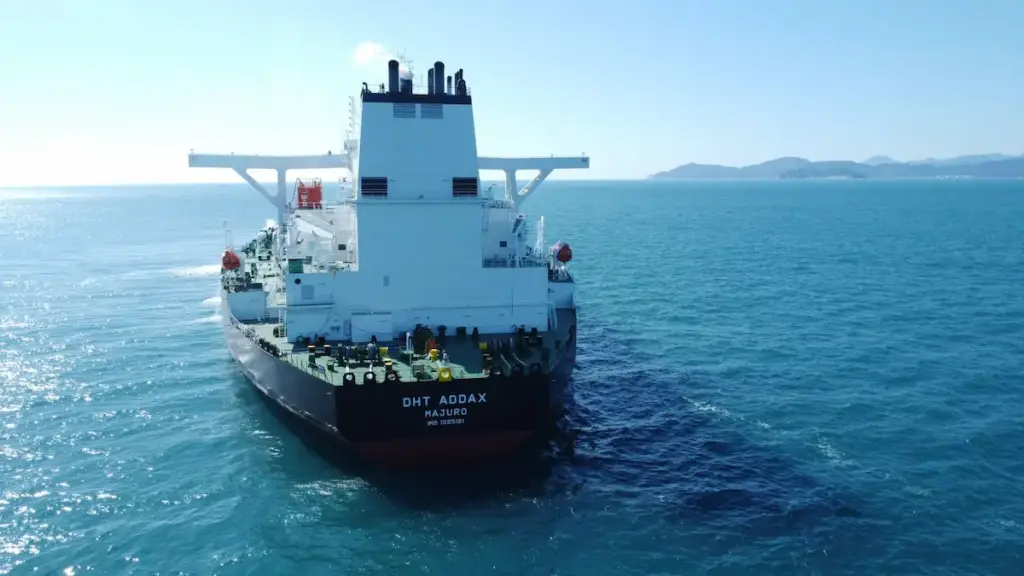
A VLCC (Very Large Crude Carrier) is an oil tanker of 200,000 to 320,000 deadweight tonnes. It carries roughly two million barrels of crude oil, linking the Middle East and West Africa to refining centers in Asia and the US Gulf. This guide covers VLCC design, chartering mechanics, and current fleet ownership.
What Is a VLCC?
A Very Large Crude Carrier is a tanker between 200,000 and 320,000 deadweight tonnes (dwt), built for high-volume, long-haul crude oil transport. It sits directly below the Ultra Large Crude Carrier (ULCC), at 320,000-550,000 dwt, and above the Suezmax class.
The VLCC band is wider than any other major tanker class. Brokers split it further by dwt and draft, since a 250,000-dwt ship and a 320,000-dwt ship charter and discharge differently. The Malaccamax section below covers that split.
VLCCs almost never carry refined products. Their economics only work in bulk crude trades, where cargo volume offsets the cost of running a 300,000-tonne ship and the port infrastructure it needs.
What Are a VLCC’s Dimensions and Cargo Capacity?
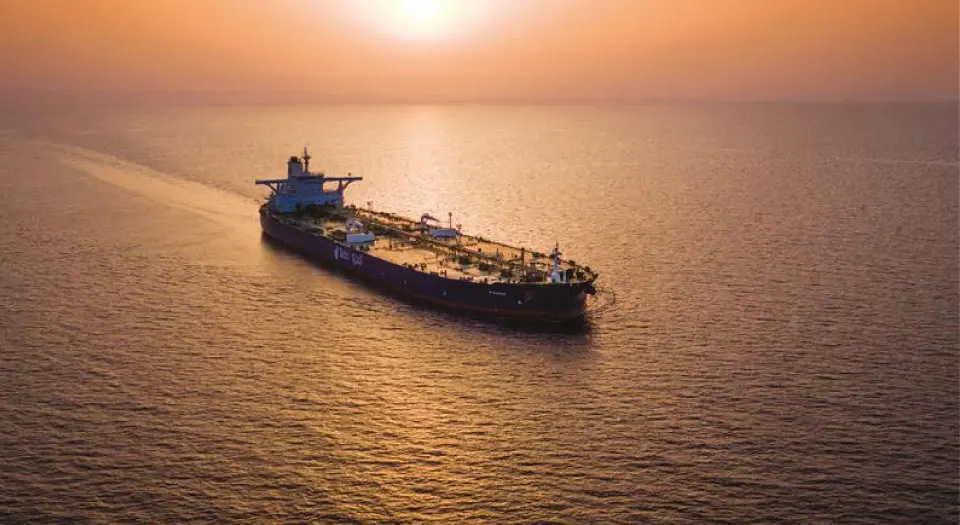
A typical VLCC carries close to two million barrels of crude oil. It runs 330-333 meters length overall, with a beam near 60 meters and a laden draft of roughly 20-22 meters.
That draft is the class’s defining constraint. A VLCC cannot approach most quay-side terminals fully loaded, so it depends on deepwater moorings instead of pierside berths.
What Is a Malaccamax VLCC?
A Malaccamax VLCC is the largest VLCC subtype, built to the maximum draft the Strait of Malacca allows, around 320,000 dwt. Ships built past that draft can’t transit the strait loaded, the shortest route between the Middle East and East Asia.
The strait’s controlling depth sets the ceiling, not any regulation. A ship built beyond it must run light through the strait or divert around it. Either option erases the VLCC’s main cost advantage on the Gulf-to-Asia run.
How Is a VLCC Built?
Every VLCC delivered since the early 2000s has a double hull, required under MARPOL Annex I Regulation 19. A second watertight skin separates the cargo tanks from the sea. A grounding or minor collision doesn’t automatically mean a spill.
Regulation 19 phased out single-hull tankers on a rolling schedule that closed in 2010 for most flag states. The IMO tightened that timeline after the Erika and Prestige spills. A VLCC built today also carries segregated ballast tanks, an inert gas system, and crude oil washing (COW) equipment, all mandated under the same Annex.
Main propulsion is almost always a single low-speed two-stroke diesel turning a fixed-pitch propeller. Service speed runs around 15-16 knots laden. Newer tonnage on order carries scrubbers or dual-fuel LNG engines to meet IMO sulfur and carbon-intensity rules, a shift covered in the ownership section below.
What Routes Do VLCCs Sail?
VLCCs run two dominant trade lanes: Middle East Gulf to East Asia, and Brazil or West Africa to the US Gulf Coast. The Gulf-to-China leg, benchmarked as the Baltic Exchange’s TD3C route, is the single most-watched rate in tanker shipping.
Both lanes share the same logic: hauls long enough that a VLCC’s per-barrel cost beats a Suezmax or Aframax, with deepwater terminals at both ends. Secondary VLCC trade runs West Africa to China, and, increasingly, around the Cape of Good Hope when Red Sea or Suez transit risk rises.
Why Can’t a Loaded VLCC Transit the Suez Canal Directly?
A fully laden VLCC exceeds the Suez Canal’s maximum draft. It must partially discharge cargo into the SUMED pipeline before transiting, or make the passage in ballast. SUMED runs overland from Ain Sukhna on the Red Sea to Sidi Kerir on the Mediterranean, parallel to the canal.
A northbound VLCC discharges enough cargo at Ain Sukhna to bring its draft under the canal limit, then transits light. It reloads the pumped volume at SUMED’s Mediterranean terminal, or sells those barrels separately. A Suezmax, which fits the canal loaded, skips this step entirely.
How Do VLCCs Load and Discharge Cargo?
VLCCs load and discharge at deepwater terminals or single buoy moorings (SBMs), since their draft rules out most conventional quays. Where no deepwater terminal exists, a VLCC discharges part of its cargo offshore in a ship-to-ship (STS) transfer, called lightering. That trims draft before the ship approaches port.
An SBM is a floating buoy anchored to the seabed and connected to shore by a submarine pipeline. The tanker moors to the buoy and pumps cargo ashore through a flexible hose without entering port. Pumping, tank stripping, and inert gas management follow the same equipment covered in this site’s guide to cargo handling systems on oil tankers.
Lightering is routine on the US Gulf Coast, where few berths take a fully laden VLCC. It’s also common off Fujairah, where VLCCs top off or discharge into smaller tankers for onward Gulf and Red Sea distribution. A charterer planning lightering into a voyage builds the extra day or two into the freight rate.
How Does VLCC Chartering Work?
VLCC charterers fix a vessel on the spot market for a single voyage, or on a time charter for a fixed period. Time charters typically run one to three years. Spot fixtures dominate VLCC chartering and set the Worldscale and TCE benchmarks the whole market watches.
A spot (voyage) charter fixes a vessel for one cargo at a rate agreed for that route. The owner covers fuel, port costs, and canal dues. A time charter hires the ship at a daily rate for a set period instead, and the charterer covers voyage costs.
Oil majors and national oil companies favor time charters for supply security. Independent traders like Vitol, Gunvor, and Trafigura run mostly on spot.
What Do Worldscale (WS) and TCE Mean for a VLCC Fixture?
Worldscale expresses a tanker’s freight rate as a percentage of WS100, a fixed reference rate calculated separately for each voyage combination. WS100 isn’t one dollar figure market-wide. The Worldscale Association publishes a different flat rate, in dollars per tonne, for every port pair each year.
A fixture at WS150 pays 1.5 times that route’s flat rate. WS280 pays 2.8 times it. Because each route’s flat rate differs, the same WS number produces very different dollar-per-tonne freight on different lanes.
Time Charter Equivalent (TCE) converts a WS-rated voyage into a daily dollar figure instead. It takes the freight revenue, subtracts bunker fuel, port charges, and canal dues, then divides what’s left by the voyage days. TCE is the number owners and charterers actually compare across fixtures, since it strips out the route-length differences a bare WS number hides.
Why Did VLCC Rates Spike Above $1 Million a Day in September 2026?
This section describes conditions as of mid-September 2026. Spot rates are the most volatile figure in shipping, so treat it as a snapshot, not a standing fact about VLCC economics.
The Baltic Exchange’s TD3C benchmark, Middle East Gulf to China, broke $1 million a day for the first time on September 14, 2026. It reached $1.099 million a day by September 15, up from roughly $700,000 at the start of the month.
The trigger was a sharp cut in Middle East crude flows. Saudi Arabia suspended its East-West pipeline and Yanbu Red Sea export terminal, while Strait of Hormuz transits slowed to a trickle. That pushed more crude onto tankers loading from the Gulf just as fewer ships were available to carry it.
Sinokor, the owner discussed below, fixed the VLCC Kuwait Prosperity at WS1350 for an Arabian Gulf-to-East voyage loading September 22. That rate equals more than $1 million a day, well above levels seen earlier in the year.
The spike also sits on top of a structural shift already under way. Tightening sanctions on the Russian shadow fleet had already been cutting the compliant VLCC count through the first half of 2026. September’s disruption hit an already-thin market.
Who Owns the World’s Largest VLCC Fleets?
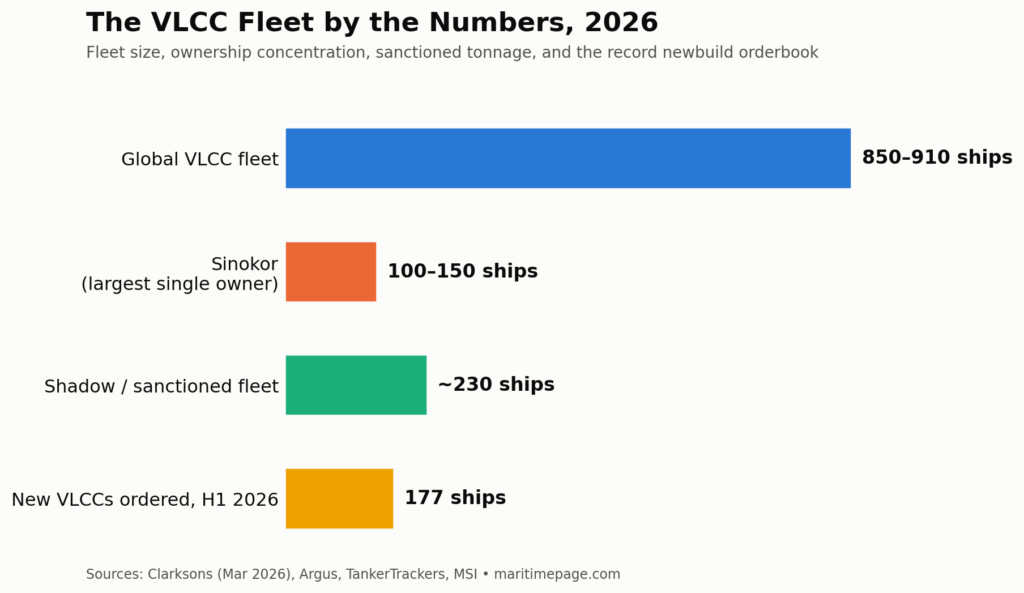
South Korea’s Sinokor Merchant Marine became the largest single commercial VLCC operator in early 2026. Broker estimates put its fleet between 100 and 150 ships by mid-year, well ahead of the next-largest owners. China Merchants, COSCO Shipping Energy, the Fredriksen Group (Frontline), Saudi Arabia’s Bahri, and the Angelicoussis Group round out the largest owners by fleet size.
Allied Shipbroking estimated in early 2026 that these six owners would soon control close to 30% of the global VLCC fleet, once Sinokor’s purchases closed. That’s a concentration level without recent precedent. Until 2023, no single commercial operator held more than about 15% of the spot-trading fleet.
Sinokor built its position mostly by buying secondhand tonnage from established owners, including a run of former Frontline VLCCs, rather than through newbuild orders. Fleet counts by owner move weekly in a market this active, so treat any single figure as dated the moment it’s published. This site’s ranking of the 10 largest oil tanker companies covers individual fleet composition in more depth.
How Many VLCCs Are There in the World?
The global VLCC fleet runs roughly 850 to 910 ships, depending on the source and whether sanctioned or laid-up tonnage is counted. Clarksons’ March 2026 fleet table listed 912 uncoated VLCC/ULCC hulls. Owner filings that exclude very old or sanctioned ships put the usable figure closer to 850-870.
That range exists because “VLCC fleet” means different things to different counters. Roughly one in five VLCCs afloat is now over 20 years old. An estimated 17% of VLCC capacity trades under sanctions and never touches mainstream, vetting-compliant charter markets at all.
Ship-tracking firm TankerTrackers counted around 230 VLCCs operating in the shadow fleet as of early 2026. That tonnage shows up in a raw hull count, but it isn’t available to an oil major or trader running standard vetting checks.
The orderbook is reshaping that count faster than at any point in two decades. Owners contracted 177 new VLCCs in the first half of 2026 alone, more than any full prior year on record. That pushed the orderbook-to-fleet ratio from roughly 2% in 2023 to around 35% by mid-2026, though most of that tonnage won’t deliver before 2028.
VLCC vs. Suezmax vs. Aframax vs. ULCC: What’s the Difference?
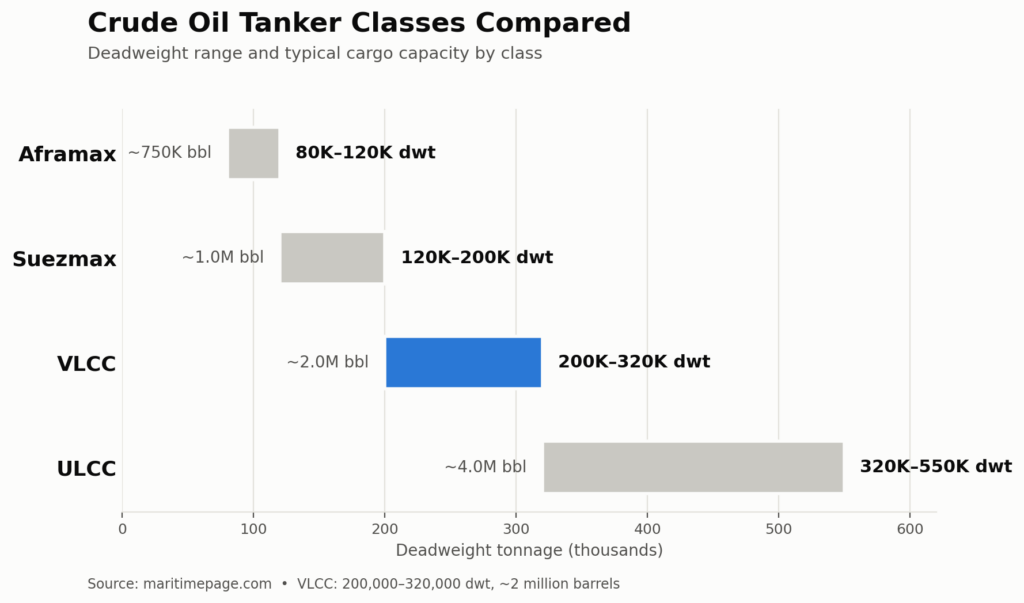
A VLCC carries roughly twice a Suezmax’s cargo and about 2.7 times an Aframax’s, but only about half to two-thirds of a ULCC’s. Each class trades on routes matched to its draft and canal limits. The table below lines up all four crude tanker classes by size, capacity, and typical trade.
| Class | Deadweight (dwt) | Typical Cargo Capacity | Typical Trade Routes |
|---|---|---|---|
| Aframax | 80,000-120,000 | ~750,000 barrels | Regional/short-haul: North Sea, Caribbean, Black Sea |
| Suezmax | 120,000-200,000 | ~1,000,000 barrels | West Africa-Europe/US; transits Suez Canal loaded |
| VLCC | 200,000-320,000 | ~2,000,000 barrels | Middle East Gulf-Asia; Brazil/West Africa-US Gulf |
| ULCC | 320,000-550,000 | ~2–3.7 million barrels | Middle East Gulf-Asia/Europe; limited to a handful of deepwater terminals |
The practical dividing line between classes is port access, not just tonnage. A Suezmax fits most canals and many conventional berths loaded. A VLCC needs a deepwater terminal or SBM, and a ULCC is restricted to the handful of ports built to take it.
For a full breakdown of where each class sits in the broader fleet, see this site’s guide to oil tanker types and classification.
Frequently Asked Questions
What does VLCC stand for?
VLCC stands for Very Large Crude Carrier, an oil tanker between 200,000 and 320,000 deadweight tonnes built for long-haul crude oil transport. It sits one size class below the Ultra Large Crude Carrier (ULCC).
How much crude oil can a VLCC carry?
A VLCC typically carries close to two million barrels of crude oil per voyage. Exact capacity varies with the ship’s specific deadweight, cargo density, and how much ballast water the voyage requires.
How many VLCCs are there in the world?
The global VLCC fleet runs roughly 850 to 910 ships as of 2026, depending on whether sanctioned, laid-up, or very old tonnage is counted. Around 230 of those operate in the sanctioned shadow fleet rather than mainstream compliant trade.
Who owns the most VLCCs?
South Korea’s Sinokor Merchant Marine became the largest single VLCC operator in 2026, with broker estimates placing its fleet between 100 and 150 ships. China Merchants, COSCO Shipping Energy, Frontline, Bahri, and the Angelicoussis Group round out the largest owners.
What is a Malaccamax VLCC?
A Malaccamax VLCC is the largest VLCC subtype, built to roughly 320,000 dwt, the maximum draft that allows a loaded transit of the Strait of Malacca. Larger ships lose the ability to take the shortest Gulf-to-Asia route while fully laden.
Why can’t a VLCC transit the Suez Canal fully loaded?
A laden VLCC’s draft exceeds the Suez Canal’s limit, so it must discharge part of its cargo into the SUMED pipeline at Ain Sukhna before transiting light. It reloads the pumped volume, or sells it separately, at the pipeline’s Mediterranean terminal.
What is the difference between a VLCC and a ULCC?
A ULCC is larger, running 320,000 to 550,000 dwt against a VLCC’s 200,000 to 320,000 dwt, and carries up to nearly twice the cargo. ULCCs are restricted to the small number of ports and terminals built to handle their draft.
Why did VLCC freight rates pass $1 million a day in September 2026?
Saudi Arabia’s suspension of East-West pipeline flows and Yanbu exports, combined with a sharp slowdown in Strait of Hormuz transits, pushed more crude onto an already tight tanker market. The Baltic Exchange’s TD3C benchmark reached $1.099 million a day on September 15, 2026, up from about $700,000 at the start of the month.

- Great Lakes Maritime Academy: Programs, Cost and Admission – October 14, 2026
- Bunker Delivery Note (BDN): Contents, MARPOL Rules and Checks – October 11, 2026
- Oil Record Book: Part I and Part II Entries, Rules and PSC Checks – October 11, 2026