Under-keel clearance (UKC) is the vertical distance between the lowest point of a ship’s hull and the seabed. Every passage plan must show that it stays above a safe minimum in shallow water, channels, port approaches and at the berth.
This guide is written for navigating officers, masters, cadets and pilots. It explains static and dynamic UKC, the calculation with a worked example, and the allowances to deduct. It also covers company UKC policies and inspections.
What Is Under-Keel Clearance?
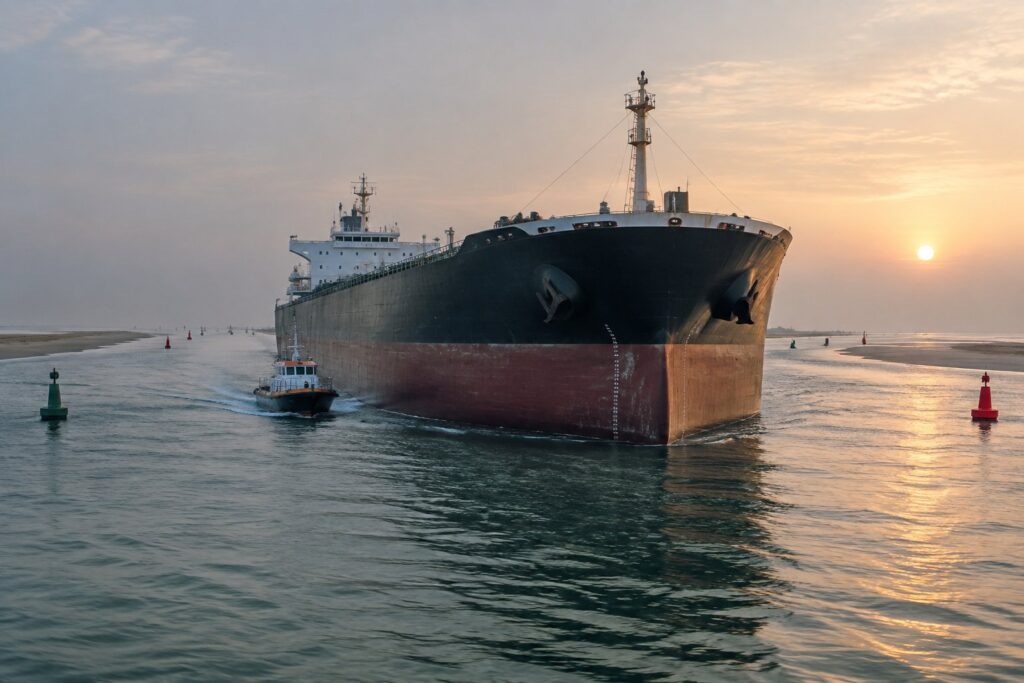
Under-keel clearance is the depth of water left beneath the keel at the ship’s deepest point. It equals the actual depth of water minus the ship’s deepest draft, after allowing for squat, motion and other factors.
UKC is a safety margin against grounding. It must cover everything that can make the ship sit deeper or the water shallower than the chart and tide table suggest. The ship’s draft is only the starting point.
What Is the Difference Between Static and Dynamic UKC?
Static UKC is the clearance with the ship stopped and upright in still water. Dynamic UKC is what remains under way, after deducting squat, heel and wave-induced motion from the static figure.
| Term | How it is found | Also called |
|---|---|---|
| Depth of water | Charted depth + predicted height of tide | Available depth |
| Static UKC | Depth of water − deepest static draft | Gross UKC |
| Dynamic UKC | Static UKC − squat − heel − wave response | Net UKC (after all allowances) |
Many companies set limits for both. The static figure is checked during loading and planning; the dynamic figure decides the safe speed and tidal window for each shallow stretch.
How Do You Calculate Under-Keel Clearance?
Add the height of tide to the charted depth and subtract the deepest draft to get static UKC. Then deduct squat, heel, wave and density allowances, and compare the result with the minimum.
- Find the least charted depth on the planned track, below chart datum.
- Add the predicted height of tide for the time of passage, corrected for weather where relevant.
- Subtract the ship’s deepest draft, usually aft when trimmed by the stern, to get static UKC.
- Deduct squat for the planned speed and channel type.
- Deduct allowances for heel, wave-induced motion and water density.
- Compare the remaining net UKC with the company and port minimum, and adjust speed or timing if it falls short.
Worked Example
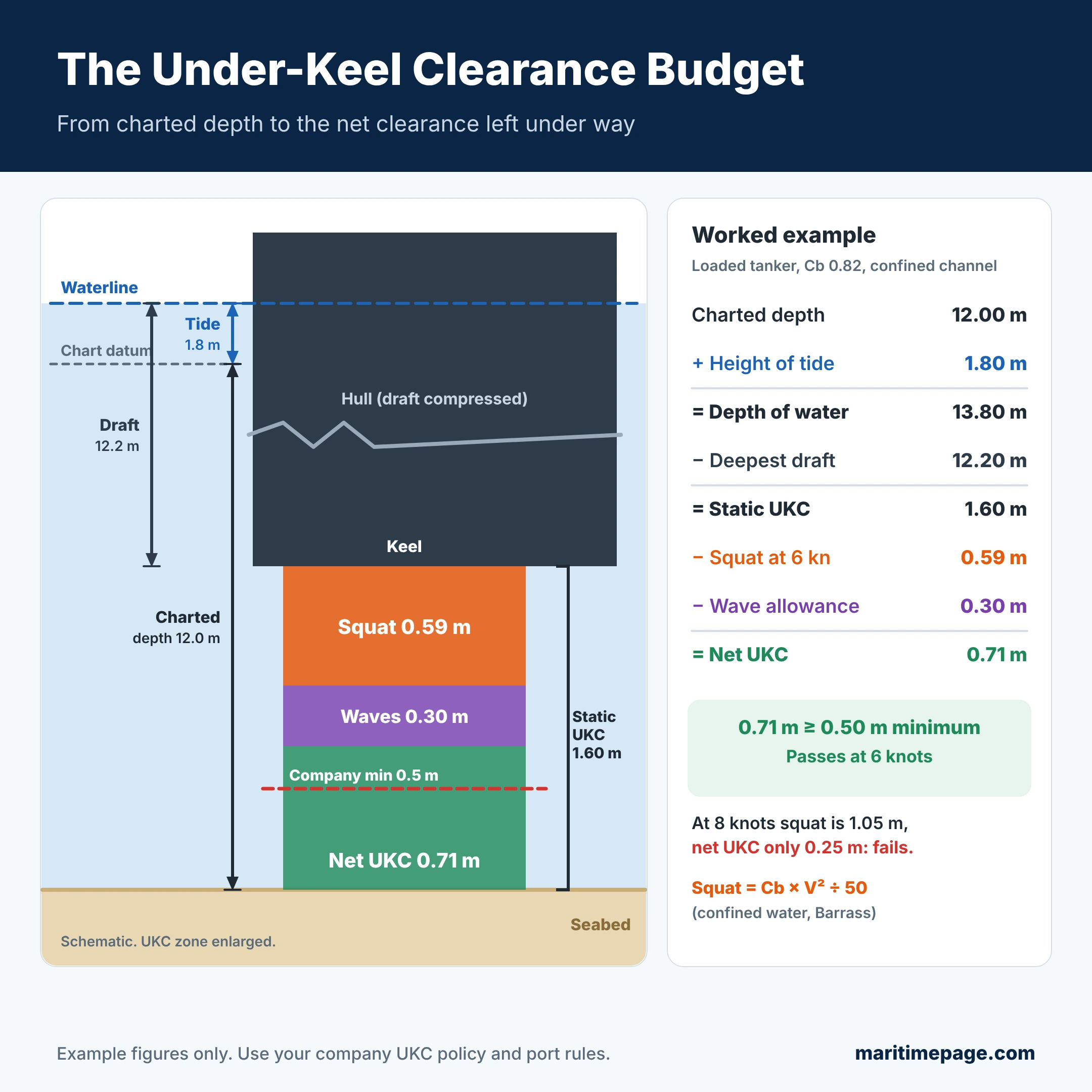
A loaded tanker with a block coefficient of 0.82 plans to pass through a confined channel. The least charted depth is 12.0 m, and the predicted height of tide is 1.8 m.
| Step | Calculation | Result |
|---|---|---|
| Depth of water | 12.0 m + 1.8 m | 13.8 m |
| Static UKC | 13.8 m − 12.2 m deepest draft | 1.60 m |
| Squat at 8 knots | 0.82 × 8² ÷ 50 | 1.05 m |
| Wave allowance | Swell at the channel entrance | 0.30 m |
| Net UKC at 8 knots | 1.60 − 1.05 − 0.30 | 0.25 m |
| Squat at 6 knots | 0.82 × 6² ÷ 50 | 0.59 m |
| Net UKC at 6 knots | 1.60 − 0.59 − 0.30 | 0.71 m |
With a company minimum of 0.5 m net UKC in channels, 8 knots fails and 6 knots passes. Because ship squat rises with the square of speed, reducing speed is the quickest way to restore the margin.
The minimum figure of 0.5 m here is an example only. Each ship works to its own company policy and any stricter port rule.
What Allowances Must Be Deducted From UKC?
The main allowances are squat, heel, wave-induced motion, water density, tide and weather effects, and chart accuracy. Each one either makes the ship sit deeper or the water shallower than planned.
| Allowance | Why it matters | How it is estimated |
|---|---|---|
| Squat | The ship sinks and trims when under way in shallow water | Barrass: Cb × V² ÷ 100 open water, ÷ 50 confined |
| Heel | The bilge goes deeper when the ship heels in a turn, wind or list | About (beam ÷ 2) × sin(heel angle) for a flat-bottomed hull |
| Wave response | Pitch, roll and heave in swell lower the hull further | Company figure for exposed approaches, often 0.3 m or more |
| Water density | A ship sinks deeper in fresh or brackish water | Dock water allowance = FWA × (1025 − ρ) ÷ 25 |
| Tide and weather | High air pressure and offshore winds lower the sea below prediction | About 1 cm lower water per hPa above average pressure |
| Chart accuracy | Surveyed depths carry an uncertainty | CATZOC zone of confidence on ENCs |
| Siltation | Channels and berths fill in between surveys | Latest port survey and harbour master notices |
A heel of only 2° on a ship 32 m wide adds about 0.56 m to the draft at the bilge. That is why turns in shallow channels are planned at low speed with small rudder angles.
Density matters on river passages and in docks. A ship moving from sea water into fresh water sinks by her fresh water allowance. See the guide to floating in salt and fresh water.
How Does Chart Accuracy (CATZOC) Affect UKC?
ENCs show each area’s zone of confidence, or CATZOC, which states how accurate the charted depths are. Lower categories need a bigger margin.
| CATZOC | Depth accuracy |
|---|---|
| A1 | ± 0.5 m + 1% of depth |
| A2 and B | ± 1.0 m + 2% of depth |
| C | ± 2.0 m + 5% of depth |
| D | Worse than C |
| U | Unassessed |
What Is a Company UKC Policy?
A company UKC policy is the part of the safety management system that sets minimum clearances for each stage of the voyage. It tells the master what margin to keep and when shore approval is needed.
Policies are usually written as a percentage of draft, a fixed figure, or both. The figures below are typical examples, not a standard.
| Voyage stage | Example minimum |
|---|---|
| Open sea | About 20% of maximum draft, or more in heavy swell |
| Coastal waters and port approaches | About 10% of draft, net of squat |
| Channels and rivers | A fixed net figure, such as 0.5 m, after all allowances |
| At berth or anchor | A fixed figure, such as 0.3–0.5 m at the lowest tide |
Many ports also set their own UKC rules for deep-draught ships, often stricter than the company figure. The master works to whichever is more demanding.
Where the minimum cannot be met, most policies require a documented risk assessment and approval from the company before the ship proceeds.
How Is UKC Monitored During a Passage?
UKC is planned in the passage plan and monitored with the echo sounder, ECDIS depth settings and speed control. The officer of the watch checks actual depths against the plan at every shallow stretch.
- Passage plan: each shallow section shows least depth, tide, speed, squat and net UKC. This is part of passage planning under SOLAS Chapter V, Regulation 34 and IMO Resolution A.893(21).
- Tidal window: the earliest and latest times the ship can safely pass a shallow point.
- ECDIS settings: safety depth and safety contour set from draft, squat and the UKC minimum, so shallow water is highlighted.
- Echo sounder: the echo sounder measures depth below the transducer, so add the transducer’s depth or set an offset. A shallow-water alarm is set from the minimum UKC.
- Speed control: speed limits for each section are marked on the plan, linked to the squat calculation and safe speed.
- Pilot exchange: the master-pilot exchange confirms draft, UKC and planned speeds before the pilot takes the con.
Shallow water also changes how the ship handles. She becomes sluggish to the helm and her turning circle increases, so turns need more room and earlier action.
What Should Be Done if UKC Is Below the Minimum?
If UKC falls below the minimum, the ship must not proceed as planned. The options are to reduce speed, wait for more tide, lighten or re-trim the ship, or choose another route.
- Reduce speed: the fastest fix, because squat falls with the square of speed.
- Change the timing: pass nearer high water or wait for a spring tide.
- Lighten or re-trim: discharge ballast or cargo, or bring the ship nearer even keel to reduce the deepest draft.
- Change the route: use a deeper channel or anchorage.
- Escalate: complete a risk assessment, inform the pilot and port, and get company approval before proceeding.
What Is UKC at the Berth and at Anchor?
At the berth, UKC is the declared berth depth plus tide minus the ship’s draft at the lowest tide during her stay. The ship must stay afloat at all states of the tide unless the berth is agreed as NAABSA.
NAABSA means “not always afloat but safely aground”: the ship may touch soft mud at low water without damage. It must be agreed in the charter party and port rules. Draft changes during berthing and loading are checked against the lowest tide.
At anchor, the officer checks the depth for the full tidal range during the stay, including spring tides. The ship also swings, so the clearance must hold over the whole swinging circle.
What Do Vetting and PSC Inspectors Check About UKC?
Vetting inspectors under OCIMF SIRE 2.0 and port state control officers check that UKC is planned, calculated with squat, and kept above the company minimum. They often ask officers to explain the calculation.
- A written company UKC policy in the safety management system, known to the officers.
- UKC calculations for recent port calls, including squat and other allowances.
- Net UKC, speed limits and tidal windows entered in the passage plan.
- ECDIS safety depth and safety contour set to match the UKC minimum.
- Echo sounder working, with records, alarm settings and the transducer offset known.
- Risk assessments and company approval wherever the minimum was not met.
Common findings are UKC calculated from static draft without squat, speeds above those used in the calculation, and ECDIS left on default safety settings. Officers unable to explain the figures are also a frequent observation.
Related Topics
- Wheel-over point and turning radius
- What a marine pilot does
- Steering a ship: helm orders and technique
Frequently Asked Questions
What is under-keel clearance?
It is the vertical distance between the lowest point of the ship’s hull and the seabed. It is a safety margin against grounding and must stay above a set minimum.
How do you calculate under-keel clearance?
Add the height of tide to the charted depth, then subtract the ship’s deepest draft. Deduct squat, heel, wave and density allowances to find the net UKC.
What is the difference between static and dynamic UKC?
Static UKC is the clearance with the ship stopped and upright. Dynamic UKC deducts squat, heel and wave motion, so it shows the margin when under way.
What is a safe under-keel clearance?
There is no single figure. Companies and ports set minimums, often around 10% of draft in approaches or a fixed net figure such as 0.5 m in channels.
Why does UKC decrease when a ship speeds up?
Because of squat. Squat rises with the square of speed, so doubling speed roughly quadruples it and cuts the clearance under the keel.
Does the echo sounder show UKC directly?
Only if an offset is set. The echo sounder measures depth below the transducer, so its reading must be corrected for the transducer’s position.
What is CATZOC?
CATZOC is the zone of confidence shown on electronic charts. It states how accurate the charted depths are, from A1 (± 0.5 m + 1%) down to unassessed.
What does NAABSA mean?
Not always afloat but safely aground. It describes a berth where a ship may rest on soft mud at low water, when agreed in the charter party.

- Great Lakes Maritime Academy: Programs, Cost and Admission – October 14, 2026
- Bunker Delivery Note (BDN): Contents, MARPOL Rules and Checks – October 11, 2026
- Oil Record Book: Part I and Part II Entries, Rules and PSC Checks – October 11, 2026