A ship’s stopping distance is how far she travels from the moment the engine is ordered astern until she lies dead in the water. For a laden large ship at sea speed, that can be several kilometres and more than ten minutes.
This guide is written for deck officers, cadets and pilots. It explains how stopping distance is measured and the IMO crash-stop standard. It also covers why large ships take so long, and other ways to shed speed in an emergency.
What Is the Stopping Distance of a Ship?
Stopping distance is how far a ship travels from the astern order until she has no way through the water. It is described by track reach, head reach, lateral deviation, and time to stop.
| Term | Meaning |
|---|---|
| Track reach | Distance measured along the ship’s actual curved path until she is dead in the water. IMO uses this figure for its standard. |
| Head reach | Distance advanced in the direction of the original course. It is shorter than track reach when the ship swings. |
| Lateral deviation | Sideways distance from the original course line when the ship stops, caused mainly by propeller walk. |
| Time to stop | Time from the astern order until the ship is dead in the water. |
Stopping figures are quoted for a stated starting speed and loading condition. A figure without both is of little use on the bridge.
What Is a Crash Stop?
A crash stop is an emergency manoeuvre from full ahead to full astern as fast as the machinery allows. It gives the shortest stop the propeller can achieve, but steering is lost as she slows.
It is also the standard stopping test at sea trials. The result is recorded and posted on the bridge so officers know what the ship can do.
A crash stop puts heavy loads on the engine, shaft and propeller. In service, it is used only when there is no better way to avoid danger.
What Does IMO Require for Stopping Ability?
IMO Resolution MSC.137(76), Standards for Ship Manoeuvrability, requires a track reach of no more than 15 ship lengths in the full astern stopping test. The Administration may accept up to 20 lengths for ships of large displacement.
| Criterion (MSC.137(76)) | Limit |
|---|---|
| Stopping ability: track reach, full astern test | ≤ 15 ship lengths (Administration may allow up to 20 L for large displacement ships) |
| Turning ability: advance | ≤ 4.5 ship lengths |
| Turning ability: tactical diameter | ≤ 5 ship lengths |
| Initial turning: distance before 10° heading change with 10° rudder | ≤ 2.5 ship lengths |
| Yaw checking and course keeping | Overshoot limits in the 10°/10° and 20°/20° zig-zag tests |
The standards apply to ships built on or after 1 January 2004 of 100 m and over, and to all chemical tankers and gas carriers. They are judged at full load, on even keel, in deep and unrestricted water and calm weather.
SOLAS Chapter II-1, Regulation 28 also requires enough astern power to control the ship in all normal circumstances. The ability to bring the ship to rest from full ahead service speed must be demonstrated and recorded at sea trials.
The turning figures in the same standard are explained in the guide to the turning circle.
Why Does a Ship Take So Long to Stop?
A ship takes long to stop because of her enormous mass and the small braking force available. Astern thrust is usually weaker than ahead thrust, and the engine needs time to reverse.
- Mass and momentum: a laden VLCC displaces over 300,000 tonnes. The water moving with the hull adds to that mass.
- Low hull resistance: a hull is shaped to slip through the water. Once way is reduced, the drag that slows her falls away quickly.
- Weaker astern thrust: a fixed-pitch propeller is less efficient going astern, and many engines give less astern power.
- Reversing delay: a direct-drive slow-speed engine must stop, then restart in the astern direction on main engine starting air.
- Speed: higher starting speed means much more energy to remove. Stopping distance grows quickly as speed rises.
This is why small speed reductions in confined waters matter so much. The same logic links stopping distance with squat and under-keel clearance: slower is safer on both counts.
How Far Do Different Ships Travel Before Stopping?
Large, heavy, slow-turning ships need the longest distances, often over two nautical miles laden. Smaller ships with controllable pitch propellers or twin screws stop far sooner.
| Ship type and condition | Typical crash-stop behaviour | What drives it |
|---|---|---|
| Laden VLCC or Capesize bulk carrier | Track reach often 2–3 nautical miles; 12–20 minutes to stop | Very large displacement, single fixed-pitch propeller |
| Same ship in ballast | Noticeably shorter track reach and time | Much less displacement |
| Large container ship | Long track reach because of high service speed | Speed and energy to remove, despite lower displacement |
| Ferry or ro-ro with CPP and twin screws | Usually a few ship lengths and a few minutes | Pitch reversal without stopping the shaft, high power to weight |
These are indicative orders of size only. Each ship’s own figures are on her wheelhouse poster and pilot card, and those are the numbers to use.
At the extreme, the Seawise Giant was reported to need about 9 km to stop from full speed.
What Happens to the Ship During a Crash Stop?
During a crash stop the ship keeps her heading at first, then swings as she slows. With a right-handed fixed-pitch propeller going astern, the stern walks to port and the bow swings to starboard.
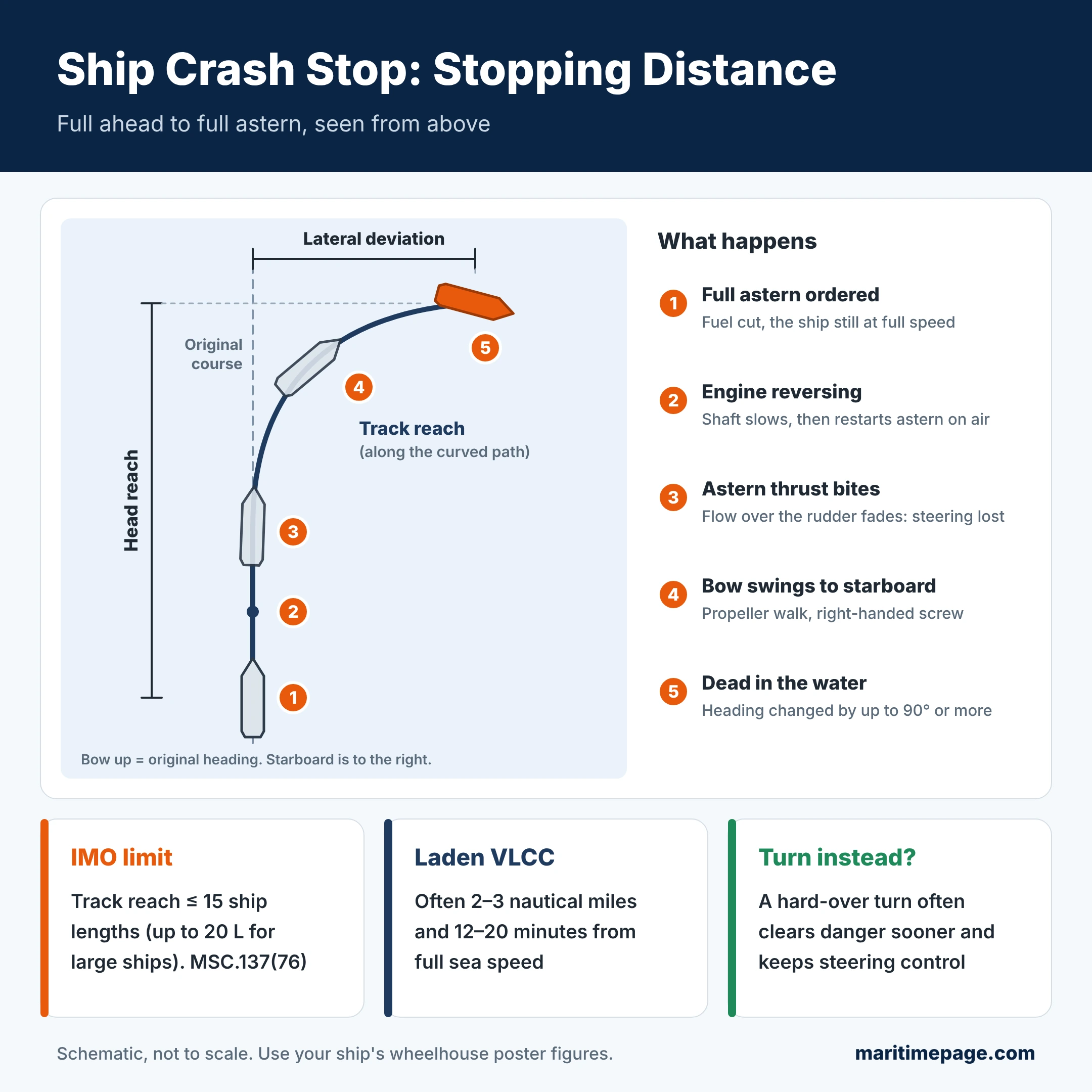
- Full astern is ordered. On a fixed-pitch engine, fuel is cut and the shaft slows.
- When shaft speed is low enough, the engine starts astern on air and the propeller begins to push astern.
- Astern thrust slows the ship, but the flow over the rudder weakens and steering is lost.
- Propeller walk swings the bow, usually to starboard on a single right-handed screw. The pivot point moves aft as way comes off.
- The ship stops with her heading changed, sometimes by 90° or more, and with a lateral offset from her original track.
The final heading is hard to predict, because wind, current and loading also act on the hull. A crash stop in a narrow channel can leave the ship swinging towards a bank.
How Do Engine and Propeller Type Affect Stopping?
A controllable pitch propeller stops a ship faster than a fixed-pitch one, because thrust reverses without stopping the shaft. Diesel-electric and podded ships can also reverse thrust quickly.
| Propulsion | How astern thrust is obtained | Effect on stopping |
|---|---|---|
| Slow-speed diesel, fixed-pitch propeller | Engine stopped and restarted astern on starting air | Longest delay; limited air starts |
| Controllable pitch propeller | Blades turned to astern pitch with the shaft still running | Quick reversal; no air starts needed |
| Diesel-electric, fixed-pitch | Electric motor reversed | Fast reversal; motor torque limits apply |
| Azimuth pods or thrusters | Units reversed or turned through 180° | Strong braking; maker’s crash-stop procedure must be followed |
| Steam turbine | Separate astern turbine | Astern power well below ahead power |
Reversible engines have only a limited number of starts from the air receivers. Repeated failed starts during a crash stop can leave the ship without propulsion at the worst moment.
What Are the Alternatives to a Crash Stop?
Alternatives include a hard-over turn, rudder cycling, gradual speed reduction, tugs and, at low speed only, the anchors. A turn often clears an obstruction ahead in a shorter distance than stopping.
- Hard-over turn: a ship’s advance in a turn is usually far less than her track reach when stopping. Turning away keeps steering and often avoids the danger sooner, a point covered in the guide to the wheel-over point.
- Rudder cycling: putting the rudder hard over from side to side adds drag and sheds speed while the ship stays near her course.
- Staged speed reduction: reducing in steps through slow ahead and stop takes more distance but keeps control.
- Tugs: tugs made fast aft can help brake and steer at low speed, mainly in port approaches.
- Anchors: anchors and windlasses are designed to hold a ship, not stop one moving at speed. Dropping them at more than a few knots risks losing the anchor and cable.
The right choice depends on sea room, traffic and the depth of water. It should be discussed in the bridge team before entering confined waters, not decided for the first time in an emergency.
What Affects a Ship’s Stopping Distance?
The main factors are speed, displacement, propulsion type and astern power. Wind, current, water depth, trim and hull condition also change how far and in which direction the ship travels.
- Speed: the biggest single factor, because energy rises with the square of speed.
- Displacement: a laden ship carries far more momentum than the same ship in ballast.
- Propulsion: fixed-pitch, CPP, diesel-electric or pods, as described above.
- Wind and current: a following current lengthens the stop over the ground; beam wind adds to the swing.
- Water depth: shallow water changes the hull’s response and increases the risk of the stern touching bottom while swinging.
- Trim: trim by the head reduces propeller immersion and directional stability.
Under COLREGs Rule 6, every vessel must consider her manoeuvrability, with special reference to stopping distance and turning ability. Rule 8(e) requires her to slacken speed or stop if needed to avoid collision.
Where Is Stopping Data Kept on Board?
Stopping data is kept on the wheelhouse poster, the pilot card and the manoeuvring booklet required by IMO Resolution A.601(15). The trial records themselves must also be on board under SOLAS.
- Wheelhouse poster: crash-stop and stopping figures from full and half ahead, laden and in ballast, with turning circles.
- Pilot card: current draft, engine and steering details handed to the pilot at boarding.
- Manoeuvring booklet: fuller trial and estimated data, including shallow water effects where available.
The pilot card and stopping figures are part of the master-pilot information exchange. They help the pilot judge speed and tug use for the ship in front of him.
What Do Inspectors Check About Stopping and Manoeuvring Data?
Port state control, class and vetting inspectors check that manoeuvring information is posted, complete and for this ship. They also check that the engine is tested astern before arrival and departure.
- Wheelhouse poster displayed on the bridge, showing the ship’s own trial figures, not a sister ship’s or a blank form.
- Manoeuvring booklet and sea trial stopping records on board.
- Pilot card completed with current draft and condition for each pilotage.
- Pre-arrival and pre-departure checks recording an engine test ahead and astern.
- Officers able to state the ship’s crash-stop figures and explain when a turn is the better option.
- Emergency manoeuvres, such as crash stop and steering failure, covered in bridge procedures and drills.
Common deficiencies are a missing or generic wheelhouse poster, pilot cards left blank, and no record of engine tests. Inspectors treat these as signs of weak bridge procedures, and serious gaps can support a detention.
Related Topics
- Bridge navigational watchkeeping
- The four stages of passage planning
- What happens if a ship loses power
Frequently Asked Questions
How long does it take a large ship to stop?
A laden VLCC or Capesize at sea speed often needs 12 to 20 minutes and 2 to 3 nautical miles. Smaller ships with controllable pitch propellers stop in a few minutes.
What is the IMO requirement for ship stopping distance?
IMO Resolution MSC.137(76) limits track reach in the full astern stopping test to 15 ship lengths. The Administration may allow up to 20 lengths for large displacement ships.
What is the difference between track reach and head reach?
Track reach is measured along the ship’s actual curved path until she stops. Head reach is the distance advanced in the direction of the original course, and is shorter when the ship swings.
What is a crash stop?
A crash stop is an emergency manoeuvre from full ahead to full astern as quickly as the machinery allows. It is also the standard stopping test at sea trials.
Why does a ship turn during a crash stop?
Going astern, the propeller pushes the stern sideways, known as propeller walk. With a right-handed propeller the bow usually swings to starboard, while the rudder loses its effect.
Is turning better than stopping to avoid a collision?
Often, yes. A ship’s advance in a hard-over turn is usually much less than her stopping distance, and she keeps steering control while turning.
Can a ship use its anchors to stop?
Only at very low speed. Anchors and windlasses are built to hold a ship, not stop one under way, and dropping them at speed can lose the anchor and cable.
Where can I find a ship’s stopping distance?
On the wheelhouse poster, the pilot card and the manoeuvring booklet required by IMO Resolution A.601(15). These show the ship’s own trial figures for laden and ballast conditions.

- Great Lakes Maritime Academy: Programs, Cost and Admission – October 14, 2026
- Bunker Delivery Note (BDN): Contents, MARPOL Rules and Checks – October 11, 2026
- Oil Record Book: Part I and Part II Entries, Rules and PSC Checks – October 11, 2026