Oil tanker cargo handling covers the pumps, pipelines, valves, inert gas, venting, gauging and heating systems that move liquid cargo safely. This guide explains each system, how cargo operations run, and what inspectors check. It is written for deck cadets, junior officers and surveyors.
Equipment varies by ship type, which the oil tanker types and classification guide covers in full. Most of the rules come from SOLAS Chapter II-2 for fire and explosion safety and MARPOL Annex I for oil pollution.
What Are the Main Cargo Handling Systems on an Oil Tanker?
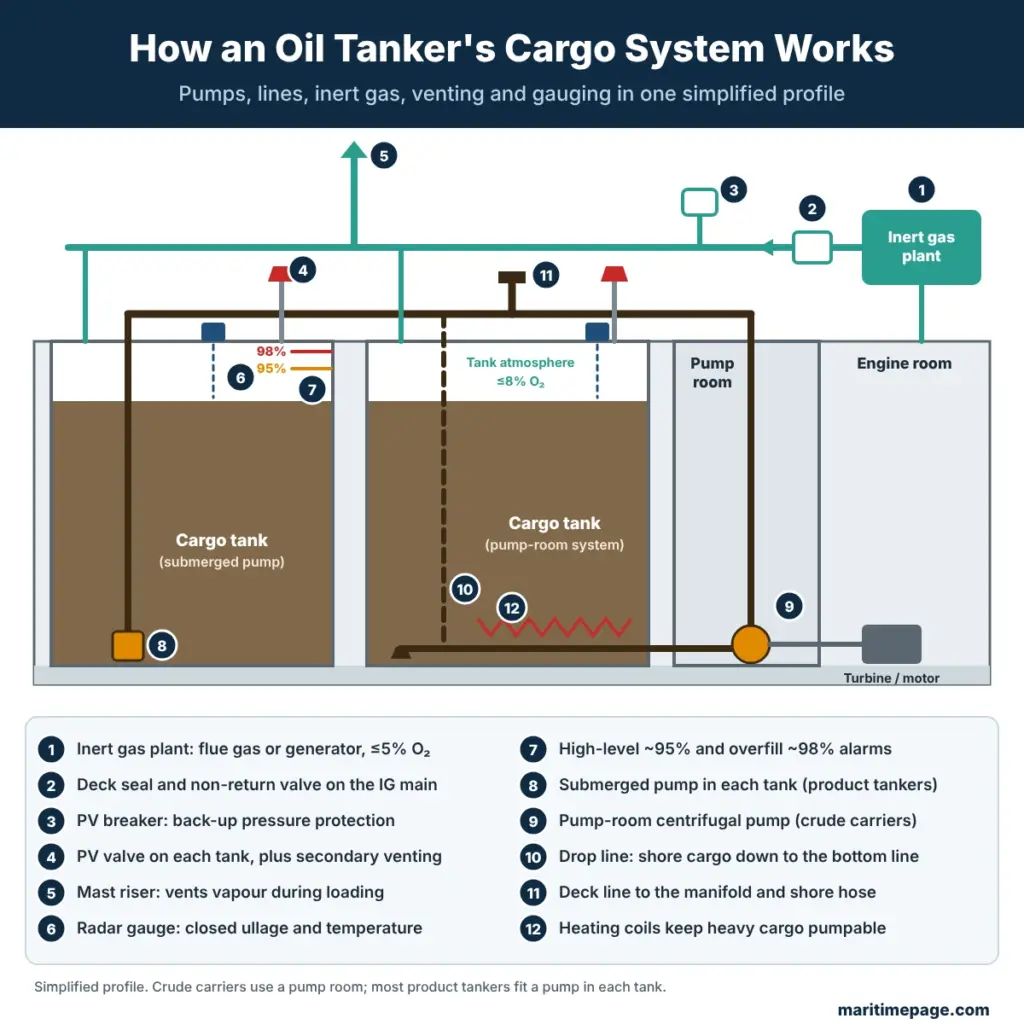
The main systems are cargo pumps, piping and valves, inert gas, tank venting, closed gauging with overfill alarms, and tank washing. Cargo heating and vapour control complete the set, run from a cargo control room.
| System | What it does | Main rule or standard |
|---|---|---|
| Cargo pumps and stripping | Discharge cargo and drain tanks | SOLAS II-2 Reg 4.5.10 (pump rooms) |
| Piping, valves and manifold | Route cargo between tanks and shore | Class rules; OCIMF manifold guidance |
| Inert gas system | Keeps tank oxygen at or below 8% | SOLAS II-2 Reg 4.5.5; FSS Code Ch. 15 |
| Venting and PV valves | Relieves tank pressure and vacuum | SOLAS II-2 Reg 4.5.3 and 11.6 |
| Gauging and overfill alarms | Measures ullage; warns before overflow | SOLAS II-2 Reg 11.6; class rules |
| Crude oil washing | Cleans crude tanks with cargo | MARPOL Annex I Reg 33 and 35 |
| Cargo heating | Keeps heavy grades pumpable | Charter party and shipper’s instructions |
| Vapour control | Limits VOC release | MARPOL Annex VI Reg 15; MSC/Circ.585 |
Each system has its own failure modes and its own inspection points. The sections below take them in the order cargo meets them, from the tank to the shoreline.
How Does Cargo Handling Differ on Crude and Product Tankers?
Crude tankers move a few grades in large volumes, so they use a central pump room, big centrifugal pumps, and crude oil washing. Product tankers carry several grades, so most fit a pump in every tank.
- Crude carriers: Aframax, Suezmax, VLCC and ULCC designs typically have three or four main cargo pumps in an aft pump room. A VLCC discharges a full cargo in roughly a day.
- Product tankers: MR and LR designs need segregations, so each tank has its own pump and line. Tank cleaning between grades matters more than speed.
- Heated cargo ships: a bitumen tanker uses insulated independent tanks and thermal oil heating, an extreme case of the cargo heating described below.
- Chemical tankers: these follow the IBC Code and use stainless steel or coated tanks; see the types of chemical tankers.
Fuel oil and crude can travel on the same ship because both are “dirty” cargoes. Clean products such as gasoline and jet fuel go on clean product tankers, where crude residues would cause contamination.
What Cargo Pumps Do Oil Tankers Use?
Oil tankers use centrifugal cargo pumps for bulk discharge, either in a pump room or submerged in each tank. Positive-displacement pumps and eductors handle stripping, the final draining of tank bottoms and lines once the main pumps lose suction.
Pump Room Centrifugal Pumps
Large crude carriers mount their main cargo pumps in a pump room between the cargo tanks and the engine room. Steam turbines or electric motors in the engine room drive the pumps through shafts with gas-tight bulkhead seals.
The pump room is one of the most hazardous spaces on a tanker, because cargo leaks collect there below deck. SOLAS II-2 Reg 4.5.10 therefore requires:
- temperature sensors on bulkhead shaft glands, bearings and pump casings, with an alarm in the cargo control room
- lighting interlocked with the ventilation, so the lights cannot run without the fans
- continuous hydrocarbon gas monitoring, alarming at no more than 10% of the lower flammable limit
- bilge level monitoring with alarms
Submerged (Deepwell) Pumps
Most product tankers, and some Aframax crude carriers, fit a hydraulically or electrically driven pump inside each tank. This removes the pump room, frees cargo space, and keeps each grade in its own line.
The pump sits in a suction well at the tank bottom, so it can strip its own tank almost dry. Hydraulic power packs in the engine room or on deck drive the pumps.
Stripping Pumps and Eductors
Stripping removes the last cargo once a centrifugal pump starts to lose suction. Pump-room ships use reciprocating or screw pumps, or an automatic stripping unit that separates vapour from the suction line.
Many tankers also use an eductor, a jet pump with no moving parts that uses a driving liquid to create suction. Efficient stripping cuts the cargo left on board (ROB), which charterers and receivers measure after discharge.
How Does the Cargo Piping and Valve System Work?
Cargo piping connects each tank to the pumps and to the deck manifold, where shore hoses or loading arms connect. Remote-operated valves route each grade, and crossovers let a pump serve several tanks.
- Bottom lines: run through the tanks from the pump room to each tank suction.
- Deck lines: carry cargo from the pumps forward to the manifold.
- Drop lines: let shore cargo flow directly from deck lines to bottom lines during loading.
- Manifold: the ship-shore connection midships on both sides, built to OCIMF’s manifold recommendations so terminals can connect.
- Valves: mostly butterfly and gate valves, hydraulically operated from the cargo control room, plus non-return valves on pump discharges.
Line contents matter commercially as well as operationally. A line displacement check confirms the shore and ship line contents before and after transfer. This protects the Bill of Lading figure.
How Does the Inert Gas System Protect Cargo Tanks?
An inert gas system keeps cargo tanks too low in oxygen to burn. It supplies gas with at most 5% oxygen and holds tanks at or below 8% oxygen, under positive pressure.
The inert gas usually comes from cleaned boiler flue gas, or from an inert gas generator burning diesel oil. Some product and chemical tankers use nitrogen generators instead. The inert gas system on tankers page explains the scrubber, fans and deck seal in detail.
Key requirements under FSS Code Chapter 15:
- capacity of at least 125% of the maximum discharge rate, so no air is drawn in during discharge
- two non-return devices on deck: a deck water seal (or double block and bleed) and a non-return valve
- two oxygen sensors, with alarms above 5% oxygen in the supply
- automatic venting to atmosphere if the supply exceeds 5% oxygen
Since 1 January 2016, new tankers of 8,000 dwt and above need a fixed inert gas system. Before that, the threshold for oil tankers was 20,000 dwt.
Inert gas does not remove hydrocarbon vapour from the tank. It removes the oxygen, so the vapour cannot ignite.
How Are Cargo Tank Pressures Controlled?
Pressure-vacuum (PV) valves, a vent mast riser, a PV breaker and the inert gas supply control cargo tank pressure. Together they stop a tank bursting during loading or collapsing during discharge.
- PV valves: one per tank, lifting at a set pressure or vacuum. High-velocity types throw vapour clear of the deck. Our PV valve and PV breaker guide covers settings and maintenance.
- Mast riser: vents large vapour volumes during loading at a safe height above deck.
- PV breaker: a liquid-filled safety device on the inert gas main that lifts if the PV valves cannot cope.
- Secondary venting: tankers built on or after 1 January 2017 need a second means per tank. This is a second full-flow PV valve or a pressure sensor with alarms (MSC.392(95)).
Tank pressure and temperature are shown in the cargo control room for every tank. At sea, the duty officer checks and logs tank pressures and inert gas readings every watch. A vacuum alarm during discharge usually means the inert gas supply is not keeping up with the pumps.
How Do Tankers Measure Cargo and Prevent Overfills?
Tankers measure cargo with closed gauging, usually radar gauges, because inerted tanks must stay sealed. Independent high-level and overfill alarms back up the gauges, typically set at 95% and 98% of tank volume.
- Fixed gauges: radar or float gauges read ullage and temperature remotely in the cargo control room.
- Portable gauging: UTI (ullage, temperature, interface) tapes go in through vapour locks without opening the tank. They also confirm the oil-water interface required by slop tank rules (MARPOL Annex I Reg 32).
- High-level alarm: warns the duty officer to slow or switch tanks, typically at 95%.
- Overfill alarm: an independent sensor, typically at 98%, warning that the tank is about to overflow.
SOLAS II-2 Reg 11.6 requires protection against cargo rising into the vent system. High-level alarms, independent gauging, and written tank-filling procedures meet that requirement on oil tankers.
What Is Crude Oil Washing?
Crude oil washing (COW) cleans cargo tanks during discharge by spraying part of the crude back through fixed tank-washing machines. The crude dissolves waxy and asphaltic residues that water cannot shift, so less sludge stays on board.
MARPOL Annex I Reg 33 requires COW on new crude oil tankers of 20,000 dwt and above, a rule introduced by the 1978 MARPOL Protocol. Installations must meet IMO’s COW specifications, revised by resolution A.897(21).
- COW runs only while tanks are inerted, because crude washing generates static and mist.
- The ship follows its approved COW Operations and Equipment Manual (Reg 35).
- Residues and any water rinse go to the slop tank for settling.
- Each COW operation is recorded in the Oil Record Book Part II.
Product tankers clean tanks with water, sometimes heated or with detergents, using fixed or portable machines. The washings also go to the slop tank.
How Is Cargo Heated on an Oil Tanker?
Heavy cargoes such as fuel oil and some crudes are heated through steam or thermal oil coils in the tank bottoms. Heating keeps viscosity low enough to pump and stops wax from settling out.
Charterers and shippers give a heating instruction, often a minimum temperature for the voyage and a higher one for discharge. Overheating can damage coatings and increase vapour losses.
Viscosity matters because centrifugal pumps lose performance as cargo thickens. Very heavy grades are often discharged with positive-displacement screw pumps, which cope better with thick cargo. A cold, viscous cargo also clings to tank structure, which increases ROB and claims.
How Do Tankers Control Cargo Vapours?
Tankers control cargo vapours with closed loading, vapour return lines to the terminal and a VOC management plan. These limit volatile organic compound (VOC) emissions during loading, the voyage and discharge.
- VOC management plan: required on crude oil tankers since 1 July 2010 under MARPOL Annex VI Reg 15, to the guidance in MEPC.185(59).
- Vapour emission control: where a port requires it, vapours return to shore through a dedicated line. Systems follow IMO’s MSC/Circ.585 safety standard.
- Closed operations: gauging, sampling and venting take place without opening the tanks, so no tank is ever “open” during normal operations.
What Safety and Emergency Equipment Supports Cargo Operations?
The main cargo safety equipment is gas detection, the ship-shore emergency shutdown (ESD) system, the deck foam system and pump room alarms. Each one targets fire, explosion or spill risk.
- Gas detection: fixed sampling in pump rooms and double-hull spaces, plus portable meters for oxygen, hydrocarbons, H₂S and toxic gases.
- ESD: stops shore pumps and closes valves on either side when activated. The link is tested before transfer starts.
- Deck foam system: covers the cargo tank deck with foam monitors and hand applicators.
- Spill kit and scuppers: deck scuppers are plugged during transfer, with absorbent and a portable pump ready.
- Enclosed space equipment: pump rooms, double-hull spaces and cargo tanks are enclosed spaces needing entry permits and atmosphere testing.
How Does a Cargo Operation Run From Loading to Discharge?
A cargo operation runs through a pre-transfer conference, the Ship/Shore Safety Checklist, a slow start, bulk transfer, then topping off or stripping. Ballast moves at the same time to keep stress and trim within limits.
Loading
- Agree the loading plan, rates, stop signals and emergency procedures with the terminal.
- Complete the Ship/Shore Safety Checklist from ISGOTT, revised in its sixth edition (2020).
- Start at a slow rate until the tank inlets are covered, to limit static charge and check for leaks.
- Increase to the agreed bulk rate while tank vapours vent through the mast riser or vapour return.
- Reduce the rate for topping off, then close tanks one by one at their final ullage.
- Gauge, sample and calculate the quantity loaded, then top up inert gas pressure.
Discharge
- Agree the discharge plan, including back-pressure limits at the shore tanks.
- Start inert gas before the pumps, then build up to full rate.
- Run crude oil washing in the planned tanks if the ship is a crude carrier.
- Strip tanks and lines, then drain the lines to shore or to a designated tank.
- Take ballast into the segregated ballast tanks in step with discharge.
MARPOL Annex I Reg 18 requires segregated ballast tanks on crude tankers of 20,000 dwt and above. Product tankers need them from 30,000 dwt. Ballast goes into cargo tanks only in exceptional cases, such as severe weather, which MARPOL allows.
What Do Inspectors Check on Cargo Handling Systems?
Port State control, class surveyors and vetting inspectors all test cargo systems. They check that alarms work, the inert gas system meets its oxygen limits, PV valves are maintained and records match what the crew does.
- Port State control: oxygen analyser calibration, deck seal water level, pump room gas detection and the Oil Record Book Part II entries. Defects here are classic grounds for ship detention under the port State control MoUs.
- Class surveys: cargo piping, pump room bulkhead seals, inert gas plant and venting are examined at annual and renewal surveys. Our page on types of ship surveys covers the cycle.
- Vetting: a SIRE 2.0 vetting inspection asks the crew to demonstrate high-level alarm tests, inert gas operation and cargo planning. It assesses equipment, procedures and the crew’s knowledge together.
- Company systems: under the ISM Code, cargo equipment sits in the planned maintenance system, and tests must be recorded.
Inspectors often find the same faults: alarms tested but not recorded, PV valves stuck from cargo residue, and oxygen analysers out of calibration. The fastest way to pass is to keep test records with dates, results and signatures.
What Are the Main Risks in Tanker Cargo Handling?
The main risks in tanker cargo handling are tank overflow, fire or explosion from vapour, structural damage from over-pressure or vacuum, toxic exposure and pollution. Typical causes are a failed alarm, a wrong valve line-up or a skipped procedure.
- Overflow: usually a valve line-up error during loading or internal transfer.
- Explosion: pump room leaks, static discharge, or air entering tanks when inert gas fails.
- Tank damage: closed vent valves or a failed PV valve during high-rate loading or discharge.
- Toxic exposure: H₂S from sour crude, and benzene in some products.
- Pollution: hose bursts, manifold leaks and overflows through the vents.
Regular ship drills for cargo spills and pump room emergencies keep the crew’s response sharp. Drills matter most on ships that load and discharge every few days.
Related Topics
- IGC Code: Cargo Systems on Gas Carriers
- What Is Bunkering on Ships?
- Largest Oil Tanker Companies in the World
Frequently Asked Questions
What equipment controls pressure and temperature in a tanker’s cargo tanks?
Pressure-vacuum (PV) valves, the vent mast riser, a PV breaker and the inert gas supply control tank pressure. Heating coils control temperature, and remote pressure and temperature sensors report both to the cargo control room.
What type of cargo pump is used on a crude oil tanker?
Large crude tankers mostly use centrifugal cargo pumps in a pump room, driven by steam turbines or electric motors. Some newer crude carriers use submerged hydraulic pumps in each tank instead.
What is the purpose of stripping cargo tanks?
Stripping removes the last cargo from tank bottoms and lines after the main pumps lose suction. It reduces cargo remaining on board, which lowers commercial claims and leaves less residue for cleaning.
Which tanker system uses flue gas from the ship’s boilers?
The inert gas system. It cleans and cools boiler flue gas, then supplies it to the cargo tanks so their oxygen content stays at or below 8% by volume.
Why does viscosity matter in tanker cargo operations?
Viscous cargo is harder to pump and drains poorly from tank structure. Heating keeps heavy grades fluid, so pumps keep their rate and less cargo stays on board after discharge.
Can crude oil and fuel oil be carried on the same tanker?
Yes. Both are dirty cargoes, so a dirty tanker can carry them on different voyages or in separate tanks. Clean products such as gasoline go on clean product tankers to avoid contamination.
Are oil tanker cargo tanks ever open during operations?
Not in normal operations. Modern tankers load, gauge, sample and vent through closed systems, so tanks stay sealed and inerted. Tanks are opened only after gas-freeing for entry or maintenance.
What emergency equipment is kept on oil tankers for cargo operations?
Tankers carry fixed and portable gas detectors, an emergency shutdown link with the terminal, a deck foam system and pump room alarms. Spill kits and plugged scuppers contain small deck spills.

- Great Lakes Maritime Academy: Programs, Cost and Admission – October 14, 2026
- Bunker Delivery Note (BDN): Contents, MARPOL Rules and Checks – October 11, 2026
- Oil Record Book: Part I and Part II Entries, Rules and PSC Checks – October 11, 2026