The IBC Code is the IMO code that sets how ships carrying dangerous chemicals in bulk must be built, equipped and operated. It decides which ship type each chemical needs, how far its tanks sit from the hull and which safety systems must be fitted. This guide covers the Code’s scope, ship types 1, 2 and 3, its chapters, the product list, the Certificate of Fitness and inspections.
What Is the IBC Code?
The IBC Code is the International Code for the Construction and Equipment of Ships Carrying Dangerous Chemicals in Bulk. It is mandatory under SOLAS Chapter VII and MARPOL Annex II for chemical tankers built on or after 1 July 1986.
The Code was adopted by the IMO Maritime Safety Committee in 1983, by resolution MSC.4(48). In 1985, resolution MEPC.19(22) extended it to cover marine pollution as well as safety.
Its aim is simple: carry chemicals so that the risk to the ship, its crew and the environment is kept to a minimum. It does this by matching each product to a ship design and a set of equipment.
Which Ships Does the IBC Code Apply To?
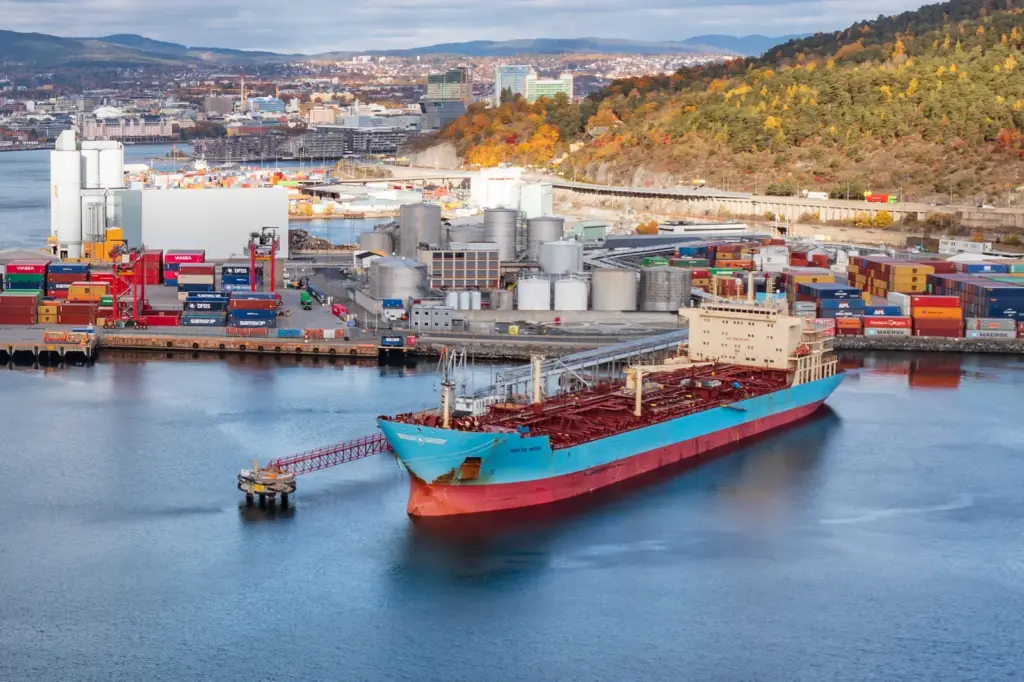
The IBC Code applies to ships of any size that carry the liquid products listed in its Chapter 17 in bulk. In practice these are chemical tankers, including oil/chemical tankers certified for both trades.
- Chemical tankers built on or after 1 July 1986 must comply with the IBC Code.
- Chemical tankers built before 1 July 1986 follow its predecessor, the BCH Code, which MARPOL Annex II makes mandatory for them.
- Oil tankers carrying only oil cargoes fall under MARPOL Annex I, not the IBC Code. See oil tanker types.
- Gas carriers carrying liquefied gases follow the IGC Code.
Products in Chapter 18 are outside the Code’s construction rules, but they may still be controlled under MARPOL Annex II. The ship layouts that meet the Code are covered in types of chemical tankers.
How Does the IBC Code Link SOLAS and MARPOL Annex II?
The IBC Code serves two conventions at once. SOLAS Chapter VII Part B makes it mandatory for safety, and MARPOL Annex II makes it mandatory for pollution prevention.
One product list therefore drives both safety and pollution rules. Each product in Chapter 17 has a MARPOL pollution category and a set of safety requirements.
| MARPOL Annex II category | Meaning | Discharge |
|---|---|---|
| X | Major hazard to marine resources or human health | Prohibited |
| Y | Hazard to marine resources, human health or amenities | Limited in quality and quantity |
| Z | Minor hazard | Less stringent limits |
| OS (other substances) | No harm when discharged from tank cleaning | Not subject to Annex II |
These four categories replaced the older five-category system on 1 January 2007. Since then, liquid cargoes other than oil may only be carried in bulk once they have been categorised.
What Are IBC Ship Types 1, 2 and 3?
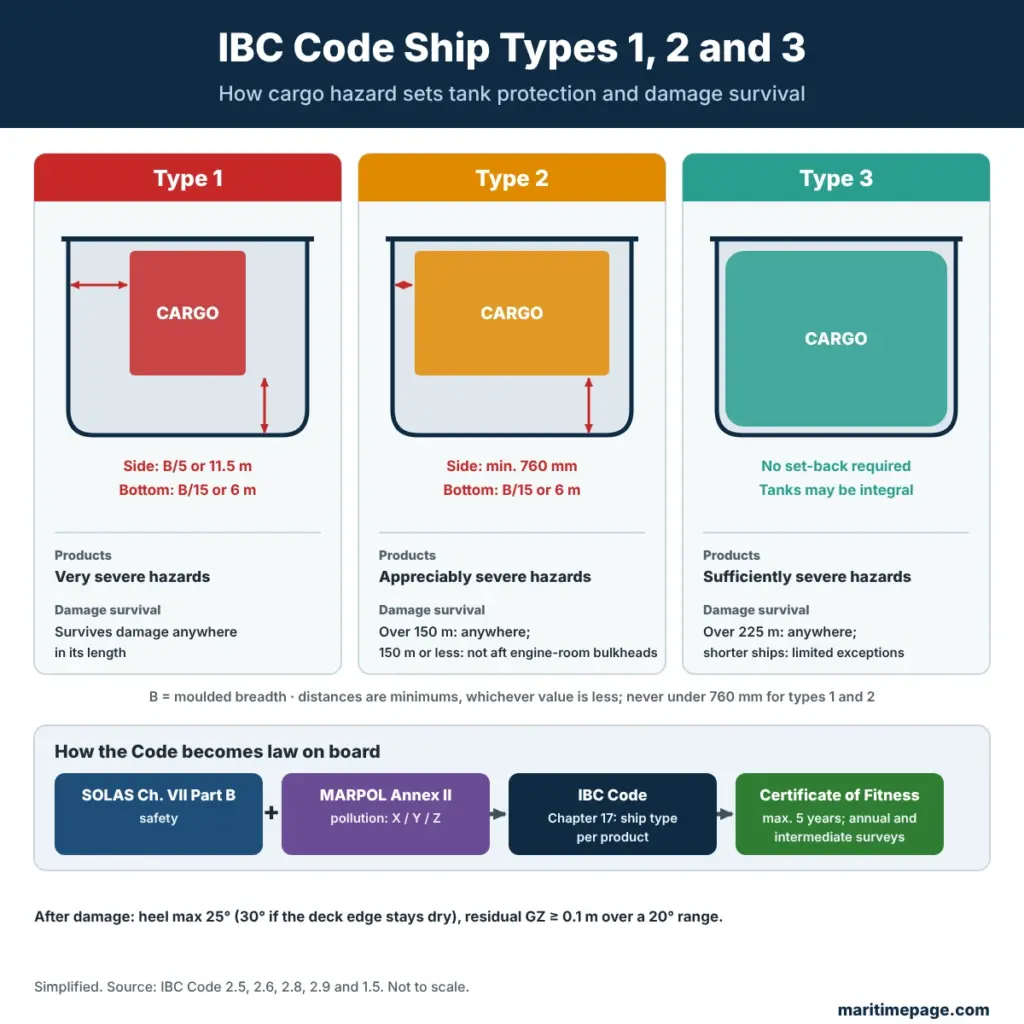
IBC ship types 1, 2 and 3 rank chemical tankers by the hazard of the products they may carry. Type 1 carries the most hazardous products and needs the best damage survival and the most protected cargo tanks.
| Ship type | Products carried | Damage it must survive (IBC 2.8) | Cargo tank location (IBC 2.6) |
|---|---|---|---|
| Type 1 | Very severe environmental and safety hazards | Damage anywhere in its length | At least B/5 or 11.5 m from the side shell and B/15 or 6 m from the bottom, whichever is less; never under 760 mm |
| Type 2 | Appreciably severe hazards | Over 150 m: anywhere in its length. 150 m or less: anywhere except the bulkheads of an aft machinery space | At least B/15 or 6 m from the bottom, whichever is less; never under 760 mm from the shell |
| Type 3 | Sufficiently severe hazards | Over 225 m: anywhere. 125–225 m: anywhere except aft machinery bulkheads. Under 125 m: anywhere except the aft machinery space | No specific location requirement |
B is the ship’s moulded breadth. After the assumed damage, heel must not exceed 25°, or 30° if the deck edge stays clear. The ship also needs a residual righting arm of at least 0.1 m over a 20° range.
This is damage stability. Intact stability is covered separately by the IS Code.
What Is in the IBC Code? The Chapter Map
The IBC Code has 21 chapters. Chapters 1 to 16 set design, equipment and operation rules, and chapters 17 to 21 hold the product lists and the criteria behind them.
| Chapter | Subject |
|---|---|
| 1 | General: definitions, surveys and certification |
| 2 | Ship survival capability and location of cargo tanks |
| 3 | Ship arrangements |
| 4 | Cargo containment |
| 5 | Cargo transfer |
| 6 | Materials of construction, protective linings and coatings |
| 7 | Cargo temperature control |
| 8 | Cargo tank venting and gas-freeing arrangements |
| 9 | Environmental control |
| 10 | Electrical installations |
| 11 | Fire protection and fire extinction |
| 12 | Mechanical ventilation in the cargo area |
| 13 | Instrumentation |
| 14 | Personnel protection |
| 15 | Special requirements |
| 16 | Operational requirements |
| 17 | Summary of minimum requirements (the product table) |
| 18 | List of products to which the Code does not apply |
| 19 | Index of products carried in bulk |
| 20 | Transport of liquid chemical wastes |
| 21 | Criteria for assigning carriage requirements |
The latest full update of chapters 17, 18, 19 and 21 entered into force on 1 January 2021. It changed the ship type, tank type or toxicity rating of some products.
How Are Cargo Tanks Classified Under the IBC Code?
The IBC Code classifies cargo tanks as independent or integral, and as gravity or pressure tanks. Chapter 17 states the tank type each product needs.
- Integral tank: part of the ship’s hull, carrying the same loads as the surrounding structure.
- Independent tank: separate from the hull structure and not essential to hull strength.
- Gravity tank: design pressure of no more than 0.07 MPa gauge at the top of the tank.
- Pressure tank: design pressure above 0.07 MPa gauge; always an independent tank.
In Chapter 17 these appear as tank types such as 1G (independent gravity) and 2G (integral gravity). Tank material and coating also matter: stainless steel, zinc silicate and epoxy each resist different cargoes, and Chapter 6 sets the rules.
Which Products Can a Chemical Tanker Carry?
A chemical tanker may carry only the products named on its Certificate of Fitness, under the conditions shown there. Those products come from Chapter 17, or from IMO’s provisional lists for new products.
Each Chapter 17 entry gives the carriage requirements in columns:
| Column | Requirement |
|---|---|
| c | MARPOL pollution category (X, Y, Z) |
| d | Hazard: safety (S), pollution (P) or both |
| e | Minimum ship type (1, 2 or 3) |
| f | Tank type: 1G (independent gravity) or 2G (integral gravity) |
| g | Tank vents: open or controlled |
| h | Tank environmental control: inert, pad, dry, vent or none |
| i | Electrical equipment: temperature class, apparatus group, flash point |
| j | Gauging: open, restricted or closed |
| k | Vapour detection: flammable (F), toxic (T) or none |
| l | Fire protection |
| n | Emergency equipment |
| o | Special requirements from chapters 15 and 16 |
New products and mixtures not yet in the Code are assessed provisionally and published in IMO’s MEPC.2/Circular lists. The current edition, MEPC.2/Circ.31, is dated 1 December 2025, and many entries carry an expiry date.
Vegetable oils are noxious liquid substances too, which is why edible-oil cargoes also follow trade rules such as the FOSFA banned list for previous cargoes.
What Safety Systems Does the IBC Code Require?
The IBC Code requires venting, gauging, environmental control, temperature control, gas detection, fire protection, ventilation and personal protection matched to each product. The stricter the hazard, the more closed the system.
- Tank venting: open venting for low-hazard products, controlled venting with pressure/vacuum valves for others. See PV valves and PV breakers.
- Environmental control: inerting, padding with an inert liquid or gas, or drying the tank atmosphere. The inert gas system page explains how inerting works.
- Gauging: open, restricted or closed, so crew are not exposed to toxic vapour.
- Vapour detection: flammable and/or toxic vapour detection, as Chapter 17 requires.
- Temperature control: heating or cooling for products that must stay within a temperature range.
- Electrical equipment: certified safe for the gas group and temperature class of the cargo.
- Fire protection: a cargo-area fire-extinguishing system suited to the product.
- Personnel protection: protective clothing, breathing apparatus, decontamination showers and eyewash stations.
Cargo pumps, lines and manifolds follow Chapter 5, as described in cargo handling systems on tankers. Pump rooms and void spaces are also enclosed spaces, with their own entry rules.
What Is the IBC Certificate of Fitness?
The International Certificate of Fitness for the Carriage of Dangerous Chemicals in Bulk is issued by or for the flag State after survey. It is valid for up to five years and lists the products the ship may carry.
The certificate is backed by a survey cycle under IBC Code 1.5:
- Initial survey: before the ship enters service or the certificate is first issued.
- Annual survey: within three months before or after each anniversary date.
- Intermediate survey: within three months of the second or third anniversary, replacing one annual survey.
- Renewal survey: at intervals of no more than five years.
The certificate stops being valid if a survey is missed or the ship changes flag. Survey types in general are explained in types of ship surveys.
Under MARPOL Annex II, a chemical tanker’s IBC certificate has the same force as the pollution prevention certificate for noxious liquid substances. The ship also needs an approved Procedures and Arrangements (P&A) Manual and a Cargo Record Book.
What Do PSC, Class and Vetting Inspectors Check?
Inspectors check that every cargo is on the Certificate of Fitness, that ship and tank type suit each product, and that MARPOL Annex II records are complete. They also check gas detection, PPE and crew knowledge.
- Certificate of Fitness vs cargo: every product loaded must be listed, with the tanks and conditions shown.
- Ship type and tank coating: correct for each product and its last cargoes.
- P&A Manual and Cargo Record Book: approved manual on board; entries for loading, discharge, prewash and tank cleaning.
- Safety equipment: calibrated vapour detectors, breathing apparatus, decontamination showers and eyewash stations.
- Cargo information: safety data for each product and the crew’s knowledge of its hazards.
- Management system: cargo and tank-cleaning procedures in the ISM Code safety management system.
Serious gaps can lead to detention under port State control. Common reasons are listed in ship detention procedure, and charterers add a vetting inspection before fixing a chemical tanker.
IBC Code vs IGC Code vs MARPOL Annex I: Which Applies to Which Cargo?
The IBC Code covers liquid chemicals, the IGC Code covers liquefied gases and MARPOL Annex I covers oil. The cargo decides the code, the ship type and the certificate.
| Cargo | Main rules | Ship types | Main certificate |
|---|---|---|---|
| Liquid chemicals and noxious liquid substances | IBC Code, SOLAS VII, MARPOL Annex II | Chemical tanker type 1, 2 or 3 | International Certificate of Fitness for Dangerous Chemicals in Bulk |
| Liquefied gases | IGC Code, SOLAS VII | Gas carrier type 1G, 2G, 2PG or 3G | International Certificate of Fitness for Liquefied Gases in Bulk |
| Crude oil and oil products | MARPOL Annex I, SOLAS | Crude and product tankers | IOPP Certificate |
Some products, such as certain chemical gases, appear in both the IBC and IGC Codes. Gas carrier types are explained in types of gas carriers, and oily tank washings on oil tankers go to slop tanks.
Related Topics
Frequently Asked Questions
What does IBC Code stand for?
IBC Code stands for the International Code for the Construction and Equipment of Ships Carrying Dangerous Chemicals in Bulk. It is often called the International Bulk Chemical Code.
Is the IBC Code mandatory?
Yes. SOLAS Chapter VII and MARPOL Annex II make the IBC Code mandatory for chemical tankers built on or after 1 July 1986. Older chemical tankers follow the BCH Code.
What are IBC ship types 1, 2 and 3?
They rank chemical tankers by the hazard of their cargo. Type 1 carries products with very severe hazards and has the most protected tanks, type 2 appreciably severe hazards, and type 3 sufficiently severe hazards.
What is the difference between the IBC Code and the IGC Code?
The IBC Code covers ships carrying liquid chemicals in bulk, while the IGC Code covers ships carrying liquefied gases. Each has its own ship types and Certificate of Fitness.
What is the IBC Certificate of Fitness?
It is the International Certificate of Fitness for the Carriage of Dangerous Chemicals in Bulk. It is issued after survey, is valid for up to five years and lists the products the ship may carry.
Does the IBC Code apply to oil tankers?
Not to oil cargoes, which fall under MARPOL Annex I. An oil/chemical tanker that also carries Chapter 17 chemicals must hold an IBC Certificate of Fitness for those products.
What are MARPOL Annex II categories X, Y and Z?
They rate noxious liquid substances by pollution hazard: X is a major hazard with discharge prohibited, Y is a hazard with limited discharge, and Z is a minor hazard with less stringent limits.
Where do I find which ship type a product needs?
Look up the product in Chapter 17 of the IBC Code: column e gives the minimum ship type. New products may appear in IMO’s MEPC.2/Circular provisional lists instead.

- Bunker Delivery Note (BDN): Contents, MARPOL Rules and Checks – October 11, 2026
- Oil Record Book: Part I and Part II Entries, Rules and PSC Checks – October 11, 2026
- What Is the IBC Code? Ship Types, Products and Certificates – October 11, 2026