The IGC Code is the IMO’s International Code for the Construction and Equipment of Ships Carrying Liquefied Gases in Bulk. It sets the design, construction, equipment and operating standards for LNG, LPG, ethylene, ammonia and other gas carriers.
This guide is written for officers and engineers on gas carriers, surveyors and cadets. It covers what the Code applies to, ship and tank types, the Certificate of Fitness, recent amendments and what inspectors check.
What Is the IGC Code?
The IGC Code is the mandatory IMO standard for ships carrying liquefied gases in bulk. It is made mandatory by SOLAS Chapter VII, Part C, and applies to gas carriers of any size built on or after 1 July 1986.
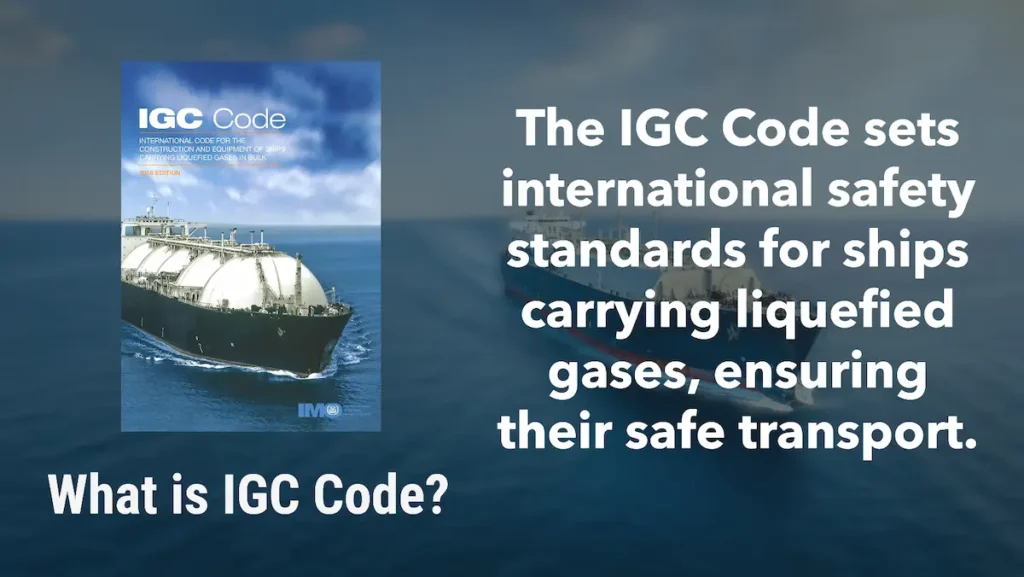
IMO adopted the original Code in 1983 by Resolution MSC.5(48). A fully revised Code, Resolution MSC.370(93), entered into force on 1 January 2016. It applies to gas carriers whose keels were laid on or after 1 July 2016.
The Code sits alongside SOLAS and MARPOL. Its sibling for liquid chemicals is the IBC Code, which covers chemical tankers.
What Does IGC Stand For?
IGC stands for International Gas Carrier, the short name of the International Code for the Construction and Equipment of Ships Carrying Liquefied Gases in Bulk.
What Is a Liquefied Gas Under the IGC Code?
Under the IGC Code, a liquefied gas is a liquid with a vapour pressure above 0.28 MPa absolute (2.8 bar) at 37.8 °C. Certain other products listed in Chapter 19 also count. Such cargoes are carried refrigerated, pressurized or both.
| Cargo | Boiling point at atmospheric pressure | Typical carriage |
|---|---|---|
| LNG (mainly methane) | −162 °C | Fully refrigerated |
| Ethylene | −104 °C | Fully refrigerated or semi-refrigerated |
| Ethane | −89 °C | Fully refrigerated or semi-refrigerated |
| Propane | −42 °C | Fully refrigerated, semi-refrigerated or fully pressurized |
| Ammonia | −33 °C | Fully refrigerated or pressurized; toxic |
| Isobutane | −12 °C | Semi-refrigerated or pressurized |
| n-Butane | −0.5 °C | Semi-refrigerated or pressurized |
LPG is a mix of propane and butane. The differences between the main fuels are covered in LNG vs LPG.
Chapter 19 also lists chemicals such as vinyl chloride monomer, propylene and butadiene. Some products appear in both the IGC and IBC Codes and may be carried by either type of ship if it is certified for them.
Which Gas Carriers Must Comply With the IGC Code?
All gas carriers built on or after 1 July 1986 must comply with the IGC Code. Older ships are not retrofitted; they follow earlier IMO codes that were in force when they were built.
| Ship built | Applicable code |
|---|---|
| On or after 1 July 2016 | Revised IGC Code, MSC.370(93) |
| 1 July 1986 to 30 June 2016 | IGC Code 1983, MSC.5(48), as amended before 2016 |
| Before 1 July 1986 | Gas Carrier Code (1975), or the Code for Existing Ships for the oldest ships |
The Code applies regardless of size. Gas carriers below 500 GT are covered too, unlike many SOLAS chapters.
What Are the IGC Ship Types 1G, 2G, 2PG and 3G?
The IGC Code assigns each cargo a ship type based on its hazard. The ship type sets how far cargo tanks must be from the shell and how much damage the ship must survive.
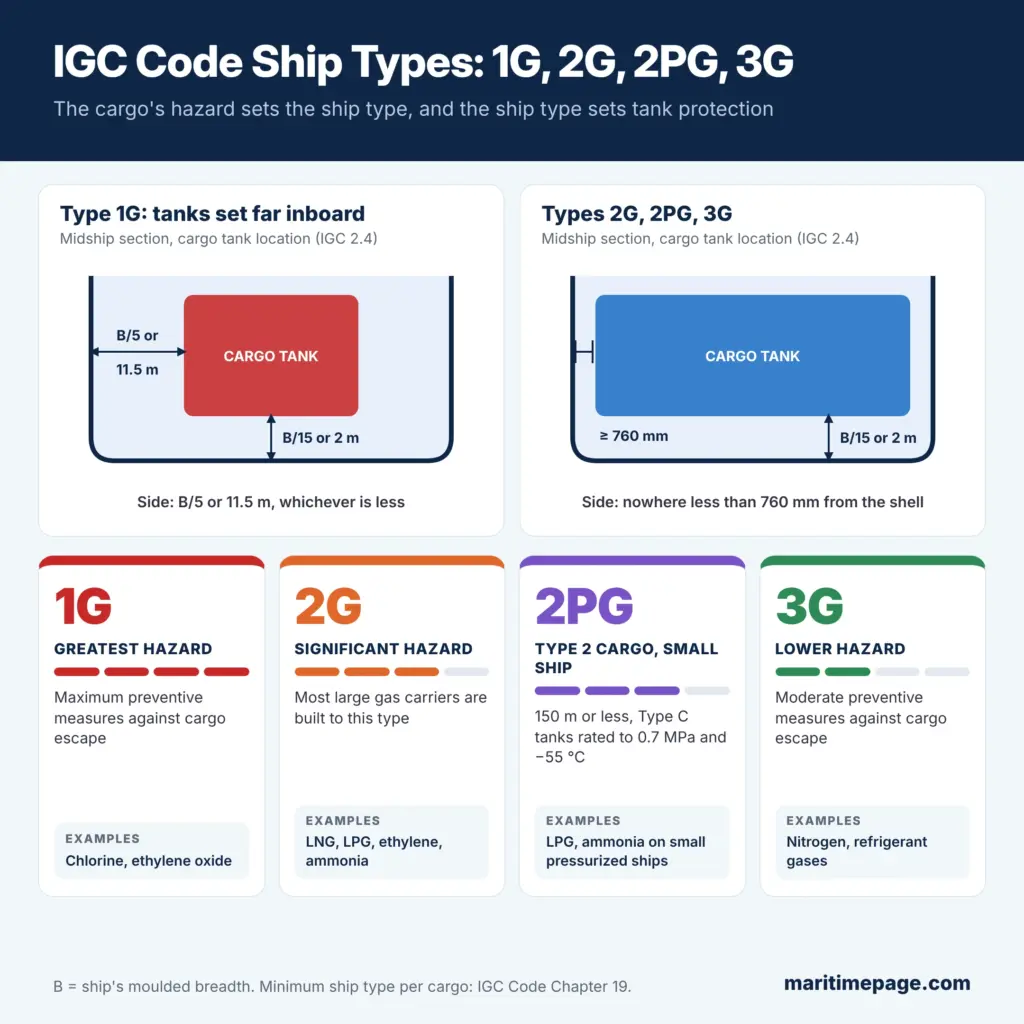
| Ship type | Hazard level | Example cargoes |
|---|---|---|
| 1G | Greatest hazard; maximum tank protection | Chlorine, ethylene oxide |
| 2G | Significant hazard | LNG, LPG, ethylene, ammonia |
| 2PG | Type 2 cargoes; ships of 150 m or less with Type C tanks rated to 0.7 MPa and −55 °C | LPG, ammonia on small pressurized ships |
| 3G | Lower hazard | Nitrogen, refrigerant gases |
The minimum ship type for every product is listed in the Chapter 19 table. Gas carriers by size and tank arrangement are explained in detail in types of gas carriers as per the IGC Code.
What Cargo Tank Types Does the IGC Code Allow?
The IGC Code recognises integral, membrane, semi-membrane and independent tanks. Independent tanks are divided into Types A, B and C by their design basis, which decides whether a secondary barrier is needed.
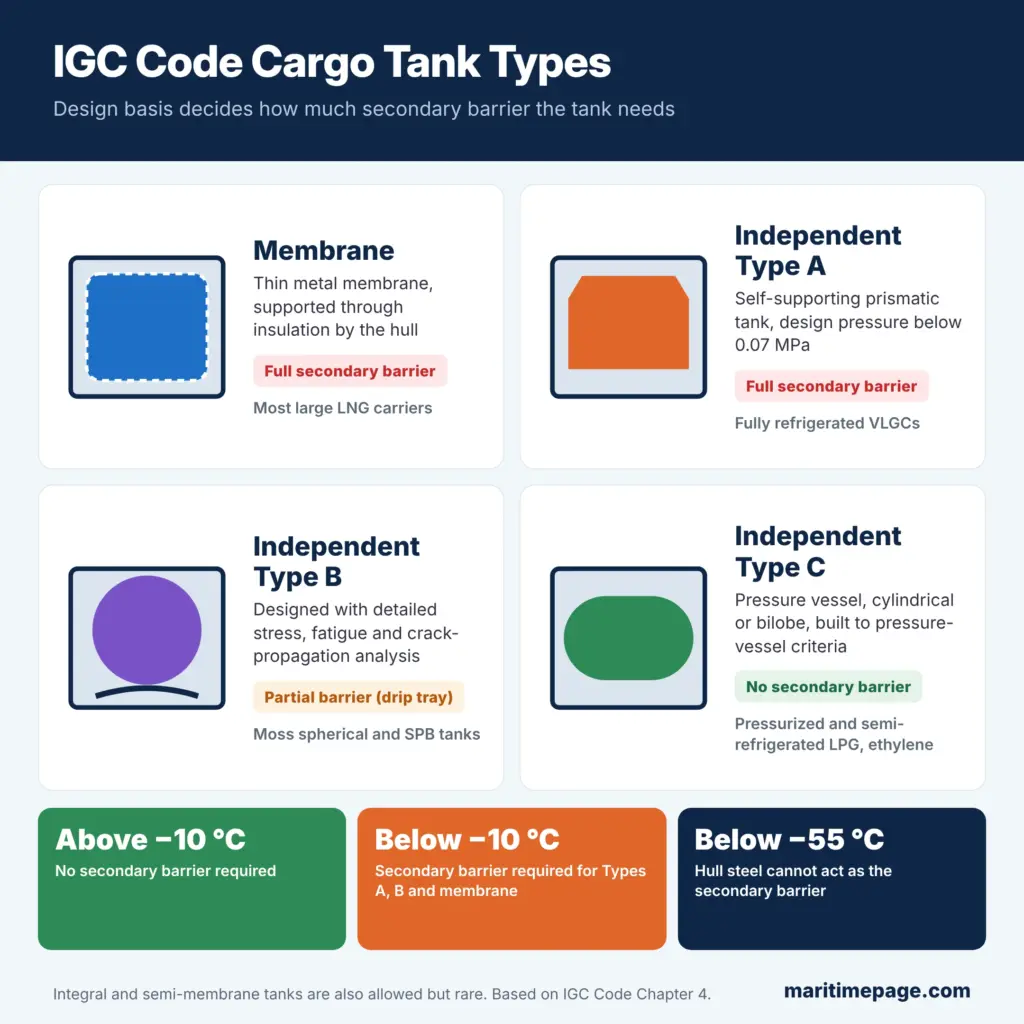
| Tank type | Design | Secondary barrier | Typical use |
|---|---|---|---|
| Membrane | Thin metal membrane supported by insulation and the hull | Full | Most large LNG carriers |
| Independent Type A | Self-supporting prismatic tank, design pressure below 0.07 MPa | Full | Fully refrigerated VLGCs |
| Independent Type B | Designed with detailed stress and fatigue analysis | Partial (drip trays) | Moss spherical and SPB tanks |
| Independent Type C | Pressure vessel, cylindrical or bilobe | Not required | Pressurized and semi-refrigerated LPG, ethylene |
| Integral and semi-membrane | Part of the hull, or partly supported membrane | Depends on cargo temperature | Rare in modern gas carriers |
A secondary barrier is needed for cargo temperatures below −10 °C. Below −55 °C, the hull steel cannot serve as the secondary barrier. Cargo-contact parts then use 9% nickel steel, stainless steel, Invar or aluminium.
What Does the IGC Code Cover?
The revised IGC Code has 19 chapters. They run from ship survival and tank location, through cargo containment, piping and safety systems, to operating requirements and the list of products.
| Chapter | Subject |
|---|---|
| 1 | General: application, definitions, surveys and certification |
| 2 | Ship survival capability and location of cargo tanks |
| 3 | Ship arrangements |
| 4 | Cargo containment |
| 5 | Process pressure vessels and liquid, vapour and pressure piping |
| 6 | Materials of construction and quality control |
| 7 | Cargo pressure and temperature control |
| 8 | Vent systems for cargo containment |
| 9 | Cargo containment system atmosphere control |
| 10 | Electrical installations |
| 11 | Fire protection and extinction |
| 12 | Artificial ventilation in the cargo area |
| 13 | Instrumentation and automation systems |
| 14 | Personnel protection |
| 15 | Filling limits for cargo tanks |
| 16 | Use of cargo as fuel |
| 17 | Special requirements |
| 18 | Operating requirements |
| 19 | Summary of minimum requirements (product list) |
Chapter 7 covers the reliquefaction plants and gas combustion units that manage boil-off gas. Chapter 9 covers inerting, which is similar in purpose to the inert gas system on oil tankers.
How Has the IGC Code Been Amended?
The IGC Code is amended through IMO resolutions that enter into force on fixed dates. The biggest change was the full revision of 2014, which applies to ships built from 1 July 2016.
| Amendment | In force | Main change |
|---|---|---|
| MSC.5(48), 1983 | 1 July 1986 | Original IGC Code made mandatory under SOLAS |
| MSC.370(93), 2014 | 1 January 2016 | Complete revision; applies to ships built on or after 1 July 2016 |
| Adopted November 2016 | 1 January 2020 | Fire integrity of windows and sidescuttles |
| Adopted May 2018 | 1 January 2020 | Revised model form of the Certificate of Fitness |
| MSC.566(109), December 2024 | 1 July 2026 | Toxic cargoes such as ammonia may be used as fuel on 2G/2PG ships, with the Administration’s permission |
Ammonia as fuel is now the most active area of change. Gas carriers burning their own cargo follow Chapter 16 of the IGC Code; other ships using gas as fuel follow the separate IGF Code.
What Is the IGC Certificate of Fitness?
The International Certificate of Fitness for the Carriage of Liquefied Gases in Bulk proves a gas carrier meets the IGC Code. The flag Administration or its recognized organization issues it, valid for up to five years.
- Products: lists every cargo the ship may carry, with the required ship type and any conditions.
- Tanks: records tank types, design pressures and temperatures, and relief valve settings.
- Surveys: initial, annual, intermediate and renewal surveys keep the certificate valid.
Surveys are usually done by the classification society acting as recognized organization, alongside the other statutory surveys. Class rules apply the Code in detail: ABS in Part 5C, Chapter 8, and DNV in Part 5, Chapter 7. DNV uses the class notation “Tanker for liquefied gas”.
What Do Inspectors Check on a Gas Carrier?
Port state control officers and vetting inspectors start with the Certificate of Fitness. They then check that the cargo on board is on its product list and that the safety systems the Code requires actually work.
- Certificate of Fitness valid, with the current cargo listed and the ship type matching.
- Emergency shutdown (ESD) system tested before cargo operations, including the ship–shore link.
- Fixed and portable gas detection calibrated, with records.
- Relief valve settings matching the certificate and any harbour settings properly recorded.
- Filling limits and the loading limit table applied to the current cargo and temperature.
- Water spray system on deck tested; fire main and dry powder systems ready.
- Personnel protection for toxic cargoes: breathing apparatus, eye wash and decontamination showers.
- Officers holding STCW endorsements for liquefied gas tanker cargo operations, under the STCW Code.
Common findings are uncalibrated gas detectors, ESD tests not recorded, and relief valve settings that do not match the certificate. Gas carriers are also inspected under the oil majors’ vetting inspection programmes.
Which Gas Carriers Must Carry the IGC Code on Board?
Every gas carrier must carry a current copy of the IGC Code, together with its Certificate of Fitness. The main gas carrier types differ in size, cargo and tank design.
| Gas carrier | Typical size | Tank design |
|---|---|---|
| LNG carrier | 125,000–266,000 m³ (Q-Max is the largest) | Membrane (Invar or stainless steel) or Moss spherical (aluminium) |
| LPG carrier (VLGC) | About 80,000–90,000 m³ | Fully refrigerated, Type A prismatic tanks |
| LPG carrier (small to medium) | Up to 40,000 m³ | Pressurized or semi-refrigerated Type C tanks |
| Ethylene and ammonia carriers | Mostly 5,000–25,000 m³ | Semi-refrigerated Type C tanks rated to −104 °C |
| Multigas carriers | About 10,000–40,000 m³ | Segregated tanks for different gases on one voyage |
The largest LNG operators are listed in top LNG carrier operators. Floating storage and regasification units, which also follow IGC principles, are explained in how an FSRU works.
How Can You Get a Copy of the IGC Code?
The official edition is sold by IMO through its IMO e-Publications site and authorized distributors. Printed copies are also sold by maritime bookshops and on Amazon.
Ships should hold the edition with all amendments in force. Digital chart and publication services often supply the Code with updates included.
Related Topics
Frequently Asked Questions
What is the full form of IGC Code?
International Code for the Construction and Equipment of Ships Carrying Liquefied Gases in Bulk, usually called the International Gas Carrier Code.
When did the IGC Code become mandatory?
On 1 July 1986, under SOLAS Chapter VII. The revised Code applies to ships built on or after 1 July 2016.
What are the ship types under the IGC Code?
1G, 2G, 2PG and 3G. Type 1G gives the most protection for the most hazardous cargoes; 3G the least.
What is the difference between Type A, B and C tanks?
Type A needs a full secondary barrier, Type B a partial one, and Type C, a pressure vessel, needs none.
What is the IGC definition of a liquefied gas?
A liquid with a vapour pressure above 0.28 MPa absolute at 37.8 °C, plus other products listed in Chapter 19 of the Code.
Does the IGC Code apply to LNG-fuelled ships?
No. Ships that use gas as fuel but do not carry it as cargo follow the IGF Code. Gas carriers burning their cargo follow Chapter 16 of the IGC Code.
What is a Certificate of Fitness?
The certificate that proves a gas carrier meets the IGC Code and lists the cargoes it may carry. It is valid for up to five years.
Can ammonia be used as fuel on gas carriers?
Yes, from 1 July 2026 under amendments MSC.566(109), on 2G/2PG ships with the Administration’s permission.

- Great Lakes Maritime Academy: Programs, Cost and Admission – October 14, 2026
- Bunker Delivery Note (BDN): Contents, MARPOL Rules and Checks – October 11, 2026
- Oil Record Book: Part I and Part II Entries, Rules and PSC Checks – October 11, 2026