The Load Line Convention is the IMO treaty that sets how deep a ship may be loaded. It fixes a minimum freeboard for each ship, marks it on the hull, and requires surveys to prove the hull stays weathertight.
This guide is written for deck officers, cadets, surveyors and port agents. It explains how freeboard is assigned, what the load line marks mean, and what surveyors and port state inspectors check.
What Is the Load Line Convention?
The International Convention on Load Lines (ICLL) limits how deeply a ship may be loaded, expressed as a minimum freeboard. Adopted on 5 April 1966, it entered into force on 21 July 1968.
The aim is reserve buoyancy. A ship loaded to her marks still has enough hull above the water, and enough weathertight closures, to survive heavy weather.
| Load Line Convention at a glance | |
|---|---|
| Full title | International Convention on Load Lines, 1966 (ICLL) |
| Adopted | 5 April 1966; in force 21 July 1968 |
| 1988 Protocol | Adopted November 1988; in force 3 February 2000 |
| Applies to | Ships on international voyages: new ships of 24 m and over, existing ships of 150 GT and over |
| Main output | Assigned freeboards, marked amidships on both sides of the hull |
| Certificate | International Load Line Certificate, valid up to 5 years with annual surveys |
| Structure | Articles, plus Annex I (freeboard rules), Annex II (zones and seasons), Annex III (certificates) |
What Did the 1988 Protocol Change?
The 1988 Protocol brought load line surveys into the harmonized system of survey and certification used by SOLAS and MARPOL. It entered into force on 3 February 2000.
It also introduced tacit acceptance for amendments. Earlier amendments from 1971 to 1983 never entered into force, because they needed acceptance by two-thirds of the Parties.
Annex I was revised in 2003 by Resolution MSC.143(77). Further amendments followed, the latest listed being MSC.375(93) of 2014, so the keel-laying date decides which version applies to a ship.
Which Ships Does the Load Line Convention Apply To?
The Convention applies to ships on international voyages. New ships of 24 m in length or more are covered, along with existing ships of 150 gross tons or more.
Article 5 excludes these ships:
- Warships.
- New ships of less than 24 m in length.
- Existing ships of less than 150 gross tons.
- Pleasure yachts not engaged in trade.
- Fishing vessels.
Ships trading only on certain inland and enclosed waters, such as the Great Lakes and the Caspian Sea, are also outside it. Under Article 6, the flag may exempt ships on short voyages between nearby ports, ships with novel features, or a single exceptional voyage.
Most flag states apply national load line rules to smaller and domestic ships. Commercial yachts are often covered by a flag-state yacht code instead.
What Is Freeboard and How Is It Assigned?
Freeboard is the vertical distance amidships from the upper edge of the deck line down to the upper edge of the relevant load line. The assigned freeboard is the minimum the ship must keep.
It is the counterpart of draft. As the ship loads deeper, draft increases and freeboard decreases by the same amount.
What Are Type A and Type B Ships?
Regulation 27 sorts ships into two types for freeboard. The type decides which freeboard table applies.
- Type A: designed to carry only liquid cargoes in bulk, with small, well-sealed deck openings. Tankers are the typical example, and they get the smaller freeboard.
- Type B: every ship that does not meet the Type A rules, such as bulk carriers, container ships and general cargo ships.
A Type B ship that proves it can survive set flooding cases may get a reduced freeboard. These are known as B-60 and B-100 freeboards, by the size of the reduction allowed.
How Is the Summer Freeboard Calculated?
The calculation starts from the tabular freeboard for the ship’s type and length in Regulation 28. It is then corrected for the features of the actual hull.
- Block coefficient: a fuller hull gets a larger freeboard.
- Depth: correction where the moulded depth differs from the standard for the length.
- Superstructures and trunks: enclosed superstructures add buoyancy and reduce the freeboard.
- Sheer: less sheer than standard adds freeboard; more sheer can reduce it.
- Minimum bow height: the bow must stand high enough to limit green water on the forecastle.
The result is the summer freeboard, the base for every other load line. The flag or its recognized organization may assign a greater freeboard than the minimum, but never a smaller one.
What Do the Load Line Marks and Letters Mean?
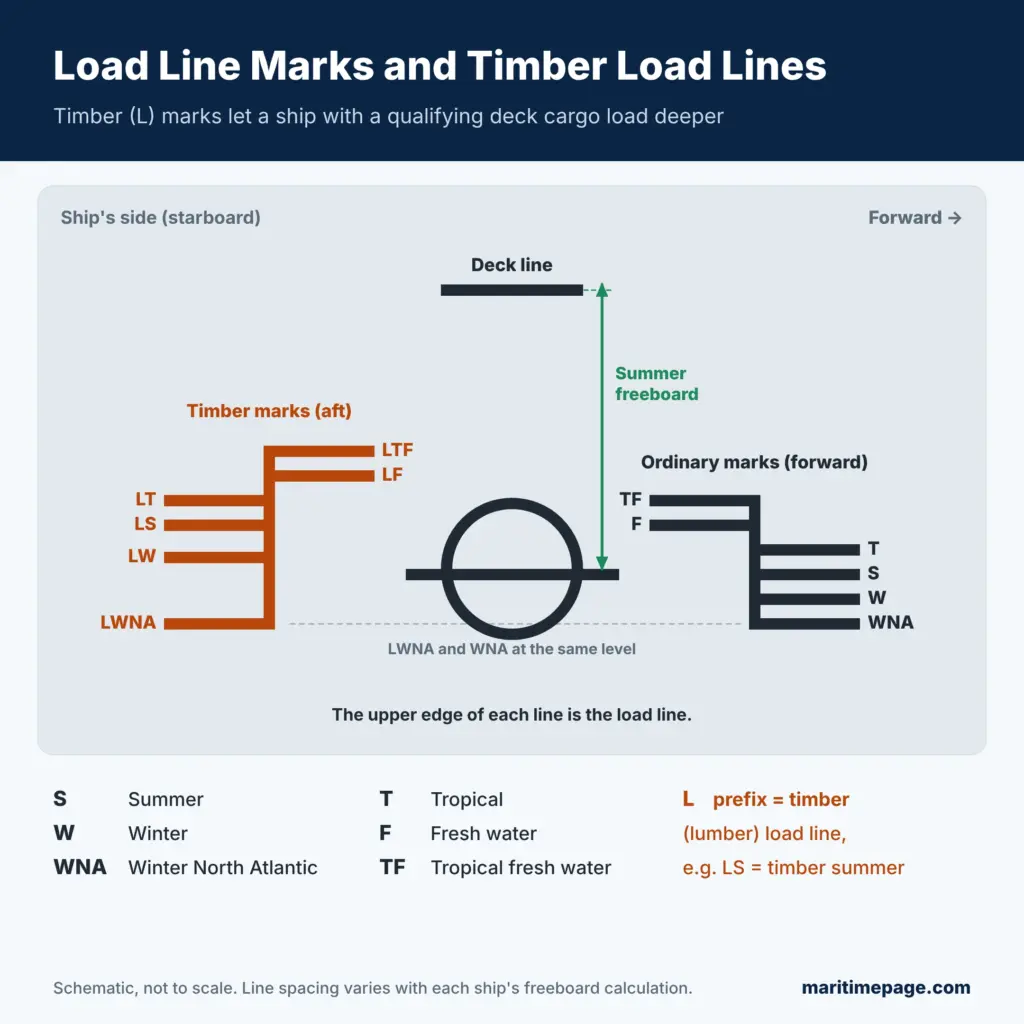
The marks show the deepest permitted draft for each zone and season. They consist of the deck line, the ring-shaped load line mark, and lines marked TF, F, T, S, W and WNA.
| Mark | Meaning | Where it applies |
|---|---|---|
| TF | Tropical fresh water | Fresh water in the Tropical Zone |
| F | Fresh water | Fresh water in the Summer Zone |
| T | Tropical | Seawater in the Tropical Zone |
| S | Summer | Seawater in the Summer Zone; level with the centre of the ring |
| W | Winter | Winter Seasonal Zones in the winter period |
| WNA | Winter North Atlantic | Ships of 100 m or less in the North Atlantic in winter |
What Are the Dimensions of the Load Line Marks?
- Deck line: 300 mm long and 25 mm wide, marked amidships at the freeboard deck.
- Load line mark: a ring of 300 mm outside diameter and 25 mm width. A horizontal line crosses it, with its upper edge through the ring’s centre.
- Load lines: horizontal lines 230 mm long and 25 mm wide, running from a vertical line 540 mm forward of the ring’s centre.
- Authority letters: up to four initials of the assigning authority, about 115 mm high, beside the ring.
- Colour: white or yellow on a dark ground, or black on a light ground, and permanently marked.
The upper edge of each line is the load line, not its centre. How to read the mark, and its history, are covered in our guide to the Plimsoll line on ships. Draft marks and other hull markings are covered in ship hull markings.
What Are Timber Load Lines?
Ships carrying a qualifying timber deck cargo may have a second set of marks, prefixed “L” and placed aft of the ring. A secured timber stow adds buoyancy, so these ships may load deeper.
The timber marks may only be used when the deck cargo meets the stowage and lashing rules. Stability and stowage detail is in our guide to intact stability criteria for timber deck cargo.
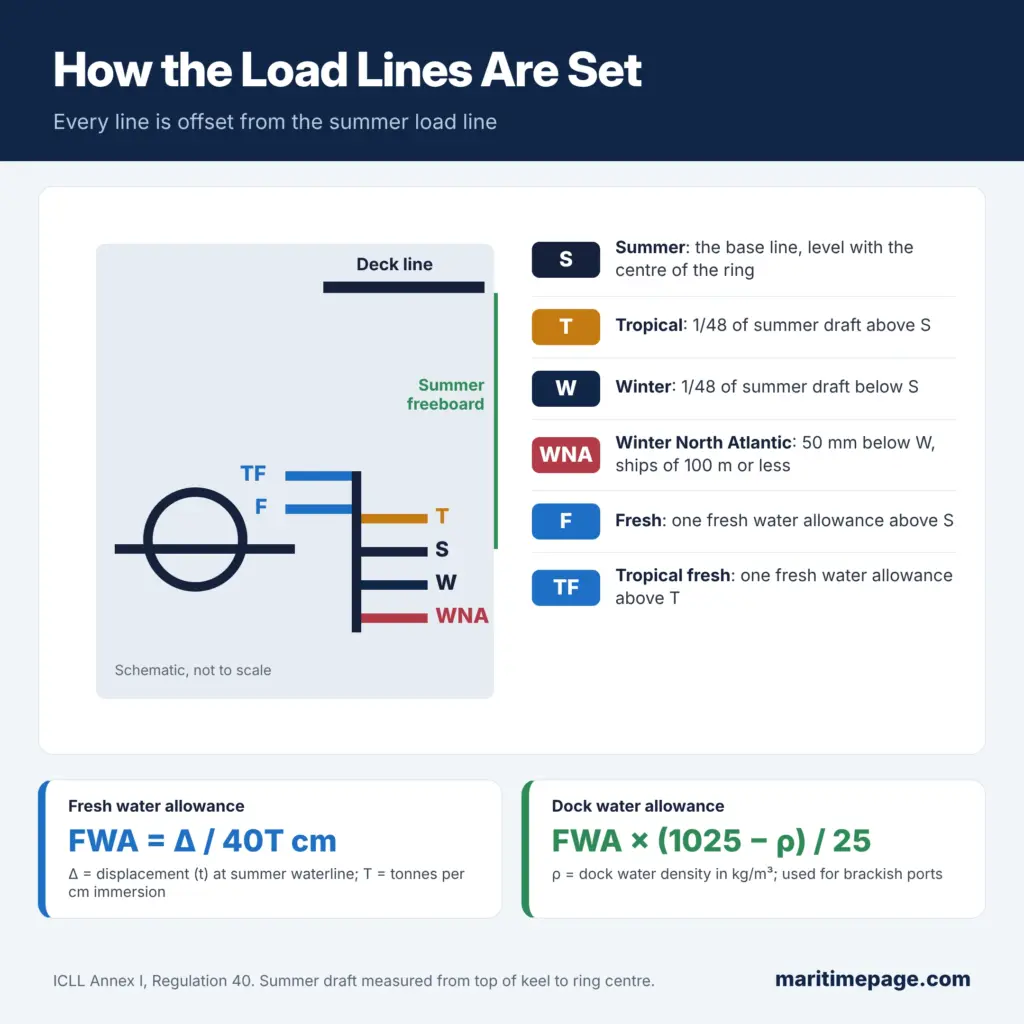
How Are the Other Load Lines Worked Out From the Summer Freeboard?
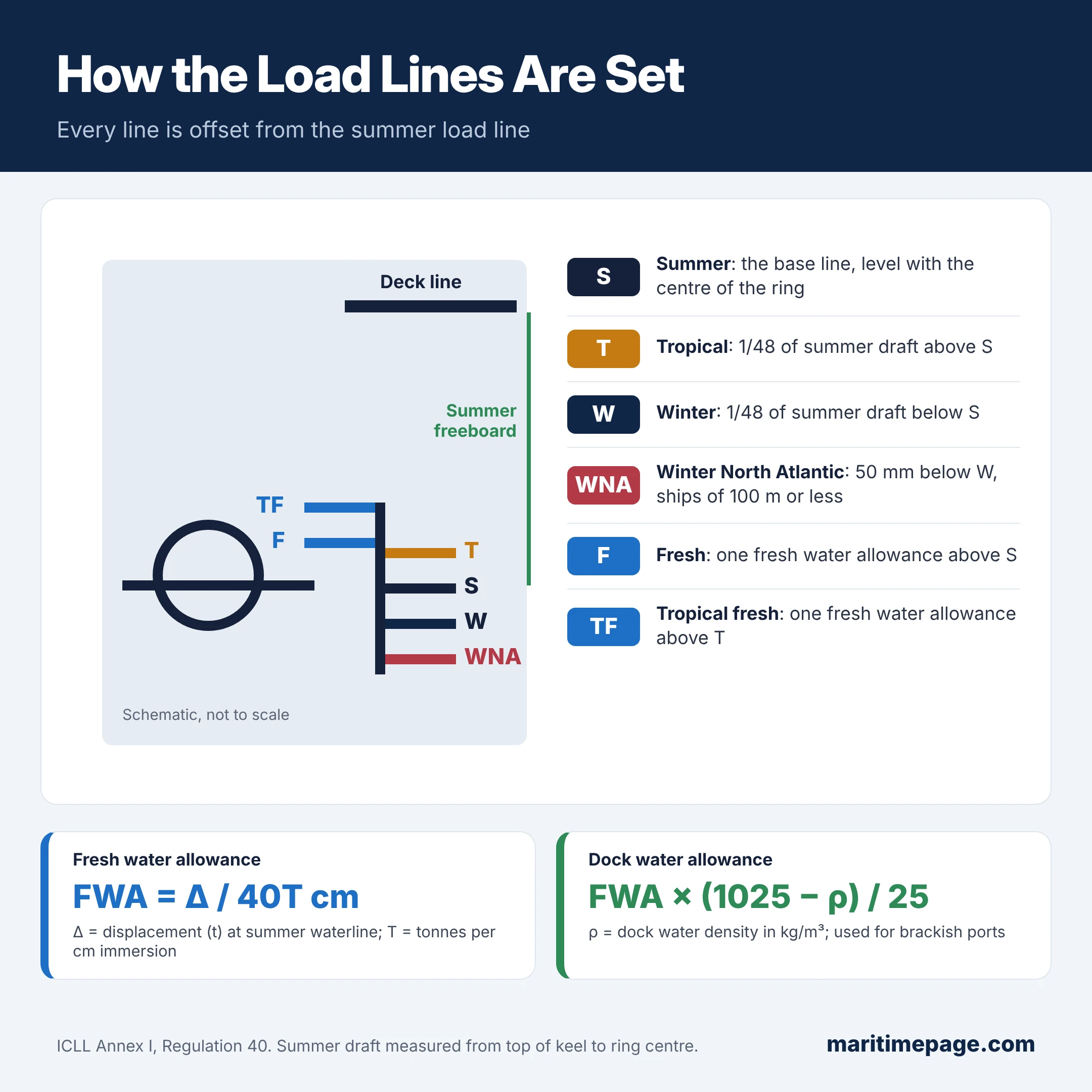
Every other line is offset from the summer load line. Tropical and winter lines move by 1/48 of the summer draft, and fresh water lines by the fresh water allowance.
| Load line | Rule (Regulation 40) |
|---|---|
| Tropical (T) | Summer freeboard minus 1/48 of the summer draft |
| Winter (W) | Summer freeboard plus 1/48 of the summer draft |
| Winter North Atlantic (WNA) | Winter freeboard plus 50 mm, for ships of 100 m or less; equal to winter for longer ships |
| Fresh (F) and Tropical Fresh (TF) | Summer or tropical freeboard minus the fresh water allowance |
Summer draft here is measured from the top of the keel to the centre of the ring. Freeboard in salt water may not be less than 50 mm in any case.
What Is the Fresh Water Allowance?
The fresh water allowance (FWA) is how much deeper a ship floats in fresh water than in seawater at the same displacement. Fresh water is less dense, so the ship sinks further.
Regulation 40 gives it as Δ / 40T centimetres. Δ is the seawater displacement in tonnes at the summer load waterline. T is the tonnes per centimetre immersion at that waterline.
Ports in brackish water use a dock water allowance, worked out in practice as FWA × (1025 − dock water density) / 25. This lets a ship load until her mark will rise to the correct line once she reaches seawater.
Illustrative example: a ship of 40,000 t displacement and 50 t/cm immersion has an FWA of 40,000 / (40 × 50) = 20 cm. In dock water of 1.010 t/m³, she may submerge her summer mark by 20 × 15 / 25 = 12 cm. See why ships float higher in salt water for the physics.
What Are Load Line Zones and Seasonal Areas?
Annex II divides the oceans into zones and seasonal areas, shown on the load line zone chart. The zone where the ship is at a given date decides which mark applies.
- Summer Zones: summer load line all year.
- Tropical Zone: tropical load line all year.
- Seasonal Tropical Areas: tropical in their tropical season, summer the rest of the year.
- Winter Seasonal Zones: northern and southern zones where the winter line applies during the winter period.
The rule that catches people out is the voyage, not the port. A ship may not be submerged below the mark for the zone she is in at departure, during the voyage, or on arrival.
A ship loading in a tropical port for a winter destination must plan her departure draft carefully. Fuel and water burned on passage must bring her up to the winter mark before she enters the winter zone.
What Are the Conditions of Assignment?
Conditions of assignment are the structural and closing-appliance standards a ship must meet before freeboard is assigned. A small freeboard is only safe if water cannot get into the hull.
| Item | What it requires |
|---|---|
| Strength and stability information | Adequate structural strength and approved stability information on board for the master |
| Hatchways and hatch covers | Coamings and covers strong and weathertight, with securing devices in working order |
| Doors and openings in superstructures | Weathertight doors with closing devices operable from both sides |
| Ventilators and air pipes | Minimum coaming heights and permanently attached closing devices where required |
| Side scuttles, windows and cargo ports | Deadlights and watertight closures; cargo port sills above the uppermost load line unless approved |
| Freeing ports | Enough area in bulwarks to clear water from the deck quickly |
| Protection of the crew | Bulwarks or guard rails at least 1 m high, lifelines and safe passage fore and aft |
Hatch covers carry the most risk on bulk carriers and general cargo ships. Our guides to types of hatch covers and the hatch cover weathertightness survey cover them in detail.
Water trapped on deck must drain fast. Freeing ports and bulwarks are sized under the Convention for that reason.
Stability is a separate requirement, set out in the IS Code intact stability criteria. A ship can be within her marks and still be unstable, for example through free surface effect in slack tanks.
How Are Ships Surveyed and Certified for Load Lines?
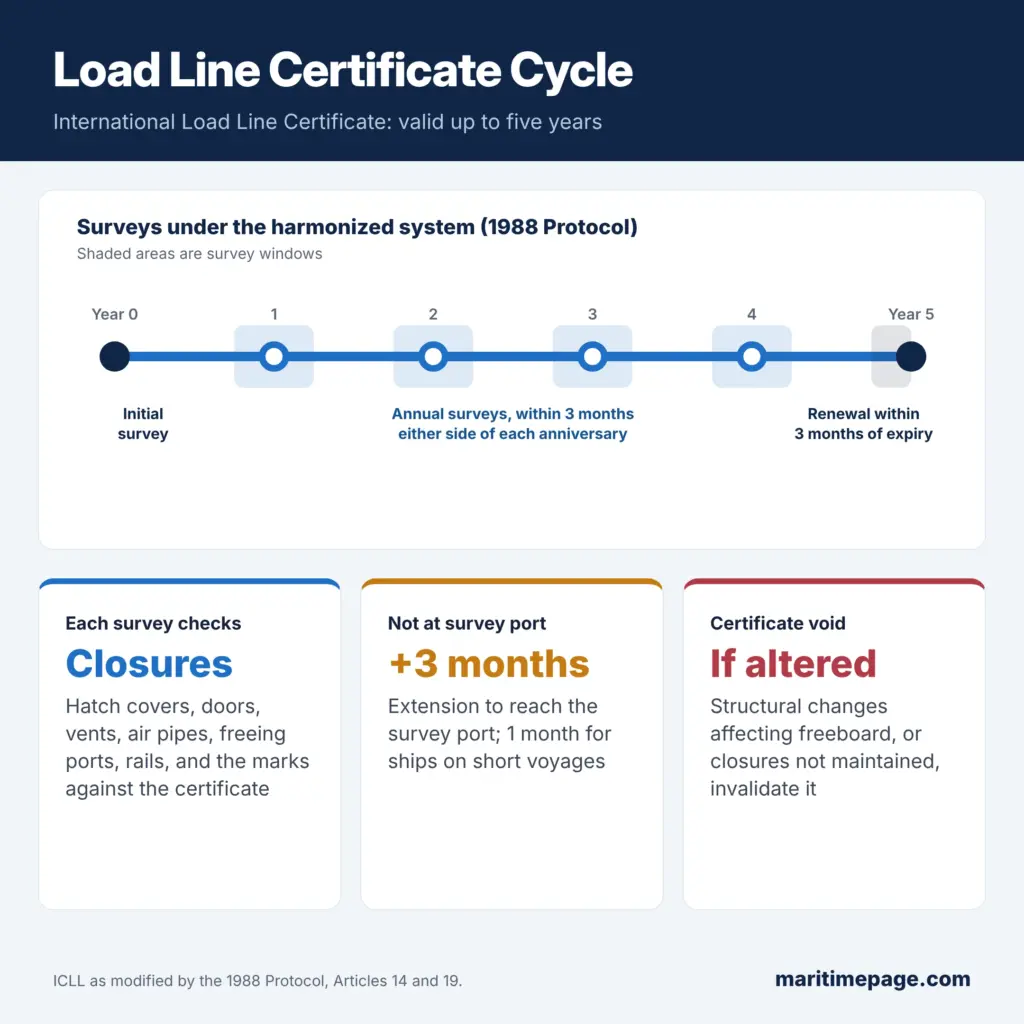
A ship receives an International Load Line Certificate after an initial survey. It is valid for up to five years, with annual surveys and a renewal survey before expiry.
- Initial survey: before the ship enters service. It covers structure, conditions of assignment, freeboard calculation and marking.
- Annual survey: within three months either side of each anniversary date. It confirms that nothing affecting the freeboard has changed and that closures and marks are in order.
- Renewal survey: at intervals not exceeding five years. Completed within three months before expiry, the new certificate runs five years from the old expiry date.
Surveys are usually carried out by a classification society acting as recognized organization for the flag. They are aligned with the other statutory surveys carried out on ships under the harmonized system.
Can a Load Line Certificate Be Extended?
Yes, in limited cases. A ship not in the port of survey at expiry may get up to three months to complete the voyage there. Ships on short voyages may get one month.
A ship exempted under Article 6 carries an International Load Line Exemption Certificate instead. The certificate becomes invalid if the hull or closures are altered in a way that affects the freeboard.
What Do PSC Inspectors and Surveyors Check for Load Lines?
Under Article 21, port state control checks the certificate, that the ship is not overloaded, and that the marks match it. Deficiencies in hatch covers or closures lead to a closer look.
- Certificate: valid, annual surveys endorsed within the window, and matching the ship’s name and marks.
- Marks: visible, correctly placed on both sides, and consistent with the freeboard on the certificate.
- Draft: mean draft against the mark for the zone, corrected for dock water density.
- Hatch covers: rubber packing, compression bars, cleats and drain channels in working order.
- Closures: weathertight doors, ventilator flaps and air pipe heads that close and seal.
- Freeing ports and rails: not blocked, welded shut or missing.
Seized air pipe heads and wasted hatch cover packing are among the most common findings. A crew member should be able to close any ventilator or door on deck without tools.
From the surveyor’s side, a fresh coat of paint on a ventilator flap is a warning, not a pass. Inspectors swing the flap and test the gasket, because paint often hides a seized hinge.
Serious defects in weathertight integrity are grounds for detention. Our list of common reasons for ship detention explains the procedure.
What Happens if a Ship Is Overloaded?
An overloaded ship must not sail. Article 12 forbids submerging the applicable load line when she puts to sea, during the voyage or on arrival. Only fresh water and fuel allowances are permitted.
- Port state: may stop the ship from sailing until cargo is discharged to the correct mark.
- Flag state: national law sets the penalties for the master and owner, usually as a criminal offence.
- Insurance and charter: overloading can breach the hull and P&I cover terms and the charter party.
The commercial pressure is real, because every centimetre is cargo. That is exactly why the decision sits with the master, whose overriding authority is set out in the ISM Code.
How Do Load Lines Fit Into Loading and Stability Planning?
The load line sets the maximum draft, and the loading plan works backwards from it. The officer converts the allowed draft into deadweight, then subtracts fuel, water and stores to find the cargo intake.
- Identify the load line for the most restrictive zone on the voyage.
- Correct for the density of the water at the loading berth.
- Read the deadweight at that draft from the hydrostatic tables.
- Subtract bunkers, fresh water, stores and the constant to find the cargo quantity.
- Check stability, trim, stress and port draft limits for the same condition.
The result goes into the ship’s cargo plan. Final drafts are read on completion and compared with the mark before the ship sails.
The load line is not the only draft limit. Port and channel depth may restrict the ship further through under keel clearance rules. Stability limits, such as a minimum metacentric height, can restrict the loading condition too.
For the full text, the IMO publication Load Lines, Consolidated Edition contains the 1966 Convention, the 1988 Protocol and the amendments. The official overview is on the IMO Load Lines page.
Related Topics
- How much a cargo ship weighs: displacement and deadweight
- Ship tonnage types explained
- MARPOL and its six Annexes
Frequently Asked Questions
What is the difference between a load line and a Plimsoll line?
They describe the same marking. Plimsoll line is the popular name, after Samuel Plimsoll. Load line is the Convention’s term, and it also covers the zone and season lines beside the ring.
What do TF, F, T, S, W and WNA mean on a ship?
Tropical fresh water, fresh water, tropical, summer, winter and winter North Atlantic. Each line shows the deepest permitted draft in that zone, season or water type.
Does the Load Line Convention apply to yachts?
Not to pleasure yachts that are not engaged in trade. Commercial yachts of 24 m and over on international voyages are covered, though many flags apply a yacht code instead.
What is the fresh water allowance?
The amount a ship sinks deeper in fresh water than in seawater at the same displacement. It equals displacement divided by 40 times the tonnes per centimetre immersion, in centimetres.
How long is a load line certificate valid?
Up to five years. Annual surveys are required within three months either side of each anniversary date, and a renewal survey before expiry.
Who assigns the load line?
The flag Administration, or a recognized organization acting for it, usually a classification society. Its initials appear beside the load line ring.
What happens if the load line is submerged?
The ship is overloaded and must not sail. Port state control can stop her until cargo is discharged, and the flag state can penalize the master and owner.
Do tugs and barges need load lines?
Tugs and barges of 24 m and over on international voyages fall under the Convention. Smaller or domestic units usually need a load line under national rules.

- What Is the ISPS Code? Security Levels, Plans and the ISSC – October 8, 2026
- What Is the Load Line Convention? Freeboard and Marks Guide – October 8, 2026
- What Is the MLC 2006? Maritime Labour Convention Explained – October 8, 2026