The IS Code, or International Code on Intact Stability 2008, sets the minimum stability an undamaged ship of 24 m and over must have. It defines the GZ curve criteria, the weather criterion, and special rules for certain ship types.
This guide is written for deck officers, cadets, surveyors and naval architecture students. It explains what the IS Code requires, how the criteria are checked, and what inspectors look for.
What Is the IS Code?
The IS Code is the 2008 International Code on Intact Stability, adopted by IMO Resolution MSC.267(85). Part A contains mandatory criteria; Part B contains recommendations and guidance on stability information, calculations and operations.
Part A became mandatory on 1 July 2010 through SOLAS Chapter II-1 and the 1988 Protocol to the Load Lines Convention. It replaced the older non-mandatory code of 1993, Resolution A.749(18).
- Part A, Chapter 1: application, and the dynamic stability phenomena in waves that the criteria do not fully cover.
- Part A, Chapter 2: general criteria for all ships, including the GZ curve and the weather criterion.
- Part A, Chapter 3: special criteria for passenger ships, oil tankers, timber carriers, grain ships and high-speed craft.
- Part B: recommended criteria for other ship types, plus guidance on stability booklets, calculations, icing, watertight integrity and the inclining test.
What Is Intact Stability?
Intact stability is a ship’s ability to float upright and return to upright when heeled, with her hull undamaged. It depends on the positions of the centre of gravity and centre of buoyancy, and on the shape of the hull.
When a ship heels, the centre of buoyancy moves to the low side. The horizontal distance between the weight and buoyancy lines is the righting lever, GZ.
Initial stability is measured by the metacentric height, GM. Stability at larger angles is shown by the GZ curve, which plots GZ against angle of heel.
Damage stability is a separate subject. It is covered by SOLAS Chapter II-1 Part B-1 and other codes, not by the IS Code.
What Are the General Intact Stability Criteria?
IS Code Part A, section 2.2 requires a GZ curve area of 0.055 m-rad to 30° and 0.09 m-rad to 40°. GZ must reach 0.20 m at 30° or more, and GM at least 0.15 m.
| Criterion (Part A, 2.2) | Minimum |
|---|---|
| Area under GZ curve up to 30° | 0.055 metre-radians |
| Area under GZ curve up to 40° (or angle of down-flooding if less) | 0.09 metre-radians |
| Area between 30° and 40° (or angle of down-flooding) | 0.03 metre-radians |
| Righting lever GZ at an angle of 30° or more | 0.20 m |
| Angle of maximum GZ | Preferably above 30°, and not less than 25° |
| Initial metacentric height GM0 | 0.15 m |
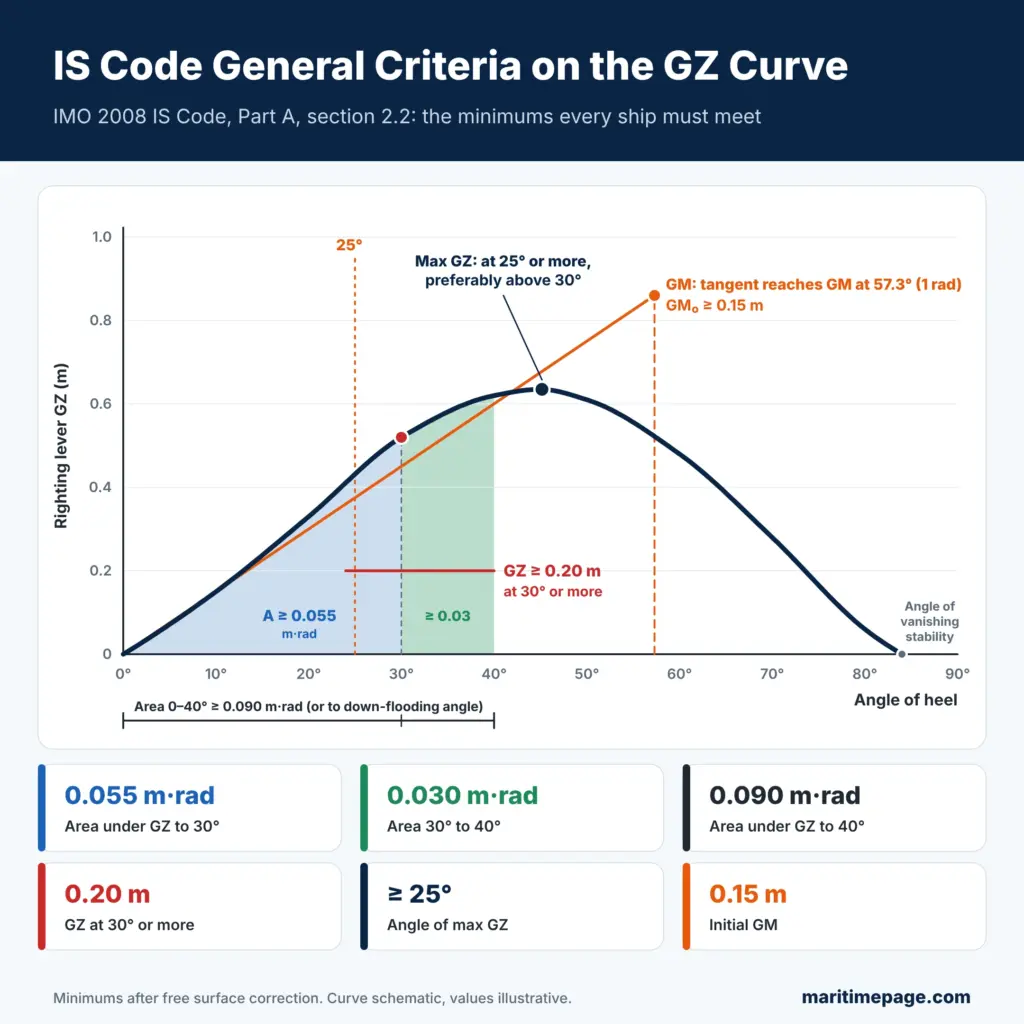
All values are after correction for the free surface effect of liquids in tanks. They must be met in every loading condition in the approved stability booklet.
The areas measure dynamic stability: the energy needed to heel the ship. A ship can have a good GM yet fail on area if her GZ curve falls away too early.
What Is the GZ Curve?
The GZ curve, or curve of statical stability, plots the righting lever against angle of heel for one loading condition. Its shape shows the ship’s stiffness, maximum righting lever, range of stability and angle of vanishing stability.
- Initial slope: set by GM. A tangent from the origin reaches GM at 57.3° (one radian).
- Maximum GZ: the greatest righting lever and the angle at which it occurs.
- Angle of vanishing stability: where GZ returns to zero; beyond it the ship capsizes.
- Range of stability: the angles over which GZ stays positive.
- Area under the curve: dynamic stability, measured in metre-radians.
- Angle of down-flooding: where water can enter through unprotected openings; areas are cut off there.
Moving weight up raises G and shrinks the whole curve. That is why loading high on deck, as with timber deck cargo, needs its own criteria.
What Is the Weather Criterion?
The weather criterion, or severe wind and rolling criterion, checks that a ship can survive a strong beam wind while rolling in waves. It applies in addition to the GZ curve criteria in Part A, section 2.3.
- A steady beam wind, based on a pressure of 504 Pa, heels the ship to an equilibrium angle.
- That angle must not exceed 16° or 80% of the angle of deck-edge immersion, whichever is less.
- The ship then rolls to windward, by an angle that depends on her form and bilge keels.
- A gust raises the wind heeling lever by half.
- The area under the GZ curve beyond the gust lever (area b) must be at least equal to the area before it (area a).
The criterion matters most for ships with large windage, such as container ships, car carriers and passenger ships.
What Special Criteria Apply to Certain Ship Types?
Part A, Chapter 3 adds criteria for passenger ships, oil tankers of 5,000 tonnes deadweight and above, timber carriers, grain ships and high-speed craft. Part B recommends criteria for other types.
| Ship type | Where | Key requirement |
|---|---|---|
| Passenger ships | Part A, 3.1 | Heel from passengers crowding to one side, or from turning, not more than 10° |
| Oil tankers ≥ 5,000 dwt | Part A, 3.2 | Criteria met in every loading and liquid-transfer condition, GM ≥ 0.15 m in port (MARPOL Annex I, Regulation 27) |
| Timber deck cargo ships | Part A, 3.3 | Area 0.08 m-rad to 40°, max GZ 0.25 m, GM 0.10 m throughout the voyage |
| Grain ships | Part A, 3.4 | Stability for grain shift under the International Grain Code |
| High-speed craft | Part A, 3.5 | Criteria of the HSC Code |
| Container ships > 100 m | Part B, 2.3 | Alternative criteria using a form factor |
| Fishing vessels, pontoons, OSVs, special purpose ships, MODUs | Part B, 2.1–2.6 | Recommended design criteria |
Timber ships use the deck cargo as buoyancy and accept a lower GM. See the guide to intact stability criteria for timber deck cargo.
What Are the Second-Generation Intact Stability Criteria?
The second-generation criteria are IMO interim guidelines that assess five dangerous behaviours in waves which the 2008 criteria do not cover. They were issued as MSC.1/Circ.1627 in 2020 for voluntary trial use.
- Dead ship condition: a ship without power drifting beam-on to wind and waves.
- Excessive acceleration: violent rolling that endangers crew and cargo, typical of very stiff ships.
- Pure loss of stability: GZ falling sharply when a wave crest sits amidships.
- Parametric rolling: large rolls built up by changing stability in head or following seas, explained in the article on parametric rolling.
- Surf-riding and broaching: the ship carried along by a following wave and slewed broadside.
Each failure mode is checked in levels: a simple first check, a more detailed vulnerability check, then direct simulation. Operational limits or guidance can be used where a design does not pass.
How Is Stability Checked on Board?
On board, stability is checked against the IS Code using the approved stability booklet and, on most cargo ships, an approved loading computer. The officer checks every loading condition before departure and for the arrival condition.
- Stability booklet: approved information required by SOLAS Chapter II-1, Regulation 5-1, with hydrostatics, cross curves and limiting KG or GM curves.
- Loading computer: calculates GM, GZ curve, criteria compliance, and on many ships hull strength. Tankers, chemical tankers and gas carriers must have an approved stability instrument.
- Departure and arrival: both conditions checked, including fuel and water used on passage.
- Corrections: free surface, water absorbed by cargo, ice accretion, and any trim effects on the GZ curve.
- Lightship data: from the inclining test at delivery, checked by lightweight surveys on passenger ships at intervals of no more than five years.
The longitudinal values used in the same calculations, such as LCB and LCF, are explained in the article on LCB and LCF.
What Do Surveyors and PSC Inspectors Check About Stability?
Class surveyors and port state control inspectors check the ship’s approved stability information and loading computer. They also check that the current voyage’s stability calculation meets the IS Code.
- Stability booklet approved by the flag state or class, matching the ship as she is now.
- Loading computer type-approved, tested against the booklet’s test conditions, and the test recorded.
- Departure stability calculation for the current voyage, including the arrival condition.
- Free surface corrections taken from the actual tank soundings, not left at zero.
- GM and KG within the limiting curves for the actual draft.
- Officers able to explain the calculation and read the GZ curve.
Common findings are missing departure calculations, loading computers never tested, and free surface ignored. A ship without adequate stability can be detained, because it is a basic seaworthiness issue.
Related Topics
Frequently Asked Questions
What is the IS Code?
The International Code on Intact Stability 2008, adopted by IMO Resolution MSC.267(85). It sets the minimum intact stability criteria for ships of 24 m and over.
Is the IS Code mandatory?
Part A is mandatory since 1 July 2010, through SOLAS Chapter II-1 and the 1988 Load Lines Protocol. Part B contains recommendations and guidance.
What is the minimum GM under the IS Code?
The general criteria require an initial GM of at least 0.15 m after free surface correction. Timber deck cargo ships may use 0.10 m under their special criteria.
What are the IS Code GZ curve criteria?
At least 0.055 m-rad of area to 30°, 0.09 m-rad to 40° and 0.03 m-rad between them. GZ must reach 0.20 m at 30° or more, peaking at no less than 25°.
What is the weather criterion?
It checks that the ship survives a strong beam wind while rolling. The steady-wind heel must not exceed 16° or 80% of deck-edge immersion, and a gust energy balance must be met.
Does the IS Code cover damage stability?
No. The IS Code covers intact stability only. Damage stability is covered by SOLAS Chapter II-1 and ship-type codes such as MARPOL Annex I.
What are the second-generation stability criteria?
IMO interim guidelines, MSC.1/Circ.1627, assessing five failure modes in waves: dead ship, excessive acceleration, pure loss of stability, parametric rolling and surf-riding.
Which ships does the IS Code apply to?
Ships of 24 m in length and over, with special criteria for passenger ships, oil tankers, timber carriers, grain ships and high-speed craft.

- What Is the IS Code? IMO Intact Stability Criteria Explained – October 5, 2026
- Ship Stopping Distance: Crash Stop and IMO Limits Explained – October 5, 2026
- Under-Keel Clearance (UKC): Calculation, Allowances, Policy – October 4, 2026