
The pivot point of a ship is the point on her centreline about which she appears to turn. It is not fixed: it moves forward when the ship goes ahead, aft when she goes astern, and shifts with speed and applied forces.
This guide is written for deck officers, cadets and pilots in training. It explains where the pivot point lies, why it moves and how to work it out. It also shows how it changes the effect of rudder, thrusters, tugs and wind.
What Is the Pivot Point of a Ship?
The pivot point is the point on the centreline with no sideways movement while the ship turns. Everything forward of it swings one way and everything aft swings the other, so it looks like the centre of rotation.
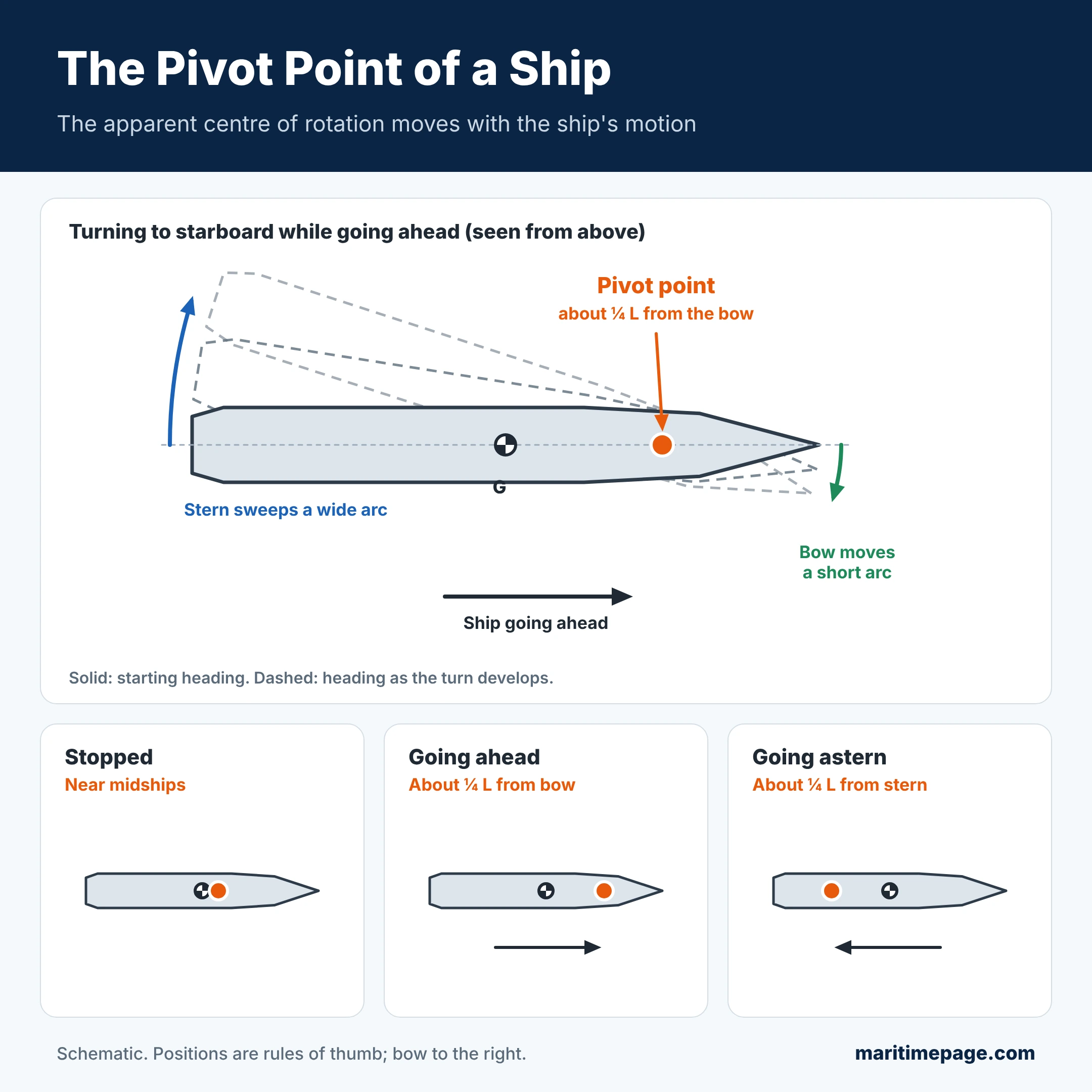
It is an apparent centre, not a physical one. Mechanically, the ship rotates about her center of gravity, while also moving ahead and sideways.
Combine the rotation with the sideways drift, and one point on the centreline ends up moving straight along the heading. That point is the pivot point, and its position depends on how the ship is moving.
Where Is the Pivot Point of a Ship?
Going ahead at steady speed, the pivot point lies about a quarter of the ship’s length from the bow. Going astern, it moves to about a quarter of the length from the stern; stopped, it is near midships.
| Ship condition | Approximate pivot point position |
|---|---|
| Stopped, no forces acting | Near midships, close to the centre of gravity |
| Gathering headway from rest | Moves well forward; some texts quote up to 1/8 L from the bow |
| Steady speed ahead | About 1/4 L from the bow |
| Turning while going ahead | About 1/4 to 1/3 L from the bow |
| Steady sternway | About 1/4 L from the stern |
| Stopped, lateral force at one end | Moves away from the end where the force acts |
These figures are rules of thumb used in ship handling, not exact values. Hull form, trim, speed, acceleration and water depth all shift the real position.
Ship-handling texts also quote the turning pivot point moving aft as the length-to-beam ratio falls. It goes from about 0.33 L from the bow at L/B 9 to 0.40 L at L/B 5.
Why Does the Pivot Point Move Forward When Going Ahead?
Going ahead, the ship’s momentum acts at the centre of gravity while water resistance builds up along the forward part of the hull. The two balance at a point forward of midships, where the pivot point settles.
When the ship starts from rest, propeller thrust acts before the hull has gathered way. The pivot point then moves even further forward, before settling back as speed steadies.
Going astern, the same happens in reverse. Resistance builds on the after body, and the pivot point moves aft towards the stern. The same shift happens in a crash stop, as the ship loses steering and swings while way comes off.
How Is the Pivot Point Calculated?
The pivot point lies where the ship’s sway velocity is cancelled by her rotation. Its distance from the centre of gravity equals the sway velocity divided by the rate of turn.
- Formula: xp = −v ÷ r, where v is the sway velocity (m/s) and r is the rate of turn (radians/s).
- Sign: xp is measured from the centre of gravity, positive forward.
- Meaning: at the pivot point, the hull moves exactly along its own heading, with zero drift angle.
Because it depends only on sway and yaw, the pivot point is independent of the forward speed itself. A small sway velocity with a fast rate of turn puts it near the centre of gravity. A large sway velocity pushes it towards the bow.
No force acts “at” the pivot point. Rudder, propeller, thruster, tug and wind forces act where they are applied. The pivot point simply shows how the ship responds to them in a turning circle or other manoeuvre.
How Does the Pivot Point Affect Turning Levers?
A force turns the ship according to its distance from the pivot point, its turning lever. When the pivot point moves forward, forces aft gain a longer lever and forces forward lose it.
The rudder benefits going ahead. With the pivot point a quarter length from the bow, the rudder works on a lever of about three-quarters of the length.
The classic example uses two tugs, each pulling 20 tonnes to starboard, at the bow and stern of a 200 m ship.
| Ship condition | Pivot point | Forward tug lever | Aft tug lever | Result |
|---|---|---|---|---|
| Stopped | 100 m from bow | 100 m | 100 m | Ship moves bodily to starboard, no swing |
| Making headway | 50 m from bow | 50 m | 150 m | Aft tug dominates; stern swings to starboard, bow to port |
| Making sternway | 150 m from bow | 150 m | 50 m | Forward tug dominates; bow swings to starboard |
The same logic explains why a pilot moves tugs or changes engine movements as the ship gains or loses way. The useful end of the ship changes with the pivot point.
Why Is a Bow Thruster Weak When the Ship Has Headway?
With headway, the pivot point moves forward towards the bow thruster, so its turning lever becomes short. Water flowing past the hull also reduces the thruster’s effective thrust as speed increases.
This is why bow thrusters are most effective with the ship stopped or moving very slowly. Going astern, the pivot point moves aft and the bow thruster gains a longer lever instead.
How Does Wind Act on a Ship Relative to the Pivot Point?
Wind acts on the ship’s side area, and the area aft of the pivot point decides which way she swings. With headway, the pivot point is forward, so wind on the larger area aft blows the stern downwind.
- Going ahead: the stern is blown downwind and many ships tend to head up into the wind.
- Going astern: the pivot point moves aft, the bow falls off downwind, and the stern tends to seek the wind.
- Stopped: most ships lie roughly beam-on to the wind, with the end carrying more windage blown furthest.
Superstructure position changes the effect. A ship with accommodation aft has extra windage behind the pivot point when going ahead, which makes the stern even more likely to fall away.
Is the Pivot Point the Same as the Centre of Rotation in a DP System?
No. The pivot point is a hydrodynamic result of how the ship moves, while the DP centre of rotation is a setpoint the operator chooses. The DP system then uses thrusters to turn the vessel about that chosen point.
On a vessel with dynamic positioning, the operator selects the rotation centre. Typical choices are the vessel’s centre, bow, stern, moonpool, crane tip or gangway end. When the heading changes, the DP holds that point stationary and swings the rest of the hull around it.
- Pivot point: apparent centre of rotation, set by speed, hull form and forces; it moves as the ship moves.
- DP rotation centre: a chosen control point, held in position by thrusters regardless of hull form or speed.
- Practical difference: on DP, a heading change about the gangway tip keeps the gangway on the platform. Under manual control, the gangway would swing with the hull.
Mixing the two up leads to wrong expectations during DP operations. A DP operator plans heading changes around the selected rotation centre, not around where the hull would pivot naturally.
What Does the Pivot Point Mean in Practical Ship Handling?
Knowing where the pivot point is tells the ship handler which end will swing, how far, and which force will be most effective. It is used for every turn, berthing and tug manoeuvre.
- Stern sweep: going ahead, the stern swings far wider than the bow, so watch the quarter when turning near a berth, buoy or other ship.
- Turning short round: a kick ahead with full rudder swings the stern while the ship gains little way. See the guide to steering a ship.
- Going astern: the pivot point moves aft, so the bow swings and small rudder or thruster forces aft have little effect.
- Dredging an anchor: an anchor on the bottom holds the bow, and the pivot point moves to the hawse pipe. Engine and rudder then swing the stern around the anchor.
- Planning turns: the advance and transfer used for wheel-over points already include the pivot point effect, as measured in sea trials.
- Berthing: during berthing, as the ship loses headway, the pivot point moves aft, and the bow responds better to thrusters and tugs.
Small boats behave the same way. Going ahead, a motorboat turns about a point roughly a third of her length from the bow. Her stern swings out when leaving a dock.
Related Topics
Frequently Asked Questions
What is the pivot point of a ship?
It is the point on the centreline about which the ship appears to turn. At that point the hull has no sideways motion and moves exactly along its heading.
Where is the pivot point when a ship is going ahead?
About a quarter of the ship’s length from the bow at steady speed. In a turn ahead it lies roughly a quarter to a third of the length from the bow.
Where is the pivot point when going astern?
It moves aft to about a quarter of the ship’s length from the stern. The bow then swings more than the stern.
Is the pivot point the same as the centre of gravity?
No. The ship physically rotates about her centre of gravity, but the pivot point is the apparent centre of rotation. The pivot point is near the centre of gravity only when the ship is stopped.
How do you calculate the pivot point?
Its distance from the centre of gravity equals the sway velocity divided by the rate of turn, with the sign reversed. It is where the drift angle is zero.
Why does the stern swing wide when a ship turns?
Going ahead, the pivot point is well forward. The stern is much further from it than the bow, so it sweeps a wider arc.
Is the pivot point the same as the DP rotation centre?
No. The pivot point is the apparent centre of rotation set by hull form and motion. The DP rotation centre is a point the operator selects, and thrusters hold it in place during heading changes.
Does a ship with headway turn into the wind?
Many do. With the pivot point forward, wind on the larger area aft pushes the stern downwind, so the bow tends to head up into the wind.

- Great Lakes Maritime Academy: Programs, Cost and Admission – October 14, 2026
- Bunker Delivery Note (BDN): Contents, MARPOL Rules and Checks – October 11, 2026
- Oil Record Book: Part I and Part II Entries, Rules and PSC Checks – October 11, 2026


Leave a Reply