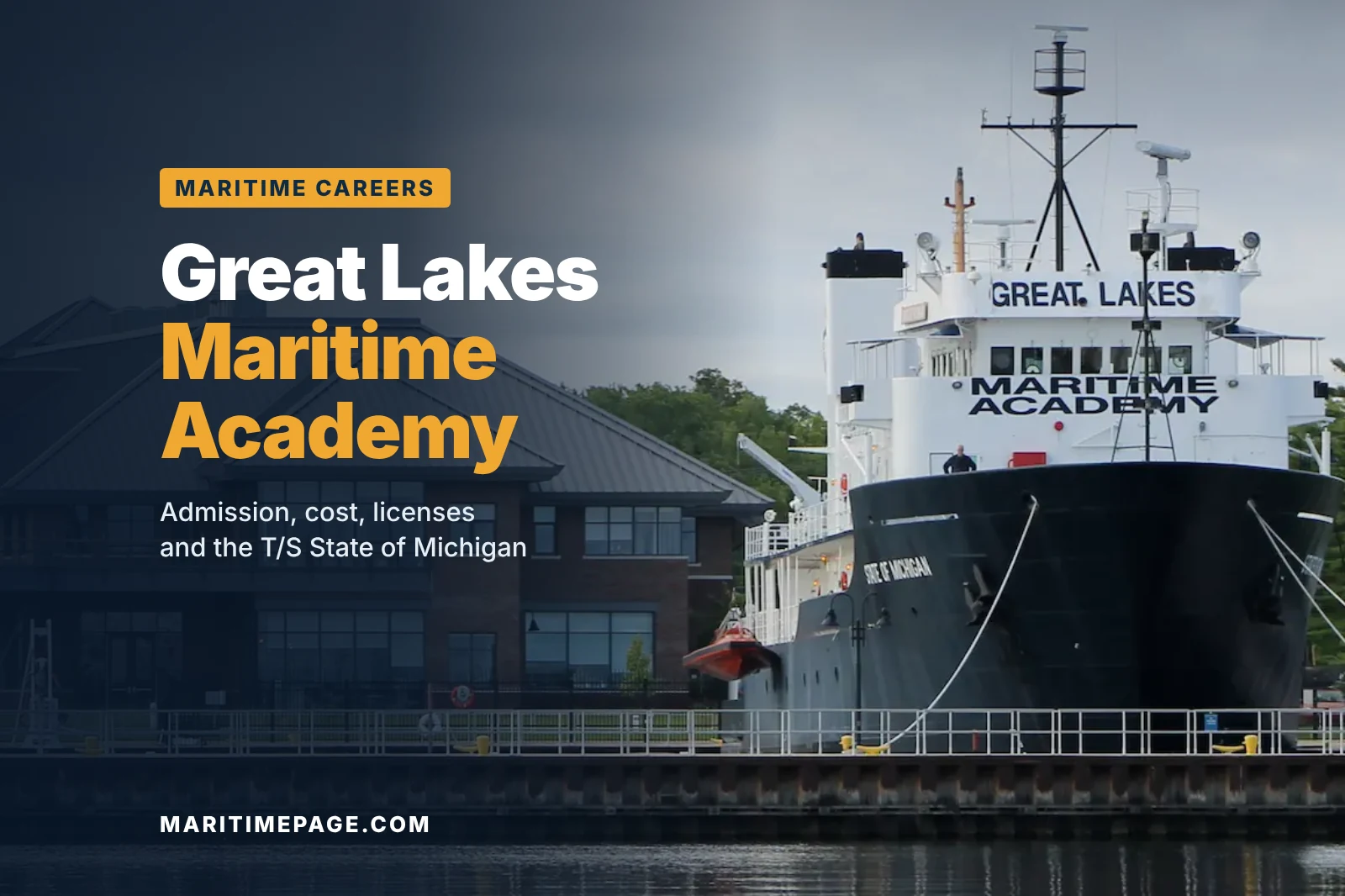
Great Lakes Maritime Academy (GLMA) in Traverse City, Michigan, is the only U.S. maritime academy focused on Great Lakes shipping. It trains deck and engineering officers through four-year Bachelor of Science degrees at Northwestern Michigan College.
This profile covers admission, licenses, cost, sea time, and pay for students and parents comparing academies. We checked every figure against the college’s own pages in October 2026.
Great Lakes Maritime Academy at a Glance
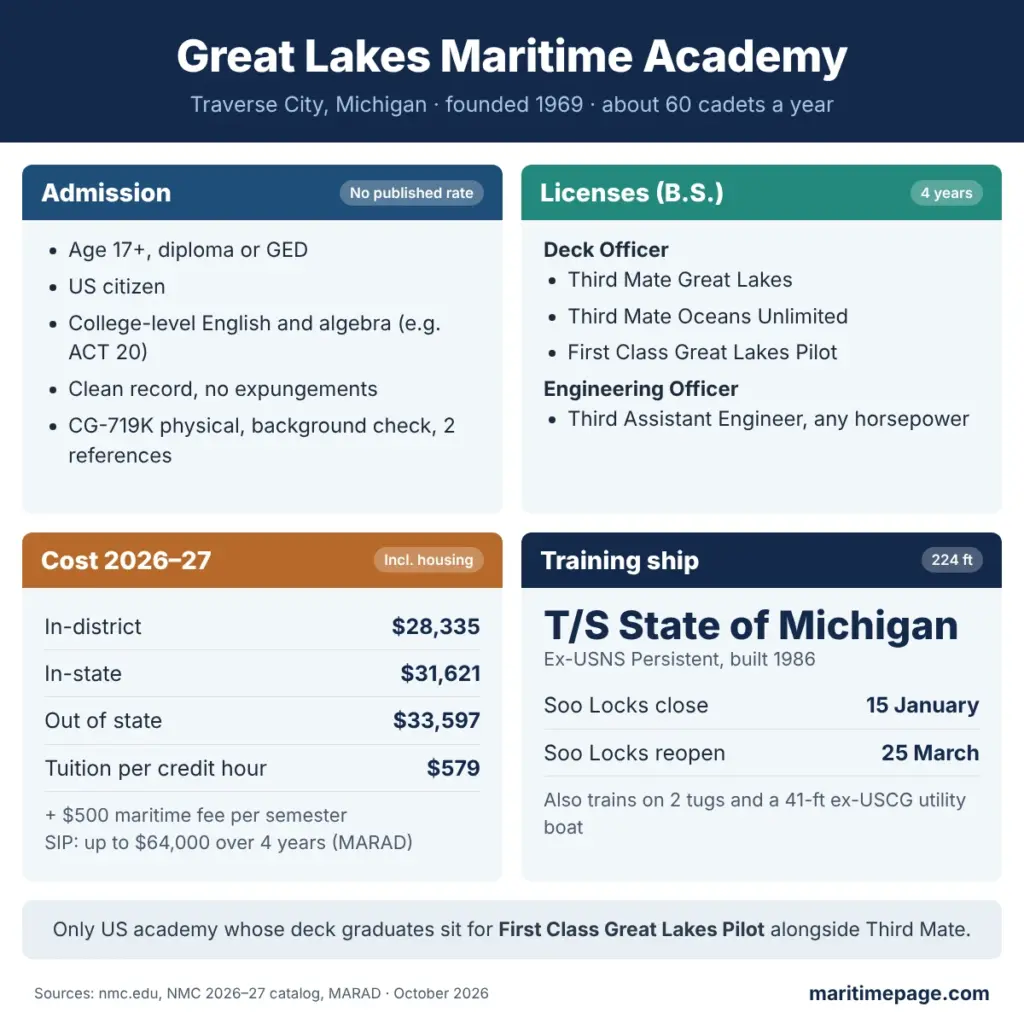
GLMA is Michigan’s state maritime academy, founded in 1969 and run by Northwestern Michigan College. It admits about 60 cadets each fall and prepares them for U.S. Coast Guard officer licenses valid on the Great Lakes and the oceans.
| Item | Great Lakes Maritime Academy |
|---|---|
| Type | State maritime academy, part of Northwestern Michigan College (NMC) |
| Location | Traverse City, Michigan, on Grand Traverse Bay |
| Founded | 1969 |
| Degrees | B.S. Maritime Technology: Deck Officer, Engineering Officer, Power Systems |
| Deck license exams | Third Mate Great Lakes and Oceans Unlimited Tonnage; First Class Great Lakes Pilot |
| Engine license exam | Third Assistant Engineer, Steam and Motor Vessels, any horsepower |
| Program length | Four years; a condensed path for students who already hold a bachelor’s degree |
| Class size | About 60 cadets, starting each mid-August |
| Acceptance rate | Not published; admission runs against a checklist |
| Estimated annual cost, 2026–27 | $28,335 in-district, $31,621 in-state, $33,597 out of state |
| Training ship | T/S State of Michigan, 224 ft, built 1986 |
| Contact | (231) 995-1200, [email protected] |
What Is Great Lakes Maritime Academy?
Great Lakes Maritime Academy is one of six state maritime academies in the US, alongside the federal academy at Kings Point. It opened in 1969 to train mates, pilots, and engineers for the commercial shipping industry on the Lakes.
The U.S. Maritime Administration (MARAD), the U.S. Coast Guard and the Michigan Department of Education approve the program. Our guide to maritime colleges and academies in the US compares GLMA with the other six.
The academy moved into a new building in 2003. Its harbor on Grand Traverse Bay was expanded in 2005 to berth the training ship and the smaller training vessels.
What Is the Great Lakes Maritime Academy Acceptance Rate?
Great Lakes Maritime Academy does not publish an acceptance rate. It admits a class of about 60 cadets each fall, and the college describes admission as competitive. Applicants are judged against a published checklist rather than a selectivity target.
To apply, you must meet every item below:
- Be at least 17 years old and hold a high school diploma or GED
- Be a US citizen
- Place at freshman English and Intermediate Algebra level, through a composite ACT of 20, transfer credits or placement testing
- Have no misdemeanors, felonies or legal expungements on record
- Pass a U.S. Coast Guard CG-719K merchant mariner physical
- Clear a background check and send two references
The record and medical rules exist because the Coast Guard screens every license applicant on the same points. Our page on merchant navy age limits and health requirements explains the medical standards in more detail.
What Degrees and Licenses Does GLMA Offer?
GLMA awards a Bachelor of Science in Maritime Technology in three tracks: Deck Officer, Engineering Officer and Power Systems. The deck and engine tracks end in a U.S. Coast Guard license exam, and passing it is a graduation requirement.
Graduates also meet the STCW Code standards, so their licenses carry the international endorsements needed on ocean-going ships.
Deck Officer
Deck cadets prepare for three Coast Guard exams: Third Mate Great Lakes, Third Mate Oceans Unlimited Tonnage and First Class Great Lakes Pilot. They also complete Great Lakes pilotage exams before graduation.
The pilot endorsement is what sets GLMA apart from the ocean academies. It lets a graduate stand a navigation watch on US-flag lakers without carrying a separate pilot. The training mirrors the deck cadet duties on any merchant ship.
Engineering Officer
Engine cadets prepare for the Third Assistant Engineer exam for steam and motor vessels of any horsepower. The coursework covers steam and diesel engineering and engine-room watchkeeping.
A new third assistant engineer starts with the watch and maintenance work described in third engineer duties on ships.
Power Systems
The Power Systems track leads to a Bachelor of Science without a Coast Guard license. It is the only GLMA program where the license exam is not a graduation requirement.
How Long Is the Program at Great Lakes Maritime Academy?
The license programs take four years, including sea time, and a new class starts each mid-August. Students who already hold a bachelor’s degree can take a condensed curriculum and finish in about three years.
The condensed path suits career changers. It still includes the full sea time and the Coast Guard license exam.
How Much Does Great Lakes Maritime Academy Cost?
NMC estimates the 2026–27 annual cost of attendance at $28,335 in-district, $31,621 in-state and $33,597 out of state. Tuition is $579 per credit hour, plus a $500 maritime program fee per semester.
| Residency | Estimated annual cost, 2026–27 |
|---|---|
| In-district (NMC district) | $28,335 |
| In-state (Michigan) | $31,621 |
| Out of state | $33,597 |
The gap between Michigan and out-of-state students is under $2,000 a year. At SUNY, Massachusetts and Maine Maritime, out-of-state tuition is more than double the in-state rate.
Financial Aid and the SIP Program
As a state academy, GLMA takes part in MARAD’s Student Incentive Payment (SIP) program. It pays up to $64,000 over four years toward tuition, uniforms, books and subsistence.
SIP cadets join the Strategic Sealift Midshipman Program and earn a commission in the U.S. Navy Reserve. In return, they accept a service obligation in the US maritime industry after graduation.
What Is the GLMA Training Ship?
GLMA trains cadets on the T/S State of Michigan, a 224-foot former US Navy ocean surveillance ship. She was built in 1986 as USNS Persistent, one of 18 Stalwart-class T-AGOS vessels that towed sonar arrays.
The Navy transferred Persistent to the Coast Guard in 1998 for drug interdiction work. The academy later negotiated her transfer to Traverse City for cadet training.
Cadets start on smaller vessels before they sail on the training ship:
- Anchor Bay: a 45-foot former Army Corps of Engineers tug, usually the first vessel cadets operate
- 41-foot utility boat: a former Coast Guard boat with twin Cummins diesels, used for twin-engine handling and towing
- Robinson Bay: a 102-foot tug built in 1958, transferred from the St. Lawrence Seaway in 2024, with a 2,105 hp electric propulsion motor
How Does Sea Time Work at GLMA?
GLMA cadets complete their sea time aboard commercial ships and the training ship, scheduled by the academy across the program. The NMC catalog cites up to 300 sailing days of cadet training under federal rules.
At sea, cadets complete written assignments and graded sea projects for each vessel. Sea time takes place on both the Great Lakes and the oceans.
On board, a cadet sits at the bottom of the officer line and works under a licensed officer. Our guide to shipboard organization and ranks shows where cadets fit in the chain of command.
What Is the Great Lakes Shipping Season?
The Great Lakes shipping season runs from late March to mid-January. The Soo Locks at Sault Ste. Marie close on 15 January for winter maintenance and reopen on 25 March.
Most of the fleet lays up for winter, which shapes both cadet sea time and graduate work patterns. Lakers carry iron ore, limestone, coal and grain, mostly as self-unloading dry bulk carriers.
Graduates who want year-round work use the oceans endorsement on their license. This is why the deck exams cover both the Great Lakes and Oceans Unlimited Tonnage.
What Do Great Lakes Maritime Academy Graduates Earn?
The US Bureau of Labor Statistics put the May 2025 median pay at $92,460 for captains, mates and pilots. Ship engineers earned a median of $109,530.
These are national medians across all experience levels, not starting pay for new third mates or third assistant engineers. GLMA does not publish graduate salary or placement figures, so ask the academy for its latest outcomes data.
How Does GLMA Compare With Other US Maritime Academies?
GLMA is the only academy whose deck program includes First Class Great Lakes Pilot. It is also the only one that publishes an admission checklist instead of an acceptance rate.
| Academy | Location | Acceptance rate | Main license focus |
|---|---|---|---|
| Great Lakes Maritime Academy | Traverse City, MI | Checklist, about 60 cadets a year | Great Lakes and oceans, plus Great Lakes pilot |
| U.S. Merchant Marine Academy | Kings Point, NY | 24% | Oceans, federal academy with no tuition |
| SUNY Maritime College | Bronx, NY | 72% | Oceans |
| Massachusetts Maritime Academy | Buzzards Bay, MA | 72% | Oceans |
| Maine Maritime Academy | Castine, ME | 54% | Oceans |
Texas A&M Maritime and Cal Poly Maritime round out the seven. The full comparison, with costs and training ships, is in our US maritime colleges guide linked above.
Is Great Lakes Maritime Academy Right for You?
GLMA suits students who want a licensed officer career on the Great Lakes, with the option to sail deep sea. Students who want a large regimented ocean academy, or no tuition, have better options.
GLMA is a strong fit if you:
- Want to work on Great Lakes freighters and be home for the winter lay-up
- Want a pilot endorsement alongside your third mate license
- Live outside Michigan and want a small gap between in-state and out-of-state cost
- Hold a bachelor’s degree already and want the condensed path
Look at another academy if you:
- Want a no-tuition federal academy with a service obligation: the U.S. Merchant Marine Academy
- Want a large regimented campus focused on ocean shipping: SUNY, Massachusetts or Maine Maritime
- Are not a US citizen: GLMA requires US citizenship
Related Topics
- What it is like working on a merchant vessel
- What an STCW certificate is and who needs one
- How many crew members modern ships carry
Frequently Asked Questions
What is the Great Lakes Maritime Academy acceptance rate?
Great Lakes Maritime Academy does not publish an acceptance rate. It admits about 60 cadets each fall against a checklist. Applicants must be 17 or older, US citizens, college-ready in English and algebra, and pass a Coast Guard physical.
Where is Great Lakes Maritime Academy located?
The academy is at Northwestern Michigan College in Traverse City, Michigan. Its campus and harbor sit on Grand Traverse Bay, an arm of Lake Michigan.
How much does Great Lakes Maritime Academy cost?
Northwestern Michigan College estimates the 2026–27 annual cost at $28,335 in-district, $31,621 in-state and $33,597 out of state. Tuition is $579 per credit hour plus a $500 maritime fee per semester.
What license do you get from Great Lakes Maritime Academy?
Deck cadets prepare for Third Mate Great Lakes, Third Mate Oceans Unlimited Tonnage and First Class Great Lakes Pilot. Engine cadets prepare for Third Assistant Engineer, steam and motor vessels of any horsepower.
Can Great Lakes Maritime Academy graduates work on ocean ships?
Yes. The deck exam covers Oceans Unlimited Tonnage and the engine license has no horsepower limit. Graduates also meet STCW standards for international voyages.
How long is the program at Great Lakes Maritime Academy?
The license programs take four years, including sea time. Students who already hold a bachelor’s degree can follow a condensed curriculum of about three years.
What is the training ship at Great Lakes Maritime Academy?
The T/S State of Michigan is a 224-foot former US Navy surveillance ship built in 1986 as USNS Persistent. Cadets also train on two tugs and a 41-foot former Coast Guard utility boat.
Do you have to be a US citizen to attend Great Lakes Maritime Academy?
Yes. US citizenship is an admission requirement, because the program leads to a U.S. Coast Guard officer license.

- Great Lakes Maritime Academy: Programs, Cost and Admission – October 14, 2026
- Bunker Delivery Note (BDN): Contents, MARPOL Rules and Checks – October 11, 2026
- Oil Record Book: Part I and Part II Entries, Rules and PSC Checks – October 11, 2026