
The merchant navy age limit starts at 16: the MLC 2006 bars anyone younger from working on a ship. There is no international maximum age. National rules, training courses and employers set the upper limits, and a valid seafarer medical certificate decides who can sail.
This guide covers the minimum and maximum ages, the age limits for officer and rating courses, and the medical and eyesight standards. It compares the rules in the US, UK, India and the Philippines, and ends with career options at sea and ashore.
The minimum age to work on a merchant ship is 16, under Regulation 1.1 of the MLC 2006. Seafarers under 18 may not work at night or do work likely to endanger their health or safety.
For under-18s, “night” covers at least nine hours, starting no later than midnight and ending no earlier than 5 a.m. Flag states may allow exceptions for approved training programmes.
Several roles and documents start at 18 rather than 16:
- Officer in charge of a watch: 18 under the STCW Code; ratings forming part of a watch can be 16.
- Ship’s cook: 18 under MLC Standard A3.2.
- US Able Seafarer endorsement: 18 under 46 CFR 12.401.
- India’s Continuous Discharge Certificate (CDC) and the Philippines’ SIRB: 18, with a training SIRB for cadets from 16.
Is There a Maximum Age Limit for Seafarers?
There is no international maximum age for seafarers. The MLC and STCW set a minimum age only. Older seafarers keep working as long as they pass the medical examination, though some flag states and many employers add their own limits.
Neither the US nor the UK sets a legal upper age. India has added rules for seafarers over 65 on Indian-flagged ships. The table compares the US, UK, India and the Philippines.
| Country | Legal maximum age | What applies to older seafarers | Source |
|---|---|---|---|
| United States | None | USCG medical certificate: 2 years for STCW service, up to 5 years otherwise | 46 CFR 10.301 |
| United Kingdom | None | ENG1 medical from an MCA-approved doctor, valid up to 2 years | GOV.UK medical certification guidance |
| India | No general cap | Over 65: not to serve on Indian-flagged cargo or passenger ships that are not required to carry lifeboats without MMD permission. Over 70: MMD permission and a strict pre-joining medical for any ship. | Indian Ship Registry notice, 12 Feb 2025, reported by SAFETY4SEA |
| Philippines | No fixed statutory cap | Fitness at the pre-employment medical (PEME); deployment and company age limits vary | POEA/DMW rules; check with the agency |
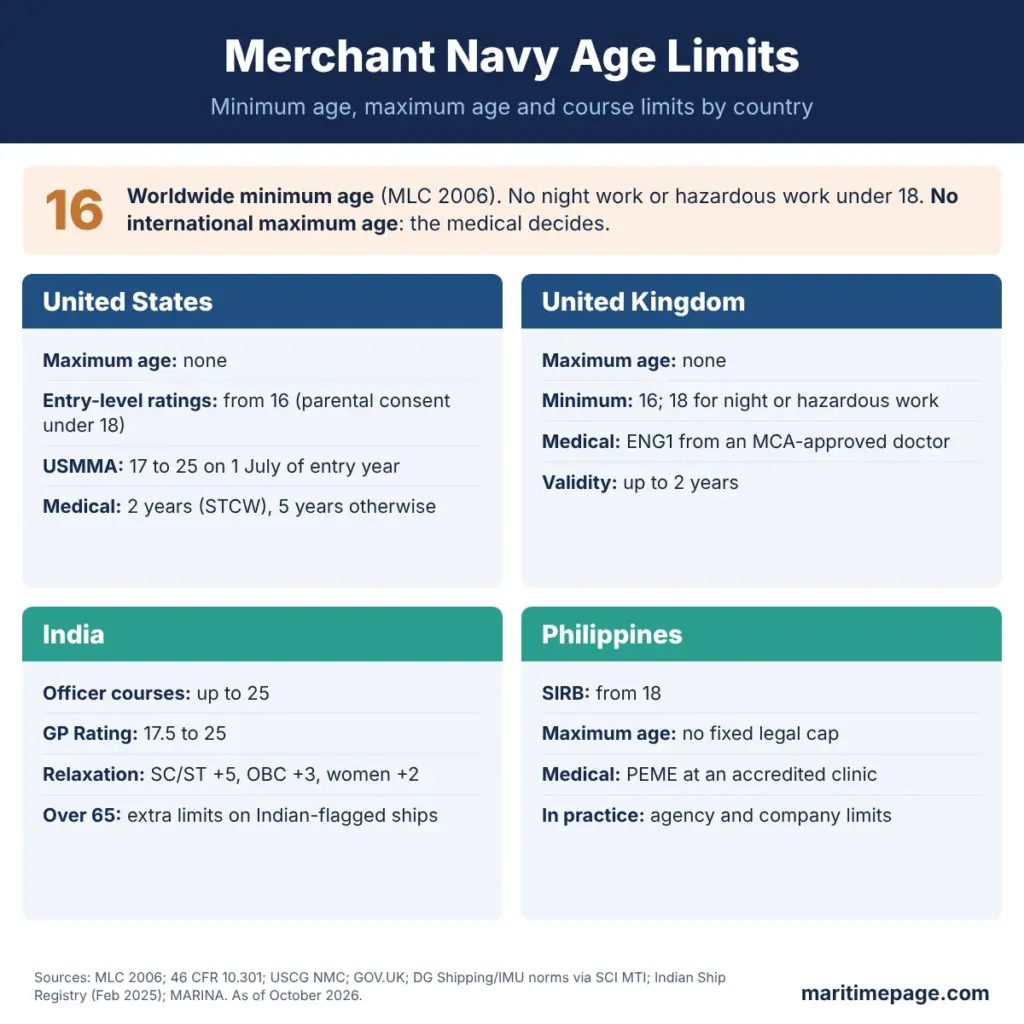
India’s Ministry of Ports, Shipping and Waterways has also prepared the Merchant Shipping (Medical) Rules, 2026. Its text limits medical certificates for seafarers over 65 to one year and adds heart, eye and blood tests.
Employers often set limits tighter than the law. Many manning agencies stop hiring ratings around 60 and officers around 65, mainly for insurance and fitness reasons.
The merchant navy has no single retirement age. Seafarers retire when they choose, when their contract or collective agreement says so, or when they no longer pass the medical.
Pensions follow national schemes and union funds, not the ship’s flag. In the Philippines, for example, 60 is the optional retirement age under the Labor Code.
Officer training courses usually cap entry at about 25. In India the officer and rating courses close at 25, with relaxations for some categories. The US Merchant Marine Academy also closes at 25, while state academies set their own limits.
| Course or route | Country | Age limit | Source |
|---|---|---|---|
| US Merchant Marine Academy (Kings Point) | US | At least 17 and not past the 25th birthday on 1 July of the entry year | Congressional academy nomination guidance, 2026 |
| State maritime academies (e.g. Great Lakes Maritime Academy) | US | Set by each school; Great Lakes has no upper limit | School admissions pages, 2026–27 |
| Entry-level ratings (ordinary seaman, wiper, steward) | US | From 16, with parental consent under 18; no upper limit | USCG NMC checklist, Jan 2025 |
| Diploma in Nautical Science (DNS) / B.Sc Nautical Science, B.Tech Marine Engineering | India | Up to 25 on the admission date | IMU and DG Shipping norms, via SCI’s Maritime Training Institute |
| General Purpose (GP) Rating | India | 17.5 to 25 on the admission date | DG Shipping norms, via SCI’s Maritime Training Institute |
| Relaxation of the upper age (India) | India | SC/ST +5 years; OBC (non-creamy layer) +3 years; women +2 years | Same |
In the US, the license-track schools are listed in our guide to the maritime academies in the US. Great Lakes Maritime Academy, one of them, admits cadets from age 17 with no upper limit.
Yes, but usually not through an officer degree course. Older entrants typically start as ratings and work up to an officer’s certificate through sea time and exams.
In the US, entry-level ratings have no upper age, and the hawsepipe route lets ratings sit for a license after enough sea service. Mechanics, electricians and cooks often join in their 30s or 40s, as engine ratings, ETOs or catering staff.
The limiting factor at that age is usually the medical, not the calendar. A candidate with good eyesight, normal colour vision and no serious chronic illness can still qualify.
Every seafarer needs a valid medical certificate showing fitness for the duties of the job. STCW Regulation I/9 and MLC Regulation 1.2 require it, issued by a medical practitioner recognised by the flag state.
The examination checks that you can do routine and emergency duties and have no condition that sea service would make worse. Help can be days away at sea, so the bar is set higher than for most shore jobs.
A typical seafarer medical covers:
- Eyesight and colour vision, against STCW Table A-I/9.
- Hearing, which matters for watchkeeping and alarms.
- Physical capability: climbing ladders, lifting, donning a lifejacket and boarding survival craft.
- Heart, lungs, blood pressure, diabetes and other chronic conditions.
- Mental health, medication, and alcohol and drug use.
Doctors apply the joint ILO/IMO Guidelines on the Medical Examinations of Seafarers. A seafarer can be found fit, fit with restrictions (for example, near-coastal only), temporarily unfit or permanently unfit.
Deck officers and lookout ratings need aided distance vision of at least 0.5 (6/12) in each eye under STCW Table A-I/9. Engineers, ETOs and radio operators need 0.4 (6/15).
| Standard | Deck officers and lookout ratings | Engine department, ETOs, radio operators |
|---|---|---|
| Distance vision, with glasses or lenses | 0.5 in each eye | 0.4 in each eye (engine staff: 0.4 combined) |
| Colour vision | CIE standard 1 or 2 | CIE standard 1, 2 or 3 |
| Visual fields | Normal | Sufficient |
| Night vision and double vision | Must work in darkness; no significant double vision | Same |
Unaided distance vision should be at least 0.1 in each eye, under STCW Section B-I/9. Seafarers who wear glasses should carry a spare pair on board.
Entry standards can be stricter than the in-service minimum. India’s DNS and GP rating courses ask for 6/6 in the better eye, 6/9 in the other, and normal colour vision on the Ishihara test.
Colour vision matters most for deck officers, who must read navigation lights, buoys and chart colours. A failed colour test closes the deck route but may still allow engine or catering work.
How Long Is a Seafarer Medical Certificate Valid?
A seafarer medical certificate is valid for up to two years, or one year for seafarers under 18, under STCW Regulation I/9. Colour vision needs re-testing only every six years.
If a certificate expires during a voyage, it stays valid until the next port with a recognised doctor, for up to three months. You will also need a valid medical to renew an STCW certificate.
| Country | Medical certificate | Who examines | Validity |
|---|---|---|---|
| United States | USCG medical certificate (application form CG-719K; 719K/E for entry level) | A licensed medical practitioner; the National Maritime Center reviews and issues | 2 years for STCW service; up to 5 years otherwise; 1 year under 18 |
| United Kingdom | ENG1 (fee £115; restrictions or refusals on an ENG3, with appeal to an independent medical referee) | MCA-approved doctors, in the UK and abroad | Up to 2 years |
| India | Medical fitness certificate under the Merchant Shipping medical rules | DG Shipping/DGMA-approved medical examiners | Up to 2 years; 1 year over 65 under the 2026 rules once in force |
| Philippines | Pre-employment medical examination (PEME) | Accredited clinics | Up to 2 years (STCW maximum) |

Yes. Women meet the same age, training and medical standards as men, and every rank is open to them. In India, women get an extra two years on the upper age limit for pre-sea courses.

Women are still rare at sea. The BIMCO/ICS Seafarer Workforce Report 2021 counted 24,059 women seafarers, about 1.2% of the global workforce.
The 2022 MLC amendments, in force since 23 December 2024, require properly sized personal protective equipment for women seafarers.
The merchant navy offers careers in three departments: deck, engine and catering. You can start as an officer cadet or as a rating, on any of the main types of cargo ships or on cruise ships.
- Deck officers keep the navigation watch and handle cargo. Most start as a deck cadet and rise to master.
- Engineers and ETOs run and repair the machinery and electrical systems.
- Ratings (deck, engine and catering) do the hands-on work, and can qualify as officers later.
How these roles fit together is shown in our guide to merchant navy ranks and shipboard organization. For daily routine, pay and living conditions, see what working on a merchant vessel is like.
- Pay: officer pay rises quickly with rank. The US median for captains, mates and pilots was $92,460 in May 2025 (BLS); the ILO minimum for an able seafarer is US$690 a month.
- Time off: months at sea are followed by weeks or months of leave at home.
- Travel: you see many ports, though port stays are often short.
- Demand: qualified officers, especially engineers, are in steady demand, but jobs follow the freight market.
- Costs: long absences from family, fatigue, isolation and physical risk.
What Jobs Can Seafarers Do After Leaving the Sea?
Former seafarers move into shore jobs that use their sea experience. Common paths are superintendent, fleet manager, harbour master, marine surveyor, inspector, ship broker, and insurance or law. Most expect senior sea service first.
- Technical or marine superintendent and fleet manager: runs ships from the company office.
- Designated Person Ashore: the link between ship and top management under the ISM Code.
- Marine surveyor: carries out cargo, condition and damage surveys, or works as a bunker surveyor.
- Inspector: works as a tanker vetting inspector or a port state control officer.
- Harbour master or marine pilot: usually requires a master’s certificate and local knowledge.
- Commercial roles: ship broking, chartering, P&I clubs and marine insurance, and maritime law.
- Teaching: lecturer or instructor at a maritime academy or training centre.
A 2013 Faststream survey of more than 2,000 sea and shore staff found seafarers most drawn to superintendent, fleet manager and harbour master roles. Legal, insurance and shipbroking jobs attracted them least.

Related Topics
- Essential seamanship skills for seafarers
- How many crew members modern ships need
- How to become an oil rig worker
Frequently Asked Questions

- Great Lakes Maritime Academy: Programs, Cost and Admission – October 14, 2026
- Bunker Delivery Note (BDN): Contents, MARPOL Rules and Checks – October 11, 2026
- Oil Record Book: Part I and Part II Entries, Rules and PSC Checks – October 11, 2026


Leave a Reply