A ballast water treatment system (BWTS) is shipboard equipment that removes or kills organisms in ballast water before it is discharged. It lets a ship meet the IMO D-2 discharge standard under the Ballast Water Management Convention.
This guide is written for ship’s officers, engineers, superintendents and cadets. It covers how a BWTS works, the main treatment methods, the rules behind them, and what inspectors check on board.
What Is a Ballast Water Treatment System?
A ballast water treatment system is a set of filters, disinfection units, sensors and controls fitted in the ballast line. It treats seawater at uptake, discharge or both, so the water released meets the D-2 standard.
IMO calls it a ballast water management system (BWMS). BWTS and BWMS mean the same equipment; the convention, the type-approval code and most class rules use BWMS.
A BWTS is not the ballast system itself. The ballast system on a cargo ship is the pumps, piping and tanks that move water for trim, list and draft. The BWTS sits inside that pipework and treats the water passing through it.
What Is Ballast Water and Why Must It Be Treated?
Ballast water is seawater a ship takes into its tanks to keep stability, trim and propeller immersion when it carries little or no cargo. Untreated, it carries live organisms from one coast to another.
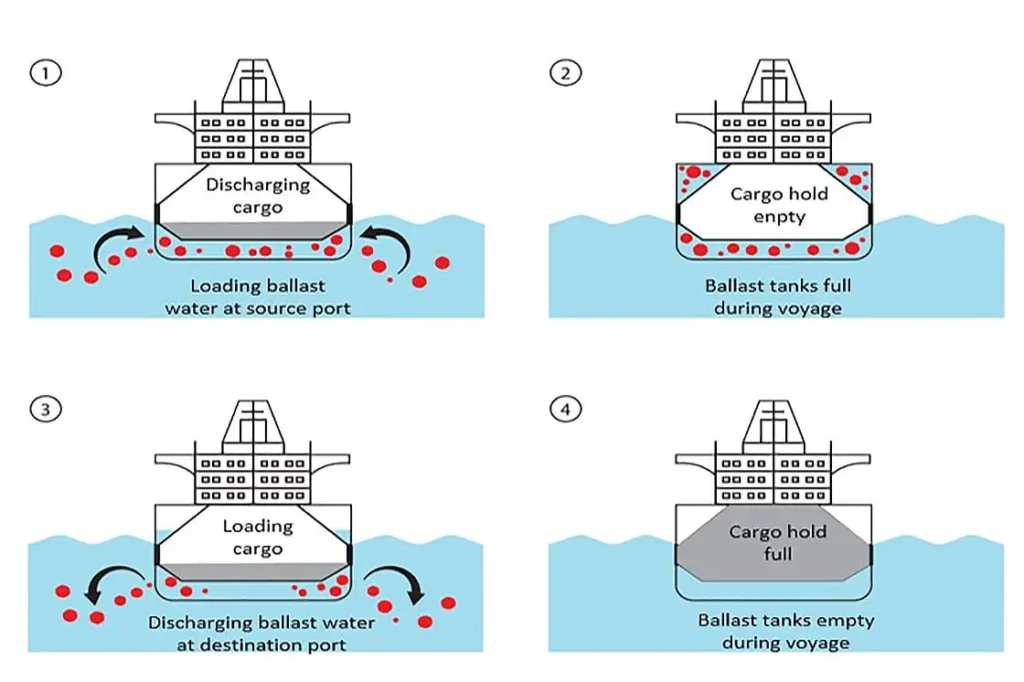
Ships load ballast in the discharge port and pump it out in the loading port, often thousands of miles away. The water sits in the ballast tanks during the voyage.
That water holds bacteria, plankton, small invertebrates, and the eggs, cysts and larvae of larger species. Released in a new region, some survive, spread and outcompete native species.
- Ecological damage: invasive species displace native ones and alter food chains.
- Economic damage: fouled water intakes, lost fisheries and costly control programmes.
- Health risk: ballast water can carry human pathogens, such as toxigenic Vibrio cholerae.
Known examples include the zebra mussel in the North American Great Lakes and the comb jelly Mnemiopsis leidyi in the Black Sea. Both are widely linked to ballast water transfer.
How Does a Ballast Water Treatment System Work?
Most systems work in two steps: a filter removes larger organisms and sediment, then a disinfection stage kills or inactivates what passes through. Some systems treat again, or neutralize chemicals, at discharge.
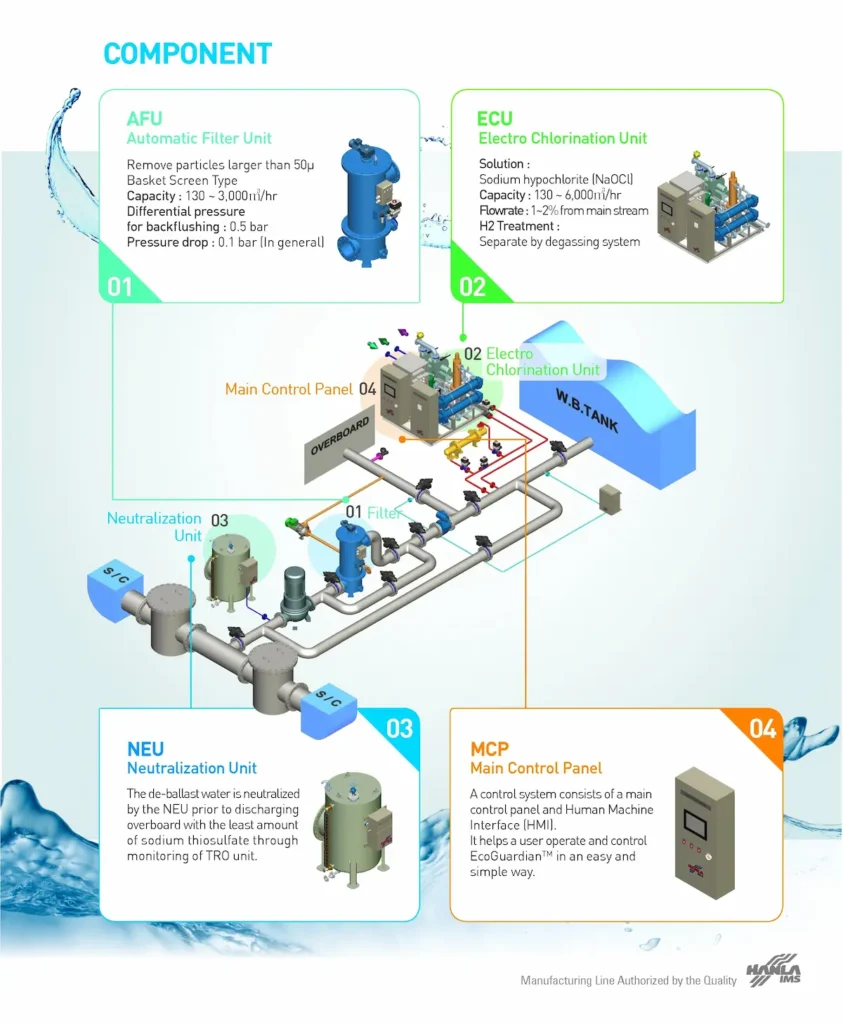
- Uptake (ballasting): seawater passes the filter, usually a self-cleaning screen of about 20–50 µm. Backflushed sediment goes straight back overboard at the same location.
- Disinfection: filtered water is exposed to UV light, an oxidant such as chlorine, or another method before it enters the tanks.
- Storage: treated water stays in the ballast tanks. Some chemical systems need a minimum holding time before discharge.
- Discharge (de-ballasting): UV systems usually treat the water a second time. Chemical systems measure the residual oxidant and add a neutralizer before the water leaves the ship.
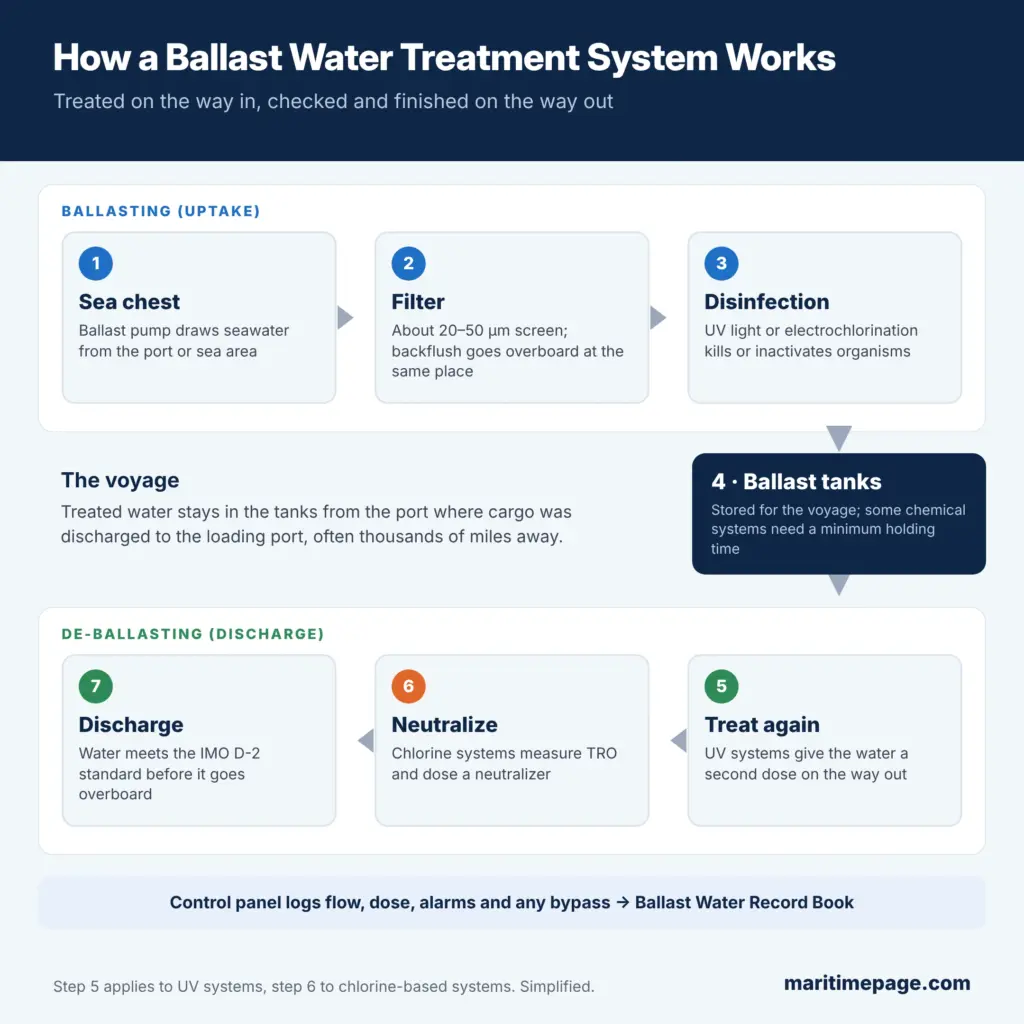
The control panel logs flow, dose, lamp intensity, sensor readings, alarms and any bypass. Those logs back up the entries in the Ballast Water Record Book.
What Are the Types of Ballast Water Treatment Systems?
BWTS types are grouped by how they kill or remove organisms: mechanical separation, physical disinfection and chemical disinfection. Almost every approved system combines a filter with one disinfection method.
| Method | How it works | Strengths | Limitations |
|---|---|---|---|
| Filtration or hydrocyclone | Screens or centrifugal separation remove organisms and sediment above the mesh size | No chemicals; reduces sediment in tanks | Does not kill small organisms; clogs in muddy water |
| Ultraviolet (UV) | UV-C light damages the DNA of organisms so they cannot reproduce | No chemicals or residuals; no holding time | Needs clear water (UV transmittance); high power demand; lamps need cleaning and replacement |
| Electrochlorination | Electrolysis of seawater produces hypochlorite on board | No chemical storage; suits large flows | Needs enough salinity; produces hydrogen; residual oxidant must be neutralized |
| Chemical injection | Stored biocide, such as sodium hypochlorite or chlorine dioxide, is dosed into the flow | Low power; compact | Chemical storage, handling and resupply |
| Ozone | Ozone gas is injected and forms oxidants in seawater | Strong disinfectant | Gas handling; residual oxidants must be treated |
| Deoxygenation | Inert gas or nitrogen strips oxygen from the water | No added biocide; can reduce tank corrosion | Long holding time; gas plant and safety issues |
| Heat treatment | Water is heated, often with engine waste heat | No chemicals | Energy demand; rarely used on its own |
Filtration plus UV and filtration plus electrochlorination are the two most common combinations in service. UV is popular on ships with small or medium ballast flows; electrochlorination suits large flows, such as big bulk carriers and tankers.
Which Ballast Water Treatment Method Is Best for a Ship?
No method is best for every ship. The right system depends on ballast pump capacity, trading area, available power and space, and the ship type.
- Flow rate: the BWTS must treat the full ballast pump capacity in m³/h, or ballasting slows down.
- Water quality: UV systems lose dose in turbid water with low UV transmittance; filters clog in silty river ports.
- Salinity: electrochlorination needs a minimum salinity, usually stated in PSU (practical salinity units). In fresh-water ports it may need stored seawater or brine.
- Temperature: cold water reduces the performance of some systems; type approval states the tested range.
- Hazardous areas: on tankers, equipment in a gas-dangerous zone must be explosion-proof, or the system is installed in a safe area.
- Power and space: UV reactors draw high power; retrofits often use a container or deckhouse module where the engine room is full.
Each type approval lists these limits as system design limitations. Operating outside them means the ship cannot rely on the system to meet D-2.
What Are the Main Components of a BWTS?
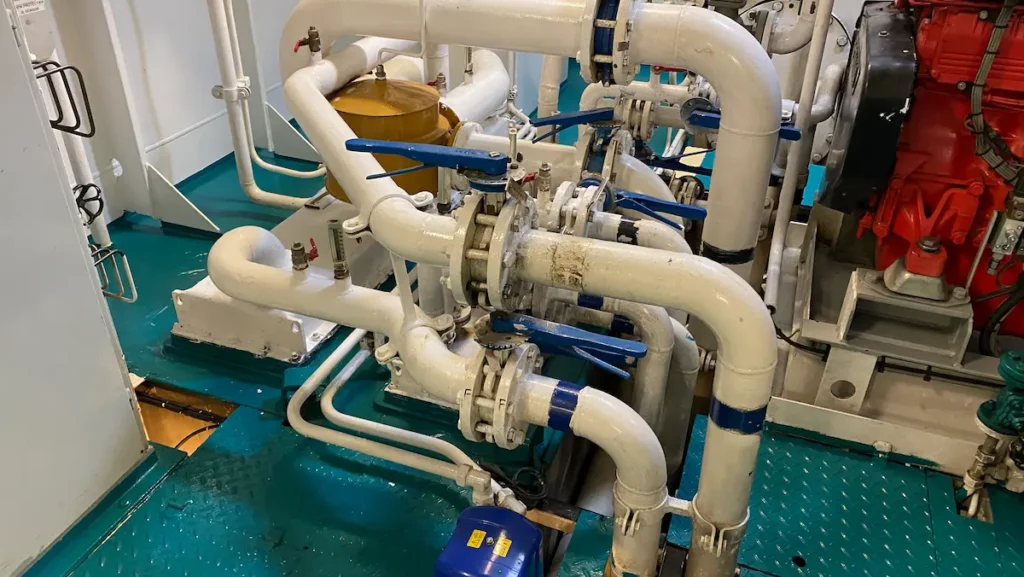
A typical BWTS has a filter, a treatment unit, sensors, a control panel, valves and sampling points. Electrochlorination and chemical systems also have dosing and neutralization units.
- Automatic backflush filter: with differential-pressure sensors that start the cleaning cycle.
- UV reactor with lamps, wipers and a UV-intensity sensor, or an electrolyser with a power rectifier and hydrogen degassing.
- TRO sensor: measures total residual oxidant to control the dose and the neutralization on discharge.
- Neutralization unit: doses an agent such as sodium thiosulfate so the discharge stays within the residual limit in the type approval.
- Flow meter and control panel: set the treatment rate and record operating data.
- Bypass and isolation valves: monitored so any bypass triggers an alarm and is recorded.
- Sampling points: on the discharge line, for commissioning tests and PSC sampling.
What Does the BWM Convention Require?
The Ballast Water Management (BWM) Convention was adopted in 2004 and entered into force on 8 September 2017. It requires ships to manage ballast water to the D-1 or D-2 standard.
Its full title is the International Convention for the Control and Management of Ships’ Ballast Water and Sediments. IMO keeps an overview on its BWM Convention implementation page.
What Is the Difference Between D-1 and D-2?
| Standard | What it requires | Status |
|---|---|---|
| D-1 (ballast water exchange) | Exchange at least 95% of ballast by volume, or pump through three times the tank volume. At least 200 nm from land in 200 m depth, or 50 nm if that is not possible | Transitional; no longer accepted once D-2 applies to the ship |
| D-2 (performance standard) | Discharge must stay below set limits of viable organisms and indicator microbes | Applies to all ships in scope; met in practice with a BWTS |
What Are the D-2 Discharge Limits?
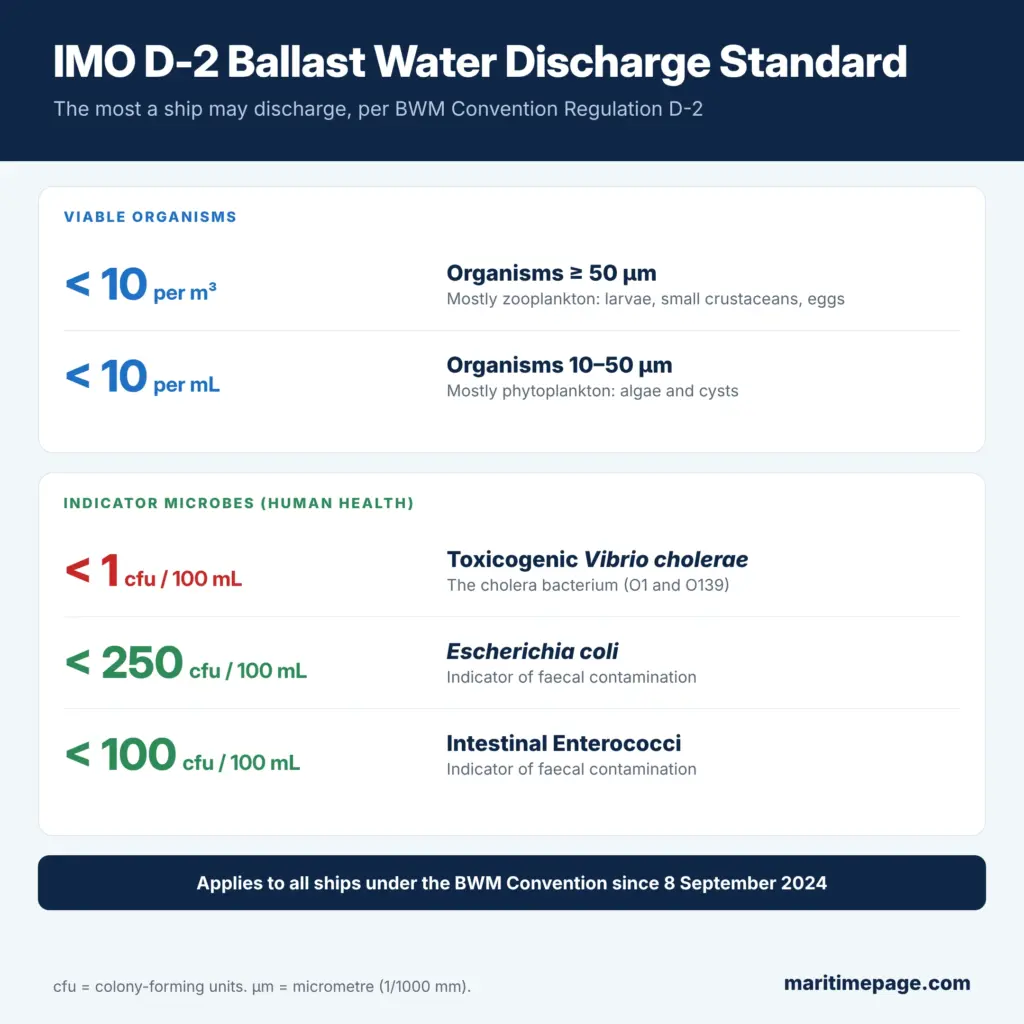
Regulation D-2 sets the maximum concentrations in discharged ballast water:
| Parameter | D-2 limit |
|---|---|
| Organisms ≥ 50 µm in minimum dimension | Less than 10 viable organisms per m³ |
| Organisms ≥ 10 µm and < 50 µm | Less than 10 viable organisms per mL |
| Toxicogenic Vibrio cholerae | Less than 1 cfu per 100 mL |
| Escherichia coli | Less than 250 cfu per 100 mL |
| Intestinal Enterococci | Less than 100 cfu per 100 mL |
When Did Ships Have to Meet D-2?
New ships built on or after 8 September 2017 had to meet D-2 on delivery. Existing ships had to comply by their first IOPP certificate renewal survey after 8 September 2019, and all ships by 8 September 2024.
The date was tied to the IOPP renewal under MARPOL Annex I because it already forces a five-yearly survey. The BWTS itself is not part of the IOPP certificate.
Which Documents Must Be on Board?
- International Ballast Water Management Certificate: for ships of 400 GT and above, issued after an initial survey.
- Ballast Water Management Plan: ship-specific and approved by the flag Administration, with safety and operating procedures.
- Ballast Water Record Book: every uptake, treatment, discharge and bypass. A new coded format (codes A to H) applies from 1 February 2025.
- BWTS type approval certificate and the manufacturer’s operating manual.
Records stay on board for at least two years after the last entry, then under company control for three more. Most companies place ballast water procedures inside the ISM Code safety management system.
Who Approves a Ballast Water Treatment System?
The flag Administration type-approves a BWTS, not IMO. Systems installed on or after 28 October 2020 must be approved under the BWMS Code, which replaced the earlier G8 guidelines.
Where a system uses an Active Substance, such as a stored or generated biocide, IMO must also grant Basic and Final Approval. Since 1 June 2022, every new installation also needs a commissioning test: a discharge sample analysed independently of the maker.
Are There Exemptions From Ballast Water Treatment?
Regulation A-4 allows exemptions for ships trading only between specified ports, based on a risk assessment. Ships that discharge ballast only where they took it on do not need treatment for that water.
The United States is not a party to the Convention. Ships discharging in US waters need a system with US Coast Guard type approval, a separate certification from the IMO one.
What Do PSC Inspectors and Class Surveyors Check on a BWTS?
Port state control inspectors check the certificate, plan and record book first. If anything looks wrong, they move to an operational check and may take a discharge sample.
- Valid International Ballast Water Management Certificate and type approval certificate for the installed system.
- Record book entries that match the control panel log, positions and ballast tank soundings.
- Any bypass or failure recorded with the reason, and the flag and port State notified.
- Alarms, filters, UV lamps and TRO sensors working, with calibration records.
- Engineers and officers able to start, run and shut down the system without the manual open.
- Ballast discharged within the system design limitations of the type approval.
Common findings are record book entries copied from the plan rather than real operations, the system left in bypass, and expired lamps or sensors. A ship that cannot meet D-2 can be stopped from discharging ballast or detained.
Class surveyors check the BWTS at the initial, annual, intermediate and renewal surveys, alongside other statutory surveys on ships. On tankers, the system also comes up in vetting inspections.
What Problems Do Crews Have With Ballast Water Treatment Systems?
Most BWTS problems on board come from water quality, power or maintenance, not the design itself. Crews need a clear procedure for each failure, because a broken system can stop cargo work.
- Filter clogging in silty ports, which slows ballasting or trips the system.
- Low UV transmittance in turbid water, which drops the dose below the approved minimum.
- Low salinity in river or lake ports, where electrochlorination cannot produce enough oxidant.
- Sensor drift in TRO and UV-intensity sensors that are not calibrated on schedule.
- Power limits when the BWTS and cargo pumps run together on generators.
IMO contingency guidance, BWM.2/Circ.62, describes what to do when treated water may not meet D-2. Options agreed with the port State include discharge to a reception facility, retaining the ballast, or exchange in an approved area.
Related Topics
- Ship scrubbers and exhaust gas cleaning
- Sewage treatment plants on ships
- How the inert gas system on tankers works
- How ships are prepared for drydocking
Frequently Asked Questions
Is a BWTS the same as a BWMS?
Yes. Ballast water treatment system and ballast water management system describe the same equipment. IMO, the BWMS Code and class rules use BWMS.
What does a ballast water treatment system do?
It filters and disinfects ballast water so the discharge meets the IMO D-2 standard. This stops ships carrying invasive organisms and pathogens between regions.
What does PSU mean on a BWTS?
PSU stands for practical salinity units. Electrochlorination systems need a minimum salinity, stated in PSU in the type approval, to produce enough oxidant.
What is TRO in a ballast water treatment system?
TRO is total residual oxidant, the active chlorine left in treated water. Sensors control the dose, and the TRO is neutralized before discharge.
Is a BWTS the same as a scrubber?
No. A scrubber cleans engine exhaust gas under MARPOL Annex VI. A BWTS treats ballast water under the BWM Convention.
Do all ships need a ballast water treatment system?
Ships under the BWM Convention must meet D-2 from 8 September 2024 at the latest, and most do it with a BWTS. Exemptions exist for ships that do not discharge ballast or trade under an approved A-4 exemption.
Can a ship bypass the BWTS?
Only in an emergency or failure, and the bypass must be alarmed, logged in the Ballast Water Record Book and reported. Contingency measures are agreed with the port State.
How long must ballast water records be kept?
At least two years on board after the last entry, then three more years under company control.

- Great Lakes Maritime Academy: Programs, Cost and Admission – October 14, 2026
- Bunker Delivery Note (BDN): Contents, MARPOL Rules and Checks – October 11, 2026
- Oil Record Book: Part I and Part II Entries, Rules and PSC Checks – October 11, 2026