The best naval architecture schools in the US are Webb Institute, the University of Michigan and the U.S. Naval Academy, with a handful of strong alternatives. They teach ship design and marine engineering, the degree route into shipyards, design offices and class societies.
This guide compares ten US programs on degree, cost model, selectivity and whether a sea-going license is possible. It is written for US students choosing a naval engineering school, with facts checked in October 2026.
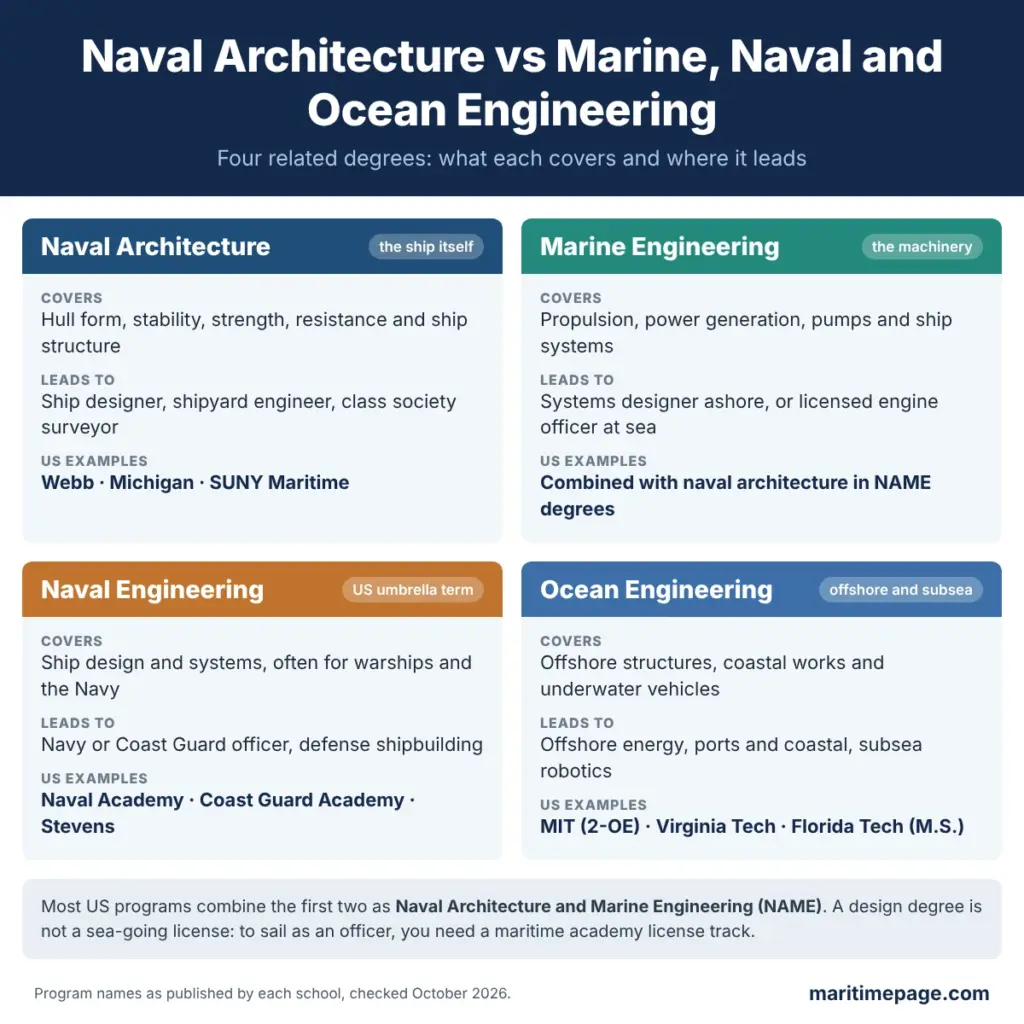
Naval architecture is the design of a ship’s hull, stability and structure. Marine engineering covers the machinery inside it, and most US degrees combine both as “Naval Architecture and Marine Engineering” (NAME).
- Naval architecture: hull form, stability, strength, resistance and ship hull construction plans
- Marine engineering: propulsion, power generation and ship systems
- Naval engineering: a US umbrella term, often used for warship design and Navy careers
- Ocean engineering: offshore structures, coastal works and underwater vehicles
A design degree is different from a sea-going officer’s license. If you want to sail as a deck or engine officer, start with our guide to the maritime colleges and academies in the US.
These ten US schools stand out for naval architecture and marine engineering. Four offer civilian naval architecture degrees, two are service academies, and four are ocean engineering, concentration or graduate routes.
| School | Program | Type | Acceptance rate | License option |
|---|---|---|---|---|
| Webb Institute | B.S. Naval Architecture and Marine Engineering | Private, full-tuition scholarship | 14% | No |
| University of Michigan | NA&ME, bachelor’s to Ph.D. | Public | 16% | No |
| U.S. Naval Academy | Naval Architecture & Marine Engineering major | Federal, tuition-free | 9% | Navy commission |
| U.S. Coast Guard Academy | Naval Architecture and Marine Engineering | Federal, tuition-free | 22% | Coast Guard commission |
| LSU New Orleans | B.S., M.S.E. and Ph.D. in NAME | Public | 67% | No |
| SUNY Maritime College | B.E. Naval Architecture | Public, maritime academy | 72% | Yes (third mate or third assistant engineer) |
| MIT | B.S. Mechanical and Ocean Engineering; 2N graduate program | Private | 5% | No |
| Virginia Tech | B.S. Aerospace and Ocean Engineering, naval engineering concentration | Public | 55% | No |
| Stevens Institute of Technology | B.E. Engineering, naval engineering concentration | Private | 48% | No |
| Naval Postgraduate School | Naval/Mechanical Engineering master’s (distance learning) | Federal, graduate only | n/a | No |
Webb Institute
Webb Institute in Glen Cove, New York, teaches one subject: naval architecture and marine engineering. Every US citizen and permanent resident receives a full-tuition scholarship, valued at over $250,000 across four years.
Each January and February, students leave class for a Winter Work Term. First-years work in shipyards and second-years sail as observers on ocean-going ships, giving four placements by graduation.
University of Michigan
The University of Michigan in Ann Arbor runs a Department of Naval Architecture and Marine Engineering. It describes itself as one of the oldest programs in the US and the only NA&ME program spanning bachelor’s to Ph.D.
Graduate options include an M.S.E. with an autonomous systems track and dual degrees with business or sustainable systems. Class sizes in the major are small, around 25 students.
The U.S. Naval Academy in Annapolis, Maryland, offers a Naval Architecture & Marine Engineering major within its Naval Architecture and Ocean Engineering Department. Tuition is free, and graduates are commissioned as Navy or Marine Corps officers with a service obligation.
The curriculum covers ship design, marine systems and marine propulsion. Admission needs a nomination, usually from a member of Congress.
United States Coast Guard Academy
The Coast Guard Academy in New London, Connecticut, offers an ABET-accredited major in Naval Architecture and Marine Engineering. Its stated mission is to give the Coast Guard officers and technical leaders.
Tuition is free in exchange for service as a Coast Guard officer. Unlike the other service academies, it does not require a congressional nomination.
LSU New Orleans (Formerly University of New Orleans)
The University of New Orleans became LSU New Orleans on 1 July 2026. Its School of Naval Architecture and Marine Engineering, set up in 1980 for local shipbuilders, offers a B.S., an M.S.E. and a Ph.D.
It is the most accessible full NAME degree on this list, with a 67% institutional acceptance rate. Its location on the Gulf Coast puts students near shipyards and offshore employers.
SUNY Maritime College
SUNY Maritime in the Bronx, New York, offers an ABET-accredited Bachelor of Engineering in Naval Architecture. Students who join the Regiment of Cadets can also earn a Coast Guard license as third mate or third assistant engineer.
That combination of a design degree and a sea-going license is rare in the US. The final three semesters are spent on a ship design project.
Massachusetts Institute of Technology
MIT’s undergraduate route is the B.S. in Mechanical and Ocean Engineering, known as Course 2-OE. Its capstone focuses on designing marine systems such as autonomous underwater vehicles.
MIT’s naval architecture strength is the graduate 2N program, run with the US Navy since 1901. It prepares Navy, Coast Guard and foreign naval officers for ship design, and admits about nine students a year.
Virginia Tech
Virginia Tech in Blacksburg, Virginia, offers naval engineering as a concentration within its B.S. in Aerospace and Ocean Engineering. Students can also add a College of Engineering minor in naval engineering.
The degree suits students who want hydrodynamics and computational fluid dynamics across both aircraft and ships.
Stevens Institute of Technology
Stevens in Hoboken, New Jersey, offers a Bachelor of Engineering in Engineering with a concentration in naval engineering. It is a specialization within a broad engineering degree, not a stand-alone NAME major.
The Naval Postgraduate School in Monterey, California, is a graduate school mainly for military officers. Its Naval/Mechanical Engineering master’s is taught by distance learning to the US military, Coast Guard, industry partners and international partners.
It is an option after a first engineering degree, not a route for high school graduates.
Choose first by career goal and cost model, then by accreditation. An ABET-accredited engineering degree is the usual route to a Professional Engineer license in the US.
| If you want | Look at |
|---|---|
| A pure ship design degree with no tuition | Webb Institute |
| Bachelor’s through Ph.D. at a large research university | University of Michigan |
| Navy or Coast Guard officer career | U.S. Naval Academy, U.S. Coast Guard Academy |
| Design degree plus a sea-going license | SUNY Maritime College |
| Gulf Coast shipyard and offshore jobs | LSU New Orleans |
| Broad engineering with a naval track | Virginia Tech, Stevens, MIT |
| A master’s while serving or working | Naval Postgraduate School, MIT 2N |
The main US master’s routes are the University of Michigan, LSU New Orleans, MIT’s 2N program and the Naval Postgraduate School. Michigan and LSU New Orleans also offer a Ph.D.
- University of Michigan: M.S.E. in NA&ME, with autonomous systems and dual-degree options
- LSU New Orleans: M.S.E. in Naval Architecture and Marine Engineering
- MIT 2N: naval architecture master’s, mainly for Navy, Coast Guard and foreign naval officers
- Naval Postgraduate School: Naval/Mechanical Engineering master’s by distance learning
Not at bachelor’s level among the programs above, since they rely on labs, design studios and placements. At graduate level, the Naval Postgraduate School teaches its Naval/Mechanical Engineering master’s by distance learning.
Admission Requirements
Undergraduate naval architecture programs expect strong high school math and physics, usually through calculus. Selectivity ranges from 5% at MIT to 72% at SUNY Maritime.
Undergraduate Admission Requirements
- High school diploma with calculus, physics and chemistry
- Transcripts, test scores where the school requires them, essays and recommendations
- For the Naval Academy: a nomination, a medical exam and a fitness assessment
- For license tracks at SUNY Maritime: a Coast Guard medical exam and the seafarer age and health requirements
Graduate Admission Requirements
Graduate programs require a bachelor’s degree, preferably in engineering, plus transcripts, references and a statement of purpose. MIT 2N and the Naval Postgraduate School mainly serve serving officers, so check eligibility before applying.
Career Opportunities
Graduates work in shipbuilding, naval defense, offshore energy, ship operation and classification. The US Bureau of Labor Statistics puts the May 2025 median pay for marine engineers and naval architects at $112,230.
BLS counts about 8,400 jobs in this occupation and projects 7% growth from 2025 to 2035, much faster than average. Our guide on how to become a naval architect covers the career path after the degree.
Naval architects design ships and offshore structures, from hull form and stability to weight and strength. They work through each stage of the shipbuilding process, from design to sea trials.
Many work for shipyards and design offices, and some for a ship classification society approving other designers’ plans.
Marine Engineer
Shore-based marine engineers design and specify propulsion, power and auxiliary systems. A sea-going marine engineer is a licensed officer who runs the machinery on board. That is a different route, covered in our guide to ranks on merchant navy ships.
Structural Engineer
Structural engineers analyze the hull, superstructure and offshore structures for the loads of the marine environment. They work with naval architects to meet class rules for strength and fatigue.
Related Topics
- IS Code intact stability criteria
- Bulbous bow design and why ships use it
- Top maritime fairs and industry events
Frequently Asked Questions

- Great Lakes Maritime Academy: Programs, Cost and Admission – October 14, 2026
- Bunker Delivery Note (BDN): Contents, MARPOL Rules and Checks – October 11, 2026
- Oil Record Book: Part I and Part II Entries, Rules and PSC Checks – October 11, 2026