The United Nations Convention on the Law of the Sea (UNCLOS) is the treaty that sets the legal rules for the world’s oceans. It defines how far a state’s waters extend, what rights ships have in them, and who controls the resources of the sea and seabed.
This guide is written for ship’s officers, maritime students and anyone who needs a clear view of the law of the sea. It covers the maritime zones, navigation rights, flag state duties, piracy, the environment and how disputes are settled.
What Is UNCLOS?
UNCLOS is the 1982 United Nations treaty that governs all uses of the oceans. It was adopted at Montego Bay, Jamaica, on 10 December 1982 and entered into force on 16 November 1994.
The Convention has 320 articles in 17 parts, plus 9 annexes. It is often called the “constitution of the oceans”. Most other ocean treaties, including IMO conventions such as SOLAS and MARPOL, work inside its framework.
As of 2026, UNCLOS has 172 parties: 171 states and the European Union. The current list is kept by the International Tribunal for the Law of the Sea.
What Does UNCLOS Stand For?
UNCLOS stands for the United Nations Convention on the Law of the Sea. With a number added, it also names the three UN conferences on the law of the sea: UNCLOS I (1958), II (1960) and III (1973–1982).
How Did UNCLOS Come About?
UNCLOS grew out of three UN conferences held between 1958 and 1982. Earlier treaties left key questions open, above all how wide a state’s territorial sea could be.
- 1958, UNCLOS I: produced four Geneva Conventions, on the territorial sea, the high seas, the continental shelf and fishing. They did not fix the breadth of the territorial sea.
- 1960, UNCLOS II: tried again to agree a territorial sea limit and failed by a narrow margin.
- 1967: Malta’s ambassador Arvid Pardo proposed that the deep seabed be treated as the common heritage of mankind. The idea shaped Part XI of the later Convention.
- 1973–1982, UNCLOS III: nine years of negotiation produced a single treaty, signed in 1982.
The Convention entered into force in 1994, twelve months after the 60th ratification. Industrialized states had objected to the deep seabed rules, which were changed by a separate 1994 Agreement before most of them joined.
What Are the Maritime Zones Under UNCLOS?
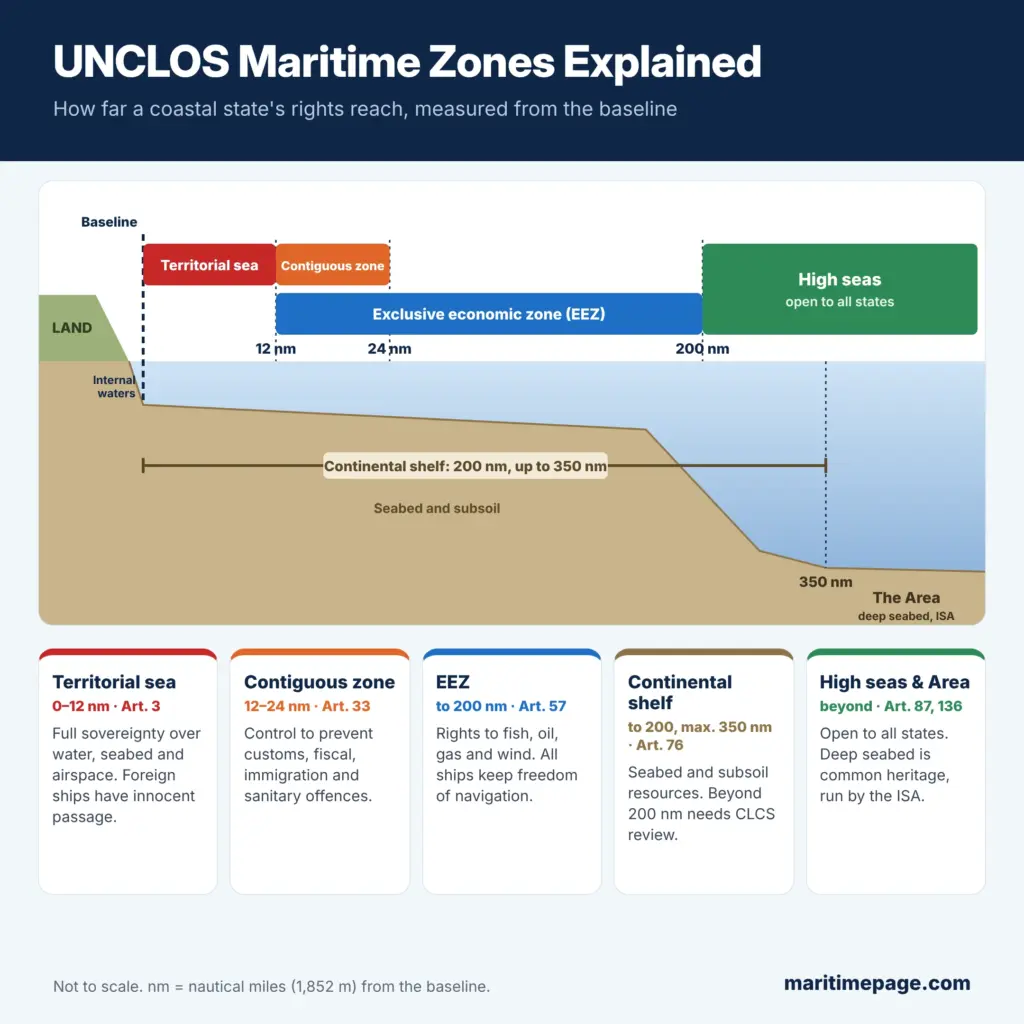
UNCLOS divides the sea into zones measured from a coastal state’s baselines. A state’s rights shrink with distance: from full sovereignty in internal waters to none on the high seas and the deep seabed.
| Zone | Limit from baseline | Coastal state rights | UNCLOS article |
|---|---|---|---|
| Internal waters | Landward of the baseline | Full sovereignty, as on land; no right of innocent passage | Art. 8 |
| Territorial sea | Up to 12 nm | Sovereignty over water, seabed and airspace, subject to innocent passage | Art. 2–3 |
| Contiguous zone | Up to 24 nm | Control to prevent and punish customs, fiscal, immigration and sanitary offences | Art. 33 |
| Exclusive economic zone (EEZ) | Up to 200 nm | Sovereign rights over fish, oil, gas and wind energy; other states keep freedom of navigation | Art. 55–57 |
| Continental shelf | 200 nm, or up to 350 nm where the shelf extends further | Sovereign rights over seabed and subsoil resources | Art. 76–77 |
| High seas | Beyond the EEZ | None; open to all states for navigation, overflight, cables and pipelines, artificial islands, fishing and research | Art. 86–87 |
| The Area | Seabed beyond national jurisdiction | None; common heritage of mankind, managed by the ISA | Art. 1, 136 |
Distances are in nautical miles of 1,852 m. A shelf can reach 350 nm, or 100 nm beyond the 2,500 m depth line. Claims beyond 200 nm are reviewed by the Commission on the Limits of the Continental Shelf.
How Are Baselines Drawn?
The normal baseline is the low-water line along the coast, as marked on official charts. Where a coast is deeply indented or fringed with islands, a state may draw straight baselines joining points along it.
Archipelagic states, such as Indonesia and the Philippines, may draw baselines around their outermost islands. The waters inside become archipelagic waters, under the state’s sovereignty.
What Rights Do Landlocked States Have?
Part X gives landlocked states a right of access to and from the sea, with freedom of transit through neighbouring states. The terms are agreed with each transit state.
Landlocked states share the freedoms of the high seas and may sail ships under their own flag. Switzerland and Mongolia, for example, both keep ship registers.
Ships of all states have four passage rights. They are innocent passage, transit passage through straits, archipelagic sea lanes passage, and freedom of navigation in the EEZ and high seas.
| Right | Where it applies | Key rules |
|---|---|---|
| Innocent passage | Territorial sea | Continuous and expeditious; not prejudicial to the coastal state; submarines must surface and show their flag (Art. 17–20) |
| Transit passage | Straits used for international navigation, such as Gibraltar, Hormuz and Malacca | Cannot be suspended; ships and aircraft pass without delay (Art. 37–44) |
| Archipelagic sea lanes passage | Designated lanes through archipelagic waters | Similar to transit passage; lanes set by the archipelagic state (Art. 53) |
| Freedom of navigation | EEZ and high seas | Applies to all ships, including warships, with due regard for coastal state rights (Art. 58, 87) |
Article 19 lists acts that make passage not innocent. They include weapons exercises, spying, loading or unloading goods or people against customs or immigration law, wilful serious pollution, fishing, and survey activity.
For a master, this shapes the passage plan. Anchoring in another state’s territorial sea is allowed only when it is incidental to ordinary navigation or forced by distress.
What Duties Does UNCLOS Give Flag States?
Every ship must sail under the flag of one state and have a genuine link with it. Article 94 then requires the flag state to exercise effective control over its ships in administrative, technical and social matters.
- Register: keep a register of ships and their particulars (Art. 94.2).
- Seaworthiness: control construction, equipment and seaworthiness (Art. 94.3).
- Crew: control manning, labour conditions and training (Art. 94.3).
- Surveys: have ships surveyed by qualified surveyors and carry the right charts and publications (Art. 94.4).
- Investigation: hold an inquiry into every serious casualty involving its ships (Art. 94.7).
In practice, flag states meet these duties through IMO and ILO instruments. These include SOLAS, MARPOL, the STCW Code for training, and the ISM Code for safety management. The main ILO instrument is the MLC 2006, which sets seafarers’ working and living conditions.
The genuine-link rule is the basis of the debate on open registries and flags of convenience. Article 98 also requires every flag state to make its masters render assistance to anyone in danger at sea.
How Does UNCLOS Deal With Piracy and Crime at Sea?
UNCLOS defines piracy in Article 101 as violence or detention for private ends, by a private ship’s crew, against another ship on the high seas. Any state may seize a pirate ship and try the pirates under Article 105.
Piracy is one of the few crimes where every state has jurisdiction on the high seas. Inside a state’s territorial sea, the same acts are armed robbery and fall under that state’s law. For current figures and hotspots, see do pirates still exist.
- Right of visit (Art. 110): warships may board a foreign ship suspected of piracy, slave trading, unauthorized broadcasting or having no nationality.
- Hot pursuit (Art. 111): a coastal state may chase a ship that broke its laws onto the high seas. The pursuit must start in its waters and be continuous.
- Drug trafficking (Art. 108): states must cooperate to suppress illicit traffic in narcotics by sea.
How Does UNCLOS Protect the Marine Environment?
Part XII of UNCLOS obliges every state to protect and preserve the marine environment. It covers pollution from land, ships, the seabed, dumping and the atmosphere, and sets out who can enforce the rules.
For ships, Article 211 requires states to set pollution rules through the “competent international organization”, which is the IMO. That is why MARPOL is the main ship-pollution treaty in practice.
| Enforcer | What UNCLOS allows | Article |
|---|---|---|
| Flag state | Enforce rules on its own ships wherever they are | Art. 217 |
| Port state | Investigate and prosecute a discharge on the high seas by a ship voluntarily in its port | Art. 218 |
| Coastal state | Inspect or detain a ship for a violation in its territorial sea or EEZ, depending on the harm caused | Art. 220 |
These articles are the legal basis for port state control of foreign ships. In 2024, ITLOS advised that greenhouse gas emissions count as marine pollution under UNCLOS, so states must act to reduce them.
Part XIII covers marine scientific research. Research in another state’s EEZ or on its continental shelf needs that state’s consent, while research on the high seas is free.
Who Controls the Deep Seabed?
The seabed beyond national jurisdiction, called the Area, and its minerals are the common heritage of mankind under Article 136. No state can claim it, and mining there is controlled by the International Seabed Authority (ISA).
The ISA, based in Kingston, Jamaica, issues exploration contracts for polymetallic nodules, sulphides and crusts. Rules for commercial exploitation have been under negotiation for years, and deep-sea mining remains one of the most disputed issues under the Convention.
Which Institutions Did UNCLOS Create?
UNCLOS created three bodies: a tribunal for disputes, an authority for the deep seabed, and a commission for continental shelf limits. Each has a separate seat and job.
| Body | Seat | Role |
|---|---|---|
| International Tribunal for the Law of the Sea (ITLOS) | Hamburg, Germany | 21 judges serving nine-year terms; decides disputes and gives advisory opinions |
| International Seabed Authority (ISA) | Kingston, Jamaica | Regulates mineral activities in the Area and shares the benefits |
| Commission on the Limits of the Continental Shelf (CLCS) | New York, USA | 21 experts; reviews claims to a continental shelf beyond 200 nm |
How Are Disputes Settled Under UNCLOS?
Part XV requires parties to settle disputes peacefully. If talks fail, a party can usually take the case to a binding forum: ITLOS, the International Court of Justice, or an arbitral tribunal.
Under Article 287, each state chooses its preferred forum. If the two states have not chosen the same one, the dispute goes to arbitration under Annex VII.
The best-known case is the 2016 South China Sea arbitration brought by the Philippines against China. The tribunal ruled that China’s “nine-dash line” claim had no basis under UNCLOS, but China rejected the award.
One procedure matters directly to ships. Under Article 292, ITLOS can order the prompt release of a detained ship and crew once a reasonable bond is posted, often in fishing cases.
Which Countries Are Not Party to UNCLOS?
About twenty UN member states are not parties. The most significant is the United States, which signed the 1994 Agreement but has never ratified the Convention.
The United States still follows most UNCLOS navigation and zone rules as customary international law. How US admiralty law fits alongside this is explained in is the United States under maritime law.
Other non-parties include Turkey, Israel, Venezuela and Peru. Iran, Colombia and the United Arab Emirates signed but have not ratified.
What Agreements Implement UNCLOS?
Three implementing agreements extend UNCLOS. They cover deep seabed mining (1994), straddling fish stocks (1995) and high seas biodiversity (2023, the BBNJ Agreement).
| Agreement | In force | What it does |
|---|---|---|
| 1994 Agreement on Part XI | 1996 | Reworked the deep seabed mining rules so industrialized states would join; ISA itself was created by the Convention |
| 1995 Fish Stocks Agreement | 2001 | Rules for straddling and highly migratory fish stocks, applied through regional fisheries organizations |
| 2023 BBNJ Agreement (High Seas Treaty) | 17 January 2026 | Marine protected areas, impact assessments and marine genetic resources beyond national jurisdiction |
What Are the Main Challenges Facing UNCLOS?
UNCLOS faces four main challenges: rejected rulings, competing seabed claims, sea-level rise moving coastlines, and pressure to mine the deep seabed.
- Compliance: the Convention has no police force. China’s rejection of the 2016 award shows the limits of enforcement.
- Arctic shelf claims: Russia, Denmark and Canada have overlapping submissions to the CLCS for the Arctic seabed.
- Sea-level rise: as coasts retreat, baselines and zones could shift. Pacific island states have declared their zones fixed regardless of sea-level change.
- Deep-sea mining: states and companies are divided on whether mining should start before the environmental effects are understood.
Why Does UNCLOS Matter to Ships and Seafarers?
UNCLOS decides which state’s laws apply to a ship at any point of a voyage. That affects routing, port entry, pollution liability, detention and the treatment of crew.
- Passage planning: territorial seas, straits and archipelagic lanes each carry different rules for anchoring, surveys and gear.
- Coastal state rules: in the EEZ, states can require reports or set fishing and resource rules, but cannot block international shipping routes.
- Port state enforcement: inspections and pollution prosecutions in port rest on UNCLOS jurisdiction.
- Collisions: under Article 97, only the flag state or the state of the officer’s nationality can bring penal proceedings for a high seas collision.
- Rescue: masters must assist people in distress at sea under Article 98.
PSC inspectors do not check UNCLOS itself. They check the IMO and ILO conventions that flag states adopted to meet their UNCLOS duties.
Related Topics
Frequently Asked Questions
What does UNCLOS stand for?
United Nations Convention on the Law of the Sea. It is the 1982 treaty that sets the legal framework for all uses of the oceans.
When did UNCLOS enter into force?
UNCLOS was signed on 10 December 1982 at Montego Bay, Jamaica, and entered into force on 16 November 1994.
How far do territorial waters extend under UNCLOS?
Up to 12 nautical miles from the baseline. The contiguous zone reaches 24 nm and the exclusive economic zone 200 nm.
Is the United States a party to UNCLOS?
No. The US has not ratified UNCLOS but follows most of its navigation and zone rules as customary international law.
Can warships enter another country’s EEZ?
Yes. All ships, including warships, have freedom of navigation in the EEZ. In the territorial sea they have only innocent passage.
What is the difference between innocent passage and transit passage?
Innocent passage applies in the territorial sea and can be suspended temporarily for security. Transit passage applies in international straits and cannot be suspended.
Is UNCLOS legally binding?
Yes, for its 172 parties. Many of its rules on zones and navigation also bind non-parties as customary international law.
How many articles does UNCLOS have?
320 articles in 17 parts, plus 9 annexes. Two implementing agreements of 1994 and 1995 and the 2023 BBNJ Agreement add to it.

- Great Lakes Maritime Academy: Programs, Cost and Admission – October 14, 2026
- Bunker Delivery Note (BDN): Contents, MARPOL Rules and Checks – October 11, 2026
- Oil Record Book: Part I and Part II Entries, Rules and PSC Checks – October 11, 2026