The MLC 2006 is the Maritime Labour Convention, the ILO treaty that sets minimum working and living conditions for seafarers. It covers who may work at sea, pay, rest and living conditions, and how flag and port states enforce them.
This guide is written for seafarers, cadets, crewing managers, shipowners and surveyors. It explains what the Convention guarantees, how ships are certified, and what inspectors look for when they board.
What Is the MLC 2006?
The MLC 2006 is the International Labour Organization’s convention on seafarers’ rights, often called the seafarers’ bill of rights. Adopted in Geneva on 23 February 2006, it entered into force on 20 August 2013.
The Convention brought dozens of older ILO maritime conventions and recommendations into one text. Its Article X lists 37 earlier conventions that it revises. The aim was one modern standard that every flag could ratify and enforce in the same way.
| MLC 2006 at a glance | |
|---|---|
| Full title | Maritime Labour Convention, 2006, as amended |
| Adopted by | International Labour Conference (ILO), 94th (Maritime) Session, 23 February 2006 |
| In force | 20 August 2013 |
| Ratifications | 113 ILO member states, with Cuba the 113th (12 June 2026) |
| Applies to | Seafarers on ships ordinarily engaged in commercial activities, with listed exclusions |
| Certification | Maritime Labour Certificate and DMLC Parts I and II, for ships of 500 GT and over in the scope of Regulation 5.1.3 |
| Certificate validity | Up to 5 years, with an intermediate inspection |
| Areas certified and inspected | 16, listed in Appendix A5-I and Appendix A5-III |
Why Is the MLC Called the Fourth Pillar of Maritime Regulation?
Three IMO conventions already regulated the ship and its crew’s competence. SOLAS covers ship safety, MARPOL covers pollution, and STCW covers training and certification.
None of them set rules on wages, contracts, food or rest. The MLC fills that gap, so it is treated as the fourth pillar alongside the three IMO conventions.
How Many Countries Have Ratified the MLC?
Cuba became the 113th ILO member state to ratify the Convention, with the ILO receiving its instrument on 12 June 2026. The ILO states that ratifying states cover 96.6% of world gross tonnage.
Ships flying the flag of a state that has not ratified are not exempt in practice. Port states apply the “no more favourable treatment” rule, so those ships face the same checks in a ratifying port.
Who Does the MLC Apply To?
The MLC applies to every seafarer on a ship ordinarily engaged in commercial activities, publicly or privately owned. A seafarer is any person employed, engaged or working in any capacity on board, whatever the department.
That definition takes in cooks, stewards and hotel staff on cruise ships, and some contractors, as determined by the flag state. The Convention applies regardless of tonnage or voyage type, with these exclusions:
- Ships engaged in fishing or similar pursuits, which fall under ILO Convention No. 188 instead.
- Ships of traditional build, such as dhows and junks.
- Warships and naval auxiliaries.
- Ships navigating exclusively in inland waters, sheltered waters, or areas where port regulations apply.
Which Ships Need a Maritime Labour Certificate?
Regulation 5.1.3 requires certification for two groups of ships. Every other ship in scope is still inspected, but certification is not mandatory.
- Ships of 500 GT or over engaged in international voyages.
- Ships of 500 GT or over flying the flag of a member state and operating from a port, or between ports, in another country.
Commercial yachts are covered when they carry paid crew and are not excluded. Private pleasure yachts not engaged in commercial activity sit outside the Convention.
How Is the MLC 2006 Structured?
The MLC has three layers: the Articles, the Regulations, and the Code. The Code has a mandatory Part A, called Standards, and a non-mandatory Part B, called Guidelines.
- Articles: the general obligations, definitions, scope and amendment procedure.
- Regulations: the basic rights, grouped into five Titles.
- Code Part A (Standards): the detailed, mandatory requirements behind each Regulation.
- Code Part B (Guidelines): recommended ways to implement Part A, which states must give due consideration to.
Numbering is shared across the layers. Regulation 2.3, Standard A2.3 and Guideline B2.3 all deal with hours of work and rest. Port State Control inspects against Part A, not Part B.
The Code can be amended through a fast-track procedure under Article XV. A Special Tripartite Committee of governments, shipowners and seafarers proposes changes, and the International Labour Conference approves them.
What Do the Five Titles of the MLC Cover?
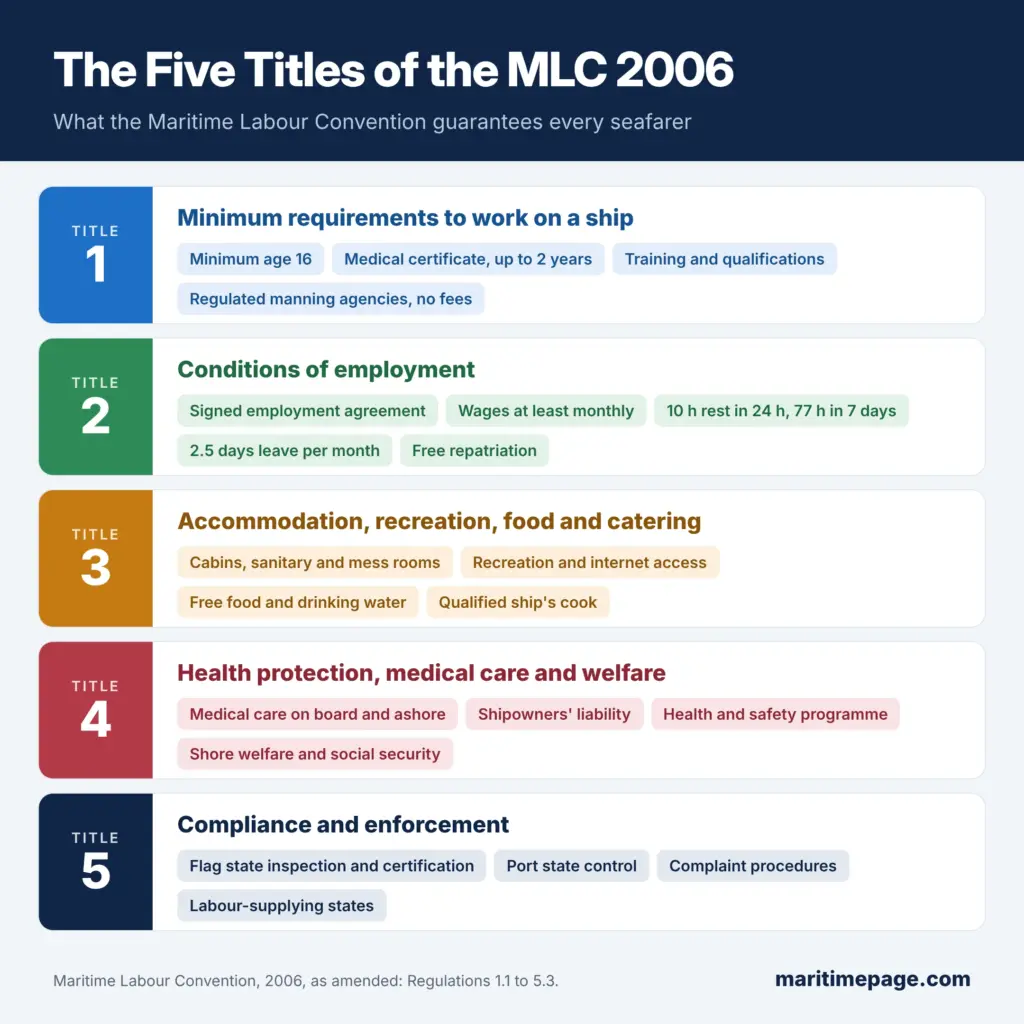
The five Titles cover minimum requirements to work at sea, conditions of employment, accommodation and food, health and welfare, and compliance and enforcement. Each Title is divided into numbered Regulations.
| Title | Subject | Regulations |
|---|---|---|
| 1 | Minimum requirements for seafarers to work on a ship | 1.1 Minimum age; 1.2 Medical certificate; 1.3 Training and qualifications; 1.4 Recruitment and placement |
| 2 | Conditions of employment | 2.1 Seafarers’ employment agreements; 2.2 Wages; 2.3 Hours of work and hours of rest; 2.4 Entitlement to leave; 2.5 Repatriation; 2.6 Compensation for the ship’s loss or foundering; 2.7 Manning levels; 2.8 Career and skill development |
| 3 | Accommodation, recreational facilities, food and catering | 3.1 Accommodation and recreational facilities; 3.2 Food and catering |
| 4 | Health protection, medical care, welfare and social security protection | 4.1 Medical care on board and ashore; 4.2 Shipowners’ liability; 4.3 Health and safety protection and accident prevention; 4.4 Access to shore-based welfare facilities; 4.5 Social security |
| 5 | Compliance and enforcement | 5.1 Flag State responsibilities; 5.2 Port State responsibilities; 5.3 Labour-supplying responsibilities |
What Does Title 1 Require Before a Seafarer Joins?
Title 1 sets the entry conditions. The minimum age is 16, and seafarers under 18 may not work at night or do work likely to endanger their health or safety.
For under-18s, night covers at least nine hours, starting no later than midnight and ending no earlier than 5 a.m. Each flag state defines the hazardous work list for young seafarers.
- Medical certificate: valid for up to two years, or one year for seafarers under 18; colour vision certification for up to six years.
- Training and qualifications: seafarers must be trained, certified as competent, and have completed personal safety training. STCW sets the competence standard.
- Recruitment and placement: private manning agencies must be licensed or regulated, and must not charge seafarers for finding them a job.
Age and fitness rules for a sea career in general are covered in our guide to the merchant navy age limit and health requirements.
What Does Title 2 Guarantee on Contracts, Pay and Leave?
Title 2 is the part most seafarers feel day to day. It requires a signed employment agreement, regular pay, limits on working time, paid leave and free repatriation.
- Seafarers’ employment agreement (SEA): signed by the seafarer and the shipowner, with a copy kept by the seafarer and the agreement available on board.
- Wages: paid at no greater than monthly intervals, with a monthly account and a way to send money home.
- Leave: at least 2.5 calendar days of paid annual leave per month of employment, plus shore leave.
- Repatriation: at no cost to the seafarer, after a maximum period of service on board of less than 12 months.
- Manning: enough crew to operate safely and efficiently, with fatigue and the nature of the voyage taken into account.
Safe manning interacts with the rest-hour rules, because a short-handed ship cannot give everyone their rest. Our article on how many crew members modern ships need explains how manning levels are set.
What Does Title 3 Require for Accommodation and Food?
Title 3 sets standards for cabins, sanitary facilities, mess rooms, recreation, food and drinking water. Food and drinking water must be of adequate quantity, quality and nutritional value, and provided free of charge.
The master or a delegated officer, with a crew member, carries out documented inspections of food stores, water and accommodation. Ship’s cooks must be trained and qualified for the job.
What Does Title 4 Cover for Health and Welfare?
Title 4 covers medical care on board and ashore, the shipowner’s liability for sickness and injury, occupational safety, shore welfare and social security. Medical care on board must be comparable to care available to workers ashore.
Regulation 4.3 requires the flag state to set occupational safety rules and the ship to run a health and safety programme. On board, this usually means risk assessments, PPE, a safety committee, and a permit-to-work system for hazardous jobs.
Heat exposure in engine rooms and on deck is one of the hazards this programme must address. See heat stress hazards faced by seafarers for the shipboard controls.
What Does Title 5 Require of Flag and Port States?
Title 5 is the enforcement chain. The flag state inspects and certifies its ships, and the port state inspects foreign ships in its ports. Labour-supplying states regulate manning agencies on their territory.
For open registries, the flag state often delegates MLC inspection to a recognized organization. Our guide to ship registries and flags of convenience explains why that chain matters for crews.
What Are the MLC Hours of Work and Rest?
Standard A2.3 sets two alternative limits. Work may not exceed 14 hours in any 24 hours and 72 in any 7 days. Or rest must be at least 10 hours in any 24 hours and 77 in any 7 days.
Each flag state chooses one basis, work or rest, in its national law. The hours-of-rest basis lines up directly with STCW, so one record serves both.
- Rest may be split into no more than two periods, one of which must be at least 6 hours long.
- The interval between consecutive rest periods must not exceed 14 hours.
- Musters, fire and lifeboat drills must be held in a way that disturbs rest as little as possible.
- A seafarer on call, such as an engineer with an unmanned engine room, gets compensatory rest if the rest period is disturbed by call-outs.
- A table of shipboard working arrangements must be posted in an easily accessible place.
- Daily hours of work or rest are recorded, endorsed by the master, and a copy given to the seafarer.
The master may suspend the schedule for the immediate safety of the ship, people on board or cargo, or to help others in distress. Once the situation is over, affected seafarers must get an adequate period of rest.
How Do MLC Rest Hours Relate to STCW?
STCW Section A-VIII/1 applies the same 10-hour and 77-hour minimums to watchkeepers and those with safety or security duties. The MLC extends rest rules to every seafarer, including galley and hotel staff.
The details of the STCW watchkeeping rule are in our guide to the STCW Code. Inspectors check the same record for both.
Why Do Rest-Hour Records So Often Fail Inspection?
Records fail when they are too perfect. A sheet showing exactly 10 hours of rest every day, through cargo operations and port calls, tells an inspector it was filled in to comply.
Inspectors cross-check rest records against the deck and engine logbooks, cargo times, drill records and overtime sheets. A mismatch between rest hours and paid overtime is one of the fastest ways to find falsified records.
What Are the Maritime Labour Certificate and the DMLC?
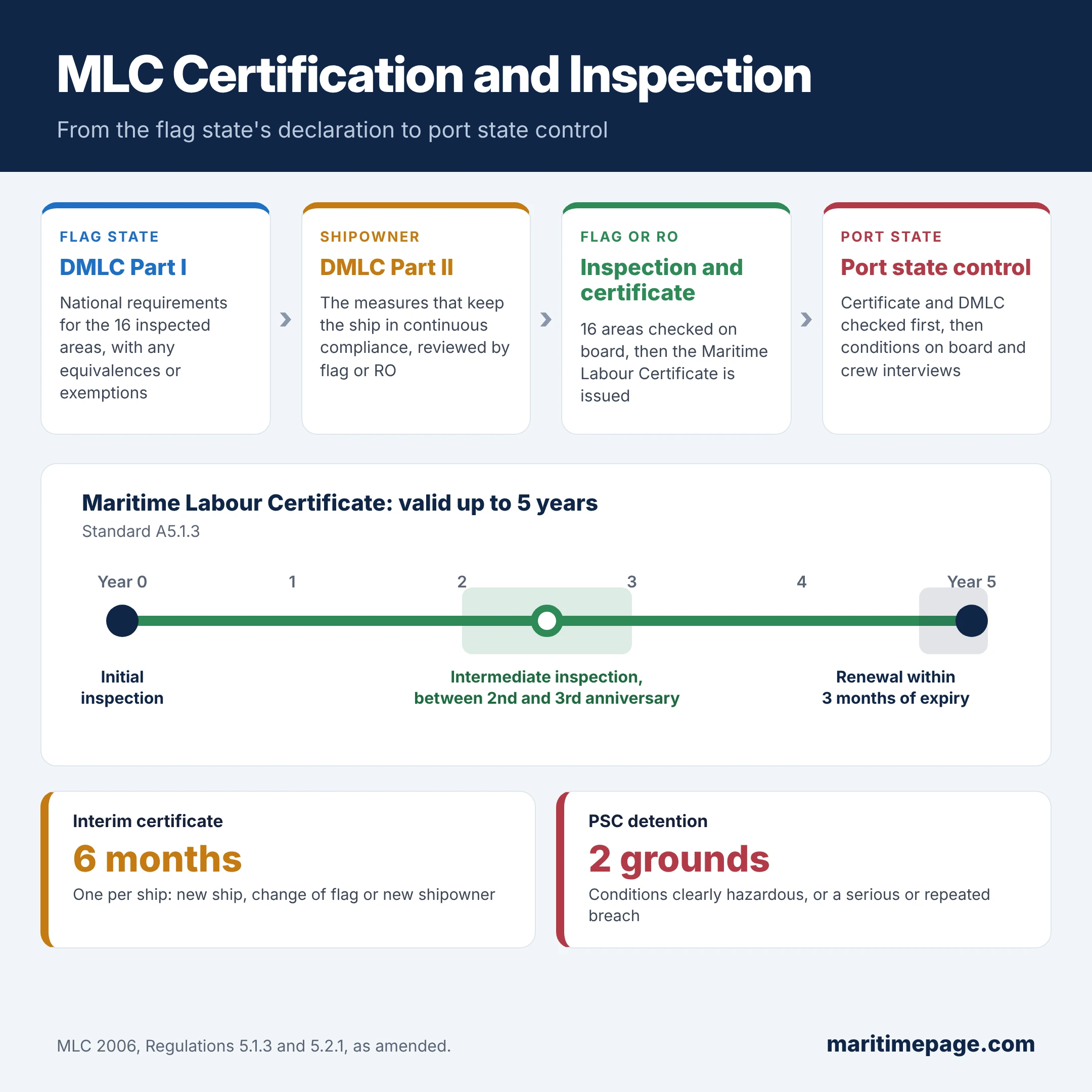
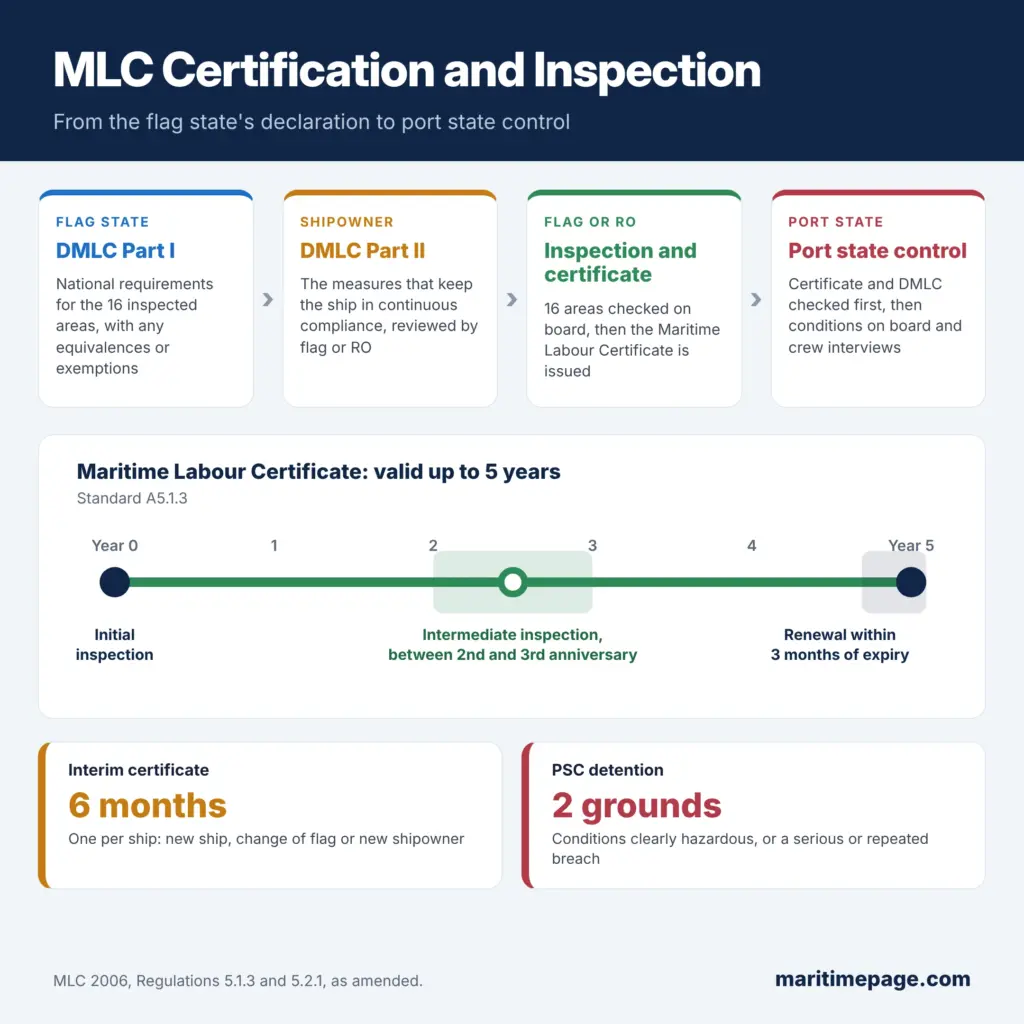
The Maritime Labour Certificate confirms that a ship’s working and living conditions comply with the flag state’s MLC law. The Declaration of Maritime Labour Compliance (DMLC) is attached to it and explains how compliance is achieved.
- DMLC Part I: drawn up by the flag state. It lists the national requirements for each of the 16 areas, plus any equivalences or exemptions.
- DMLC Part II: drawn up by the shipowner. It sets out the measures that keep the ship in continuous compliance, and the flag or RO reviews and certifies it.
The certificate, the DMLC and the financial security certificates must be kept on board and posted where seafarers can see them. Part II usually points back to procedures in the company’s safety management system.
How Long Is a Maritime Labour Certificate Valid?
The full-term certificate is valid for up to five years, with an intermediate inspection in between. The table follows Standard A5.1.3.
| Certificate or inspection | Rule |
|---|---|
| Maritime Labour Certificate | Valid for up to 5 years; flags may set a shorter period |
| Intermediate inspection | Between the second and third anniversary dates; the certificate is endorsed if satisfactory |
| Renewal inspection | Within 3 months before expiry, so the new certificate runs 5 years from the old expiry date |
| Extension (2016 amendments) | Up to 5 months past expiry, if the renewal inspection is passed but the new certificate cannot yet be placed on board |
| Interim certificate | Up to 6 months, one per ship, on delivery, change of flag, or a new shipowner taking over |
MLC inspections are usually combined with the ship’s other statutory surveys carried out on ships, often by the same recognized organization on the same visit.
What Happens During an MLC Inspection?
Flag and port state inspectors check the same 16 areas, starting with the certificate and DMLC. They then verify on board that conditions match the paperwork, and interview crew in private where needed.
What Are the 16 Areas Inspectors Check?
Appendix A5-I lists the areas the flag state certifies, and Appendix A5-III lists the same areas for port state control. The 2014 amendments added the two financial security items to the original 14.
- Minimum age
- Medical certification
- Qualifications of seafarers
- Seafarers’ employment agreements
- Use of any licensed, certified or regulated private recruitment and placement service
- Hours of work or rest
- Manning levels for the ship
- Accommodation
- On-board recreational facilities
- Food and catering
- Health and safety and accident prevention
- On-board medical care
- On-board complaint procedures
- Payment of wages
- Financial security for repatriation
- Financial security relating to shipowners’ liability
What Do Inspectors Actually Look At on Board?
An MLC inspection is a walk-through as much as a document check. Inspectors compare what the SEA, payroll and records say with what the crew, the cabins and the provision stores show.
- Crew list against certificates: every name has a valid medical certificate and STCW certificates for the job they hold.
- SEAs: signed, in force, matching the crew list, with the required content such as wages, leave and repatriation terms.
- Wage accounts: monthly statements issued, wages paid on time, and allotments reaching families.
- Rest-hour records: complete, signed, and consistent with logbooks and overtime.
- Galley and provision stores: food stock, temperature of cold rooms, cleanliness, drinking water quality, and the master’s inspection records.
- Accommodation: cabin condition, ventilation, heating, sanitary spaces, and no stores kept in living spaces.
- Financial security certificates: valid and posted for both repatriation and shipowners’ liability.
From a surveyor’s side, the galley and the cold rooms are often more telling than the office files. A dirty galley, broken reefer alarms or water tanks never cleaned point to a ship where the paperwork and the reality have drifted apart.
What MLC Deficiencies Lead to Detention?
Port state control must stop a ship from sailing when conditions are clearly hazardous to seafarers’ safety, health or security. Detention also applies to a serious or repeated breach of the Convention, including seafarers’ rights.
- Wages unpaid for weeks or months, or seafarers working without a valid SEA.
- Rest-hour violations serious enough to make the watch unsafe, or falsified records.
- Insufficient food or drinking water for the intended voyage.
- Seafarers kept on board beyond the maximum service period without their agreement.
- Missing or expired financial security certificates.
- Underage seafarers, or crew without valid medical certificates.
The ship stays detained until the deficiencies are fixed, or until the inspector accepts a corrective plan. Our list of common reasons for ship detention covers the procedure.
Wages are a live PSC focus. The Paris and Tokyo MoUs ran a joint concentrated inspection campaign on crew wages and SEAs from 1 September to 30 November 2024.
What Rights Does a Seafarer Have in a Complaint or Dispute?
Every seafarer has the right to complain about any breach of the MLC, on board or ashore, without being victimized. Regulation 5.1.5 requires on-board procedures for fair, effective and expeditious handling of complaints.
- Raise the complaint at the lowest level possible, usually the head of department.
- Take it to the master if it is not resolved.
- Complain directly to the master or to an external authority at any stage.
- Report to the flag state, or to a port state control officer when the ship is in port.
The SEA or the on-board procedure must give contact details for the flag state and the seafarer’s country of residence. Seafarers may be accompanied or represented during the complaint, and can also contact their union or the ITF.
What Happens if a Seafarer Is Abandoned?
Since 18 January 2017, flag states must require financial security for abandonment, and certified ships carry proof of it. It pays for repatriation, essential needs such as food, accommodation and medical care, and up to four months of outstanding wages.
A seafarer counts as abandoned when the shipowner fails to pay repatriation costs, leaves them without maintenance and support, or otherwise cuts ties. Failing to pay contractual wages for at least two months also counts.
The seafarer, or a representative, can claim directly against the insurer or provider, usually the ship’s P&I club. The financial security certificate on board gives the contact details.
Who Pays for Death or Long-Term Disability?
Regulation 4.2 makes the shipowner liable for sickness, injury and death connected with employment. Financial security must cover contractual claims for death or long-term disability due to an occupational injury, illness or hazard.
The amounts are those set in the SEA or collective agreement. Cover applies to events while the seafarer serves on board or is being repatriated.
How Has the MLC 2006 Been Amended?
The Code has been amended in 2014, 2016, 2018, 2022 and 2025. Four packages are in force; the 2025 package is expected to enter into force in December 2027.
| Amendments | In force | Main changes |
|---|---|---|
| 2014 | 18 January 2017 | Financial security for abandonment and for shipowners’ liability for death and long-term disability; two new inspection areas |
| 2016 | 8 January 2019 | Elimination of shipboard harassment and bullying; extension of a certificate’s validity by up to 5 months in one specific case |
| 2018 | 26 December 2020 | Wages and entitlements continue while a seafarer is held captive after piracy or armed robbery |
| 2022 | 23 December 2024 | Recruitment agency failures, repatriation help from flag and port states, internet and telephone access, free food and water, properly sized PPE, reporting of seafarer deaths |
| 2025 | Expected December 2027 | Seafarers recognized as key workers, shore leave without visa or special permit, repatriation costs clarified, harassment and bullying measures, fair treatment of detained seafarers |
The 2018 package responded to crews held for months by pirates without pay. Background on the threat is in our article on whether pirates still exist today.
The 2025 amendments were adopted by the Special Tripartite Committee in April 2025. They add no new inspection areas, but DMLC Part II procedures will likely need updating before entry into force.
How Does the MLC Connect to ISM, STCW and ISPS?
The MLC sets conditions, STCW sets competence, the ISM Code sets the management system, and ISPS sets security. On board, all four meet in the same records, procedures and inspections.
- ISM Code: most companies write their MLC procedures, such as complaints, rest hours and food inspections, into the safety management system. DMLC Part II often references it.
- STCW: sets who is qualified for each job. An STCW certificate proves competence; the MLC protects that person’s pay, contract and rest.
- ISPS Code: security measures in port must be balanced against the seafarer’s right to shore leave, which the 2025 amendments reinforce.
For crews, the practical point is simple. A single PSC visit can raise MLC, STCW and ISM deficiencies from the same failure, such as a falsified rest-hour record.
For the full text, the ILO’s consolidated edition, Maritime Labour Convention, 2006, as amended, is the standard reference for masters, crewing offices and inspectors.
The official text, ratification list and guidance are on the ILO Maritime Labour Convention page. The ILO also runs an MLC frequently asked questions database.
Related Topics
- What working on a merchant vessel is like
- Shipboard organization and ranks
- Types of drills on board merchant ships
- Modern-day piracy and maritime crime
Frequently Asked Questions
Does the MLC apply to yachts or fishing vessels?
It applies to commercial yachts engaged in commercial activity with paid crew. Private pleasure yachts are outside it. Fishing vessels are excluded and fall under ILO Convention No. 188 instead.
What is the minimum age for a seafarer under the MLC?
The minimum age is 16. Seafarers under 18 may not work at night or do work likely to endanger their health or safety.
How many hours must a seafarer rest under the MLC?
At least 10 hours in any 24-hour period and 77 hours in any 7-day period. Rest may be split into no more than two periods, one at least 6 hours long.
What is the difference between the Maritime Labour Certificate and the DMLC?
The certificate confirms the ship complies with the flag state’s MLC requirements. The DMLC is attached to it: Part I lists the national requirements, and Part II sets out the shipowner’s measures to comply.
Who pays for a seafarer’s repatriation?
The shipowner, at no cost to the seafarer. If the shipowner abandons the crew, the financial security provider, usually the P&I club, covers repatriation and up to four months of outstanding wages.
Can a ship be detained for MLC deficiencies?
Yes. Port state control must detain a ship when conditions are clearly hazardous to seafarers or when there is a serious or repeated breach, such as unpaid wages.
What is a seafarer’s employment agreement?
The SEA is the signed contract between the seafarer and the shipowner. It sets out wages, hours, leave, repatriation and termination terms, and a copy must be available on board.
How do I make a complaint about my employer at sea?
Use the ship’s on-board complaint procedure, starting with your head of department or the master. You can also go directly to the flag state, a port state control officer, or your union.

- What Is the MLC 2006? Maritime Labour Convention Explained – October 8, 2026
- What Is the ISM Code? SMS, DOC, SMC and Audits Explained – October 6, 2026
- What Is the IS Code? IMO Intact Stability Criteria Explained – October 5, 2026