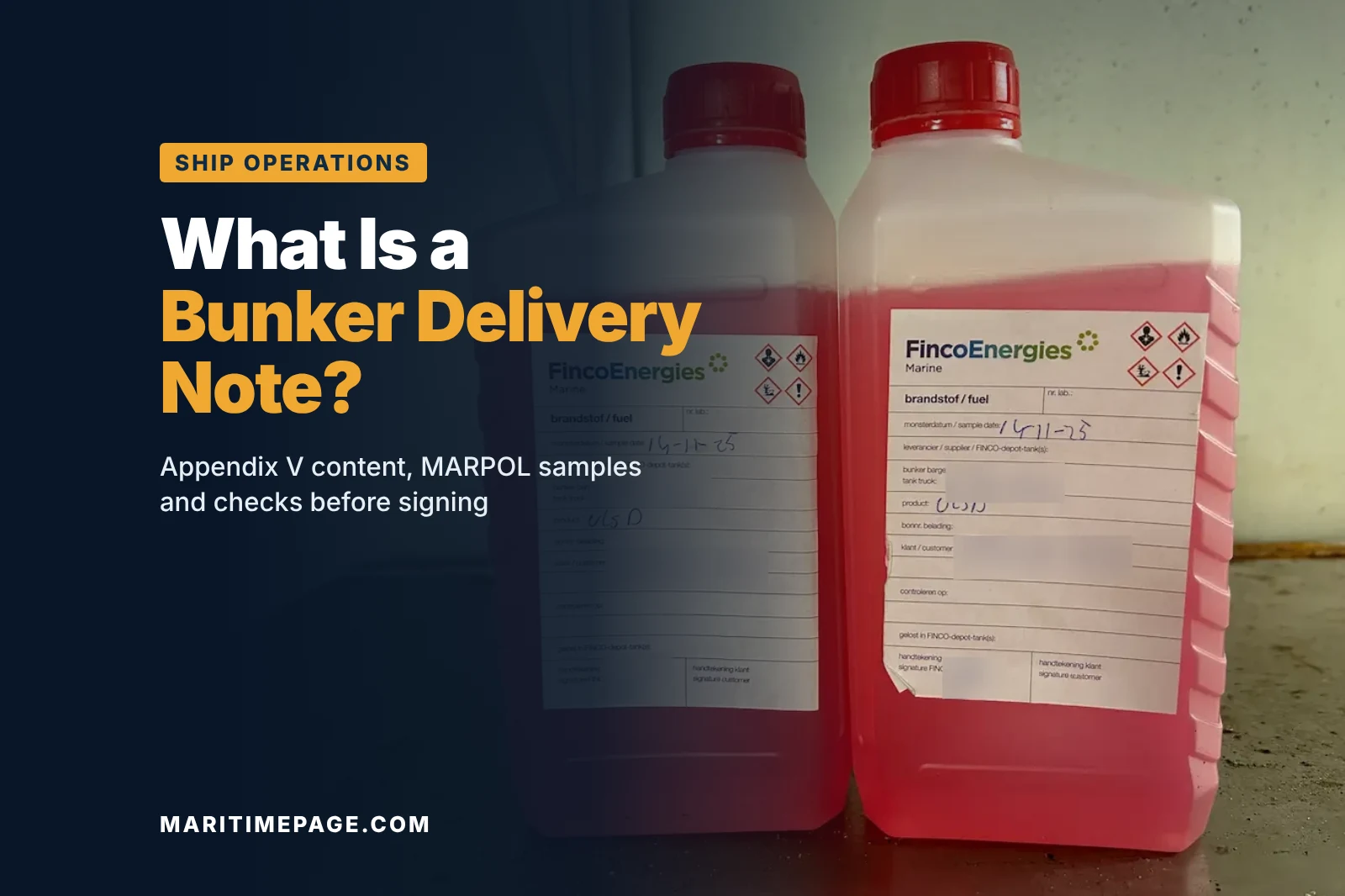
A bunker delivery note (BDN) is the document a fuel supplier must give a ship for every fuel delivery. It states what was delivered and declares that it meets MARPOL Annex VI. It goes with a sealed fuel sample, the MARPOL sample.
This guide covers what a BDN must contain, signing, retention, checks before signing and inspections.
What Is a Bunker Delivery Note?
A bunker delivery note is the supplier’s signed record of a fuel delivery, required by MARPOL Annex VI Regulation 18. It states the product, quantity, density and sulphur content, and declares that the fuel complies with Annex VI.
The BDN is a regulatory document, not just a commercial one. Port State control uses it to check that the ship burns fuel within the sulphur limits.
It differs from the bunker invoice, which is the commercial bill, and from the ship’s own soundings and records. The commercial side of buying fuel is covered in how bunker trading works.
Which Ships and Deliveries Need a BDN?
Ships of 400 gross tonnage and above under MARPOL Annex VI must receive a bunker delivery note for each delivery of fuel for combustion. The supplier issues it at the end of the delivery.
The rule applies however the fuel arrives, whether by barge, truck or pipeline. The delivery itself is described in bunkering on ships.
LNG and other gas fuels are delivered with a BDN too. For gas and low-flashpoint fuels, IMO amendments set how density and sulphur are stated; LNG bunkering explains that procedure.
What Information Must a Bunker Delivery Note Contain?
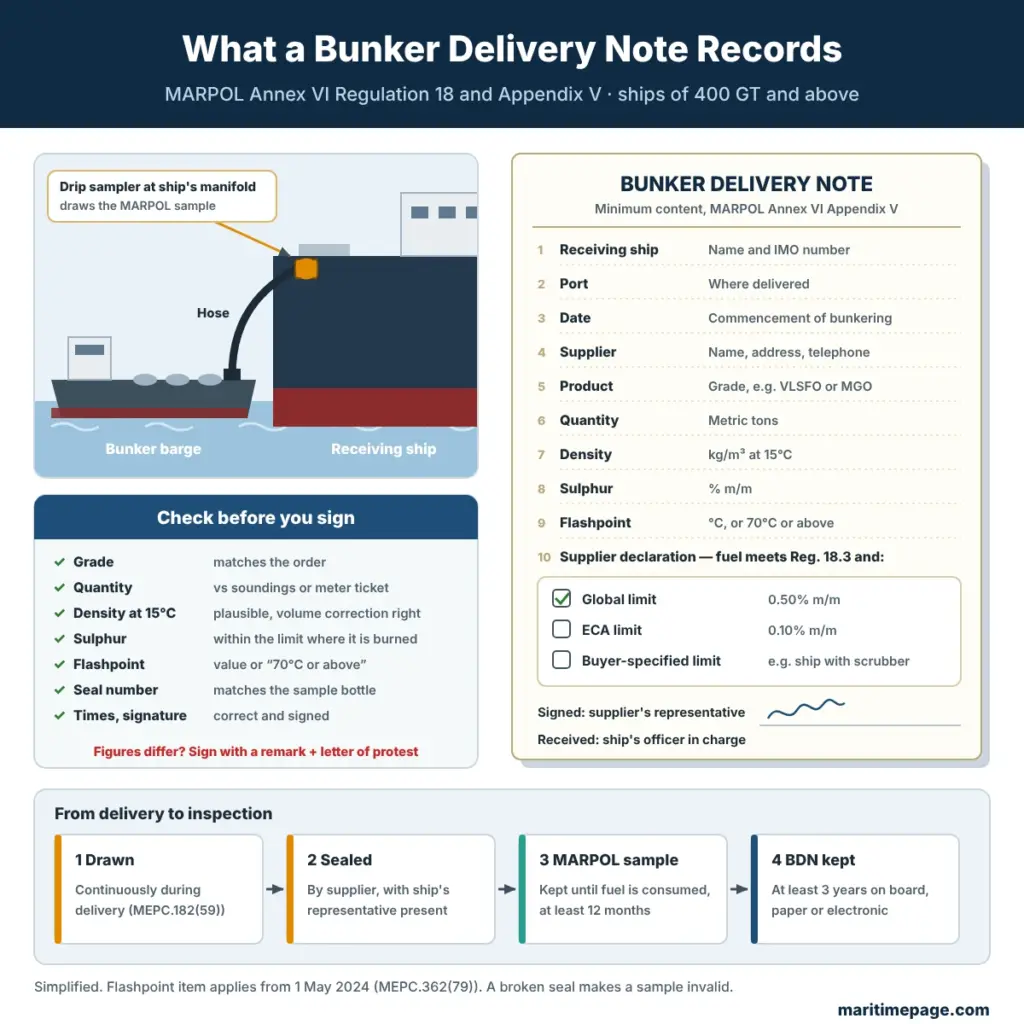
Appendix V of MARPOL Annex VI lists the minimum content of a bunker delivery note. It includes the ship, port and date, the supplier, the product, quantity, density, sulphur content, flashpoint and a signed supplier declaration.
| BDN item (Appendix V) | What it shows |
|---|---|
| Name and IMO number of receiving ship | Which ship received the fuel |
| Port | Where the fuel was delivered |
| Date of commencement of bunkering | When delivery started |
| Name, address and telephone number of the supplier | Who is responsible for the fuel |
| Product name(s) | Grade delivered, such as VLSFO or MGO |
| Quantity in metric tons | Mass delivered |
| Density at 15°C (kg/m³) | Tested to ISO 3675 or ISO 12185 |
| Sulphur content (% m/m) | Tested to ISO 8754 |
| Flashpoint (°C) | Tested to ISO 2719; a value below 70°C, or a statement that it is 70°C or above |
| Supplier declaration | Signed by the supplier’s representative: the fuel meets Regulation 18.3 and the chosen sulphur limit |
The declaration ticks one sulphur limit: the global limit, the emission control area limit, or a limit the buyer specified. The last option is for ships using an approved equivalent such as a scrubber.
The flashpoint item has applied since 1 May 2024, under resolution MEPC.362(79). Suppliers often add commercial fields, and the MARPOL sample seal number can also be recorded on the BDN.
Who Signs the BDN and How Long Is It Kept?
The supplier’s representative signs and certifies the declaration on the bunker delivery note, and the ship’s officer in charge receives it. The ship must keep the BDN for at least three years after the delivery.
The BDN must be readily available for inspection by the relevant authorities. Electronic BDNs are accepted if they hold at least the Appendix V information and are protected against changes.
IMO confirmed this in a 2023 unified interpretation of Regulations 18.5 and 18.6, issued as MEPC.1/Circ.795/Rev.8. Singapore announced that electronic BDNs would be mandatory for all its bunker suppliers from 1 April 2025.
On board, keeping and filing BDNs is part of the safety management system under the ISM Code.
What Is the MARPOL Sample?
The MARPOL sample is a representative sample of the delivered fuel, sealed at the end of delivery. The ship keeps it until the fuel is substantially consumed, and for at least 12 months.
- Drawing it: taken continuously during delivery with a drip sampler, following IMO guidelines in resolution MEPC.182(59).
- Sealing: the supplier seals the sample in the presence of the ship’s representative, and a broken seal makes it invalid.
- Storage: the sample need not stay on board but must be readily available to the authorities.
- Purpose: if an authority suspects non-compliant fuel, the MARPOL sample is tested under the verification procedure in Appendix VI of Annex VI.
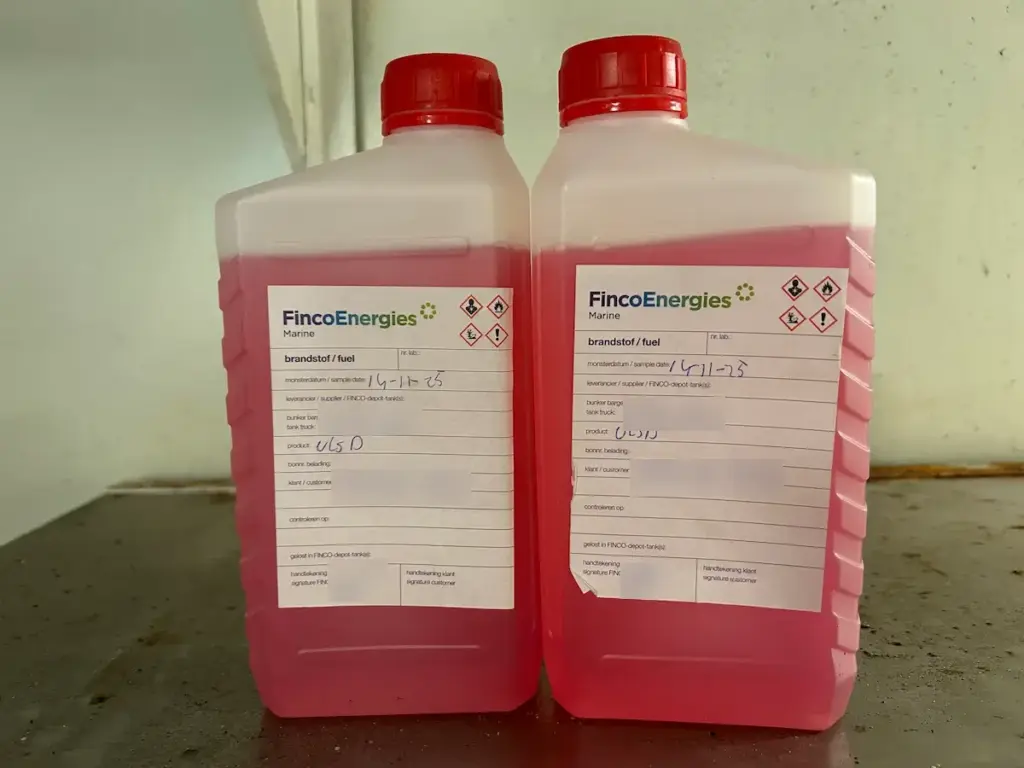
The MARPOL sample is separate from the ship’s commercial samples and the supplier’s sample. It is also separate from the in-use and onboard samples that inspectors can draw from the ship’s own fuel system.
How Do You Check a BDN Before Signing?
Check the bunker delivery note against the order, your own soundings and the supplier’s figures before you sign. Never sign a blank or incomplete BDN, and record any disagreement in a letter of protest.
- Grade: the product name and grade match what was ordered.
- Quantity: the tonnes on the BDN match the ship’s opening and closing soundings, or the mass flow meter ticket where used.
- Density and temperature: the density at 15°C is plausible for the grade, and the volume correction has been applied correctly.
- Sulphur: the declared sulphur content is within the limit for the area where the fuel will be burned.
- Flashpoint: a value or a 70°C statement is shown.
- Seal numbers: the MARPOL sample seal number matches the bottle.
- Times and signatures: start and finish times are correct, and the supplier’s declaration is signed.
If figures differ, sign with a remark and issue a letter of protest at once. Many owners appoint a bunker surveyor to witness the measurements and paperwork.
Which Sulphur Limits Does the BDN Support?
The BDN declaration confirms fuel sulphur against MARPOL Annex VI Regulation 14. The limit is 0.50% m/m worldwide since 1 January 2020 and 0.10% m/m inside emission control areas (ECAs).
| ECA | 0.10% sulphur applies from |
|---|---|
| Baltic Sea | In force |
| North Sea | In force |
| North American area | In force |
| United States Caribbean Sea area | In force |
| Mediterranean Sea | 1 May 2025 |
| Canadian Arctic | 1 March 2027 |
| Norwegian Sea | 1 March 2027 |
| North-East Atlantic Ocean | 1 September 2028 |
Ships with an approved scrubber may burn higher-sulphur fuel, which the BDN declares against a buyer-specified limit. See ship scrubbers, and MGO and MDO for ECA distillates.
What If the BDN and the Fuel Do Not Match?
If the BDN is incomplete or the sample was not properly drawn or sealed, document it and inform the flag State, port authority and supplier. Raise quantity or quality differences with a letter of protest.
- Missing information or a bad sample: record it and notify the flag Administration. Send copies to the port authority and the supplier, and keep one on board.
- Short quantity: protest in writing and keep the sounding records, temperatures and meter tickets.
- Sulphur above the declared value: the MARPOL sample may be tested under the Annex VI verification procedure.
- No compliant fuel available: the ship reports this to its flag State and the next port, using a fuel oil non-availability report (FONAR).
Commercial claims for off-specification fuel are a separate process, judged against the fuel standard named in the contract.
What Do PSC and Class Inspectors Check?
PSC officers check that BDNs for the last three years and the sealed MARPOL samples are on board. They also check declared sulphur against the area of use and ECA changeover records.
- BDNs: complete, signed and kept for three years.
- MARPOL samples: sealed, labelled and kept for at least 12 months.
- Sulphur compliance: BDN sulphur matches the limit for the area, and in-use samples may be taken.
- Fuel changeover: dates, times and positions recorded when entering and leaving ECAs.
- Bunker records: BDN quantities match the Oil Record Book bunkering entries.
Missing BDNs or samples are common findings. Serious gaps can lead to detention under port State control, and charterers review fuel records during a vetting inspection.
How Does the BDN Relate to Other Records?
The bunker delivery note is the source for the ship’s bunkering entries and fuel data. Its quantity and grade feed the Oil Record Book, the engine logs and the fuel consumption reported for emissions rules.
- Oil Record Book: each grade is entered under code H with tonnes and sulphur content. See the Oil Record Book.
- Fuel consumption data: delivered fuel underpins the annual fuel data behind a ship’s CII rating.
- Fuel planning: tank capacity and remaining on board, covered in how much fuel cargo ships carry.
Related Topics
Frequently Asked Questions
What is a bunker delivery note?
A bunker delivery note (BDN) is the supplier’s signed record of a fuel delivery to a ship, required by MARPOL Annex VI Regulation 18. It states the product, quantity, density, sulphur content and flashpoint.
What must a BDN contain?
Appendix V of MARPOL Annex VI requires the ship’s name and IMO number, port, delivery date, supplier details, product, quantity in tonnes, density at 15°C, sulphur content, flashpoint and a signed supplier declaration.
How long must the BDN be kept?
The ship must keep each bunker delivery note for at least three years after delivery, readily available for inspection.
What is a MARPOL sample?
It is a representative sample of the delivered fuel, sealed at the end of bunkering and kept under the ship’s control until the fuel is substantially consumed, and for at least 12 months.
Who signs the BDN?
The fuel supplier’s representative signs and certifies the declaration on the BDN. The ship’s officer in charge receives it and should only sign for receipt once the figures are checked.
What is the difference between a BDN and a bunker invoice?
The BDN is a MARPOL document recording what was delivered and declaring compliance. The invoice is the commercial bill for the fuel and is not a regulatory record.
What if the BDN quantity is wrong?
Sign with a remark, issue a letter of protest at once and keep the soundings, temperatures and meter tickets. A bunker surveyor can witness the figures for any later claim.
Does LNG bunkering use a BDN?
Yes. LNG and other gas fuels are delivered with a bunker delivery note, and IMO amendments set how density and sulphur are stated for these fuels.

- Bunker Delivery Note (BDN): Contents, MARPOL Rules and Checks – October 11, 2026
- Oil Record Book: Part I and Part II Entries, Rules and PSC Checks – October 11, 2026
- What Is the IBC Code? Ship Types, Products and Certificates – October 11, 2026