
The best maritime colleges in the US fall into two groups. Seven maritime academies train licensed merchant marine officers, while four universities teach naval architecture, ocean engineering and naval careers.
This guide compares all eleven maritime schools on license route, training ship, acceptance rate and cost. It is written for US students and parents choosing a school, and every figure was checked in October 2026.
What Is a Maritime College?
A maritime college trains people for careers at sea and in the shipping industry. Most combine a bachelor’s degree with sea training on a training ship, leading to a U.S. Coast Guard officer license.
A maritime academy is a maritime college with a regimented cadet program and a license track. In everyday searches, “maritime college”, “maritime academy” and “maritime school” mean the same kind of institution.
Core Maritime Disciplines Offered:
- Marine Transportation (the deck officer track)
- Marine Engineering (the engine officer track)
- Naval Architecture
- Maritime Business and logistics
- Maritime Law (taught as coursework)
- Environmental Science and marine safety
- Oceanography and ocean engineering
Maritime law is the one discipline these schools teach only as coursework. Practicing admiralty law in the United States requires a law degree and a bar admission.
Graduates work at sea as deck and engine officers, or ashore in shipping companies, shipyards, ports and government agencies. License-track cadets can also earn a commission in the U.S. Navy Reserve.
How Many Maritime Academies Are There in the US?
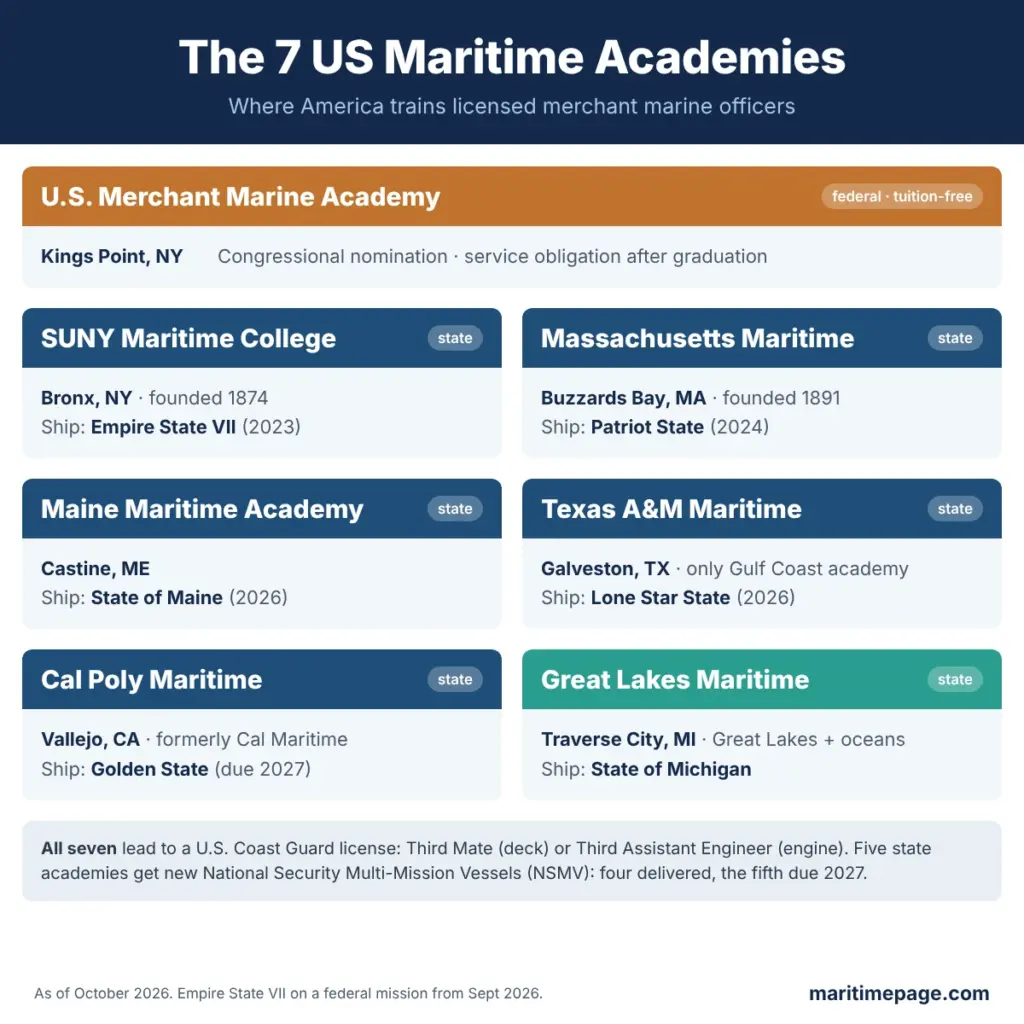
The US has seven maritime academies that train licensed merchant marine officers. One is federal, the U.S. Merchant Marine Academy at Kings Point, and six are state academies.
The six state academies are SUNY Maritime, Massachusetts Maritime, Maine Maritime, Texas A&M Maritime, Cal Poly Maritime and Great Lakes Maritime. The U.S. Maritime Administration (MARAD) supports them with federal training ships and student incentive payments.
The U.S. Naval Academy and the U.S. Coast Guard Academy are military service academies, not merchant marine academies. Their graduates serve as officers, although qualified watch officers from both can qualify for a third mate license.
| Academy | Type | Location | Training ship (October 2026) |
|---|---|---|---|
| U.S. Merchant Marine Academy | Federal | Kings Point, NY | Not part of the NSMV program |
| SUNY Maritime College | State (New York) | Bronx, NY | Empire State VII (NSMV, 2023)* |
| Massachusetts Maritime Academy | State | Buzzards Bay, MA | Patriot State (NSMV, 2024) |
| Maine Maritime Academy | State | Castine, ME | State of Maine (NSMV, 2026) |
| Texas A&M Maritime Academy | State | Galveston, TX | Lone Star State (NSMV, 2026) |
| Cal Poly Maritime Academy | State | Vallejo, CA | Golden State (NSMV) due 2027 |
| Great Lakes Maritime Academy | State | Traverse City, MI | State of Michigan |
Top Maritime Colleges and Academies in the US
The list keeps the order of earlier editions and is not a ranking. Acceptance rates and middle-50% SAT ranges come from College Board BigFuture, checked in October 2026.
1. SUNY Maritime College
Location: Fort Schuyler, Throggs Neck (Bronx), NY
Type: State maritime academy, license track
Courses Offered: Marine Engineering, Marine Transportation, International Business
Training Ship: Empire State VII
Acceptance Rate: 72%
SAT Range: 1123–1288
Tuition (2026–27): $7,070 New York residents, $17,970 out of state
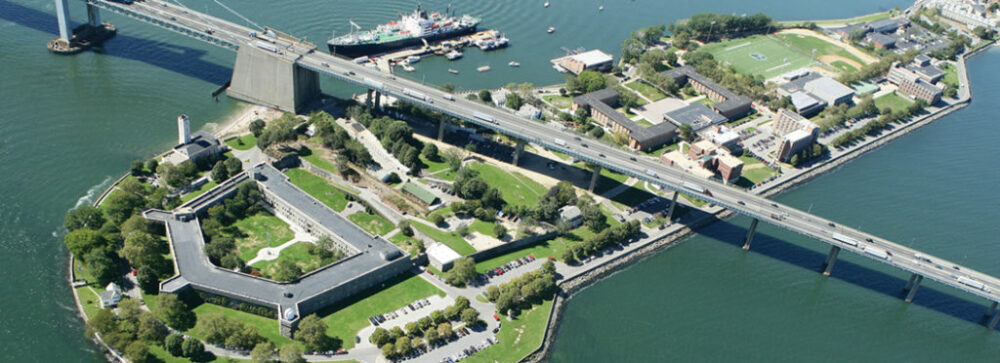
SUNY Maritime opened in 1874 as the New York Nautical School and calls itself the oldest school of its kind in the US. Every bachelor’s program can be combined with preparation for a Coast Guard officer license.
Cadets train on Empire State VII, the first National Security Multi-Mission Vessel (NSMV), delivered in September 2023. She replaced the 1961-built Empire State VI and berths up to 600 cadets.
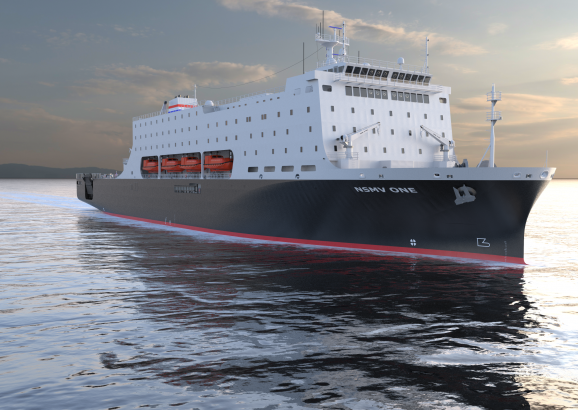
In August 2026, MARAD reassigned the ship to a federal mission of about 170 days. Applicants should ask the college how it is running sea training until she returns.
The college estimates a 2026–27 cost of $31,315 for a New York resident, including food and housing. SUNY says Summer Sea Terms can add close to $45,000 over three summers.
- Phone: (718) 409-7200
- Address: 6 Pennyfield Avenue, Fort Schuyler, NY 10465
- Program: Strategic Sealift Officer Program
2. Florida Institute of Technology
Location: Melbourne, FL
Type: Private university, no license track
Courses Offered: Ocean Engineering, Oceanography, Environmental Science, Marine Science
Acceptance Rate: 58%
SAT Range: 1120–1320
Florida Tech is not a maritime academy and does not prepare students for a Coast Guard license. It suits students aiming at ocean engineering, oceanography or marine science careers.
The university builds internships and research projects into these programs. Its M.S. in Ocean Engineering is taught on the Melbourne campus.
Florida has no state maritime academy. The only license-track academy on the Gulf Coast is Texas A&M Maritime Academy in Galveston.
- Phone: (321) 674-8000
- Address: 150 W. University Blvd, Melbourne, FL 32901
3. Massachusetts Maritime Academy
Location: Buzzards Bay, MA
Type: State maritime academy, license track
Courses Offered: Marine Transportation, Marine Engineering, Facilities and Environmental Engineering, Marine Safety and Environmental Protection, International Maritime Business
Training Ship: Patriot State
Acceptance Rate: 72%
SAT Range: 1030–1185
Tuition and fees (2026–27): $12,151 Massachusetts residents, $25,201 out of state
Massachusetts Maritime was founded in 1891 and describes itself as the oldest maritime academy in continuous operation in the US. SUNY’s claim rests on its 1874 founding date instead.
Cadets follow a regimented lifestyle in a cadet corps. They sail on Patriot State, the second NSMV, which replaced the 1967-built TS Kennedy and made its first cadet voyage in January 2025.
Room ($9,336) and board ($6,350) come on top of tuition and fees. Some majors add a program fee or an STCW fee.
- Phone: (508) 830-5000
- Address: 101 Academy Drive, Buzzards Bay, MA 02532
4. Maine Maritime Academy
Location: Castine, ME
Type: State maritime academy, license track
Courses Offered: Marine Engineering Operations, Marine Engineering Technology, Marine Systems Engineering, Marine Transportation Operations, Coastal and Marine Environmental Science, International Business and Logistics
Training Ship: State of Maine
Acceptance Rate: 54%
SAT Range: 1095–1260
Tuition (2026–27): $12,536 Maine residents, $28,840 out of state
Four Maine Maritime majors lead to an unlimited Coast Guard license, and all four require membership in the Regiment of Midshipmen. The academy also teaches marine biology and small vessel operations without the license track.
The third NSMV, State of Maine, was formally delivered to the academy on 30 March 2026. License-track students pay an Unlimited License Program fee on top of tuition.
- Phone: (207) 326-4311
- Address: Pleasant Street, Castine, ME 04220
5. LSU New Orleans (Formerly University of New Orleans)
Location: New Orleans, LA
Type: Public university, no license track
Courses Offered: Naval Architecture and Marine Engineering (B.S., M.S.E., Ph.D.)
Acceptance Rate: 67%
Specialty: Naval architecture for the Gulf Coast shipbuilding and offshore industry
The University of New Orleans became LSU New Orleans on 1 July 2026, when it returned to the LSU System. Its School of Naval Architecture and Marine Engineering was set up in 1980 at the request of local shipbuilders.
The school offers degrees in naval architecture and marine engineering and is a direct route into becoming a naval architect. Students use internships and career services to build their professional portfolios.
Attending maritime industry fairs alongside coursework is another way students make the employer contacts that turn into a first job offer.
- Phone: (888) 514-4275
- Address: 2000 Lakeshore Drive, New Orleans, LA 70148
Location: Annapolis, MD
Type: Federal service academy (U.S. Navy), tuition-free
Courses Offered: Naval Architecture, Marine Engineering
Acceptance Rate: 9%
SAT Range: 1210–1410
Founded in 1845, the Naval Academy trains officers for the Navy and Marine Corps, not for the merchant marine. Graduates are commissioned as Navy ensigns or Marine Corps second lieutenants.
Admission requires a nomination, usually from a member of Congress. Education is tuition-free in return for a period of active-duty service after graduation.
- Phone: (410) 293-1000
- Address: 121 Blake Road, Annapolis, MD 21402
7. United States Merchant Marine Academy
Location: Kings Point, NY
Type: Federal maritime academy, license track, tuition-free
Courses Offered: Marine Transportation, Marine Engineering Systems, Marine Engineering and Shipyard Management
Acceptance Rate: 24%
SAT Range: 1150–1330
Kings Point has the lowest acceptance rate of the license academies with published figures. Like the Naval Academy, it requires a congressional nomination and charges no tuition.
Every midshipman must earn a deck or engineering officer license to graduate, and graduates owe a service obligation. Options include keeping the license six years plus eight years in a reserve unit, or five years of active duty.
- Phone: (516) 726-5800
- Address: 300 Steamboat Road, Kings Point, NY 11024
8. Webb Institute
Location: Glen Cove, NY
Type: Private college, no license track
Courses Offered: Naval Architecture and Marine Engineering (single major)
Acceptance Rate: 14%
SAT Range: 1430–1530
Webb gives every US citizen and permanent resident a full-tuition scholarship, valued at over $250,000 across four years. Students still paid an estimated $26,265 in 2025–26 for living costs, fees, books, travel and a laptop.
Each January and February, students leave the classroom for a Winter Work Term, four in total. First-years work in shipyards, and second-years sail as observers on ocean-going ships.
Webb, LSU New Orleans and the Naval Academy are the core of our comparison of naval engineering schools in the US. That guide covers the degree programs in more depth.
- Phone: (516) 671-2213
- Address: 298 Crescent Beach Road, Glen Cove, NY 11542
9. Cal Poly Maritime Academy (Formerly California State University Maritime Academy)
Location: Vallejo, CA
Type: State maritime academy, license track
Courses Offered: Marine Engineering, Marine Transportation
Training Ship: Golden State (NSMV) due 2027
Acceptance Rate: 99% (listed under the former Cal Maritime name)
Cal Maritime merged into Cal Poly San Luis Obispo after a November 2024 vote by the CSU trustees. Its license programs now run as Cal Poly Maritime Academy, with full academic integration planned by fall 2026.
The 1989-built TS Golden Bear completed her final summer sea term in July 2026, after about 30 years with the academy. Her replacement, the NSMV Golden State, is due in 2027.
- Phone: (707) 654-1000
- Address: 200 Maritime Academy Drive, Vallejo, CA 94590
10. Great Lakes Maritime Academy
Location: Traverse City, MI
Type: State maritime academy (Northwestern Michigan College), license track
Courses Offered: Marine Engineering, Marine Transportation (Deck Officer)
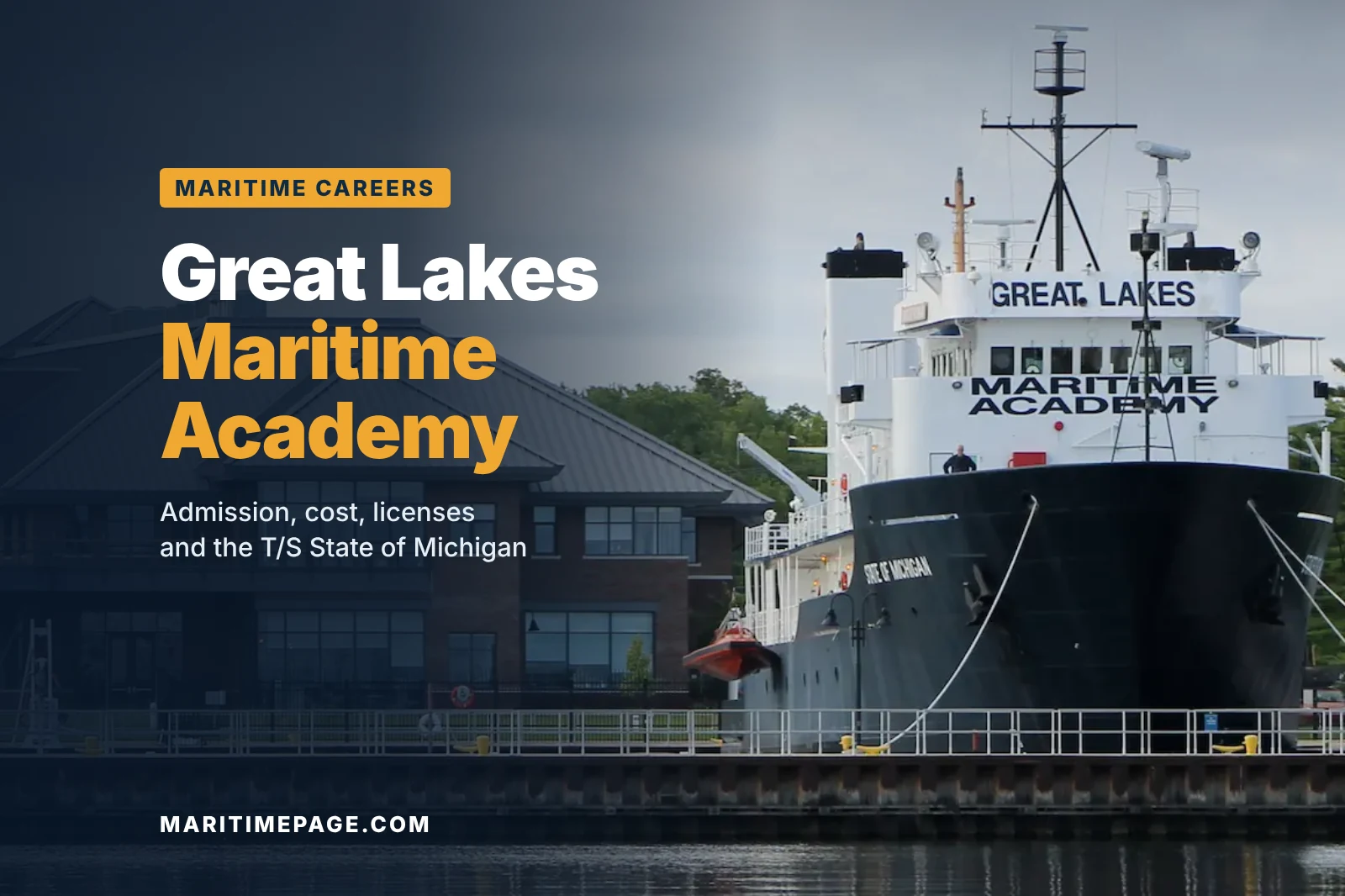
Training Ship: T/S State of Michigan
Tuition (2026–27): $579 per credit hour, plus a $500 maritime program fee per semester
Great Lakes Maritime is the only academy built around Great Lakes shipping. Deck cadets sit the Coast Guard exams for Third Mate Great Lakes, Third Mate Oceans Unlimited Tonnage and First Class Great Lakes Pilot.
The program takes four years, or three for students who already hold a bachelor’s degree. The college estimates annual costs of $28,335 in-district, $31,621 in-state and $33,597 out of state.
The academy publishes an admissions checklist rather than an acceptance rate. Applicants must be US citizens aged at least 17, pass a CG-719K physical and a background check, and send two references.
- Phone: (231) 995-1200
- Address: Northwestern Michigan College, 1701 East Front Street, Traverse City, MI 49686
11. Texas A&M Maritime Academy
Location: Galveston, TX
Type: State maritime academy, license track
Courses Offered: Marine Engineering Technology, Marine Transportation, Maritime Business
Training Ship: Lone Star State
Founded in 1962, Texas A&M Maritime Academy is the only maritime academy on the Gulf Coast. Deck cadets work toward Third Mate (Unlimited Tonnage), and Marine Engineering Technology cadets toward Third Assistant Engineer (Unlimited Horsepower).
License cadets complete three summer sea terms. From August 2026 their training ship is Lone Star State, the fourth NSMV, a 524-foot ship with berths for up to 600 cadets.
Out-of-state license students from Louisiana, Mississippi, Alabama, Florida, Puerto Rico and Panama pay the in-state rate, saving $300 per credit hour. Students from six nearby states save $150 per credit hour.
- Phone: (409) 740-4411
- Address: 200 Seawolf Parkway, Galveston, TX 77553
How Do You Become a Licensed Officer Through a Maritime Academy?
You complete an approved deck or engine program at a maritime academy, train at sea as a cadet and pass the U.S. Coast Guard exam. You graduate with a Merchant Mariner Credential endorsed as third mate or third assistant engineer.
- Meet entry rules: US citizenship for an officer license, a Coast Guard medical exam and the age and health requirements for seafarers.
- Enroll in a license track: Marine Transportation for deck officers, Marine Engineering for engine officers.
- Complete sea training: summer sea terms on a training ship or cadet duties on commercial ships, recorded for the license exam.
- Pass the Coast Guard exam: deck graduates qualify as Third Mate (Unlimited Tonnage), engine graduates as Third Assistant Engineer (Unlimited Horsepower).
- Receive STCW endorsements: the credential carries the international endorsements set by the STCW Code.
The STCW endorsement is what a US officer needs for international voyages. Our guide to the STCW certificate explains the certificate of competency and its renewal.
Third mate is the first rung on the deck officer ladder shown in our guide to ranks on merchant navy ships. Engine graduates start in the role described in third engineer duties.
Can You Get a License Without Going to a Maritime Academy?
Yes. Under 46 CFR 11.407, a sailor qualifies for third mate after three years of ocean deck service, including six months of bridge watchkeeping.
Mariners call this the “hawsepipe” route. A Coast Guard-approved Apprentice Mate training program is a third option.
How Much Does a Maritime Academy Cost?
Published 2026–27 in-state tuition at the state academies runs from $7,070 (SUNY Maritime) to $12,536 (Maine Maritime), before housing. The U.S. Merchant Marine Academy, the Naval Academy and Webb Institute charge no tuition.
| School | In-state | Out of state | What the figure covers |
|---|---|---|---|
| SUNY Maritime | $7,070 | $17,970 | Tuition, 2026–27 |
| Massachusetts Maritime | $12,151 | $25,201 | Tuition and fees, 2026–27 |
| Maine Maritime | $12,536 | $28,840 | Tuition, 2026–27, before the license program fee |
| Great Lakes Maritime | $31,621 | $33,597 | Estimated annual cost incl. housing, 2026–27 |
| Texas A&M Maritime | In-state rate for license students from LA, MS, AL, FL, Puerto Rico and Panama | Tuition reduction since 1 September 2024 | |
| U.S. Merchant Marine Academy | $0 tuition | Service obligation after graduation | |
| Webb Institute | $0 tuition ($26,265 other costs) | Full-tuition scholarship, 2025–26 | |
Sea terms, uniforms and license fees add to these figures. Compare full cost-of-attendance pages, not tuition alone.
Financial Aid and Scholarships
The largest maritime-specific aid is MARAD’s Student Incentive Payment (SIP) program, worth up to $64,000 over four years. It is open to state academy cadets in the Strategic Sealift Midshipman Program.
In return, SIP graduates keep their unlimited license for six years and work at least three years in the US maritime industry. The main route is officer service on US-flag vessels, plus eight years in a reserve unit if commissioned.
Each school also offers its own scholarships, grants and loans. Start with these financial aid pages:
- SUNY Maritime College
- Florida Institute of Technology
- Massachusetts Maritime Academy
- Maine Maritime Academy
- LSU New Orleans (formerly University of New Orleans)
- United States Naval Academy
- United States Merchant Marine Academy
- Webb Institute
How Do You Choose a Maritime College?
Choose by career goal first, then cost. A sea-going officer career needs one of the seven license academies; a ship design career needs a naval architecture degree.
| If your goal is | Look at |
|---|---|
| Deck or engine officer at the lowest in-state cost | Your home state’s academy: SUNY, Massachusetts, Maine, Texas A&M, Cal Poly or Great Lakes |
| Officer license with no tuition | U.S. Merchant Marine Academy (service obligation applies) |
| Careers on the Great Lakes | Great Lakes Maritime Academy |
| Gulf Coast and offshore shipping | Texas A&M Maritime Academy |
| Ship design (naval architecture) | Webb Institute, LSU New Orleans, U.S. Naval Academy |
| Ocean engineering or oceanography | Florida Institute of Technology |
| Navy or Marine Corps officer | U.S. Naval Academy |
Career Opportunities After Graduation
Graduates of maritime colleges work in four main sectors:
- Marine Industry: officer posts with transport and shipping companies, and shore roles such as bunker surveying
- Naval Services: U.S. Navy, Navy Reserve, Coast Guard
- Manufacturing: shipyards, engineering and production companies
- Energy: offshore drilling, including the path to becoming an oil rig worker, and renewable energy
The US Bureau of Labor Statistics put the May 2025 median pay at $92,460 for captains, mates and pilots and $109,530 for ship engineers. It projects 4% employment growth for water transportation workers from 2025 to 2035.
Internship Programs and Career Services
Every license academy builds sea time into the degree through sea terms, and some add cadet placements on commercial ships. Webb places students in shipyards and at sea during its winter work terms.
Universities such as Florida Institute of Technology and LSU New Orleans rely on internships with marine industry partners. Ask each school which employers recruit on campus and how many graduates sail on their license.
Online Learning and Distance Education Options
Officer license programs cannot be completed online, because they require sea time and practical training. Graduate study is a different matter:
- SUNY Maritime offers its M.S. in International Transportation Management 100% online. It also runs a master’s program in Maritime and Naval Studies.
- Florida Institute of Technology teaches its M.S. in Ocean Engineering on the Melbourne campus.
Related Topics
- What it is like working on a merchant vessel
- Essential seamanship skills for new mariners
- The bosun’s rank and duties on a ship
Frequently Asked Questions
How many maritime academies are there in the US?
There are seven: the federal U.S. Merchant Marine Academy at Kings Point and six state academies. The state academies are SUNY Maritime, Massachusetts Maritime, Maine Maritime, Texas A&M Maritime, Cal Poly Maritime and Great Lakes Maritime.
What is the best maritime academy in the US?
No official ranking exists, so the best choice depends on your career goal and home state. Kings Point has the lowest acceptance rate of the license academies with published figures, while your own state academy usually costs least. For ship design rather than a seagoing career, Webb Institute is the specialist.
No. Maritime academies train civilian merchant marine officers for commercial ships. Cadets can add a U.S. Navy Reserve commission through the Strategic Sealift program, while the U.S. Naval Academy is a separate military school.
How many years is maritime academy?
A license-track bachelor’s degree takes four years, including sea terms. Great Lakes Maritime Academy also offers a three-year path for students who already hold a bachelor’s degree.
What are the acceptance rates at US maritime academies?
College Board figures checked in October 2026 put Kings Point at 24%, Maine Maritime at 54%, and SUNY Maritime and Massachusetts Maritime at 72%. Great Lakes Maritime Academy admits against a published checklist instead of a rate.
How much does maritime academy cost?
In 2026–27, in-state tuition runs from $7,070 at SUNY Maritime to $12,536 at Maine Maritime, before housing and sea terms. The U.S. Merchant Marine Academy charges no tuition. MARAD’s SIP program pays state academy cadets up to $64,000 over four years in exchange for service.
Is there a maritime academy in Florida?
No. None of the six state maritime academies is in Florida. Florida Tech offers ocean engineering without a license track, and Florida residents in Texas A&M’s license program pay the Texas in-state rate.
Do maritime academy graduates get a Coast Guard license?
License-track graduates sit the U.S. Coast Guard exam and leave with a Merchant Mariner Credential as third mate or third assistant engineer. Students in non-license majors, such as maritime business, graduate without one.

- Great Lakes Maritime Academy: Programs, Cost and Admission – October 14, 2026
- Bunker Delivery Note (BDN): Contents, MARPOL Rules and Checks – October 11, 2026
- Oil Record Book: Part I and Part II Entries, Rules and PSC Checks – October 11, 2026
Leave a Reply