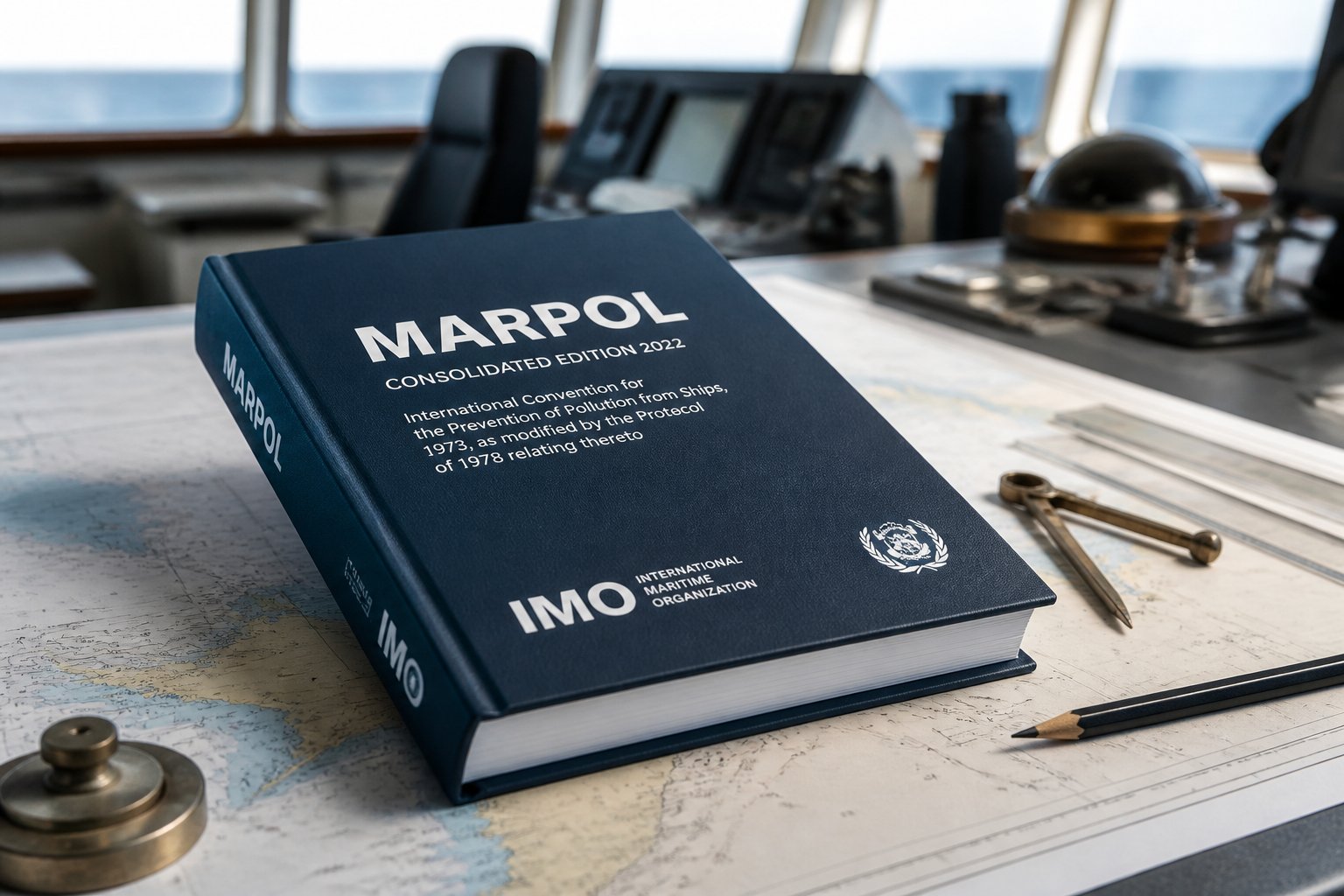
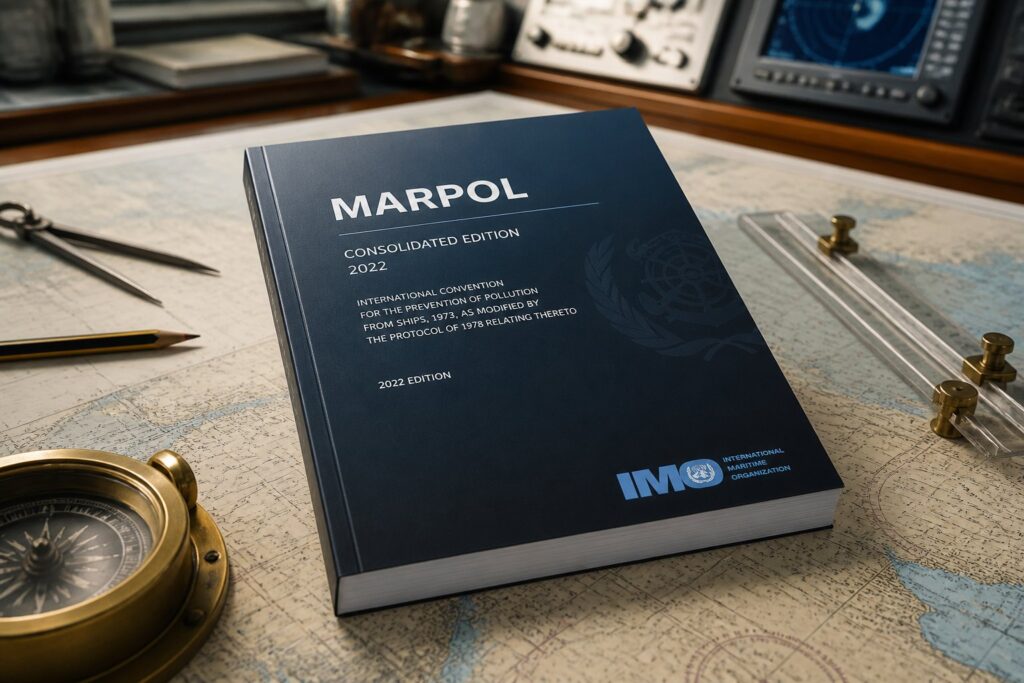
MARPOL is the International Convention for the Prevention of Pollution from Ships. It’s the IMO treaty governing oil, chemical, sewage, garbage, and air pollution at sea.
Adopted in 1973 and in force since 1983 as MARPOL 73/78, it’s split into six Annexes, each covering a different pollution source. This guide breaks down what each Annex regulates and which of your ship’s systems, certificates, and daily operations it touches.
What Are the Six MARPOL Annexes?
MARPOL has six Annexes, each regulating a different source of ship pollution: oil, noxious liquid chemicals, packaged harmful substances, sewage, garbage, and air pollution. The table below shows what each covers and when it entered into force.
| Annex | Covers | In Force Since | Mandatory? |
|---|---|---|---|
| I | Oil | 1983 | Yes |
| II | Noxious liquid substances (bulk chemicals) | 1987 | Yes |
| III | Harmful substances in packaged form | 1992 | No — widely ratified |
| IV | Sewage | 2003 | No — widely ratified |
| V | Garbage | 1988 | No — widely ratified |
| VI | Air pollution | 2005 | No — widely ratified |
What Does MARPOL Annex I Cover?
MARPOL Annex I regulates oil pollution from ships — construction standards, discharge limits, and the equipment and paperwork that prove compliance. It covers everything from bilge water separators to the Oil Record Book.
Every oil tanker and cargo ship above a certain size needs an International Oil Pollution Prevention (IOPP) Certificate. A survey confirms the ship meets Annex I’s construction and equipment rules before it’s issued.
The certificate runs on a five-year cycle, with annual and intermediate inspections in between to keep it valid.
Slop tanks exist because of Annex I Regulation 29, which sets minimum retention capacity for oil residues a tanker can’t discharge at sea. A 15 parts-per-million limit applies to machinery-space bilge water too.
That’s why every engine room runs an oily water separator through its bilge system. An alarm shuts the overboard discharge valve automatically once the limit is exceeded.
Two systems handle the oil residues Annex I regulates. The fuel oil purifier separates water and sludge from bunkers before combustion. The waste oil incinerator then burns off what can’t be discharged or landed ashore.
Tank arrangement isn’t just a design choice either. Annex I’s double-hull rules shape how much fuel a tanker can carry and where it sits relative to the outer hull.
Every drop of oil transferred, burned, or discharged gets logged in the ship’s Oil Record Book. Falsifying it is one of the most common reasons ships get detained under port state control.
It can also expose the master and company to criminal charges in some jurisdictions. Falsified ORB entries are one of the more common MARPOL prosecutions on record.
What Does MARPOL Annex II Cover?
MARPOL Annex II regulates noxious liquid substances carried in bulk — mainly bulk chemicals — setting discharge criteria based on how hazardous each substance is. It sorts cargoes into four pollution categories, X through Z, each with different cleaning and discharge rules.
Chemical tankers are built specifically around Annex II’s categories. A ship’s IMO Type 1, 2, or 3 hull classification maps directly to how hazardous the cargoes it’s certified to carry are.
Type 1 tankers carry the most dangerous Category X cargoes. They’re built with the most damage-survivability margin — a double hull set well back from the shell plating.
Type 3, the least restrictive, covers lower-risk Category Y and Z cargoes.
Annex II compliance is built on the IBC Code — the International Code for the Construction and Equipment of Ships Carrying Dangerous Chemicals in Bulk. It sets the actual tank type, venting, and cargo segregation standards a chemical tanker has to meet.
What Does MARPOL Annex III Cover?
MARPOL Annex III regulates harmful substances carried in packaged form — containers, portable tanks, and drums rather than bulk cargo. It works alongside the IMDG Code, which sets the actual packaging, labeling, and stowage rules that satisfy Annex III’s requirements.
The IMDG dangerous cargo manifest is the paperwork that ties a specific shipment to its Annex III classification. When something goes wrong, onboard spill response follows procedures set out in the IMDG Code itself, not Annex III’s text directly.
What Does MARPOL Annex IV Cover?
MARPOL Annex IV regulates sewage discharge from ships, banning untreated discharge within a set distance of land unless it’s passed through an approved treatment plant. Passenger ships face stricter distance and treatment-standard rules than cargo vessels.
A ship’s sewage treatment plant exists to meet these effluent standards before discharge is allowed inside the regulated zone. Outside that zone, or once treated to the required standard, discharge is permitted at a set minimum speed while under way.
What Does MARPOL Annex V Cover?
MARPOL Annex V regulates garbage disposal from ships, banning plastic discharge outright and setting distance-from-land rules for everything else, from food waste to cargo residues. It’s the Annex most crews interact with daily, since every ship generates garbage that has to be sorted and logged.
Garbage management procedures exist specifically to meet Annex V’s sorting, storage, and discharge-distance requirements. Every ship above 400 GT has to carry a written Garbage Management Plan, and a garbage record book logging every discharge or incineration.
What Does MARPOL Annex VI Cover?
MARPOL Annex VI regulates air pollution from ships — sulfur oxides, nitrogen oxides, ozone-depleting substances, and, since 2023, greenhouse gas intensity. It’s the newest and fastest-evolving Annex, and the one most cargo ship operators deal with most directly.
The 0.50% global sulfur cap took effect under Annex VI Regulation 14 in January 2020, down from a previous 3.5% limit. It’s why most cargo ships now run on low-sulfur fuel or fit an exhaust gas cleaning system instead.
Ships that fit a scrubber to keep burning higher-sulfur fuel still have to meet the same Annex VI wash-water discharge limits. Annex VI also sets tiered nitrogen oxide limits by engine build date.
Tier III, the strictest tier, applies only to newer engines operating inside designated Emission Control Areas.
Whichever route a ship takes, the fuel supplier has to document it on a Bunker Delivery Note under Annex VI Regulation 18. On the fuel-quality side specifically, bunker surveyors verify that what’s actually delivered matches what that note says.
Since November 2022, Annex VI amendments have added two efficiency metrics. The Energy Efficiency Existing Ship Index (EEXI) is a one-time design rating, and the Carbon Intensity Indicator (CII) is an annual operational rating.
Both became operative from January 2023 and are now central to cutting a cargo ship’s CO2 emissions. A ship rated CII “D” for three consecutive years, or “E” once, has to submit a corrective action plan to keep trading.
Regional rules now add another layer on top of Annex VI. The EU’s emissions trading system prices a ship’s carbon output directly, pushing the same decarbonization measures Annex VI already incentivizes.
Are All Six MARPOL Annexes Mandatory?
No — only Annexes I and II are mandatory for every MARPOL party. Annexes III through VI are optional under Article 14, though all four now have wide enough ratification to function as global standards in practice.
More than 160 countries have ratified the core convention, covering upwards of 98% of world merchant tonnage. Annex VI was the last to reach that level of acceptance, but it’s now ratified by over 100 countries representing a similar tonnage share.
In practice, no major flag state opts out of any Annex. MARPOL’s “no more favourable treatment” clause also lets port state control hold even non-parties’ ships to the same standards other vessels have to meet.
How Is MARPOL Enforced?
Flag states certify their own ships against MARPOL through classification societies, while port state control inspects visiting foreign ships for compliance. A ship found in serious violation can be detained until the deficiency is fixed.
Classification societies issue and renew the statutory certificates — IOPP, IAPP, and the rest — that prove Annex compliance. That happens through the surveys covered elsewhere on this site.
Port state control is the backstop: MARPOL violations are a leading cause of ship detention. Charterers also run their own vetting inspections on top of the regulatory minimum.
A detention or poor inspection record follows a ship. It affects who’s willing to charter her next.
Frequently Asked Questions
What does MARPOL stand for?
MARPOL stands for the International Convention for the Prevention of Pollution from Ships, adopted in 1973 and in force since 1983 as MARPOL 73/78.
How many MARPOL Annexes are there?
Six: Annex I (oil), Annex II (noxious liquid chemicals), Annex III (packaged harmful substances), Annex IV (sewage), Annex V (garbage), and Annex VI (air pollution).
Which MARPOL Annexes are mandatory?
Only Annex I and Annex II are mandatory for every party to MARPOL. Annexes III through VI are technically optional, though nearly every flag state has ratified all six.
What is MARPOL Annex VI?
Annex VI regulates air pollution from ships, including the global sulfur cap, NOx limits, and — since 2023 — the EEXI and CII efficiency ratings.
Is ballast water management part of MARPOL?
No. Ballast water is regulated by the separate Ballast Water Management (BWM) Convention, not a MARPOL Annex, even though both address ship-sourced marine pollution.
What happens if a ship violates MARPOL?
Violations can trigger detention under port state control and fines. Falsifying records like the Oil Record Book can carry criminal liability for the master and the company.
Who enforces MARPOL?
Flag states enforce MARPOL through classification society surveys and certification, while port state control inspects foreign ships calling at their ports for compliance.
When did the MARPOL sulfur cap take effect?
The global 0.50% sulfur cap under Annex VI Regulation 14 took effect on January 1, 2020, down from the previous 3.5% limit.

- What Is MARPOL? Guide to All Six Annexes and Enforcement – September 9, 2026
- 14 Marine Surveyors in Ohio – June 14, 2026
- Boat Salvage Yards in Alabama (2026): Used Marine Parts & Locations – June 14, 2026