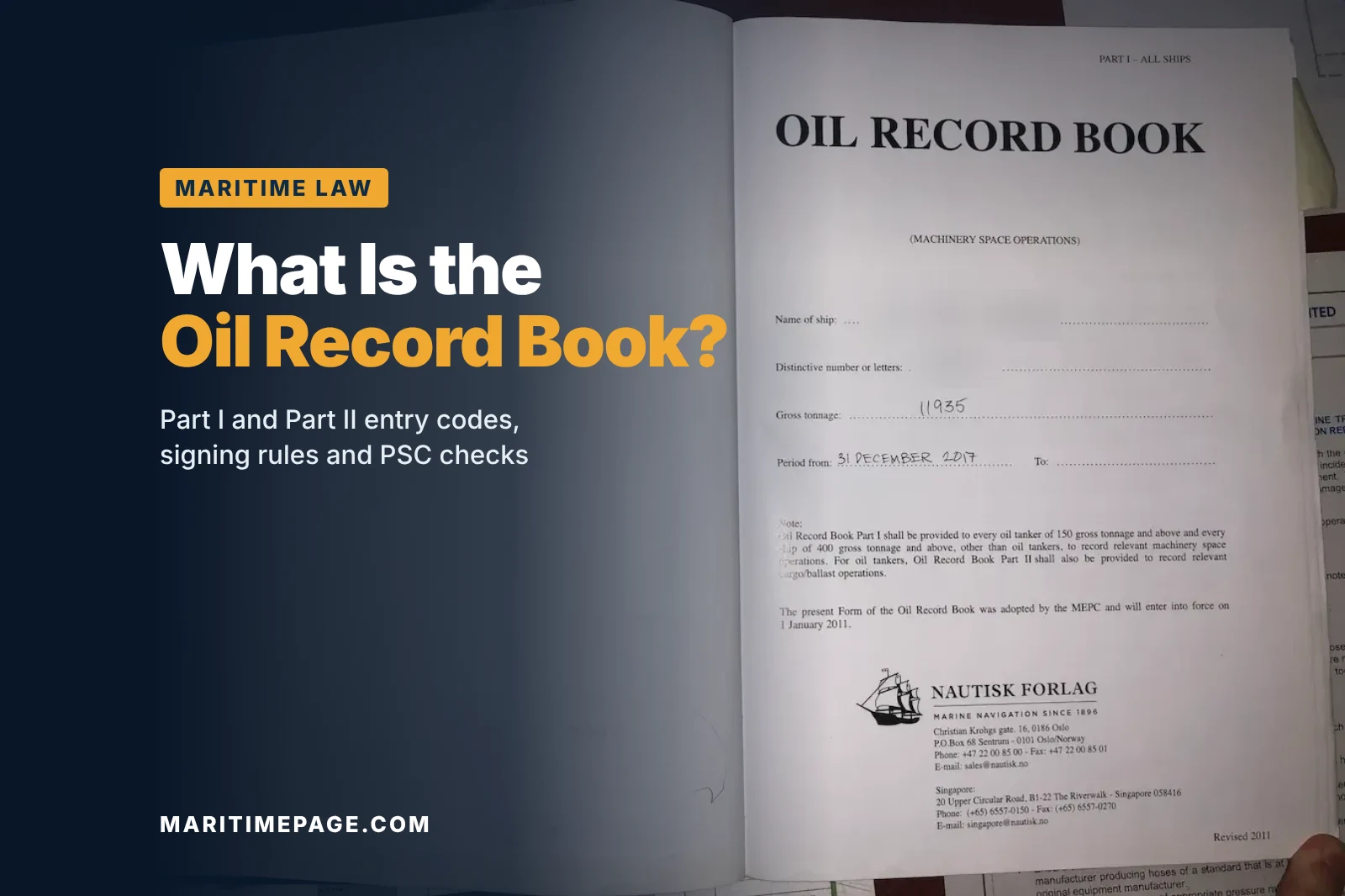
The Oil Record Book (ORB) is the MARPOL Annex I log in which a ship records every operation involving oil, oily water and oil residues. Part I covers machinery space operations on all ships in scope, and Part II covers cargo and ballast operations on oil tankers. This guide covers who needs an oil record book, the entry codes, correct entries, retention, supporting equipment and inspections.
What Is the Oil Record Book?
The Oil Record Book is the official record of a ship’s oil-related operations, required by MARPOL Annex I. Regulation 17 covers Part I (machinery space operations), and Regulation 36 covers Part II (cargo and ballast operations).
The book shows that oil and oily residues were kept on board, burned, delivered ashore or discharged within the limits. Its format, codes and item numbers are set out in an appendix to Annex I.
Every entry should match the tank soundings, equipment printouts and shore receipts. That is why port State control officers treat it as a key piece of evidence.
Which Ships Must Carry an Oil Record Book?
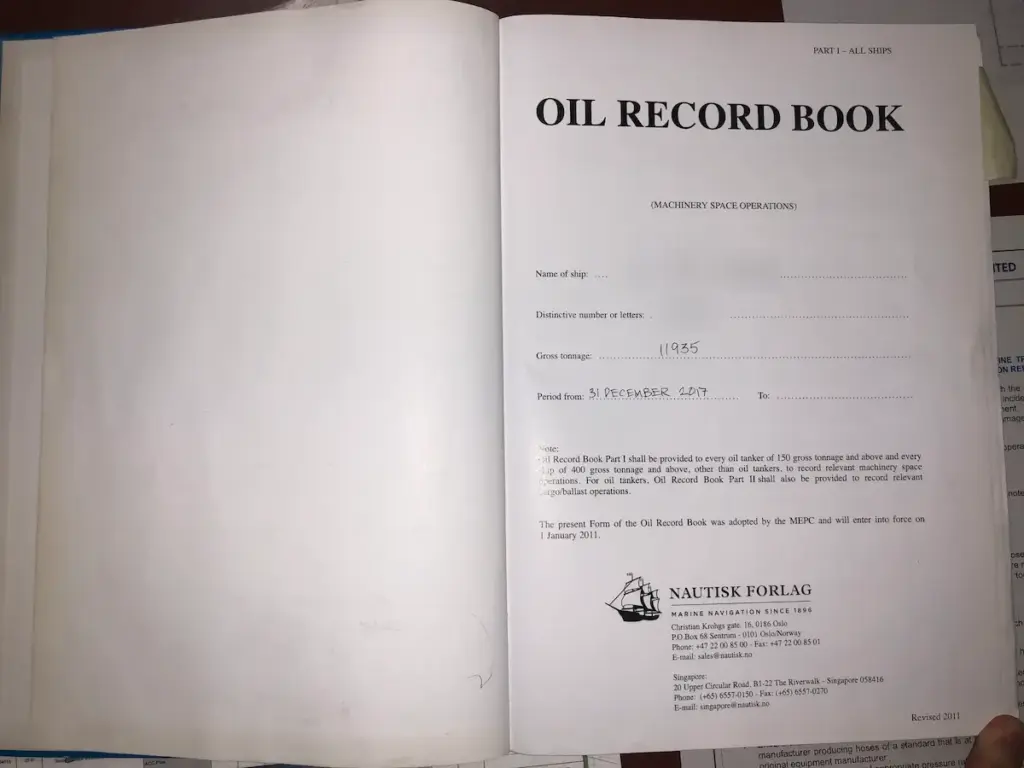
Oil tankers of 150 gross tonnage and above and all other ships of 400 GT and above must carry Oil Record Book Part I. Oil tankers of 150 GT and above must also carry Part II.
| Ship | Part I (machinery space) | Part II (cargo and ballast) |
|---|---|---|
| Oil tanker, 150 GT and above | Required | Required |
| Other ship, 400 GT and above | Required | Not required |
| Chemical tanker, 400 GT and above | Required for machinery spaces | Not used for chemical cargo, which goes in the Cargo Record Book |
Other MARPOL record books sit alongside it. Chemical tankers keep a Cargo Record Book under Annex II and the IBC Code. Garbage goes in the Garbage Record Book, explained in garbage management on ships.
What Goes in Oil Record Book Part I?

Oil Record Book Part I records machinery space operations under nine code letters, A to I. They cover fuel tank ballasting, sludge, bilge water, the oil filtering equipment, accidental discharges, bunkering and general remarks.
| Code | Operation |
|---|---|
| A | Ballasting or cleaning of oil fuel tanks |
| B | Discharge of dirty ballast or cleaning water from oil fuel tanks |
| C | Collection, transfer and disposal of oil residues (sludge) |
| D | Non-automatic starting of discharge overboard, transfer or disposal of bilge water |
| E | Automatic starting of discharge overboard, transfer or disposal of bilge water |
| F | Condition of the oil filtering equipment |
| G | Accidental or other exceptional discharges of oil |
| H | Bunkering of fuel or bulk lubricating oil |
| I | Additional operational procedures and general remarks |
Each code has numbered items. For example, C.11 records sludge collected, including a weekly inventory of sludge tanks, and C.12 records how sludge was transferred or disposed of.
Sludge comes mainly from fuel and lube oil separators, described in how a fuel oil purifier works. It is landed ashore or burned in the waste oil incinerator, and bilge water comes from the bilge system.
What Goes in Oil Record Book Part II?
Oil Record Book Part II records an oil tanker’s cargo and ballast operations under codes A to O, plus P to R for specific trades. They cover loading, discharge, crude oil washing, ballast, tank cleaning, slops and the ODME.
| Code | Operation |
|---|---|
| A | Loading of oil cargo |
| B | Internal transfer of oil cargo during voyage |
| C | Unloading of oil cargo |
| D | Crude oil washing (COW tankers only) |
| E | Ballasting of cargo tanks |
| F | Ballasting of dedicated clean ballast tanks (CBT tankers only) |
| G | Cleaning of cargo tanks |
| H | Discharge of dirty ballast |
| I | Discharge of water from slop tanks into the sea |
| J | Collection, transfer and disposal of residues and oily mixtures not otherwise dealt with |
| K | Discharge of clean ballast contained in cargo tanks |
| L | Discharge of ballast from dedicated clean ballast tanks (CBT tankers only) |
| M | Condition of the oil discharge monitoring and control system |
| N | Accidental or other exceptional discharges of oil |
| O | Additional operational procedures and general remarks |
| P, Q, R | Loading, re-allocation and discharge to shore of ballast water (tankers in specific trades) |
Slop tank decanting and discharges are the most scrutinised Part II entries, as explained in slop tanks on tankers. Crude oil washing and cargo transfers are covered in cargo handling systems on tankers, and tanker types in oil tanker types.
How Do You Make a Correct Oil Record Book Entry?
Record each operation without delay, in chronological order, with the date, code letter, item number and particulars. The officer in charge signs each completed operation, and the master signs each completed page.
- Date and code: write the date, the code letter and the item number in their columns.
- Particulars: record tanks, quantities in cubic metres or tonnes, times and positions as the item requires.
- Tank names: use the tank names exactly as listed in the IOPP Certificate supplement.
- Signature: the officer or officers in charge sign and date each completed operation.
- Page signature: the master signs each completed page.
- No gaps: leave no blank lines between entries.
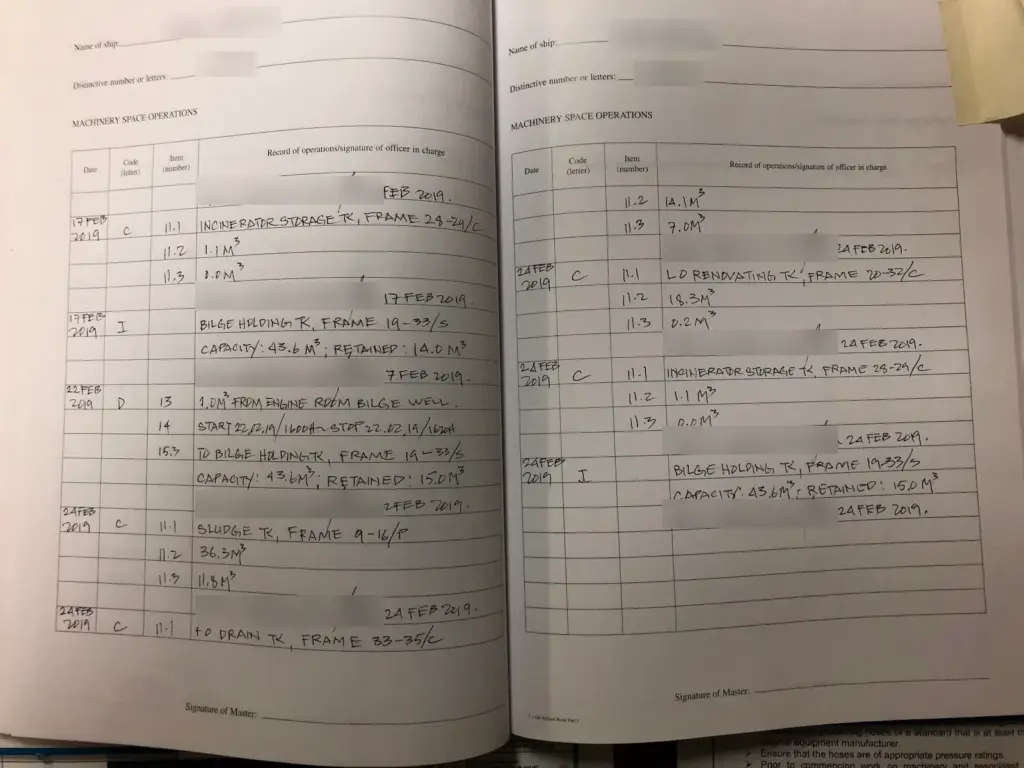
Entries must be at least in English, French or Spanish for ships holding an IOPP Certificate. If the flag State’s official language is also used, that version prevails in a dispute.
Corrections: strike through a wrong entry with a single line so it stays readable, then sign and date it and write the correct entry below. A missed entry is recorded later under code I with the original operation date.
IMO guidance in MEPC.1/Circ.736/Rev.2 shows how to record each Part I operation. For example, code H bunkering entries record the port and times. For each fuel grade they give the quantity in tonnes, the sulphur content and the tanks filled.
How Long Must the Oil Record Book Be Kept?
The Oil Record Book must be kept on board, readily available for inspection, and preserved for three years after the last entry. Only unmanned ships under tow are exempt from keeping it on board.
An electronic Oil Record Book has been allowed since 1 October 2020, when amendments adopted by resolution MEPC.314(74) entered into force. The supporting guidelines, MEPC.312(74), require the flag State to assess the system and issue a Declaration of MARPOL Electronic Record Book.
- The declaration must be kept on board.
- Electronic record book procedures must be part of the ship’s safety management system under the ISM Code.
- The system must keep records for the period the Annex requires and back up data automatically.
- It must print a copy of verified records for the master to certify when an authority asks.
What Equipment Feeds the Oil Record Book?
Oil Record Book figures come from tank soundings, the oily water separator and its 15 ppm alarm, and the ODME on tankers. Every discharge entry should be backed by these records.
- Oily water separator (OWS): treats machinery space bilge water. Discharge is only allowed with the ship en route and the oil content no more than 15 ppm, outside special areas.
- 15 ppm bilge alarm: for equipment approved to MEPC.107(49), it must alarm and stop the discharge automatically when oil content exceeds 15 ppm.
- Sludge and bilge tank soundings: weekly sludge inventories and bilge holding tank figures support codes C and D.
- ODME (tankers): monitors cargo-area discharges against the limits: 30 litres per nautical mile, 1/30,000 of the cargo, over 50 nautical miles from land.
- Shore receipts: reception facility receipts for sludge and slops are kept with the book.
What Happens If the Oil Record Book Is Wrong?
A missing, false or inconsistent Oil Record Book can lead to a PSC deficiency, detention and, in some countries, prosecution of the company and crew. Inspectors read it as evidence of how the ship handles oil.
- Deficiency: missing signatures, wrong codes or incomplete entries are recorded and must be rectified.
- Detention: entries that cannot be reconciled with soundings or equipment, or signs of illegal discharge, can lead to detention. See ship detention procedure.
- Prosecution: in the United States, an inaccurate Oil Record Book has been prosecuted as a felony under the Act to Prevent Pollution from Ships.
Inspections under the regional port State control MoUs are logged in shared databases. A detention therefore follows the ship to its next ports.
What Do PSC, Class and Vetting Inspectors Check?
Inspectors compare the Oil Record Book with tank soundings, OWS and ODME records, sludge and slop quantities, bunker records and shore receipts. Unexplained differences matter more than neat handwriting.
- Consistency: sludge and bilge tank soundings match the latest entries.
- Discharges: every overboard discharge has a position, time, quantity and the OWS or ODME working.
- Equipment: the 15 ppm alarm stops discharge when tested, and seals on overboard valves match the records.
- Receipts: shore delivery entries are backed by reception facility receipts.
- Signatures and codes: each operation is signed, each page is signed by the master, and the correct codes are used.
- Capacity vs production: sludge production looks reasonable for the fuel burned and the separators in use.
Class surveys check the oil pollution prevention equipment against the IOPP Certificate, as described in types of ship surveys. On tankers, a vetting inspection also reviews the Oil Record Book and its supporting records.
How Does the Oil Record Book Relate to Other Records?
The Oil Record Book is one of several MARPOL record books, and its figures must agree with the ship’s other records. Bunker entries must match the bunker documents, and sludge entries must match receipts.
- Bunker Delivery Note: the quantity and grade in code H should match the delivery note handed over by the supplier. Bunkering itself is described in bunkering on ships.
- Engine room logbook and sounding log: the daily figures behind the ORB entries.
- SOPEP: the shipboard oil pollution emergency plan used for code G accidental discharges.
- Safety management system: company procedures for record keeping, internal audits and training.
Related Topics
Frequently Asked Questions
What is the Oil Record Book?
The Oil Record Book is the MARPOL Annex I record of a ship’s oil-related operations. Part I covers machinery space operations and Part II covers cargo and ballast operations on oil tankers.
What is the difference between Oil Record Book Part I and Part II?
Part I records machinery space operations such as sludge, bilge water and bunkering on all ships in scope. Part II records cargo and ballast operations on oil tankers, such as loading, crude oil washing and slop discharges.
Who signs the Oil Record Book?
The officer or officers in charge sign each completed operation, and the master signs each completed page.
How long must the Oil Record Book be kept?
It must be kept on board, readily available for inspection, and preserved for three years after the last entry.
Is an electronic Oil Record Book allowed?
Yes. Since 1 October 2020, MARPOL allows an electronic record book approved by the flag State, which issues a Declaration of MARPOL Electronic Record Book to be kept on board.
Which ships need an Oil Record Book?
Every oil tanker of 150 gross tonnage and above and every other ship of 400 gross tonnage and above needs Part I. Oil tankers of 150 GT and above also need Part II.
What are the Oil Record Book entry codes?
Part I uses code letters A to I, such as C for sludge, D and E for bilge water and H for bunkering. Part II uses A to O, plus P to R for tankers in specific trades.
What happens if the Oil Record Book is falsified?
A false or inconsistent Oil Record Book can lead to port State control detention. In the United States, failing to keep an accurate book has been prosecuted as a felony.

- Bunker Delivery Note (BDN): Contents, MARPOL Rules and Checks – October 11, 2026
- Oil Record Book: Part I and Part II Entries, Rules and PSC Checks – October 11, 2026
- What Is the IBC Code? Ship Types, Products and Certificates – October 11, 2026